
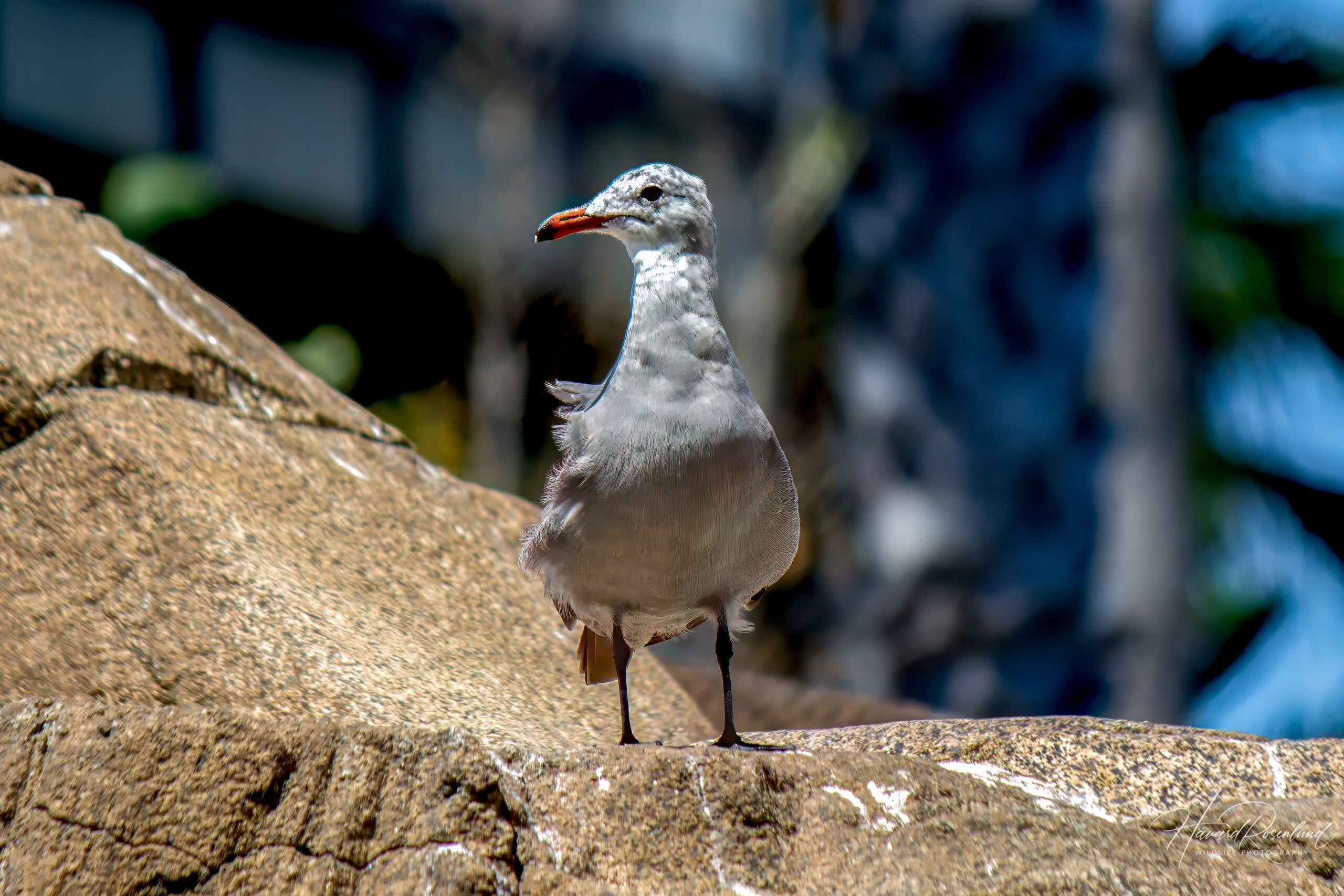
Heermann’s Gull
Larus heermanni
At a glance
Habitat
- Pacific coastal waters, beaches, rocky shores, estuaries, lagoons and islands; usually close to the coast
Diet
- Mainly small schooling fish, supplemented by squid, crustaceans, molluscs, carrion, eggs and stolen prey
Activity
- Diurnal
Size
- Length: 46–53 cm Weight: 371–643 g
Range
- Breeds mainly in the Gulf of California, Mexico, then disperses north along the Pacific coast to the United States and southwestern Canada
Description
Heermann's gull (Larus heermanni) is a distinctive medium-sized gull of the Pacific coast of North America. Adults are 46–53 cm long and weigh about 371–643 g. Breeding birds have a dark grey body, white head, black legs and a bright red bill with a black tip. Outside breeding, the head becomes grey and streaked, while immature birds are much darker brown.
The species is strongly centred on northwestern Mexico during breeding and is much more widely seen along the Pacific coast after the breeding season.
Habitat
Heermann's gulls are strongly marine and usually remain close to the coast. They use nearshore and offshore waters, beaches, rocky shores, kelp beds, tidepools, estuaries, lagoons and harbours.
Breeding is concentrated on dry, sparsely vegetated islands in the Gulf of California, where dense colonies form close to marine areas with abundant food.
Diet
Small schooling fish, especially sardines and anchovies, are particularly important during breeding. The diet also includes squid, crustaceans, molluscs, insects, carrion, eggs and occasional small vertebrates.
Foraging
Heermann's gulls take fish from the surface while flying or sitting on the water and may plunge deeply enough to submerge the whole body.
Food stealing is another characteristic feeding strategy. Brown pelicans are especially important targets: several gulls may mob a pelican that has just caught fish and seize prey spilled or released from its throat pouch.
They also chase terns, smaller gulls and boobies to make them drop or surrender fish. Kleptoparasitism gives the gulls access to schooling fish caught by other birds and is a conspicuous part of the species' coastal feeding ecology.
Migration
After breeding, large numbers disperse north from the Gulf of California along the Pacific coast of the United States, reaching as far as southwestern Canada. Most birds seen in California are therefore post-breeding visitors rather than local breeders.
Southward return movements begin later in the year as birds move back toward the principal Mexican breeding areas.
Breeding
Heermann's gulls breed in exceptionally dense colonies on dry islands. About 95% of the global breeding population nests on Isla Rasa in the Gulf of California, making the species unusually dependent on conditions at a single site. The nest is a shallow scrape on the ground lined with feathers, grass, sticks, shells and other debris.
Clutches contain one to three eggs, and both parents incubate for about 28 days. After hatching, both continue caring for the chicks. The young remain within their natal territories for about six to seven weeks before gaining access to seawater, so the adults provide both food and water by regurgitation during this period. Dense nesting creates intense territorial pressure, and chicks that wander into neighbouring territories can be attacked.
Status
Heermann's gull is classified as near threatened on the IUCN Red List. The species remains numerous, but its extremely concentrated breeding distribution makes the global population unusually vulnerable to changes at a small number of colonies.
Threats
The main long-term vulnerability is the concentration of most breeding birds on Isla Rasa and nearby islands. Changes in sardine and anchovy abundance can reduce breeding success, while commercial fishing pressure and warm-water events can alter the availability of these key prey.
Disturbance and introduced predators can also threaten breeding colonies on islands where ground-nesting birds have little protection. Because so much of the population breeds in one region, local problems can affect a large share of the species at once.
Conservation
Protection of Isla Rasa has been central to the recovery and security of the species. Large-scale egg harvesting that once affected the colony ended after the island received formal protection in the 1960s, and the site remains one of the most important seabird breeding areas in the Gulf of California.
Protected breeding islands, freedom from introduced predators and abundant stocks of small pelagic fish all reduce the risks created by the species' highly concentrated breeding distribution.
Image gallery
Loading map and observations…
Have you seen this species?
Independent species archive
Did you find this species page useful?
Wildlife Vagabond is independently built and maintained. Voluntary support helps cover hosting, maps, data storage and continued improvements to the species archive.
Support Wildlife VagabondSpecies content will remain freely available.
References
Information about the species’ global distribution and status is based primarily on global Red List data. See the references below for details.
- BirdLife International. (n.d.). Heermann's Gull species factsheet. https://datazone.birdlife.org/species/factsheet/heermanns-gull-larus-heermanni
- Cornell Lab of Ornithology. (n.d.). Heermann's Gull Life History. https://www.allaboutbirds.org/guide/Heermanns_Gull/lifehistory
- International Union for Conservation of Nature. (n.d.). Heermann's Gull. The IUCN Red List of Threatened Species. https://www.iucnredlist.org/species/22694296/178958787
- Velarde, E., & Ezcurra, E. (2018). Are seabirds’ life history traits maladaptive under present oceanographic variability? The case of Heermann’s Gull (Larus heermanni). The Condor: Ornithological Applications, 120(2), 388–401. https://doi.org/10.1650/CONDOR-17-5.1
- Velarde. (1999). Breeding Biology of Heermann's Gulls on Isla Rasa. https://academic.oup.com/auk/article/116/2/513/5168664