
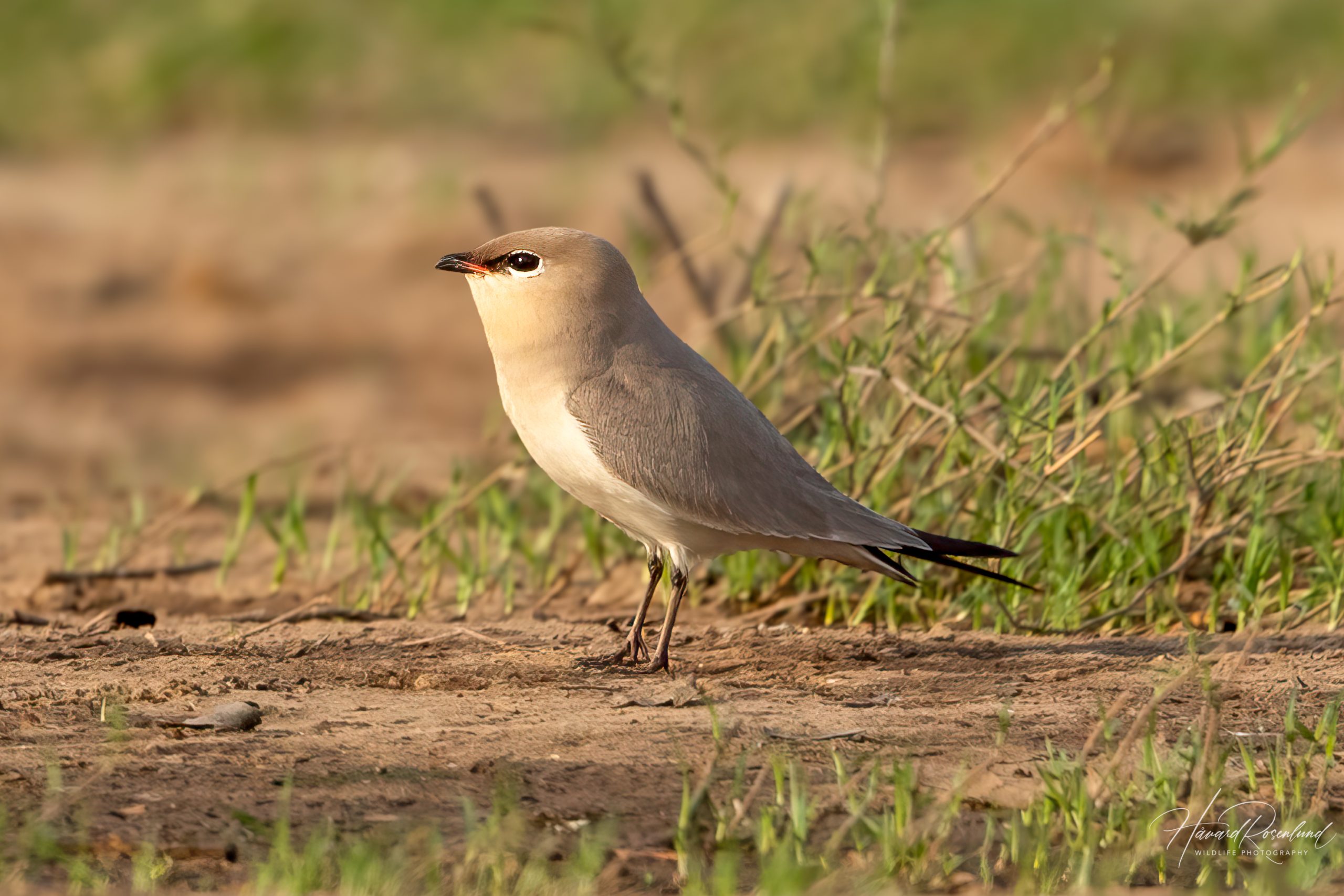
Small Pratincole
Glareola lactea
At a glance
Habitat
- Open sand and gravel bars, riverbanks, islands, lake shores and other sparsely vegetated ground near water
Diet
- Mainly flying insects; also other small invertebrates taken in the air or from the ground
Activity
- Diurnal, often especially active toward dusk
Size
- Length: 16–19 cm; wingspan 42–48 cm Weight: 37–40 g
Range
- South Asia from Pakistan and India east through Nepal, Bangladesh and Myanmar into parts of mainland Southeast Asia
Description
The small pratincole (Glareola lactea), also known as little pratincole, is a small riverine shorebird about 16–19 cm long, with a wingspan of roughly 42–48 cm and a mass of around 37–40 g. Adults are pale grey-brown above and whitish below, with a short black bill, dark eye-line, long pointed wings and a shallowly forked tail. In flight, a broad white trailing edge contrasts strongly with the dark flight feathers.
The Oriental pratincole (Glareola maldivarum) is much larger and longer-winged, with a more contrasting dark throat bordered by a pale line in breeding plumage. Small pratincole is noticeably shorter-bodied, paler and more compact.
Habitat
Small pratincoles are closely associated with large rivers and other open wetlands. They use exposed sandbanks, gravel bars, river islands, lake and reservoir margins and, locally, tidal flats and estuaries. Breeding birds favour open or sparsely vegetated ground close to water.
The habitat is naturally dynamic. Falling water levels expose new nesting and resting ground, while floods and sudden releases from dams can remove it again. A 2018 study on the Mekong found that small pratincoles selected broad, open sandbars while often placing individual nests beside some vegetation. Nest success nevertheless fell as herbaceous vegetation increased, and nests closer to the river channel were more vulnerable to flooding.
Diet
Flying insects form most of the diet, including flies, beetles, termites and other small invertebrates. Birds hunt with fast, swallow-like flight, often skimming low over water or exposed ground and snapping prey from the air.
They also take insects from the ground, especially around sandbars and wet margins. Feeding activity can continue into the evening, and large flocks may gather where emerging insects create a concentrated food source.
Behaviour
Small pratincoles are highly social. Outside breeding they may form flocks of dozens or hundreds of birds, resting tightly together on bare sand and gravel where their pale plumage provides excellent camouflage.
They are agile in flight but also spend substantial time on the ground. Flocks keep contact with short, sharp calls during feeding and flight, often rising together when disturbed before settling again on another open bank or island.
Breeding
Breeding timing varies across the range but is generally linked to the dry, low-water season when sandbars and river islands are exposed. Birds nest in loose colonies and become more defensive around eggs and chicks. The nest is a shallow scrape on sand or gravel, and clutches usually contain two to four well-camouflaged eggs. Both parents incubate and help protect the nesting area.
A five-year study on the Mekong River monitored 504 small pratincole nests and found a mean incubation period of 20.9 days. Predation, egg collection, flooding and trampling caused many nest failures. Guarded nests had about 21% nest success, compared with about 6% for unguarded nests. The chicks hatch covered in down and mobile, leave the scrape soon after hatching and remain under parental protection.
Status
The small pratincole is classified as least concern on the IUCN Red List. It remains widespread across South Asia and parts of Southeast Asia, but its dependence on exposed river margins makes local populations sensitive to changes in river systems.
State of India’s Birds 2025 places the species in the Moderate Priority category nationally. The updated estimate shows a long-term decline of about 58.3%, while the current annual estimate is a decline of about 1.0%; the recent estimate is too uncertain to establish a clear direction. Sand and gravel extraction, altered river flow, flooding, disturbance, livestock, egg collection and predation can all reduce breeding success at individual colonies.
Image gallery
Loading map and observations…
Have you seen this species?
Independent species archive
Did you find this species page useful?
Wildlife Vagabond is independently built and maintained. Voluntary support helps cover hosting, maps, data storage and continued improvements to the species archive.
Support Wildlife VagabondSpecies content will remain freely available.
References
Information about the species’ global distribution and status is based primarily on global Red List data. See the references below for details.
- AviList. (n.d.). v2025 – Global avian checklist. https://www.avilist.org/
- BirdLife International. (n.d.). Small Pratincole (Glareola lactea) species factsheet. https://datazone.birdlife.org/species/factsheet/small-pratincole-glareola-lactea
- Claassen, A. H., Forester, J. D., Arnold, T. W., & Cuthbert, F. J. (2018). Consequences of Multi-Scale Habitat Selection on Reproductive Success of Riverine Sandbar-Nesting Birds in Cambodia. Avian Biology Research, 11(2), 108-122. https://doi.org/10.3184/175815618X15202599846467
- Claassen, A. H., Sok, K., Arnold, T. W., & Cuthbert, F. J. (2017). Effectiveness of direct payments to increase reproductive success of sandbar-nesting river birds in Cambodia. Bird Conservation International, 27(4), 495-511. https://doi.org/10.1017/S0959270916000368
- eBird. (n.d.). Small Pratincole. Cornell Lab of Ornithology. https://ebird.org/species/smapra1
- International Union for Conservation of Nature. (n.d.). Small Pratincole (Glareola lactea). The IUCN Red List of Threatened Species. https://www.iucnredlist.org/species/22694152/93441581
- State of India's Birds. (2025). State of India’s Birds (2025 update) – Small Pratincole. https://stateofindiasbirds.in/species/smapra1/