
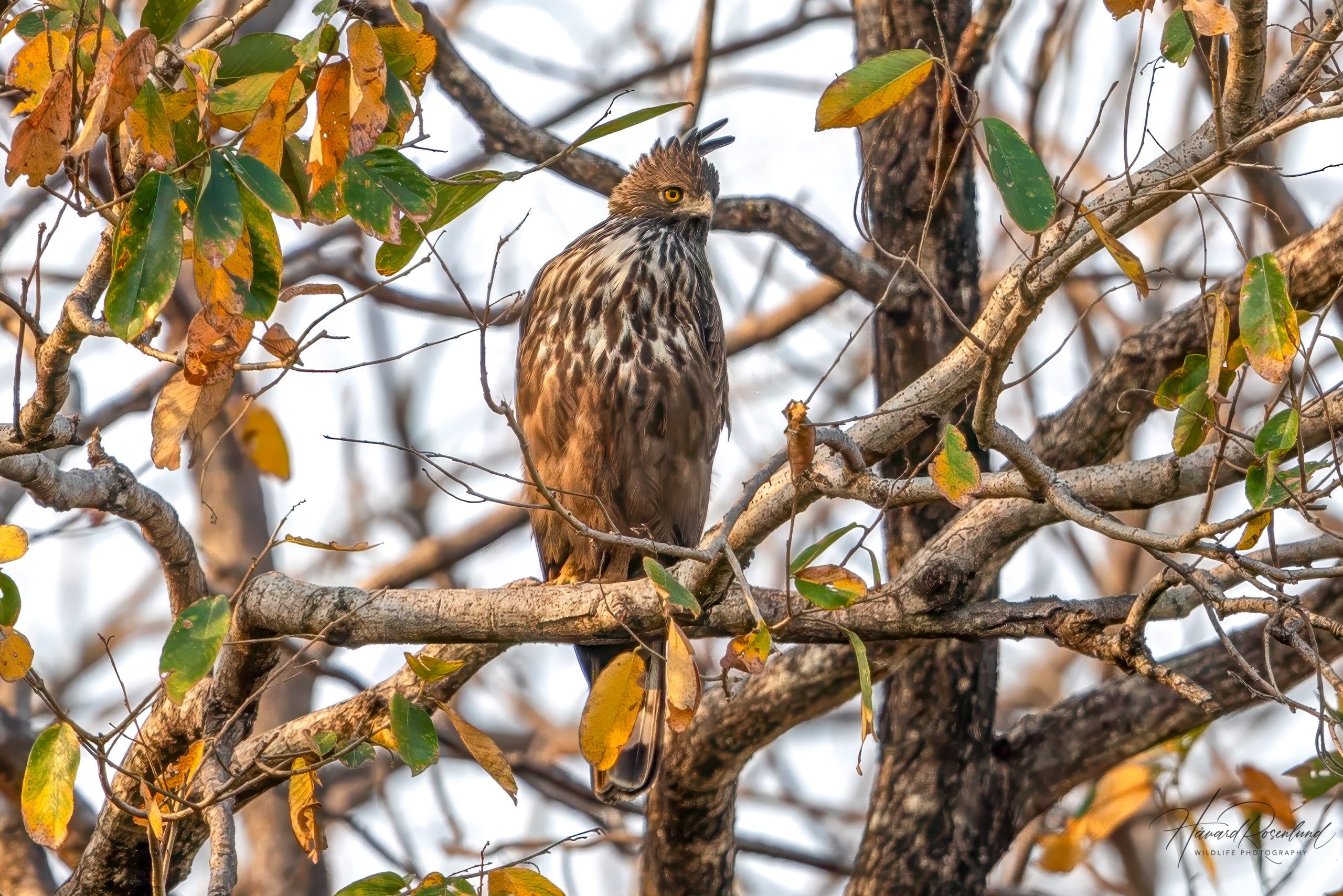
Changeable Hawk-Eagle
Nisaetus cirrhatus
At a glance
Habitat
- Forest specialist using dry and moist woodland, forest edges and plantations with enough mature trees
Diet
- Mainly birds, reptiles and small to medium-sized mammals, taken in powerful attacks from perches
Activity
- Diurnal
Size
- Length: 60–72 cm Weight: about 1.2–1.9 kg
Range
- South and Southeast Asia, from the Indian subcontinent through mainland Southeast Asia and Indonesia to parts of the Philippines
Description
The changeable hawk-eagle (Nisaetus cirrhatus) is a medium-large forest eagle of South and Southeast Asia. Adults are about 60–72 cm long, have a wingspan of roughly 127–138 cm and weigh around 1.2–1.9 kg, with females generally larger than males. The long tail, broad wings and powerful feathered legs give it the typical build of a hawk-eagle.
The name “changeable” refers to the remarkable variation in plumage. Birds range from pale forms with heavily streaked underparts to almost entirely dark individuals, and crest length also varies strongly between populations. This variation can make identification difficult, especially where several Nisaetus species occur together.
Taxonomy
The species has been at the centre of a long taxonomic debate. On mainland India, the more strongly crested form N. c. cirrhatus and the shorter-crested or nearly crestless N. c. limnaeetus were at times proposed as separate species.
A 2020 study compared plumage, body measurements, genetics and calls. Although the two forms differed on average, many birds were intermediate and the genetic data showed continued exchange between them. The researchers therefore concluded that reproductive separation was weak and recommended keeping them within one species, Nisaetus cirrhatus.
Habitat
The changeable hawk-eagle is a forest specialist, but it is not restricted to untouched rainforest. It uses dry and moist deciduous forest, evergreen forest, forest edges, wooded hills and plantations, and can persist in partly modified landscapes as long as enough mature trees and connected woodland remain.
A study published in 2018 examined 91 nests belonging to six raptor species in western central India and found that changeable hawk-eagle nesting areas were particularly associated with dry deciduous and evergreen forest and with nearby water. All 14 nests of the species in that study were in trees.
Diet
The changeable hawk-eagle is a powerful generalist predator. Birds form an important part of the diet, but it also takes reptiles and mammals ranging from squirrels and hares to larger prey when an opportunity appears.
The same 2018 study found a particularly high proportion of bird prey in the diet compared with several other raptors living in the same region. The upper end of the prey spectrum can be striking: in Corbett Tiger Reserve, a 2024 observation documented a changeable hawk-eagle killing a rhesus macaque (Macaca mulatta). Such events are unusual, but they show that the eagle is capable of tackling surprisingly large prey.
Hunting
Changeable hawk-eagles often hunt from within or just above the forest canopy. A bird may remain quietly on a concealed or partly exposed perch while watching for prey, then launch a fast attack through or below the canopy. This surprise-based hunting style makes effective use of the cover and short flight distances available in wooded habitats.
Behaviour
Changeable hawk-eagles are usually seen alone or in pairs and can also soar high above their territories, particularly during warm parts of the day. Their high, ringing whistles often reveal a bird long before it is visible through the trees.
Breeding
Breeding timing varies across the large range. In much of India nesting is concentrated from the cool season into spring. Pairs are territorial around the breeding area, and courtship includes circling flights, dives and repeated calling. A pair builds a large stick nest high in a tree and often adds fresh green leaves throughout the breeding period. The same nest or nesting area may be reused in later years.
Only one egg is usually laid. A study published in 2017 followed a pair in West Java through breeding attempts in 2012 and 2013. The female performed most of the incubation, but the male also took part. Incubation was estimated at about 50 days, and the chick left the nest after around 62 days. The nestling period generally lasts around 60–70 days. The young bird remains dependent on its parents after its first flights, giving the species the slow reproductive rate typical of large forest raptors.
Status
The changeable hawk-eagle is classified as least concern on the IUCN Red List. It remains widespread across South and Southeast Asia, but the global population is considered to be declining.
Indian monitoring published in 2025 points towards a long-term decline, but the evidence remains too limited for a confident long-term assessment. The trend in recent years is approximately stable. As a forest specialist, the species is especially vulnerable where mature woodland is cleared or broken into small isolated patches, even though it can tolerate some plantations and other modified forest.
Image gallery
Loading map and observations…
Have you seen this species?
Independent species archive
Did you find this species page useful?
Wildlife Vagabond is independently built and maintained. Voluntary support helps cover hosting, maps, data storage and continued improvements to the species archive.
Support Wildlife VagabondSpecies content will remain freely available.
References
Information about the species’ global distribution and status is based primarily on global Red List data. See the references below for details.
- BirdLife International. (n.d.). Changeable Hawk-Eagle species factsheet. https://datazone.birdlife.org/species/factsheet/changeable-hawk-eagle-nisaetus-cirrhatus
- Clark, W. S., Boesman, P. F. D., & Marks, J. S. (2020). Changeable Hawk-Eagle (Nisaetus cirrhatus). In Birds of the World. Cornell Lab of Ornithology. https://doi.org/10.2173/bow.y00839.01
- Gjershaug, J. O., Diserud, O. H., Kleven, O., Rasmussen, P. C., & Espmark, Y. (2020). Integrative taxonomy of the Changeable Hawk-Eagle Nisaetus cirrhatus complex (Accipitriformes: Accipitridae) in India. Zootaxa, 4789(2). https://doi.org/10.11646/zootaxa.4789.2.10
- Gunawan, Nazar, S., & Noske, R. A. (2017). Nest cycle and nestling development of a pair of Changeable Hawk-Eagles Nisaetus cirrhatus in Gunung Halimun-Salak National Park, West Java. Kukila, 20, 39–47. https://kukila.org/index.php/KKL/issue/view/38
- International Union for Conservation of Nature. (n.d.). Changeable Hawk-Eagle. The IUCN Red List of Threatened Species. https://www.iucnredlist.org/species/22732090/181767197
- Pande, S., Yosef, R., Morelli, F., Pawar, R., & Mone, R. (2018). Diet and habitat affinities in six raptor species in India. Avian Research, 9(1), 36. https://doi.org/10.1186/s40657-018-0129-2
- Singh, S., Anwar, M., & Shafi, S. (2024). Changeable Hawk-Eagle Nisaetus cirrhatus Predation on Rhesus Macaque Macaca mulatta from Corbett Tiger Reserve, India. Journal of the Bombay Natural History Society (JBNHS). https://doi.org/10.17087/jbnhs/2024/v121/170939
- State of India's Birds. (2025). State of India’s Birds 2025 – Changeable Hawk Eagle. https://stateofindiasbirds.in/species/br-y00839/