
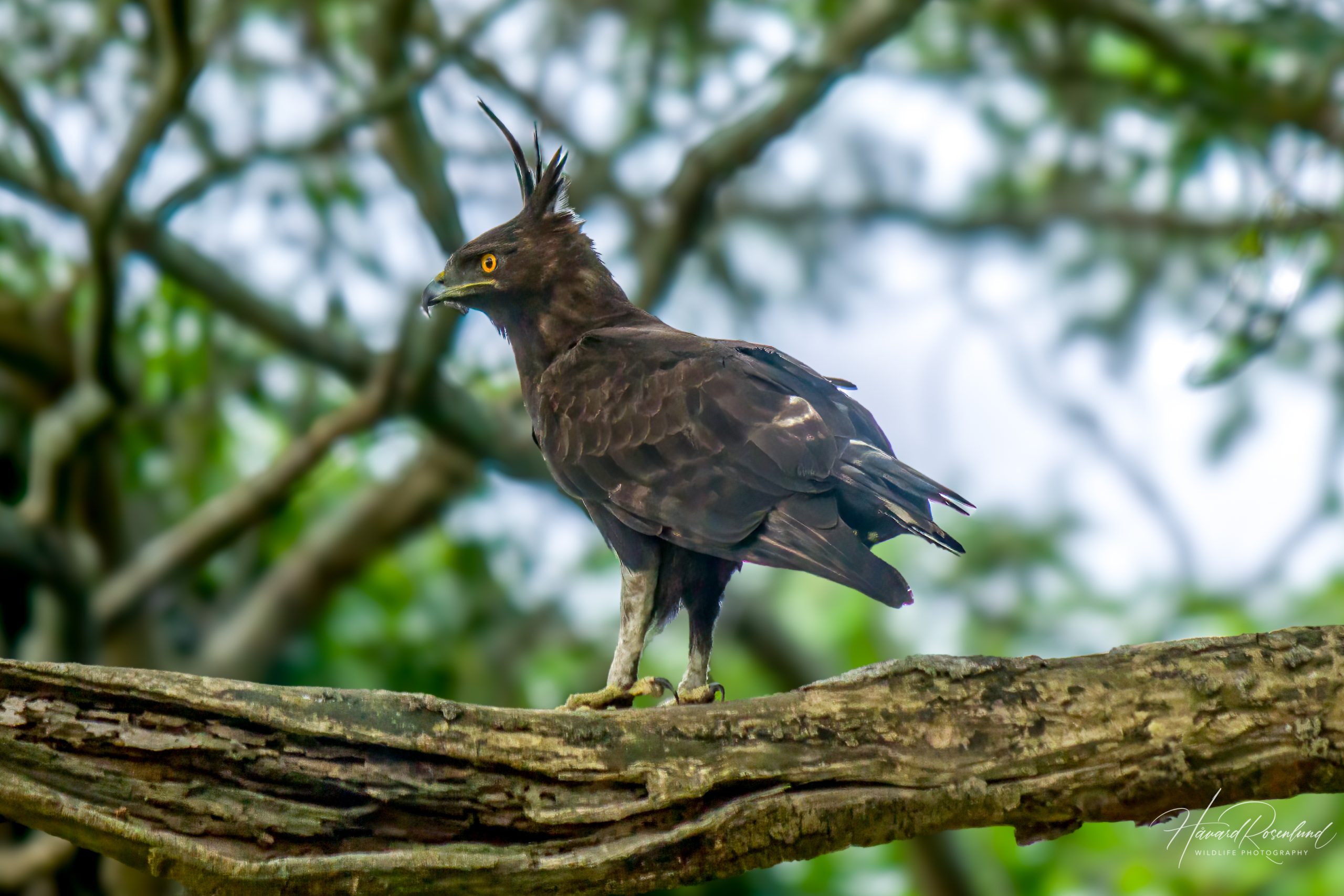
Long-crested Eagle
Lophaetus occipitalis
At a glance
Habitat
- Woodland and forest edges beside wet grassland, marshes, rivers and mixed farmland
Diet
- Strongly rodent-focused; also shrews, reptiles, amphibians and large invertebrates
Activity
- Diurnal; typically hunts from exposed perches
Size
- Length: About 50 cm Weight: Males about 1.1 kg; females about 1.4 kg
Range
- Widespread but patchy across sub-Saharan Africa
Description
The long-crested eagle (Lophaetus occipitalis) is a distinctive medium-sized African eagle, instantly recognisable by its long, shaggy black crest. Adults are about 50 cm long. The species shows clear sexual size dimorphism, meaning females are larger than males: males weigh roughly 1.1 kg and females around 1.4 kg. Females also often have a somewhat shorter crest.
The plumage is mostly dark brown to black, with bright yellow eyes, white feathered legs and a boldly barred black-and-white tail. In flight, large white patches on the underwings contrast strongly with the dark coverts. Juveniles are browner and paler, with a less developed crest.
Habitat
Long-crested eagles favour woodland, forest margins and riverine tree belts beside short wet grassland, marshes, pastures and cultivated ground. The combination of productive rodent habitat and elevated hunting perches is especially important, which is why apparently suitable wooded areas may remain unoccupied when prey is scarce.
The species often uses edge-rich mosaics rather than continuous closed forest. Wet depressions, drainage lines and agricultural margins can all provide productive hunting habitat as long as trees or other safe perches remain available.
Diet
Rodents dominate the diet in many regions. Vlei rats, mice, mole-rats and other small mammals are particularly important, with shrews also taken regularly; reptiles, frogs and large invertebrates form a smaller part of the diet.
The strong dependence on small mammals links local eagle numbers closely to prey abundance. When rodent populations rise, hunting conditions improve and breeding can become more successful, while prey scarcity can reduce territory quality.
Hunting
The long-crested eagle is a specialised perch hunter. It typically sits motionless on an exposed tree, pole or other elevated lookout and watches grass or low vegetation before dropping rapidly onto detected prey.
This strategy is efficient where rodents move through short or patchy vegetation, and it explains the eagle's frequent use of field edges, wet grasslands and roadsides. Birds may shift among nearby perches as they search, but spend far less time in prolonged aerial hunting than many larger eagles.
Behaviour
Long-crested eagles are usually encountered alone or as established pairs. Adults are territorial and show strong site fidelity, meaning they can remain associated with the same area for long periods. They may still make occasional short exploratory movements beyond their usual range before returning.
This flexibility allows adults to retain familiar hunting grounds while responding to changes in prey conditions in the surrounding landscape.
Breeding
Breeding timing varies geographically and can respond to rainfall and rodent abundance. Pairs build a stick nest in a tall tree, including native trees and occasionally large eucalyptus.
One or two eggs are laid and incubated mainly by the female while the male supplies food. Incubation lasts about 42 days. Young leave the nest after roughly eight weeks and remain dependent on the adults for several more weeks. If two chicks hatch, usually only one survives to fledging; the cause of the other chick's death is not firmly documented in this species.
Relationship with humans
The long-crested eagle can benefit from some forms of moderate landscape modification. Partial woodland clearing, small fields and plantations may create open, rodent-rich feeding areas while retaining trees and other structures for nesting, roosting and hunting.
Utility poles can provide excellent hunting lookouts in open farmland, but the same infrastructure can be dangerous. The species is vulnerable to electrocution, meaning fatal electric shock when a bird bridges live and grounded parts of power infrastructure.
Status
The long-crested eagle was reassessed globally in 2025 and remains Least Concern on the IUCN Red List. The global population trend is considered broadly stable, and the population is thought to number several tens of thousands of mature individuals.
Regional trends differ. The species has increased and expanded westward in parts of South Africa, where agricultural landscapes can provide productive rodent habitat, while long-term counts in Kenya have recorded severe local declines outside protected areas. It therefore remains secure globally despite pressure on some regional populations.
Image gallery
Loading map and observations…
Have you seen this species?
Independent species archive
Did you find this species page useful?
Wildlife Vagabond is independently built and maintained. Voluntary support helps cover hosting, maps, data storage and continued improvements to the species archive.
Support Wildlife VagabondSpecies content will remain freely available.
References
Information about the species’ global distribution and status is based primarily on global Red List data. See the references below for details.
- BirdLife International. (2026). IUCN Red List for birds. BirdLife DataZone. https://datazone.birdlife.org
- Coordinated Avifaunal Roadcounts. (n.d.). Long-crested Eagle: summary of the 2025 BirdLife/IUCN assessment, range, threats and trends. https://car.birdmap.africa/species/LCE
- International Union for Conservation of Nature. (2025). Lophaetus occipitalis (Long-crested Eagle). The IUCN Red List of Threatened Species. https://www.iucnredlist.org/species/22696134/281488645
- Jeffery, R., & Brooke, R. K. (1962). Nesting of the long-crested eagle <i>Lophaetus occipitalis</i> in Salisbury. Ostrich, 33(4), 33-34. https://doi.org/10.1080/00306525.1962.9633456
- Maphalala, M. I., Monadjem, A., Bildstein, K. L., McPherson, S., Hoffman, B., & Downs, C. T. (2020). Ranging behaviour of Long-crested Eagles Lophaetus occipitalis in human-modified landscapes of KwaZulu-Natal, South Africa. Ostrich, 91(3), 221-227. https://doi.org/10.2989/00306525.2020.1770888
- Ngila, P. M., Chiawo, D., Owuor, M. A., Wasonga, V. O., Ellwood, E., & Mugo, D. (2024). Assessing the susceptibility of raptor species to electrocution: A framework for Kenya. Environmental and Sustainability Indicators, 22, 100400. https://doi.org/10.1016/j.indic.2024.100400
- The Peregrine Fund. (n.d.). Long-crested Eagle: ecology and rodent-specialist diet. https://peregrinefund.org/explore-raptors-species/eagles/long-crested-eagle