
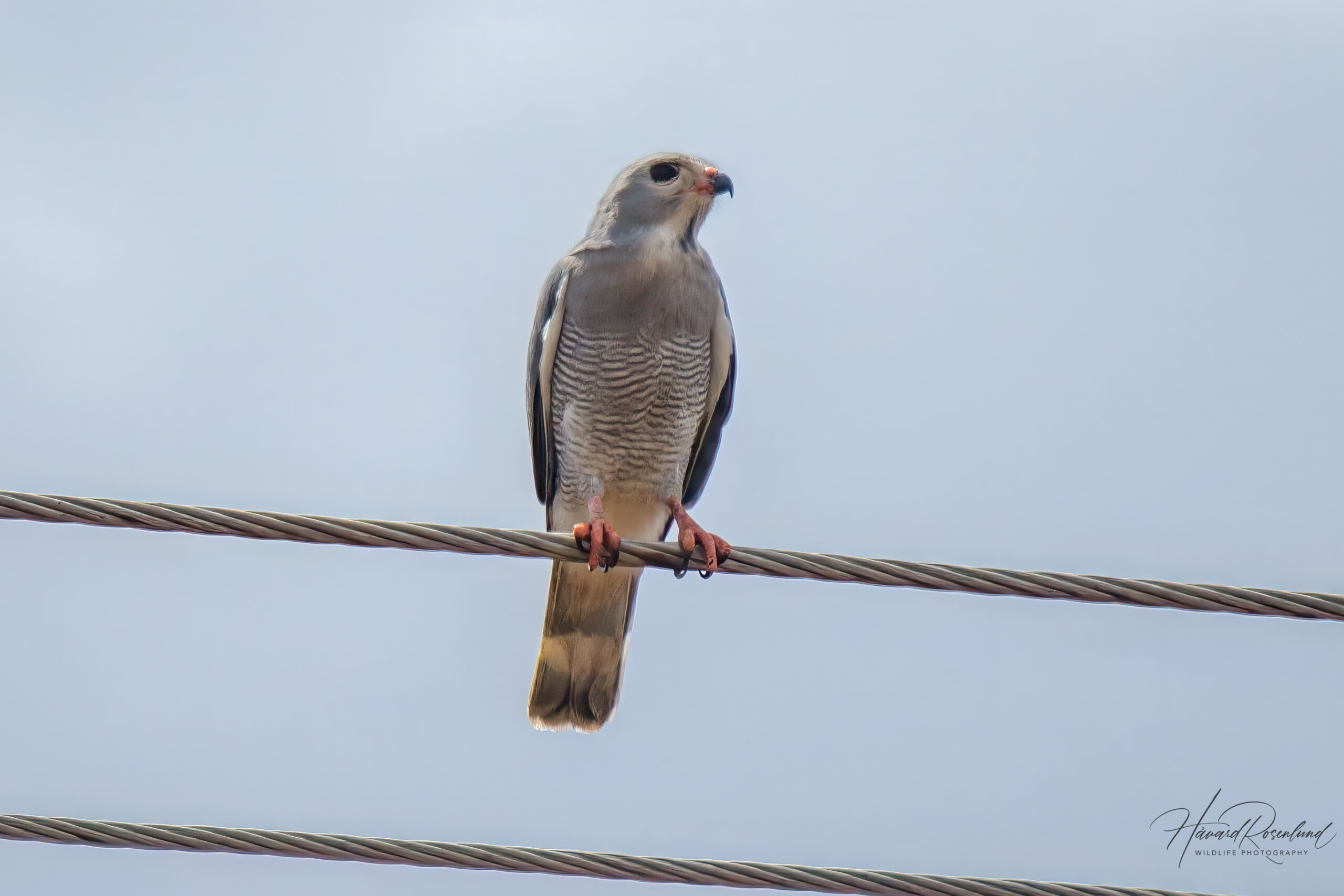
Lizard Buzzard
Kaupifalco monogrammicus
At a glance
Habitat
- Savanna woodland, miombo, bushveld and woodland edges
Diet
- Lizards and other reptiles, frogs, rodents and large invertebrates; birds are rare prey
Activity
- Diurnal
Size
- Length: 35–37 cm Weight: ♂ ~245 g; ♀ ~305 g
Range
- Widespread across sub-Saharan Africa from West and East Africa south to South Africa
Description
The lizard buzzard (Kaupifalco monogrammicus) is a small, stocky African raptor widespread across sub-Saharan Africa. Adults are about 35–37 cm long, with a wingspan of roughly 63–79 cm and a body mass of about 220–410 g. Females average larger than males.
The head, upperparts and upper breast are grey, while the belly is white with fine dark barring. Its most distinctive field mark is the narrow vertical black stripe down the centre of the white throat. The dark tail typically has a single broad white band and a pale tip. Two subspecies are recognised: K. m. monogrammicus from West Africa east to Ethiopia and Kenya, and K. m. meridionalis from southern Kenya southwards into Angola, Namibia and South Africa.
Despite its English name, the lizard buzzard is not closely allied to the typical Buteo buzzards. Recent phylogenetic work places Kaupifalco within Accipitrinae, as the sister lineage to a large group that includes many hawks traditionally placed in Accipiter as well as harriers. In the field it can be confused with the Gabar goshawk (Micronisus gabar), but that species is more slender and has several narrow pale tail bands rather than one broad white band. The lizard buzzard’s vertical black throat stripe is an especially useful distinguishing feature.
Habitat
Lizard buzzards favour open woodland and woodland edge, including miombo, savanna woodland and bushveld. They also use cultivated mosaics, rural gardens and other moderately modified landscapes where trees provide exposed hunting and nesting sites.
The combination of scattered trees and relatively open ground is especially suitable: elevated branches or poles provide lookout points, while prey remains accessible on the ground and in low vegetation.
Diet
Lizards and other small reptiles are important prey, but the diet is considerably broader. Frogs, rodents, large grasshoppers, spiders and other invertebrates are also taken, while birds appear to be only occasional prey.
Hunting
The lizard buzzard is primarily a sit-and-wait hunter. It spends long periods watching from an exposed branch, dead snag or pole before dropping rapidly onto prey on the ground or in low vegetation. Short flights between lookout points allow a bird to scan new patches while keeping this energy-efficient hunting strategy.
This strategy works best where scattered perches overlook relatively open ground and prey is easy to reach. Hunting activity also varies through the day and with local conditions, following changes in how easy lizards, insects and other prey are to detect and capture.
Behaviour
Lizard buzzards are usually encountered alone or in pairs and are largely resident. Pairs can occupy the same territories for long periods, although limited local movements may occur as rainfall, prey availability and habitat conditions change.
The species is often quiet, but it gives a clear repeated whistle that becomes especially conspicuous around the breeding period. Territorial calls are therefore easiest to notice at that time, even though pairs can remain associated with the same area outside the immediate breeding period.
Breeding
Breeding timing varies geographically. In southern Africa egg laying has been recorded from May to January, with a strong peak around September and October. Courtship includes aerial display, while both sexes take part in building the compact stick nest, usually high in a mature tree and lined with softer material such as green leaves or lichen.
A clutch contains 1–3 eggs, most often two. The female performs the incubation, which lasts about 32–34 days, while the male brings food. After hatching both parents provision and defend the young. Chicks leave the nest at around 40 days but remain dependent on the adults for considerably longer, becoming fully independent only after roughly three months.
Status
The lizard buzzard is classified as least concern on the IUCN Red List. It has a very large sub-Saharan range, remains widespread in suitable savanna and woodland habitats, and the global population trend is considered stable.
Woodland clearing can reduce local populations where it removes mature nesting trees and the elevated perches used for hunting, but no major threat is currently known across the species’ range.
Image gallery
Loading map and observations…
Have you seen this species?
Independent species archive
Did you find this species page useful?
Wildlife Vagabond is independently built and maintained. Voluntary support helps cover hosting, maps, data storage and continued improvements to the species archive.
Support Wildlife VagabondSpecies content will remain freely available.
References
Information about the species’ global distribution and status is based primarily on global Red List data. See the references below for details.
- Avibase. (n.d.). Kaupifalco monogrammicus meridionalis. https://avibase.bsc-eoc.org/species.jsp?avibaseid=4BE00C5C074F915C
- Biodiversity Explorer. (n.d.). Lizard Buzzard (Kaupifalco monogrammicus). Iziko Museums of South Africa. https://www.biodiversityexplorer.info/birds/accipitridae/kaupifalco_monogrammicus.htm
- BirdLife International. (n.d.). Lizard Buzzard species factsheet. https://datazone.birdlife.org/species/factsheet/lizard-buzzard-kaupifalco-monogrammicus
- Catanach, T. A., Halley, M. R., & Pirro, S. (2025). Enigmas no longer: using ultraconserved elements to place several unusual hawk taxa and address the non-monophyly of the genus Accipiter (Accipitriformes: Accipitridae). Biological Journal of the Linnean Society, 144(2), blae028. https://doi.org/10.1093/biolinnean/blae028
- International Union for Conservation of Nature. (n.d.). Lizard Buzzard. The IUCN Red List of Threatened Species. https://www.iucnredlist.org/species/22695421/93508702
- Oiseaux.net. (n.d.). Lizard Buzzard. https://www.oiseaux.net/birds/lizard.buzzard.html
- Thiollay, J. M., & Clobert, J. (1990). Comparative foraging adaptations of small raptors in a dense African savanna. Ibis, 132(1), 42-57. https://doi.org/10.1111/j.1474-919X.1990.tb01015.x