
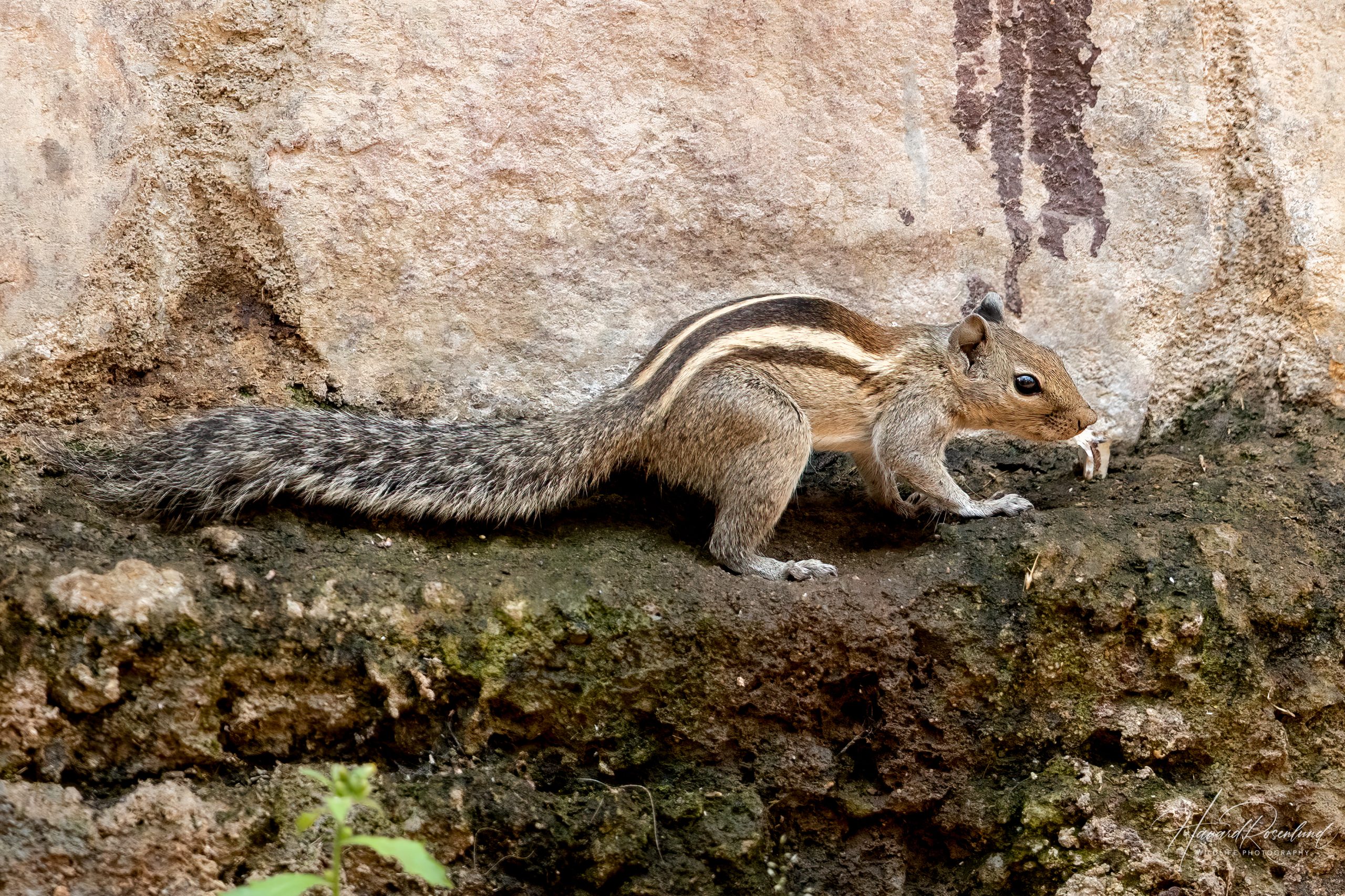
Indian Palm Squirrel
Funambulus palmarum
At a glance
Habitat
- Dry and deciduous forest, scrub, plantations, gardens, farmland and urban areas
Diet
- Omnivorous; seeds, nuts, fruit, flowers, insects and other small animal food
Activity
- Diurnal
Size
- Length: body about 12–19 cm; tail about 14–16 cm Weight: about 100–120 g
Range
- Central and southern India and Sri Lanka
Description
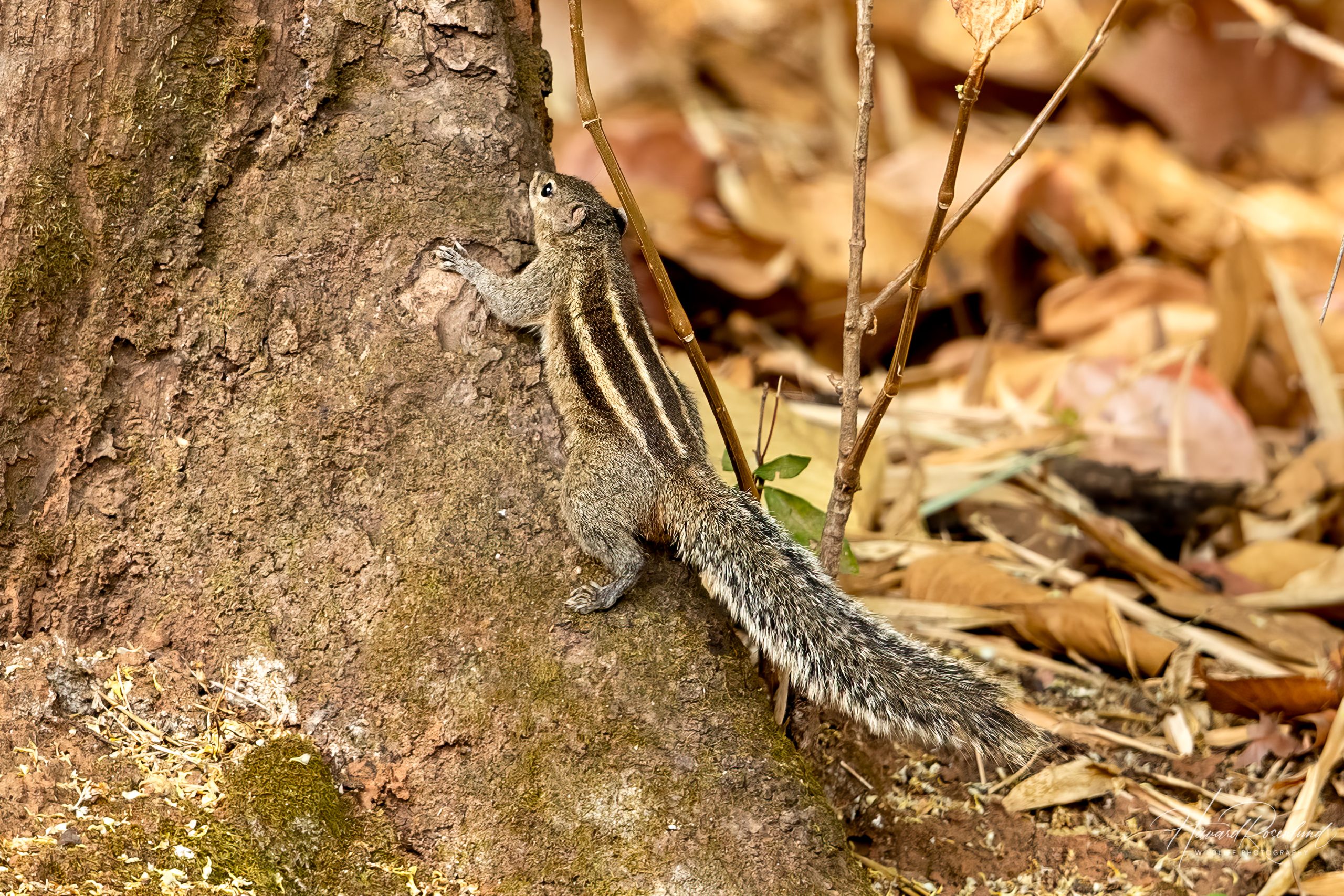
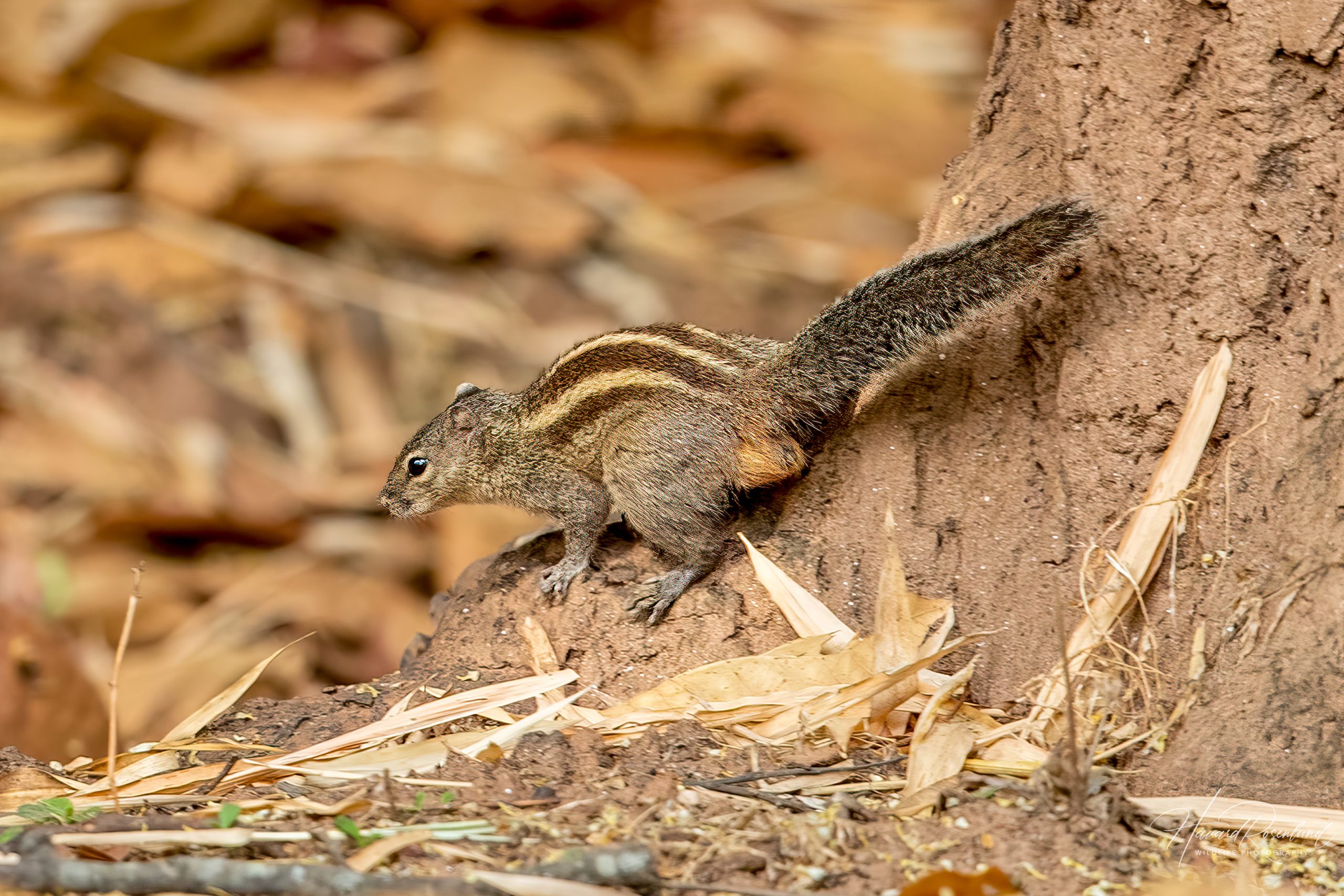
The Indian palm squirrel (Funambulus palmarum), also called the three-striped palm squirrel, is a small tree squirrel native to central and southern India and Sri Lanka. Adults have a head-and-body length of roughly 12–19 cm, with a tail of about 14–16 cm, and usually weigh around 100–120 g. The grey-brown back carries three prominent pale longitudinal stripes, while the belly is cream to whitish and the tail is long and bushy.
It can overlap locally with the northern palm squirrel (Funambulus pennantii) in central India. The two are easily separated in good views: the Indian palm squirrel has three pale dorsal stripes, whereas the northern palm squirrel has five.
Habitat
Indian palm squirrels use dry and deciduous forest, scrub, plantations, gardens, farmland and urban areas. In the Western Ghats they occur widely in deciduous forest but are less characteristic of wet evergreen forest. Trees, walls, roofs and other elevated structures provide routes for movement, refuge and feeding sites.
The species is especially successful in human-modified landscapes and occurs from rural plantations to densely populated towns. Food and nesting opportunities may remain abundant even where natural vegetation is fragmented.
Diet
The diet is broad and omnivorous. Nuts, fruit, seeds, buds, young shoots, flowers, nectar, bark and insects are all taken, and individuals forage both in trees and on the ground. They manipulate food deftly with the forepaws and use their strong incisors to open hard items.
The plant diet can be remarkably varied. An account from Point Calimere Wildlife Sanctuary in Tamil Nadu recorded use of about 50 plant species. Nectar feeding may also make the squirrels occasional pollinators of flowering trees such as the silk-cotton tree (Ceiba pentandra).
Behaviour
Indian palm squirrels are diurnal and spend much of the day moving rapidly between trees, the ground and human structures. They frequently pause upright to scan their surroundings and use short, sharp calls in alarm and social interactions. Individuals are often seen alone, although several may feed close together where resources are concentrated.
The species remains active throughout the year rather than entering seasonal hibernation, a useful adaptation in warm climates where food can remain available across seasons.
Reproduction
Indian palm squirrels build globular nests from grass, leaves, fibres and other soft material, usually among branches. Gestation is about 34 days, and litters usually contain two or three young.
Breeding timing varies geographically. In Sri Lanka reproduction has been recorded throughout the year, with a peak from November to April. A study published in 1991 on wild males from Karnataka likewise found spermatogenesis continuing throughout the year, showing that males retain reproductive capacity across seasons.
Relationship with humans
Few mammals are more at home around people in southern India. Indian palm squirrels are common in gardens, temple grounds, campuses and residential areas, where they may benefit from ornamental trees and deliberately or accidentally provided food. That familiarity makes them conspicuous urban wildlife in many places.
The same adaptability can create conflict when squirrels feed on fruit and other crops. A habitat-modelling study published in 2025 estimated about 39,600 km² of climatically suitable habitat for the species in India under current conditions and projected an increase of about 48.1% under future climate scenarios. Its overlap with agricultural land was likewise projected to increase by more than 48%, particularly across parts of the Deccan Plateau and the Eastern and Western Ghats. These are modelled projections rather than observed future population changes.
Status
The Indian palm squirrel is classified as least concern on the IUCN Red List. It remains widespread within its native range and tolerates a broad spectrum of natural and human-modified habitats.
Its adaptability means that habitat conversion does not affect it in the same way as more specialised forest squirrels. Local populations can nevertheless be influenced by urban redevelopment, loss of mature trees, persecution in agricultural areas and changes in food availability.
Image gallery
Loading map and observations…
Have you seen this species?
Independent species archive
Did you find this species page useful?
Wildlife Vagabond is independently built and maintained. Voluntary support helps cover hosting, maps, data storage and continued improvements to the species archive.
Support Wildlife VagabondSpecies content will remain freely available.
References
Information about the species’ global distribution and status is based primarily on global Red List data. See the references below for details.
- Abedin, I., Chatterjee, P., Singha, H., Kim, H.-W., & Kundu, S. (2025). Climate-Driven Habitat Shifts of Two Palm Squirrel Species (Sciuridae: Funambulus) and Projected Expansion of Their Range Overlap with Indian Agroecosystems. Biology, 14(12), 1666. https://doi.org/10.3390/biology14121666
- AnAge: The Animal Ageing and Longevity Database. (n.d.). HAGR AnAge – Funambulus palmarum life-history data. https://genomics.senescence.info/species/entry.php?species=Funambulus_palmarum
- International Union for Conservation of Nature. (n.d.). Indian Palm Squirrel. The IUCN Red List of Threatened Species. https://www.iucnredlist.org/species/8701/115087934
- Mammal Diversity Database. (n.d.). Funambulus palmarum. American Society of Mammalogists. https://www.mammaldiversity.org/taxon/1001602/
- Patil, S. B., & Saidapur, S. K. (1991). Kinetics of spermatogenesis in the wild squirrel Funambulus palmarum (Linnaeus). Acta anatomica, 141(4), 352-63. https://doi.org/10.1159/000147147
- Squirrels of India. (n.d.). Three-striped Palm Squirrel. https://squirrelsofindia.in/species/funambulus-palmarum
- Wilson, D. E., Lacher, T. E., Jr., & Mittermeier, R. A. (2016). Funambulus palmarum. In Handbook of the Mammals of the World – Volume 6: Lagomorphs and Rodents I (pp. 715). Lynx Edicions. https://doi.org/10.5281/zenodo.6818630