
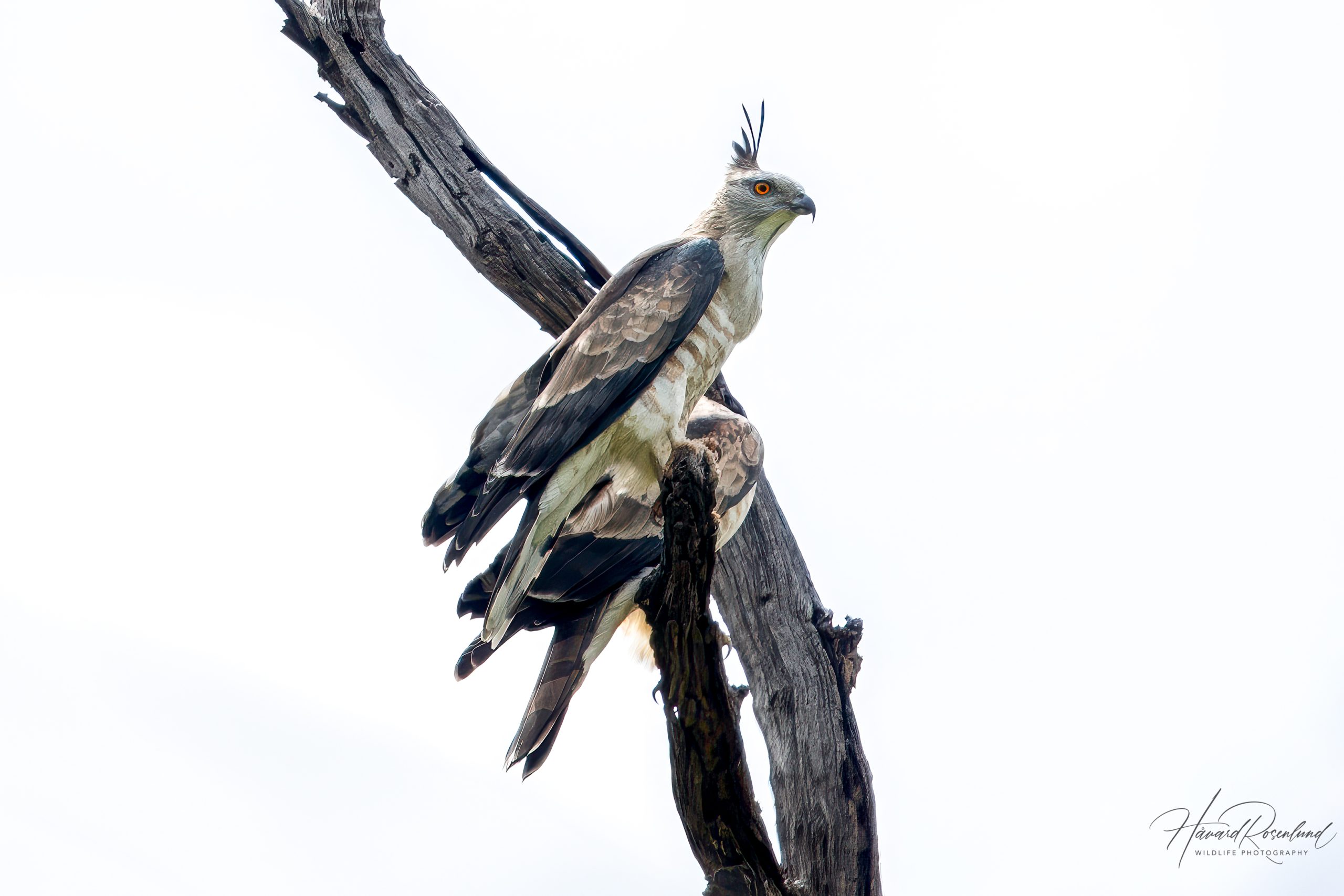
Jerdon’s Baza
Aviceda jerdoni
At a glance
Habitat
- Moist and semi-evergreen forest, forest edge, wooded foothills and tree-rich plantations
Diet
- Large insects, lizards, frogs and other small vertebrates
Activity
- Diurnal
Size
- Length: about 41–48 cm Weight: about 350–365 g
Range
- Discontinuously distributed from the Indian subcontinent through mainland Southeast Asia to parts of Indonesia and the Philippines
Description
Jerdon's baza (Aviceda jerdoni) is a medium-sized crested raptor with a scattered distribution across South and Southeast Asia. Adults are about 41–48 cm long, have a wingspan of roughly 117 cm and weigh around 350–365 g. The long black crest is tipped white, the upperparts are brown, and the pale underparts carry broad rufous-brown barring. The wings are broad and the tail has several dark bands.
Adult males tend to show a greyer head and face, while females are generally browner. The combination of the long crest, barred underparts and relatively compact, broad-winged build gives the species a distinctive appearance when seen well, although it can be remarkably inconspicuous inside forest. Five subspecies are recognised; in India the nominate A. j. jerdoni occurs in the north-east, while A. j. ceylonensis occurs in south-western India and Sri Lanka.
Habitat
Jerdon's bazas use moist and semi-evergreen forest, forest edge, wooded foothills and other tree-rich landscapes. They also occur in plantations where a substantial canopy remains; several breeding observations in Wayanad, Kerala, have come from coffee-growing landscapes with large trees.
The species is generally local and sparsely distributed rather than continuously common. A mixture of tall nesting trees, forest cover and edges or openings that provide hunting opportunities appears important. Its secretive behaviour and low density also make it easy to overlook, so apparent rarity can partly reflect limited detection.
Diet
The diet combines large insects with small vertebrates. Grasshoppers, mantises, beetles and other large arthropods are taken alongside lizards, frogs, small mammals and occasionally birds.
A breeding study published in 2007 from Wayanad recorded 323 prey deliveries at two nests. Amphibians made up 33% of all recorded deliveries, lizards 24% and grasshoppers 19%, with beetles, mantises, a small bird and two rodents also recorded. Malabar flying frogs (Rhacophorus malabaricus) were especially important among the amphibian prey, showing how strongly the diet can reflect locally abundant animals.
Hunting
Jerdon's bazas hunt from within the forest canopy, using concealed or partly exposed perches before making short pounces onto prey on the ground or in vegetation. They can also make low, agile flights through gaps between trees while searching for large insects and small vertebrates.
Observations at the Wayanad nests revealed an unusual prey-handling habit. During the study, adults carried prey in the bill rather than the feet on all but three observed occasions, including frogs, lizards and large insects. A male was also seen taking lizards by pouncing from a concealed perch close to the nesting area.
Behaviour
Jerdon's bazas are usually encountered alone or as pairs and often spend long periods quietly perched within the canopy. They glide between trees and may also soar above the forest when moving between areas, while their unobtrusive habits and preference for wooded cover can make them surprisingly difficult to detect even where they occur.
Breeding
Breeding birds become much more conspicuous. Pairs call, perform aerial displays and defend the nest area; in Wayanad, adults were observed attacking a crested serpent-eagle (Spilornis cheela) that approached a nest.
Jerdon's baza builds a relatively small platform of twigs high in a tree, often adding fresh green leaves. A clutch usually contains two or three eggs. Both members of the pair take part in nest building, and field observations show that both sexes can incubate. Breeding timing varies geographically and can be strongly influenced by local seasonal conditions.
Detailed observations published in 2007 from breeding attempts in Wayanad in 2006 and 2007 indicate an incubation period of about 37–40 days. Both parents brought food after hatching. Between days 20 and 30 after hatching in the 2006 nest, prey was delivered about every 20 minutes, and during one two-hour period the interval fell to about 15 minutes. In the best-documented 2007 nest, two young left the nest at about 27 and 29 days of age.
A later report published in 2021 drew together observations from four breeding attempts in Wayanad. Several nests failed after strong wind and rain damaged or dislodged the exposed nest structure, showing that severe pre-monsoon weather can be an important source of nest failure.
Status
Jerdon's baza is classified as least concern on the IUCN Red List. It has a broad overall range, but records are patchy and the species is described as uncommon or rare in many parts of that range.
Its population trend is difficult to assess. State of India’s Birds 2025 could not estimate either the long-term or current annual trend in India because the available data were insufficient. Information on population size and breeding biology also remains sparse. Loss of forest and mature trees may reduce habitat for a raptor that depends on a well-developed tree canopy and abundant prey, while repeated breeding records from tree-rich coffee landscapes in Wayanad show that some traditional plantations can still provide suitable habitat. The species' low density and secretive behaviour also make genuine population change difficult to distinguish from variation in how often it is detected.
Image gallery
Loading map and observations…
Have you seen this species?
Independent species archive
Did you find this species page useful?
Wildlife Vagabond is independently built and maintained. Voluntary support helps cover hosting, maps, data storage and continued improvements to the species archive.
Support Wildlife VagabondSpecies content will remain freely available.
References
Information about the species’ global distribution and status is based primarily on global Red List data. See the references below for details.
- Abhijith & Kumar. (2021). Notes on multiple breeding attempts of Jerdon’s Baza from Wayanad, Kerala. https://www.researchgate.net/publication/356183944_Notes_on_multiple_breeding_attempts_of_Jerdon's_Baza_Aviceda_jerdoni_from_Wayanad_Kerala
- BirdLife International. (n.d.). Jerdon’s Baza species factsheet. https://datazone.birdlife.org/species/factsheet/jerdons-baza-aviceda-jerdoni
- International Union for Conservation of Nature. (n.d.). Jerdon’s Baza. The IUCN Red List of Threatened Species. https://www.iucnredlist.org/species/22694956/181759887
- Oiseaux.net. (n.d.). Jerdon’s Baza biometrics, subspecies and breeding data. https://www.oiseaux.net/en/oiseaux/jerdon.s.baza.html
- State of India's Birds. (2025). State of India’s Birds 2025 – Jerdon’s Baza. https://stateofindiasbirds.in/species/jerbaz1/
- Tobias, J. A., Sheard, C., Pigot, A. L., Devenish, A. J. M., Yang, J., Sayol, F., Neate‐Clegg, M. H. C., Alioravainen, N., Weeks, T. L., Barber, R. A., Walkden, P. A., MacGregor, H. E. A., Jones, S. E. I., Vincent, C., Phillips, A. G., Marples, N. M., Montaño‐Centellas, F. A., Leandro‐Silva, V., Claramunt, S., … Schleuning, M. (2022). AVONET: morphological, ecological and geographical data for all birds. Ecology Letters, 25(3), 581-597. https://doi.org/10.1111/ele.13898
- Vishnudas, C. K. (2007). Notes on the breeding of Jerdon’s Baza Aviceda jerdoni in Wayanad district, Kerala. Indian BIRDS, 3(2), 62–64. https://indianbirds.in/pdfs/IB_Main_3.2_2007.pdf