
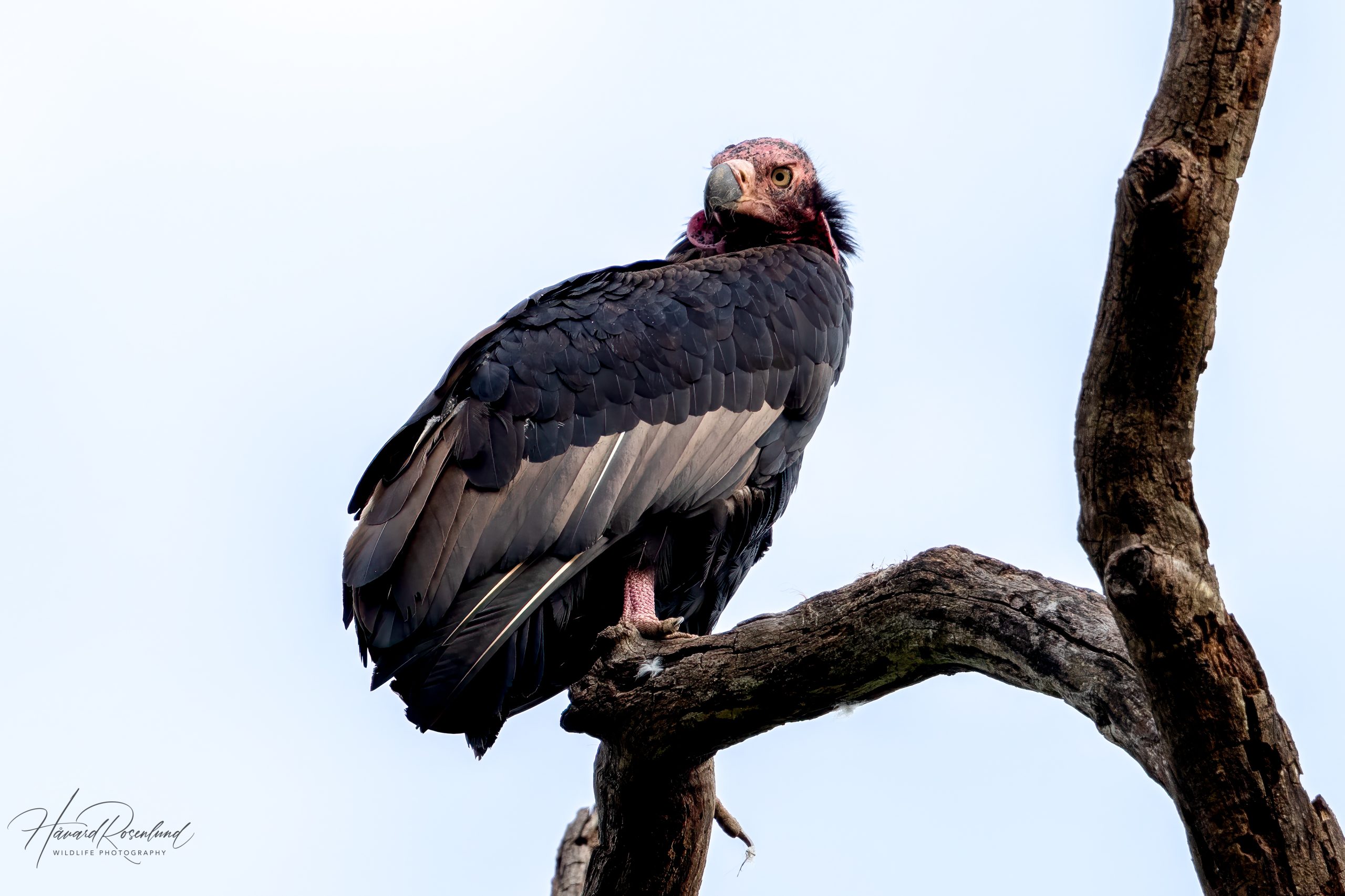
Red-headed Vulture
Sarcogyps calvus
At a glance
Habitat
- Dry deciduous and open woodland, forest edges and semi-arid landscapes
Diet
- Carrion from wild and domestic vertebrates
Activity
- Diurnal; wide-ranging soaring scavenger
Size
- Length: 76–86 cm Weight: —
Range
- Indian subcontinent with small remnant populations in Southeast Asia
Description
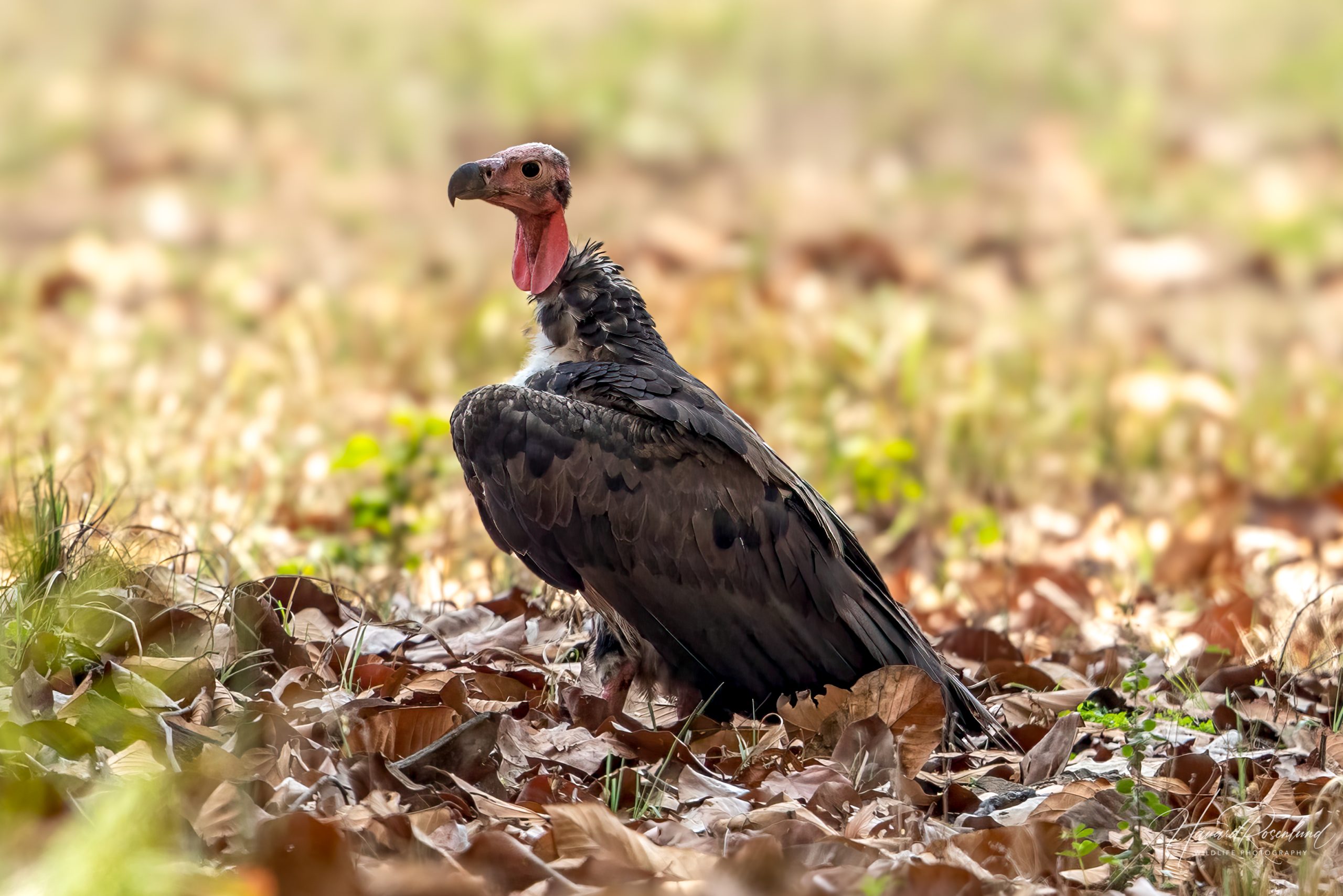
The red-headed vulture (Sarcogyps calvus) is a large, dark Old World vulture centred on the Indian subcontinent, with small remnant populations farther east in Southeast Asia. Adults are roughly 76–86 cm long with a wingspan a little over 2 m. The body and wings are predominantly black, contrasting strongly with the bare deep red to orange head and neck, white patches at the base of the thighs and pale panels visible in the wing.
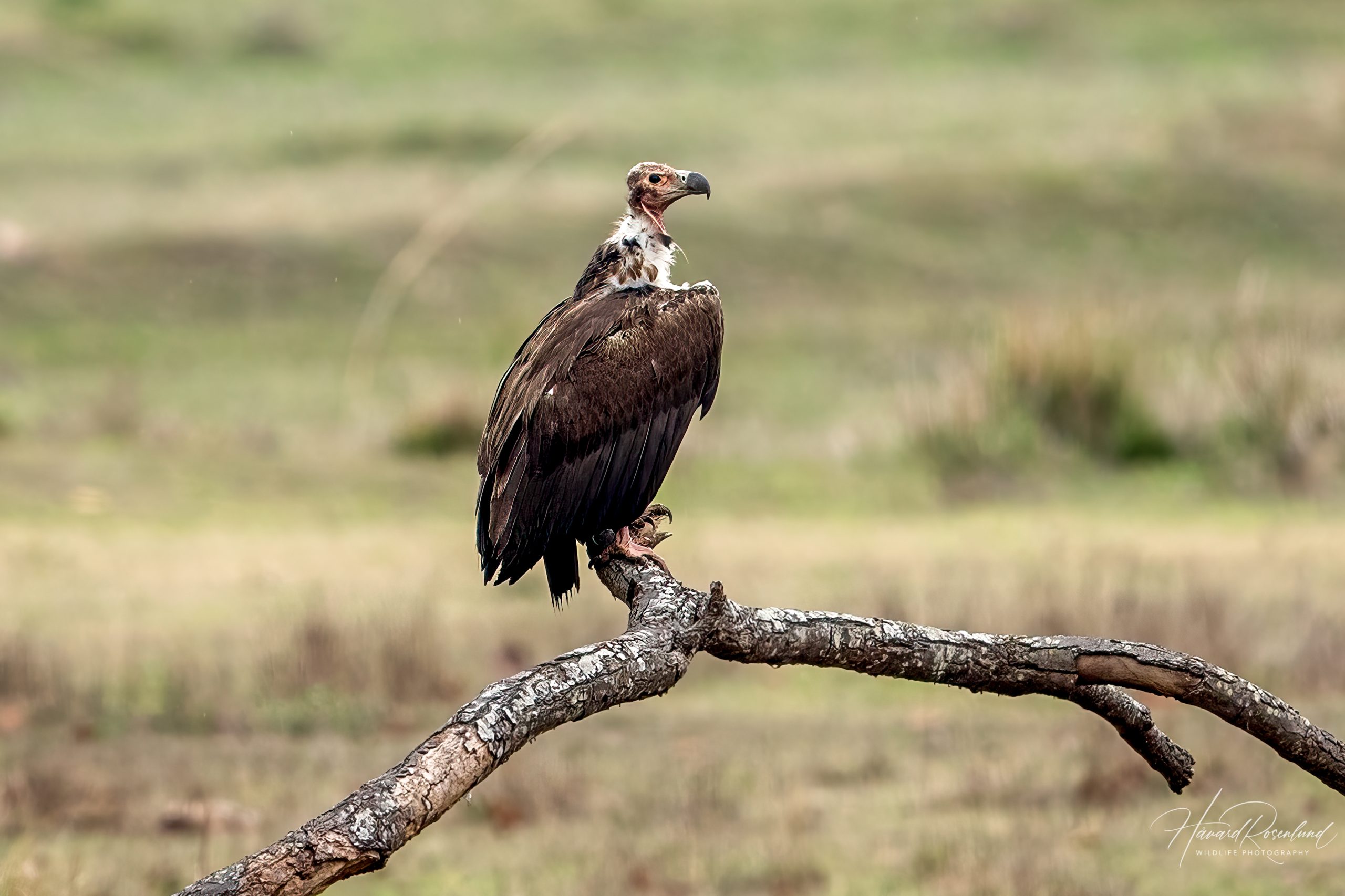
Males and females are similar in size and plumage but can be separated by eye colour: adult males have a pale whitish to yellowish iris, while females have a dark brown iris. Juveniles have a duller, darker head and browner plumage. The species is the only living member of the genus Sarcogyps.
Habitat
Red-headed vultures use dry deciduous and other open woodland, forest edges, wooded savanna, semi-arid landscapes and adjoining open country where carcasses can be located from the air. They occur from lowlands to around 2,500 m. Unlike highly colonial Gyps vultures, they are strongly associated with well-preserved wooded landscapes for nesting.
These wooded refuges have become especially important as the population has collapsed. India's national vulture assessment for 2023–2025 found every confirmed active nest inside protected areas, and most recent breeding-season records likewise came from protected landscapes. Dense woodland and the species' widely spaced solitary nests can make breeding birds unusually difficult to find.
Diet
The species is a specialised scavenger and feeds primarily on the carcasses of medium-sized and large vertebrates. Domestic livestock carcasses form part of the food supply in many areas, alongside wild ungulates and other animals.
Scavenging
Red-headed vultures spend much of the day soaring on thermals while searching broad areas for carrion. Unlike the gregarious Gyps vultures, they usually arrive and feed singly, as pairs or in very small numbers.
Their strong, broad bill can tear through tough skin and muscle, giving them access to parts of a carcass that smaller scavengers struggle to open. At carcasses shared by several vulture species, red-headed vultures usually feed singly or in pairs among the more numerous Gyps vultures. An individual can nevertheless be assertive toward other scavengers when it gains access to food.
Ecological role
The red-headed vulture contributes a somewhat different feeding role from the narrower-billed Gyps vultures with which it often shares carcasses. Its powerful, broad bill can tear tough skin and muscle and lets it exploit parts of a carcass that are less accessible to weaker-billed scavengers.
Like other vultures it also removes decomposing tissue, recycles nutrients and shortens the time carcasses remain in the landscape. Its ecological importance therefore lies both in carrion removal and in the functional diversity it adds to a scavenger community made up of species with different feeding abilities.
Behaviour
Red-headed vultures are strongly territorial and are most often encountered alone or as a pair. They roost in trees rather than forming the huge communal aggregations associated with some other Asian vultures.
Home ranges
Satellite tracking of a resident red-headed vulture in western India produced an annual home range of about 2,779 km², with a core-use area of roughly 321 km². Mean daily movement was about 41 km.
During the breeding season the tracked bird used a smaller area because it repeatedly returned to the nest, consistent with the species' territorial breeding system. Even then, its movements covered a landscape much larger than any single protected area, so a breeding bird depends on safe carrion and low mortality risk far beyond its nest site.
Breeding
The red-headed vulture is a solitary tree nester. A pair builds a large stick platform high in a mature tree, often lining the centre with leaves and dry grass, and a single egg is usual. Both adults take part in incubation and chick care. Breeding is generally concentrated from December to April, although timing varies across the range.
A study published in 2016 from Nepal monitored three active nests during the 2013–2014 breeding season. Incubation lasted about two months, and the chicks fledged roughly four months after hatching, in late June.
The 2023–2025 national assessment in India found only five active nests: four in protected areas of Madhya Pradesh and one in Desert National Park in Rajasthan. The Madhya Pradesh nests included large Terminalia bellirica trees in dry deciduous forest, while the Rajasthan nest was in a Prosopis cineraria tree in an arid landscape. The nests were widely spaced, which helps explain why such a sparse, solitary breeder is difficult to find.
Status
The red-headed vulture is classified as critically endangered on the IUCN Red List. Repeated road surveys documented an approximately 91–94% collapse in India between the early 1990s and early 2000s. Later surveys suggested that the rate of decline slowed after the 2006 veterinary diclofenac ban, but numbers remained extremely low and highly concentrated in a few sites.
The first systematic national breeding assessment, carried out in 2023–2025, confirmed only five active nests and found none occupied at ten previously known nesting sites. Using those five pairs together with breeding-season records from 35 other protected areas, the assessment estimated at least about 80 breeding adults in India. This is a minimum estimate of breeding birds rather than a count of the entire Indian population, but it shows how scarce and fragmented the species has become.
Threats
Veterinary non-steroidal anti-inflammatory drugs (NSAIDs) remain a major concern. Diclofenac caused the catastrophic collapse of South Asia's Gyps vultures. Red-headed vultures have not been experimentally tested for diclofenac sensitivity, so its role is less certain than in Gyps vultures. However, the decline slowed after India's 2006 veterinary ban and the species feeds on the same livestock carcasses that expose other vultures. The evidence therefore suggests that diclofenac contributed to the collapse. Other vulture-toxic veterinary NSAIDs remain a regional risk.
Additional pressures include deliberate or accidental poisoning, loss and degradation of mature nesting woodland, disturbance at nest sites, reduced or unsafe carrion supplies, electrocution and other hazards linked to infrastructure. With so few breeding pairs spread over a huge area, loss of even individual adults or nests can have disproportionate consequences.
Conservation
Conservation in South Asia focuses on keeping vulture-toxic veterinary drugs out of livestock treatment, promoting safer alternatives such as meloxicam, maintaining safe carcass supplies and protecting nesting habitat. Vulture Safe Zones bring these measures together across large areas used by foraging birds, including checks on veterinary drug use, work with veterinarians and livestock owners, population monitoring and habitat protection.
India's 2023–2025 assessment shows how important protected areas have become as refuges for red-headed vultures. Searching for nests, following known territories over time and protecting large nesting trees remain important alongside efforts to keep livestock carcasses free of toxic veterinary drugs. Captive conservation programmes and regional cooperation provide additional support for the remaining population.
Conservation organizations

Image gallery
Loading map and observations…
Have you seen this species?
Independent species archive
Did you find this species page useful?
Wildlife Vagabond is independently built and maintained. Voluntary support helps cover hosting, maps, data storage and continued improvements to the species archive.
Support Wildlife VagabondSpecies content will remain freely available.
References
Information about the species’ global distribution and status is based primarily on global Red List data. See the references below for details.
- Bhusal & Paudel. (2016). Distribution and breeding ecology of Red-headed Vulture Sarcogyps calvus in Nepal. Bird Conservation Nepal, 25, 1–4. https://birdlifenepal.org/public/uploads/files/1485850321-Danphe_Newsletter_%28January-December_2016%29.pdf
- BirdLife International. (n.d.). Red-headed Vulture species factsheet. https://datazone.birdlife.org/species/factsheet/red-headed-vulture-sarcogyps-calvus
- Cuthbert, R., Green, R. E., Ranade, S., Saravanan, S., Pain, D. J., Prakash, V., & Cunningham, A. A. (2006). Rapid population declines of Egyptian vulture (Neophron percnopterus) and red‐headed vulture (Sarcogyps calvus) in India. Animal Conservation, 9(3), 349-354. https://doi.org/10.1111/j.1469-1795.2006.00041.x
- Galligan, T. H., Amano, T., Prakash, V. M., Kulkarni, M., Shringarpure, R., Prakash, N., Ranade, S., Green, R. E., & Cuthbert, R. J. (2014). Have population declines in Egyptian Vulture and Red-headed Vulture in India slowed since the 2006 ban on veterinary diclofenac? Bird Conservation International, 24(3), 272-281. https://doi.org/10.1017/S0959270913000580
- International Union for Conservation of Nature. (n.d.). Red-headed Vulture. The IUCN Red List of Threatened Species. https://www.iucnredlist.org/species/22695254/205031246
- Kumar, P., Kumari, P., Vasudev, V., Lavania, P., Gupta, G., Tiwari, P., Dobriyal, M., & Srivastav, M. (2025). Threatened Vultures of India: Population, Ecology, and Conservation. EcoHealth, 23(1), 18-37. https://doi.org/10.1007/s10393-025-01742-w
- Ram, M., Sahu, A., Tikadar, S., Gadhavi, D., Rather, T. A., Jhala, L., & Zala, Y. (2022). Home Range, Movement and Activity Patterns of Six vulture Species Using Satellite Telemetry in Saurashtra landscape, Gujarat, India. Ecologies, 3(4), 492-507. https://doi.org/10.3390/ecologies3040035
- Saving Asia’s Vultures from Extinction. (n.d.). SAVE – Saving Asia's Vultures from Extinction. https://save-vultures.org/
- The Peregrine Fund. (n.d.). Red-headed Vulture. https://peregrinefund.org/explore-raptors-species/vultures/red-headed-vulture-0
- Wildlife Institute of India. (2025). Pan India Assessment and Monitoring of Endangered Species – Vulture. https://wii.gov.in/uploads/media/publications/research-reports/IDWH_Vulture_Report_2025.pdf