
White-rumped Vulture
Gyps bengalensis
At a glance
Habitat
- Open woodland, forest edge, farmland and settlement mosaics with tall nesting and roosting trees
Diet
- Carrion, especially carcasses of medium-sized and large mammals
Activity
- Diurnal; wide-ranging soaring scavenger
Size
- Length: about 75–90 cm Weight: about 3.5–7.5 kg
Range
- Formerly widespread across South and Southeast Asia; now highly fragmented, with strongest remaining populations in the Indian subcontinent
Description
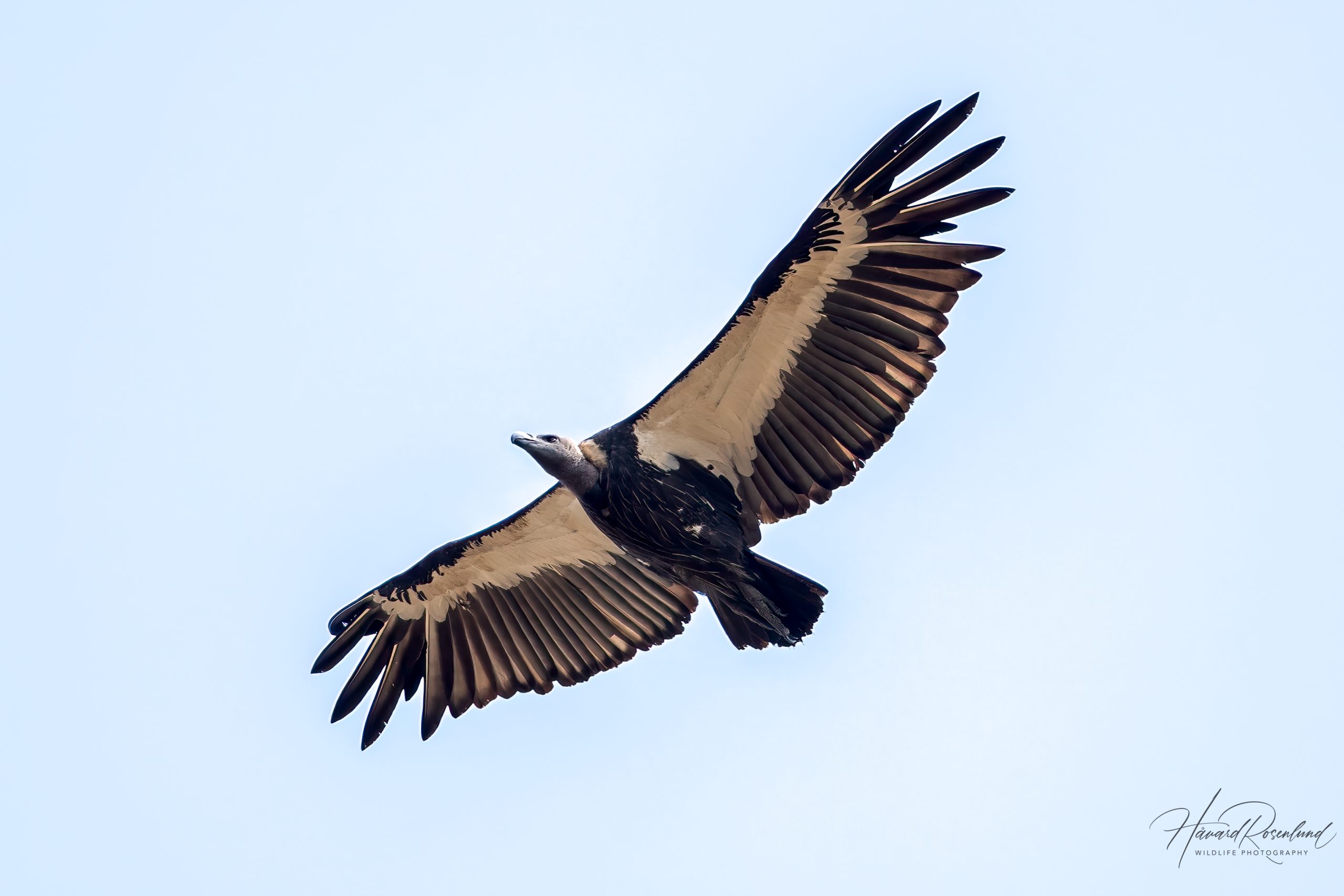
The white-rumped vulture (Gyps bengalensis) is a large Old World vulture of South Asia and one of the most dramatic examples of a once-abundant bird being driven close to extinction within a few years. Adults are about 75–90 cm long, have a wingspan of roughly 205–220 cm and typically weigh around 3.5–7.5 kg. The dark body contrasts sharply with a white neck ruff and the conspicuous white lower back and rump that give the species its English name. The head and upper neck are mostly bare and dark, often with a pinkish tinge.
In flight, adults also show broad pale underwing coverts contrasting with dark flight feathers. Juveniles are much browner and lack the sharp contrast of the adult plumage. The broad wings and short tail are built for efficient soaring.
Habitat
White-rumped vultures use open woodland, forest edge, farmland, river valleys and human-dominated landscapes where carcasses are available and large trees remain for roosting and nesting. Historically the species was closely associated with villages and livestock-keeping areas across much of the Indian subcontinent.
A study published in 2024, based on surveys in Himachal Pradesh from 2020 to 2024, located 17 colonies containing 617 active nests, almost all in large old chir pine trees. Nest choice was strongly associated with tree size, canopy characteristics and spacing from neighbouring nests, showing how strongly surviving colonies can depend on old nesting trees.
Diet
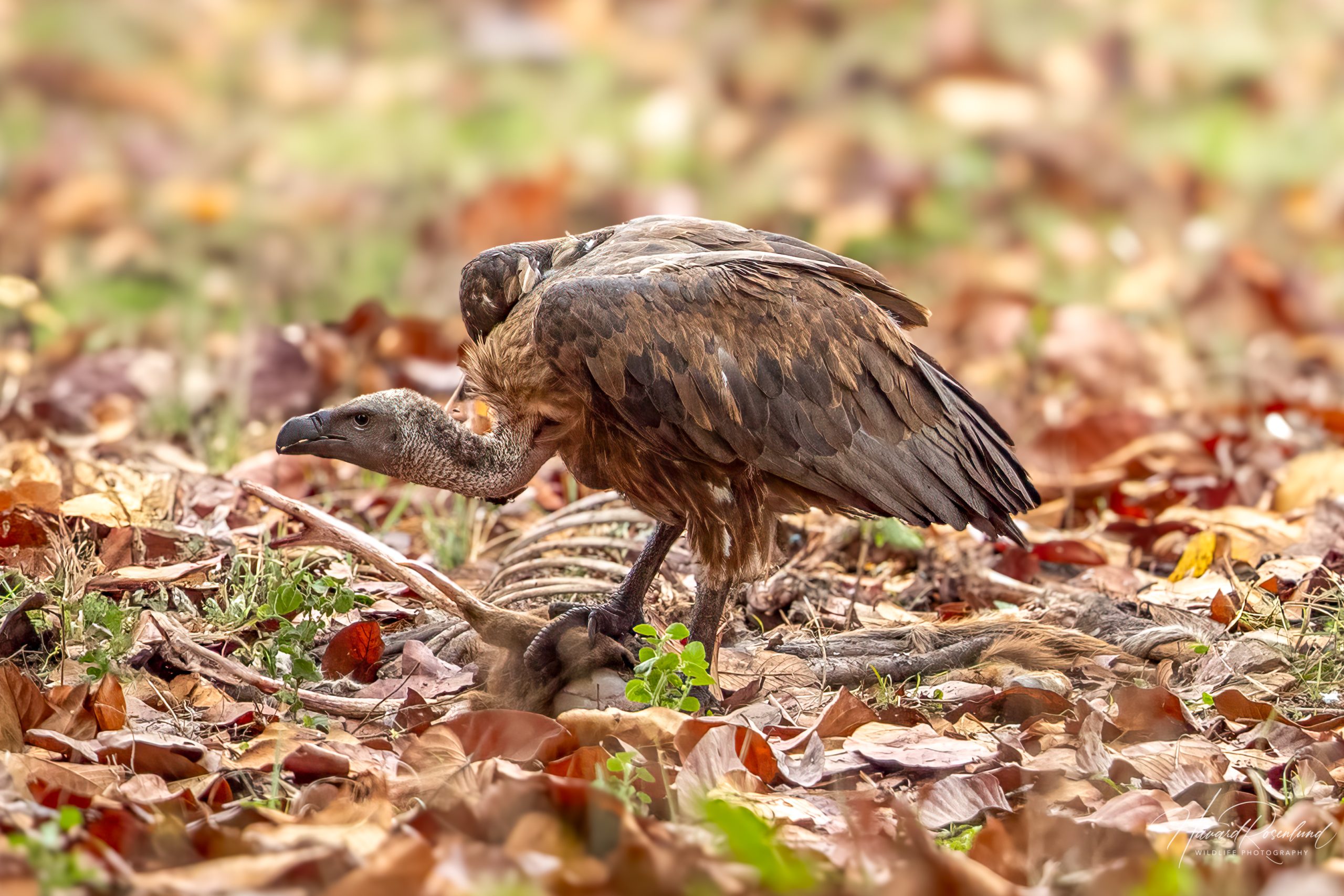
The species is an obligate scavenger and feeds mainly on the carcasses of medium-sized and large mammals, particularly livestock in human-dominated landscapes. Its long neck and relatively narrow head allow it to reach deep into carcasses, while groups of vultures can strip a large carcass rapidly. By removing carrion quickly, vultures also reduce how long decaying animal remains are exposed in the landscape.
This feeding ecology once made the species extraordinarily successful, but it also made the vultures highly vulnerable when toxic veterinary drugs entered the livestock food supply. Birds feeding on animals that had been treated shortly before death ingested drug residues in the tissues. Because even very low contamination levels can be lethal, dependence on livestock carrion turned a formerly abundant food source into a major mortality risk.
Scavenging
White-rumped vultures search for carrion by soaring on thermals and gliding across large areas with little energy expenditure. Food is located mainly by sight, but birds also watch the movements and descent of other vultures and scavengers, allowing an individual to react quickly when another bird has found a carcass.
Because carcasses are unpredictable, birds may spend much of the day travelling between roosts, nesting areas and widely scattered feeding sites. This wide-ranging search behaviour makes the conditions in the surrounding landscape just as important as the protection of the nesting colony itself.
Ecological role
As a specialised carrion feeder, the white-rumped vulture was once one of South Asia's most important large scavengers. Large numbers could remove livestock and wild-animal carcasses quickly, recycling nutrients and shortening the period in which decomposing remains were available to feral dogs and other scavengers.
The species' collapse therefore changed more than vulture numbers. Where white-rumped vultures disappeared, a major part of the natural carcass-disposal system vanished with them, showing how strongly sanitation and scavenger communities in human-dominated landscapes had depended on this once-abundant bird.
Social behaviour
White-rumped vultures are highly social. Birds soar together on thermals, gather at communal roosts and can arrive in large numbers at a carcass.
At feeding sites competition can be intense, with birds jostling for access to the most nutritious parts of a carcass. The species is otherwise relatively quiet, but hisses, grunts and harsh croaking calls can be heard around feeding and nesting sites.
Home ranges
A satellite-tracking study published in 2022 in the Saurashtra landscape of Gujarat, western India, included two white-rumped vultures. Their annual home ranges were about 384 and 303 km², with core-use areas of only about 18 and 5 km².
The two birds travelled an average of roughly 48 and 39 km per day. These relatively compact annual ranges probably reflect the dense and predictable distribution of livestock carrion, roosts and nesting sites in the study landscape rather than a general inability to travel farther. The contrast with Indian and Himalayan vultures in the same study shows how strongly the spatial ecology of scavengers depends on where carcasses are concentrated.
Breeding
White-rumped vultures nest in trees, often in loose colonies where several pairs use the same stand of mature trees. Pairs often return to the same nesting trees in successive years. A pair builds a large stick platform high in the canopy and normally lays a single egg. Both adults incubate. Incubation is commonly reported as roughly 45–52 days, but a six-year field study published in 2023 from the Deccan Plateau recorded 57–66 days, with a mean of 61 days. Published estimates therefore show substantial variation.
The chick remains in the nest for a prolonged period. Many accounts give roughly two to three months, while the same Deccan Plateau study recorded an average nestling period of 105 days. Breeding in India is concentrated mainly through the cooler dry season, beginning around October or November and continuing into March or April. The species' low reproductive rate is a major reason recovery is slow: a pair normally produces at most one chick per breeding attempt. The 2020–2024 work in Himachal Pradesh also found that forest fire, resin tapping and felling of old nesting trees can quickly damage breeding habitat.
Relationship with humans
Few large wild birds were historically as closely associated with people in South Asia as the white-rumped vulture. Cattle and buffalo carcasses left near settlements and at carcass-disposal sites provided predictable food, and colonies often nested in large trees within human-dominated landscapes.
This relationship benefited both sides: livestock systems supplied the birds with food, while vultures removed carcasses rapidly and without human handling. It also created the pathway for the diclofenac disaster, because veterinary drugs given to domestic animals passed directly to vultures through the same carcasses on which they had long depended.
Status
The white-rumped vulture is classified as critically endangered on the IUCN Red List. In India, road surveys indicate that the population fell by about 99.9% between the early 1990s and the mid-2000s. A series of road-transect surveys published in 2024 found no consistent trend between 2007 and 2022, but the population index during this period remained only about one five-hundredth of the 1992 level.
The end of the steepest decline is therefore not yet a recovery. The same 2024 survey found no clear sustained increase in India, while some neighbouring regions, especially Nepal, have shown more encouraging trends where vultures are now exposed to toxic veterinary drugs less often.
Threats
The primary cause of the collapse was veterinary diclofenac, a non-steroidal anti-inflammatory drug used to treat livestock. Vultures feeding on carcasses containing diclofenac residues suffer acute kidney failure and visceral gout, in which uric acid crystals accumulate around the internal organs. India, Pakistan and Nepal banned veterinary diclofenac in 2006, but illegal use did not disappear immediately and other unsafe veterinary drugs entered the market.
A South Asian pharmacy study published in 2025, based on surveys conducted between 2012 and 2024, showed that the threat remains active. Diclofenac was still available in parts of India, while several other NSAIDs known or suspected to be toxic to vultures were also sold. Nimesulide, another drug confirmed as dangerous, was banned for veterinary use in India in 2025. Additional threats include deliberate poisoning, loss of large nesting trees, disturbance, unsafe carcass disposal and infrastructure hazards.
A range-wide habitat model published in 2026 found that more than 88% of the most suitable habitat currently lies outside protected areas. Under a stronger climate-change scenario, highly suitable habitat could decline by as much as 60% by 2100. Toxic veterinary drugs remain the most immediate threat, but loss and degradation of suitable landscapes could increasingly constrain long-term recovery.
Conservation
Recovery efforts focus first on preventing vultures from being exposed to toxic veterinary drugs through livestock carcasses. Vulture-safe meloxicam is promoted as an alternative painkiller, while surveys of pharmacies and livestock carcasses are used to detect continuing exposure to dangerous drugs. Vulture Safe Zones are large landscapes where veterinary outreach, drug monitoring, protection of breeding colonies and provision of safe food are combined across areas large enough to cover normal vulture movements.
Captive breeding and release programmes supplement efforts to rebuild wild populations. White-rumped vultures have been bred and released in Nepal, where satellite-tagged birds are used to test whether release landscapes are genuinely safe. India and other range states also maintain conservation-breeding programmes. Protecting surviving wild colonies remains equally important: every productive colony represents a source of naturally reared birds for a population that can only recover slowly.
Conservation organizations

Image gallery
Loading map and observations…
Have you seen this species?
Independent species archive
Did you find this species page useful?
Wildlife Vagabond is independently built and maintained. Voluntary support helps cover hosting, maps, data storage and continued improvements to the species archive.
Support Wildlife VagabondSpecies content will remain freely available.
References
Information about the species’ global distribution and status is based primarily on global Red List data. See the references below for details.
- Bhattacharya, M., & Talukdar, G. (2024). Nest site selection and threats to nesting colonies of white-rumped Vulture (Gyps bengalensis) in Himachal Pradesh. Forest Ecology and Management, 573, 122335. https://doi.org/10.1016/j.foreco.2024.122335
- BirdLife International. (2025). India bans veterinary nimesulide. https://www.birdlife.org/news/2025/01/10/vulture-conservation-in-india-boosted-by-additional-veterinary-drug-ban/
- BirdLife International. (n.d.). White-rumped Vulture species factsheet. https://datazone.birdlife.org/species/factsheet/white-rumped-vulture-gyps-bengalensis
- International Union for Conservation of Nature. (n.d.). White-rumped Vulture. The IUCN Red List of Threatened Species. https://www.iucnredlist.org/species/22695194/204618615
- Majgaonkar, I., Bowden, C. G. R., & Quader, S. (2018). Nesting Success and Nest-Site Selection of White-Rumped Vultures (Gyps bengalensis) in Western Maharashtra, India. Journal of Raptor Research, 52(4), 431–442. https://doi.org/10.3356/JRR-17-26.1
- Mallord, J. W., Ranade, S., Bhusal, K. P., Alam, A. B. M. S., Chaudhry, M. J. I., Chakraborty, S. S., Subbaiah, B., Bohra, D. L., Dube, A., Shringarpure, R., Chaudhary, I. P., Joshi, A. B., Rana, D. B., Thakuri, D. C., Dangaura, H. L., Azmiri, K. Z., Ahmed, S., Zakir, T., Ahmed, S., … Green, R. E. (2025). The continued threat of toxic NSAIDs to Critically Endangered Gyps vultures in South Asia. Bird Conservation International, 35, e38. https://doi.org/10.1017/S0959270925100270
- Prakash, V., Bajpai, H., Chakraborty, S. S., Singh Mahadev, M., Mallord, J. W., Prakash, N., Ranade, S. P., Shringarpure, R. N., Bowden, C. G. R., & Green, R. E. (2024). Recent trends in populations of Critically Endangered Gyps vultures in India. Bird Conservation International, 34, e1. https://doi.org/10.1017/S0959270923000394
- Ram, M., Sahu, A., Tikadar, S., Gadhavi, D., Rather, T. A., Jhala, L., & Zala, Y. (2022). Home Range, Movement and Activity Patterns of Six vulture Species Using Satellite Telemetry in Saurashtra landscape, Gujarat, India. Ecologies, 3(4), 492-507. https://doi.org/10.3390/ecologies3040035
- Ravikanth, M., & Baskaran, N. (2023). Breeding ecology of critically endangered Long-billed vulture Gyps indicus (Scopoli, 1786) and White-rumped vulture G. bengalensis (Gmelin, 1788) in Kaghaznagar Forest Division and its adjoining areas in the Deccan Plateau, India. Journal of Animal Diversity, 5(3), 31-42. https://doi.org/10.61186/JAD.2023.5.3.4
- Saving Asia’s Vultures from Extinction. (n.d.). SAVE – Saving Asia's Vultures from Extinction. https://save-vultures.org/
- The Peregrine Fund. (n.d.). White-rumped Vulture. https://peregrinefund.org/explore-raptors-species/vultures/white-rumped-vulture
- William, G., Saqib, Z., Qadir, A., Siddiqua, A., Asam, Z. U. Z., Farid, M., & Chaudhry, M. J. I. (2026). Multi-scale modeling of habitat suitability and human-induced risk for the critically endangered white-rumped vulture (Gyps bengalensis) in South and Southeast Asia. The Science of Nature, 113(3), 67. https://doi.org/10.1007/s00114-026-02122-2