
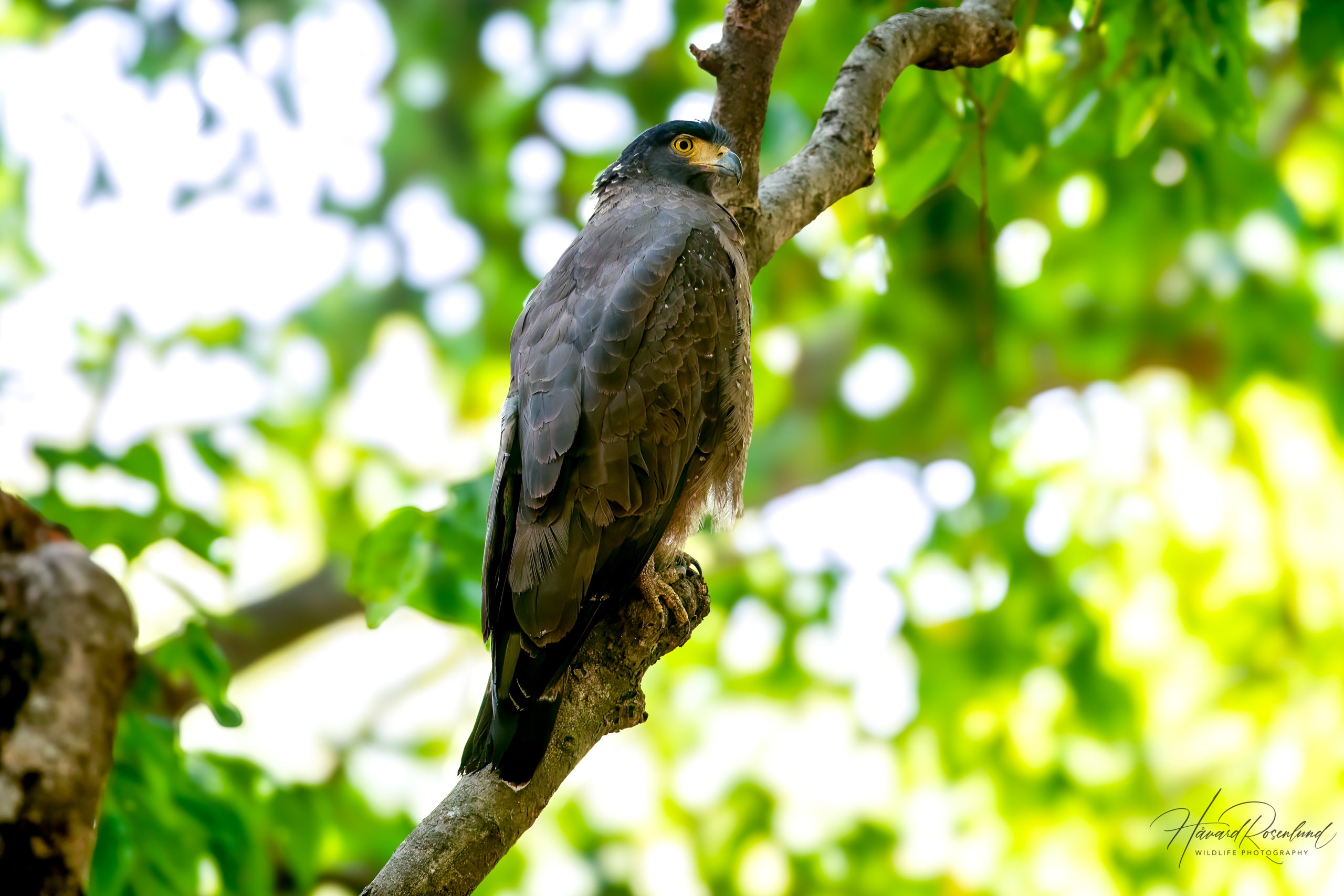
Crested Serpent-Eagle
Spilornis cheela
At a glance
Habitat
- Evergreen and deciduous forest, wooded hills, riverine forest and forest edges
Diet
- Mainly snakes and other reptiles; also frogs, birds and small mammals
Activity
- Diurnal; hunts from perches and soars above forest
Size
- Length: 55–76 cm Weight: ~0.4–1.8 kg
Range
- South and Southeast Asia
Description
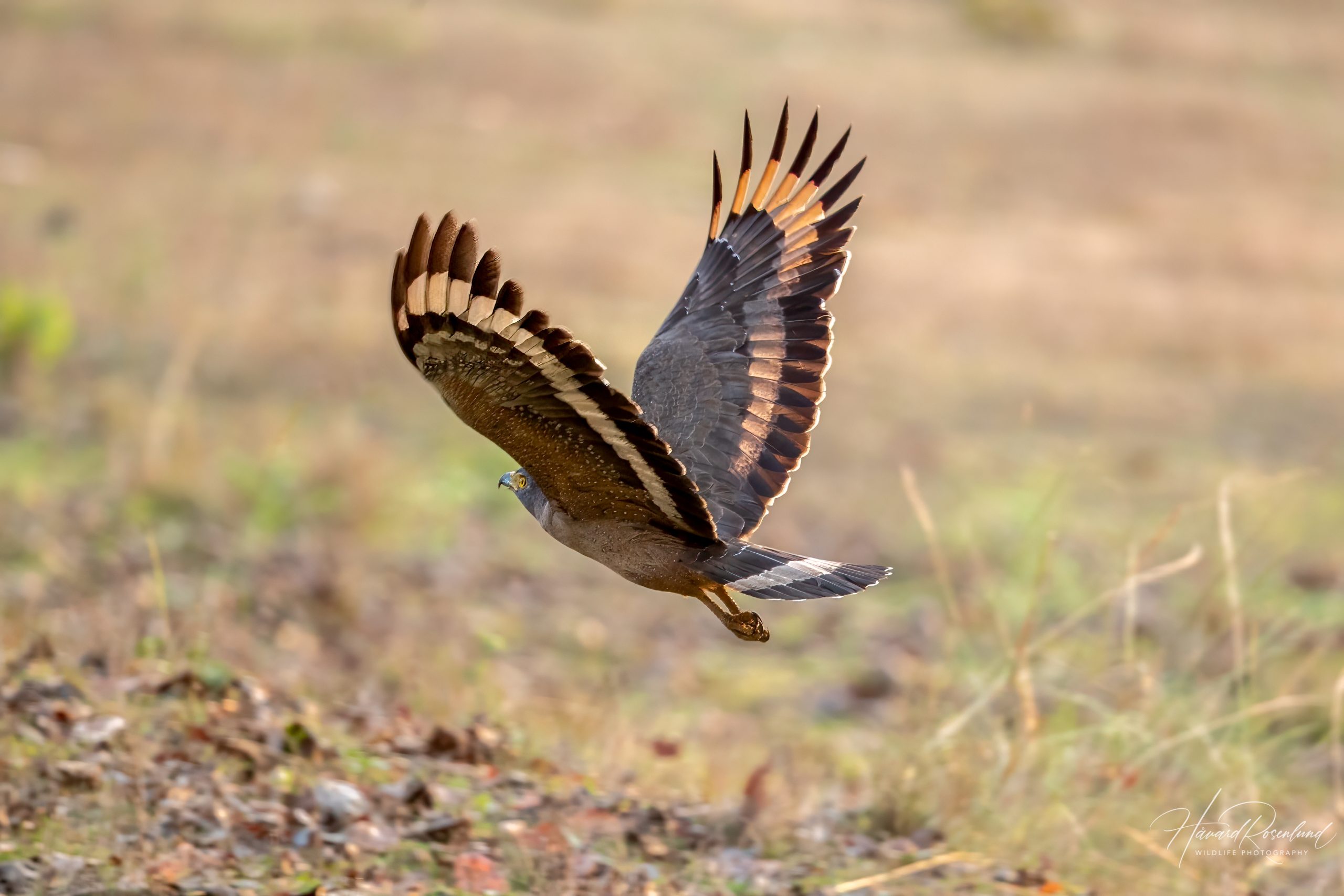
The crested serpent-eagle (Spilornis cheela) is a heavily built forest raptor widespread across South and Southeast Asia. Size varies strongly among populations: adults are roughly 55–76 cm long, with a wingspan of about 109–169 cm and recorded body masses from around 0.4 to 1.8 kg. The broad rounded wings and relatively short tail are well suited to soaring above forest and manoeuvring between trees.
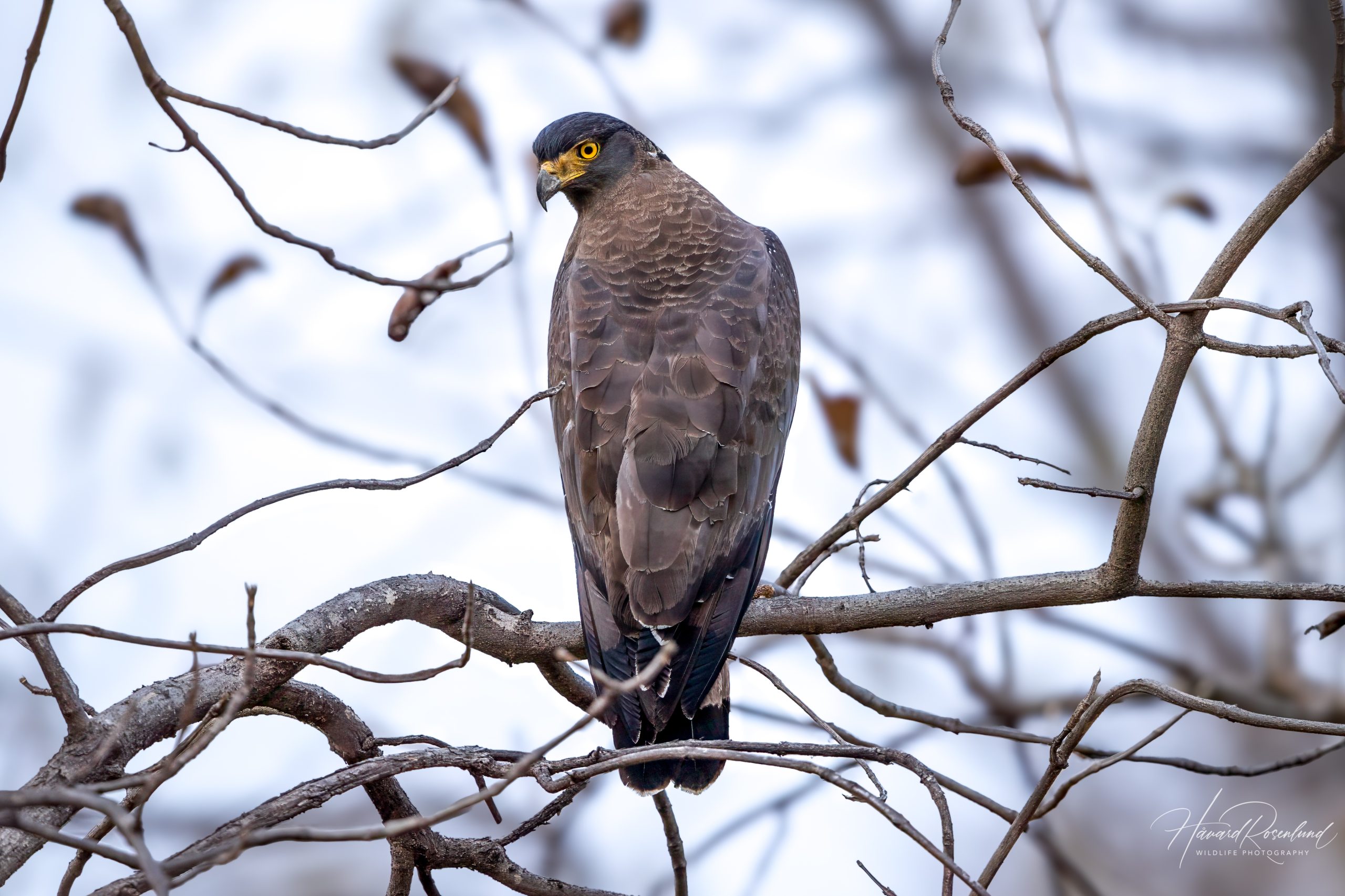
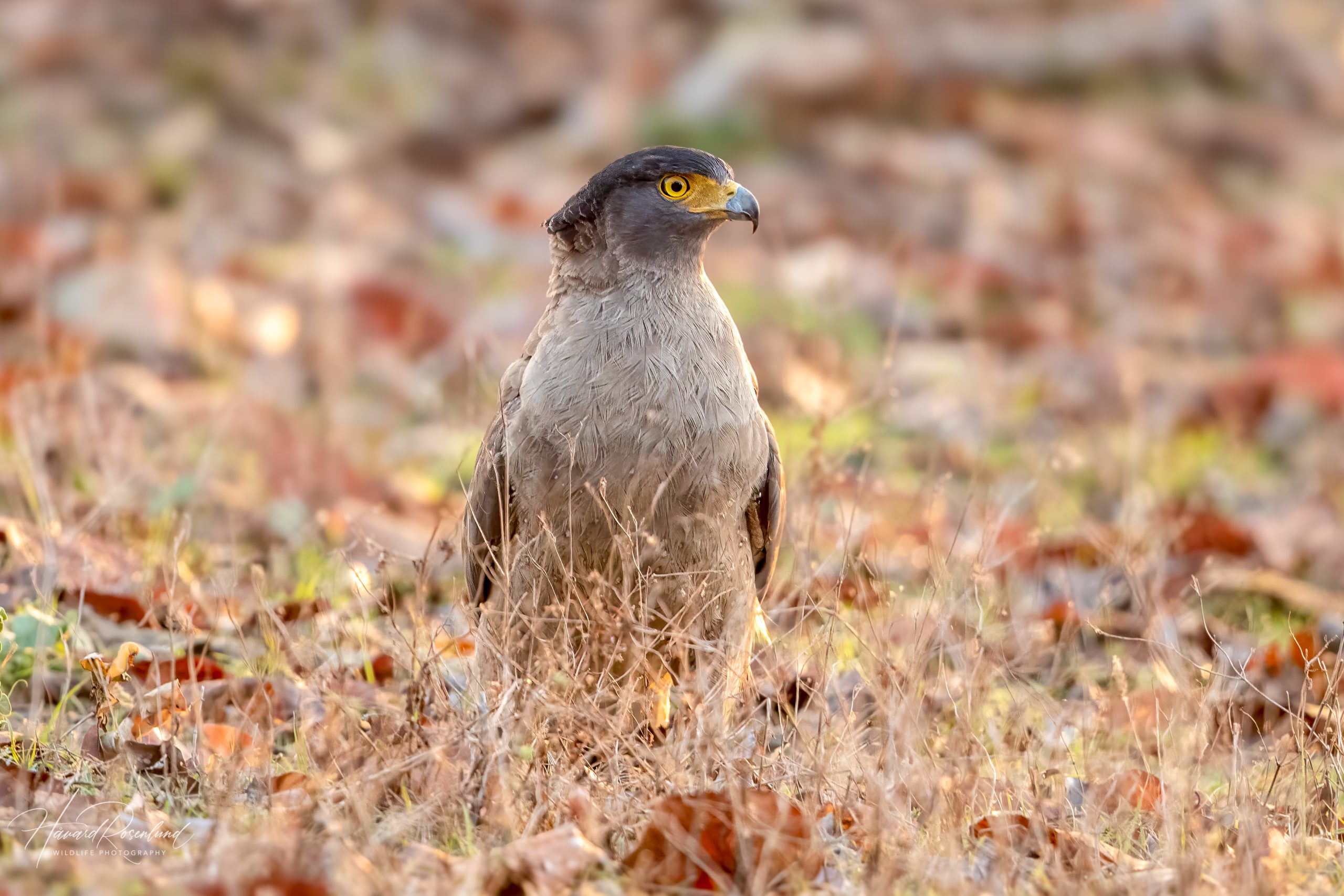
Adults are dark brown with a blackish, white-tipped crest, bright yellow bare skin around the eyes and bill, yellow legs, pale spotting below and a conspicuous broad pale band across the tail. A similar band crosses the flight feathers and becomes particularly obvious when the bird circles overhead. Its loud, rising whistle is often the first sign that a serpent-eagle is nearby.
Taxonomy
The crested serpent-eagle is unusually variable across its range. AviList v2025 treats Spilornis cheela as one broad species with 21 subspecies, extending from mainland South and Southeast Asia to numerous islands in the Ryukyu, Sunda and Nicobar groups. Several island forms have been treated as separate species in other recent taxonomies. This broad species treatment therefore encompasses striking geographic variation in both body size and plumage.
The serpent-eagle on Great Nicobar, Spilornis klossi, is nevertheless treated as a separate species. S. cheela thus includes extensive regional variation without combining every serpent-eagle in the region into one species.
Habitat
Crested serpent-eagles are strongly associated with wooded landscapes, from evergreen and moist forest to dry deciduous woodland, forest edges, wooded hills and some plantations. They occur from lowlands to about 3,000 m in the Himalayas and are often seen soaring above the canopy or sitting on exposed branches from which they can watch the ground.
A study published in 2018 from central India associated the species' nest sites with water bodies, dry deciduous forest and evergreen forest. In the Kolli Hills of southern India, a study published in 2012 found nests concentrated in relatively undisturbed riverine forest with large trees. Mature woodland, large nest trees and nearby water are therefore important features of many breeding sites.
Diet
Reptiles form the core of the diet. Snakes are particularly important, but lizards, freshwater turtles and other reptiles are taken together with frogs, birds and small mammals.
The Kolli Hills study recorded 173 feeding observations and found reptiles making up 74% of prey, while birds accounted for 18%. A broader 2018 study of six raptor species in central India also confirmed the species' strong association with reptile prey. The link with snakes is therefore a genuine ecological specialisation rather than simply a feature reflected in the species' name.
Hunting
Crested serpent-eagles spend long periods watching from partly concealed or exposed perches in the outer canopy and along forest edges. From there they scan the ground and surrounding vegetation before dropping rapidly to seize prey, including snakes and lizards on or close to the ground.
The same perch-hunting strategy can be used higher in the vegetation when arboreal reptiles are available, while birds also search while soaring above the forest. The Kolli Hills study recorded 1,237 perching observations and found the eagles especially using the outer canopy of trees along forest edges. This combination of patient lookout hunting and broader aerial searching suits a predator whose reptile prey can be both concealed and unevenly distributed.
Breeding
Breeding timing varies geographically but generally falls in the dry season before the monsoon in much of India. Pairs perform conspicuous soaring displays accompanied by repeated calls. The nest is a stick platform in a large tree, and fresh green leaves may be added to the lining.
The Kolli Hills study, published in 2012, followed 32 active nests from 2005 to 2010. Birds did not construct new nests during the study but renewed or altered old nests, particularly in December, with both sexes taking part. Clutch size was consistently one egg, mean incubation lasted about 41.5 days and the chick remained in the nest for about 64.5 days before fledging. The female performed most of the incubation and kept the chick warm, while the male supplied much of the food.
Status
The crested serpent-eagle is classified as least concern on the IUCN Red List. It has a very large range and remains widespread in India, where State of India's Birds classifies it as a low conservation priority.
The 2025 update estimates an Indian distribution of about 1.22 million km², a long-term decline of roughly 21.3% and a more recent annual decline of about 1.3%. The species is a forest specialist, and continued loss or degradation of mature woodland and riverine forest can reduce local populations.
Image gallery
Loading map and observations…
Have you seen this species?
Independent species archive
Did you find this species page useful?
Wildlife Vagabond is independently built and maintained. Voluntary support helps cover hosting, maps, data storage and continued improvements to the species archive.
Support Wildlife VagabondSpecies content will remain freely available.
References
Information about the species’ global distribution and status is based primarily on global Red List data. See the references below for details.
- BirdLife International. (n.d.). Crested Serpent-Eagle species factsheet. https://datazone.birdlife.org/species/factsheet/crested-serpent-eagle-spilornis-cheela
- Cornell Lab of Ornithology – eBird Status and Trends. (n.d.). Crested Serpent-Eagle. https://science.ebird.org/status-and-trends/species/crseag1/range-map
- Gokula, V. (2012). Breeding ecology of the crested serpent eagle Spilornis cheela (Latham, 1790) (Aves: Accipitriformes: Accipitridae) in Kolli hills, Tamil Nadu, India. TAPROBANICA: The Journal of Asian Biodiversity, 4(2), 77. https://doi.org/10.4038/tapro.v4i2.5059
- International Union for Conservation of Nature. (n.d.). Crested Serpent-Eagle. The IUCN Red List of Threatened Species. https://www.iucnredlist.org/species/22695293/95221642
- Pande, S., Yosef, R., Morelli, F., Pawar, R., & Mone, R. (2018). Diet and habitat affinities in six raptor species in India. Avian Research, 9(1), 36. https://doi.org/10.1186/s40657-018-0129-2
- State of India's Birds. (2025). Crested Serpent Eagle. https://stateofindiasbirds.in/species/crseag1/