
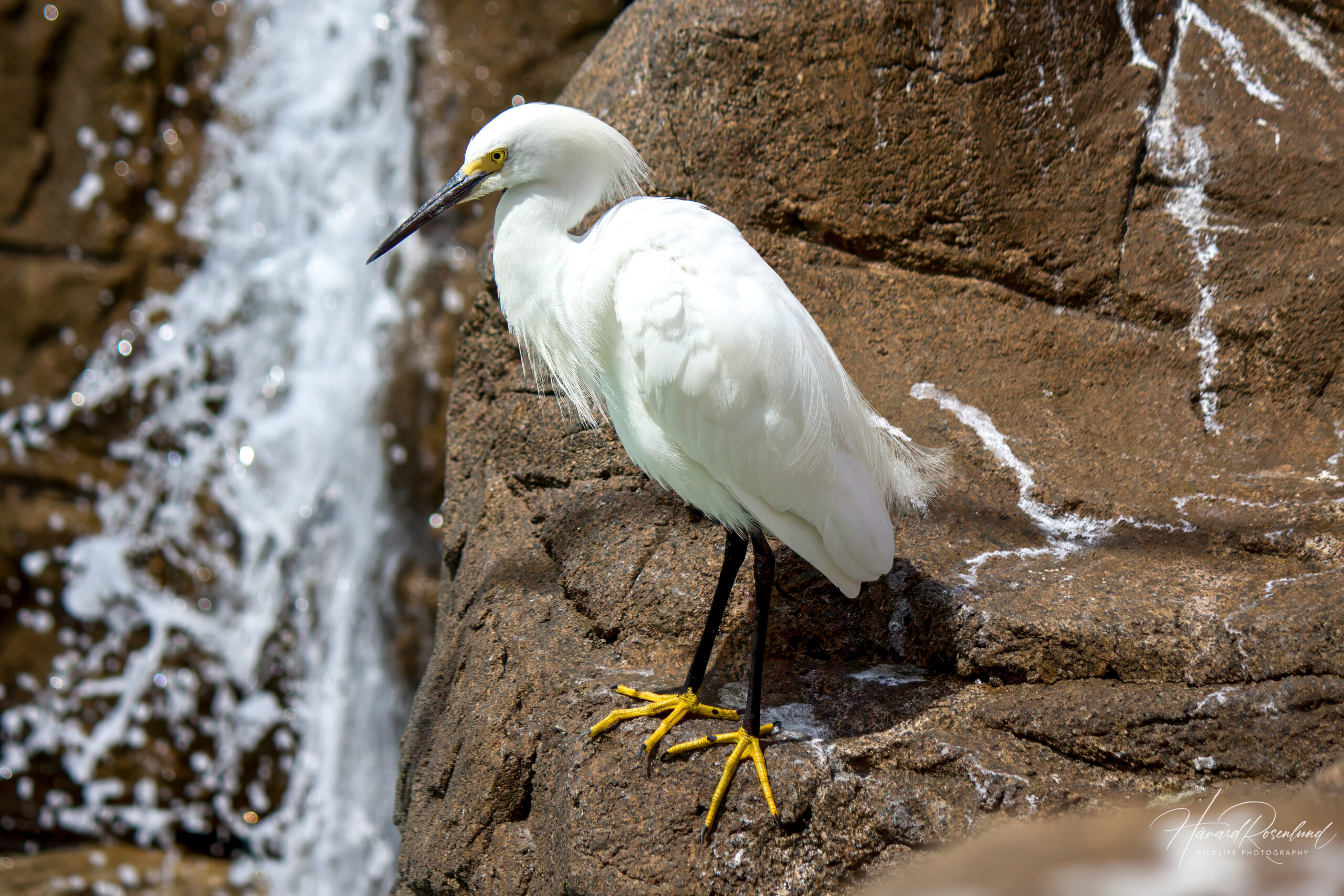
Snowy Egret
Egretta thula
At a glance
Habitat
- Shallow coastal and inland wetlands, especially saltmarshes, tidal flats, mangroves, lagoons and marsh pools
Diet
- Mostly small fish, crustaceans and aquatic insects, with frogs, worms and other small aquatic animals
Activity
- Diurnal
Size
- Length: 56–66 cm Weight: About 370 g
Range
- The Americas, from the United States through the Caribbean and Central America to much of South America
Description
The snowy egret (Egretta thula) is a small, slender white heron of the Americas, 56–66 cm long and weighing about 370 g. Adults have a thin black bill, black legs and conspicuously yellow feet, together with yellow bare skin between the bill and eyes. In breeding condition the facial skin and feet become more intensely coloured and long, delicate plumes develop on the head, neck and back.
It is very similar to the Old World little egret (Egretta garzetta). Snowy egrets usually show brighter yellow lores and several shorter head plumes, while little egrets typically have greyer or greenish lores and two long narrow nape plumes in breeding plumage.
Habitat
Snowy egrets use shallow coastal and inland wetlands, especially saltmarshes, tidal flats, mangroves, estuaries, shallow bays, swamps, marsh pools and lake margins.
They also feed in flooded agricultural fields and temporary wetlands. Shallow water with exposed edges or patches of emergent vegetation is especially useful because it allows the birds to move quickly while disturbing prey.
Diet
The diet is dominated by small aquatic animals, particularly fish, crustaceans and insects. Frogs, worms and other small invertebrates are also taken.
Prey choice changes with habitat and season, and the species readily exploits temporary concentrations of small fish and invertebrates in shrinking pools, tidal channels and flooded fields.
Hunting
Snowy egrets are among the most active hunters in the heron family. Instead of relying only on stand-and-wait feeding, they walk, run and hop through shallow water, flick the wings, sway the head and vibrate the bill to disturb prey.
The bright yellow feet are actively used to paddle the water or probe mud, flushing hidden animals into view before the bird strikes. They may also spread or flick the wings to change light conditions over the water and hover briefly while reaching for prey. This flexible repertoire allows them to exploit prey that more static herons may miss.
Social behaviour
Snowy egrets often feed in loose groups and regularly join ibises, gulls, terns and other herons where prey is concentrated. Their energetic movements can disturb prey for nearby birds, while the activity of other species may reveal areas where food is concentrated.
Outside breeding colonies they may also gather at communal resting sites, although individuals often keep some distance from one another while actively hunting.
Migration
Movement patterns vary across the range. Many birds breeding in the United States migrate south after breeding, while populations in warmer parts of the Caribbean, Central America and South America are more resident or make shorter seasonal movements.
Local dispersal also follows changing water levels and food availability, so birds may move rapidly between wetlands as conditions change.
Breeding
Snowy egrets breed colonially, frequently alongside other herons, ibises and spoonbills. Males establish small territories within dense vegetation and perform conspicuous displays before pairing. A common courtship display involves stretching the neck and pointing the bill almost vertically while pumping the body, raising the ornamental plumes and calling; aerial and jumping displays also occur. The male starts the nest and later supplies most of the material while the female does much of the final construction.
Nests are loose platforms in shrubs, trees or dense marsh vegetation. A clutch usually contains two to six pale greenish-blue eggs. Both parents incubate for about 24–25 days and later feed the young. Chicks begin climbing out of the nest and into nearby branches or vegetation after roughly 20–25 days, but are generally not fully capable of flight until around 30 days and remain dependent on their parents beyond that.
Relationship with humans
The long breeding plumes once made snowy egrets one of the major victims of the North American plume trade. Huge numbers were killed in the late nineteenth and early twentieth centuries so the feathers could be used in fashionable hats, causing severe population declines.
Legal protection and changing fashion eventually ended the commercial slaughter and allowed populations to recover. The species became one of the clearest historical examples of how the plume trade helped drive the early bird-conservation movement in North America.
Status
The snowy egret is classified as least concern on the IUCN Red List and remains widespread across the Americas.
Loss and degradation of coastal and inland wetlands can reduce local feeding and breeding habitat, particularly where shallow-water areas and colony sites disappear.
Image gallery
Loading map and observations…
Have you seen this species?
Independent species archive
Did you find this species page useful?
Wildlife Vagabond is independently built and maintained. Voluntary support helps cover hosting, maps, data storage and continued improvements to the species archive.
Support Wildlife VagabondSpecies content will remain freely available.
References
Information about the species’ global distribution and status is based primarily on global Red List data. See the references below for details.
- Avibase. (n.d.). AviList 2025b / Avibase – Snowy Egret (Egretta thula). https://avibase.bsc-eoc.org/species.jsp?avibaseid=AA7901D88E7203E5&lang=EN
- BirdLife International. (n.d.). Snowy Egret species factsheet. https://datazone.birdlife.org/species/factsheet/snowy-egret-egretta-thula
- Cornell Lab of Ornithology. (n.d.). Snowy Egret Life History. https://www.allaboutbirds.org/guide/Snowy_Egret/lifehistory
- International Union for Conservation of Nature. (n.d.). Snowy Egret. The IUCN Red List of Threatened Species. https://www.iucnredlist.org/species/22696974/93595536
- National Audubon Society. (n.d.). Audubon Field Guide – Snowy Egret. https://www.audubon.org/field-guide/bird/snowy-egret