
Cooper’s Hawk
Astur cooperii
At a glance
Habitat
- Woodland, forest edge and increasingly leafy suburbs, parks and urban neighbourhoods
Diet
- Mostly medium-sized birds, supplemented by small mammals and occasional reptiles or insects
Activity
- Diurnal
Size
- Length: 37–45 cm Weight: 220–680 g
Range
- North America, from southern Canada through the United States and Mexico; northern populations migrate south in winter
Description
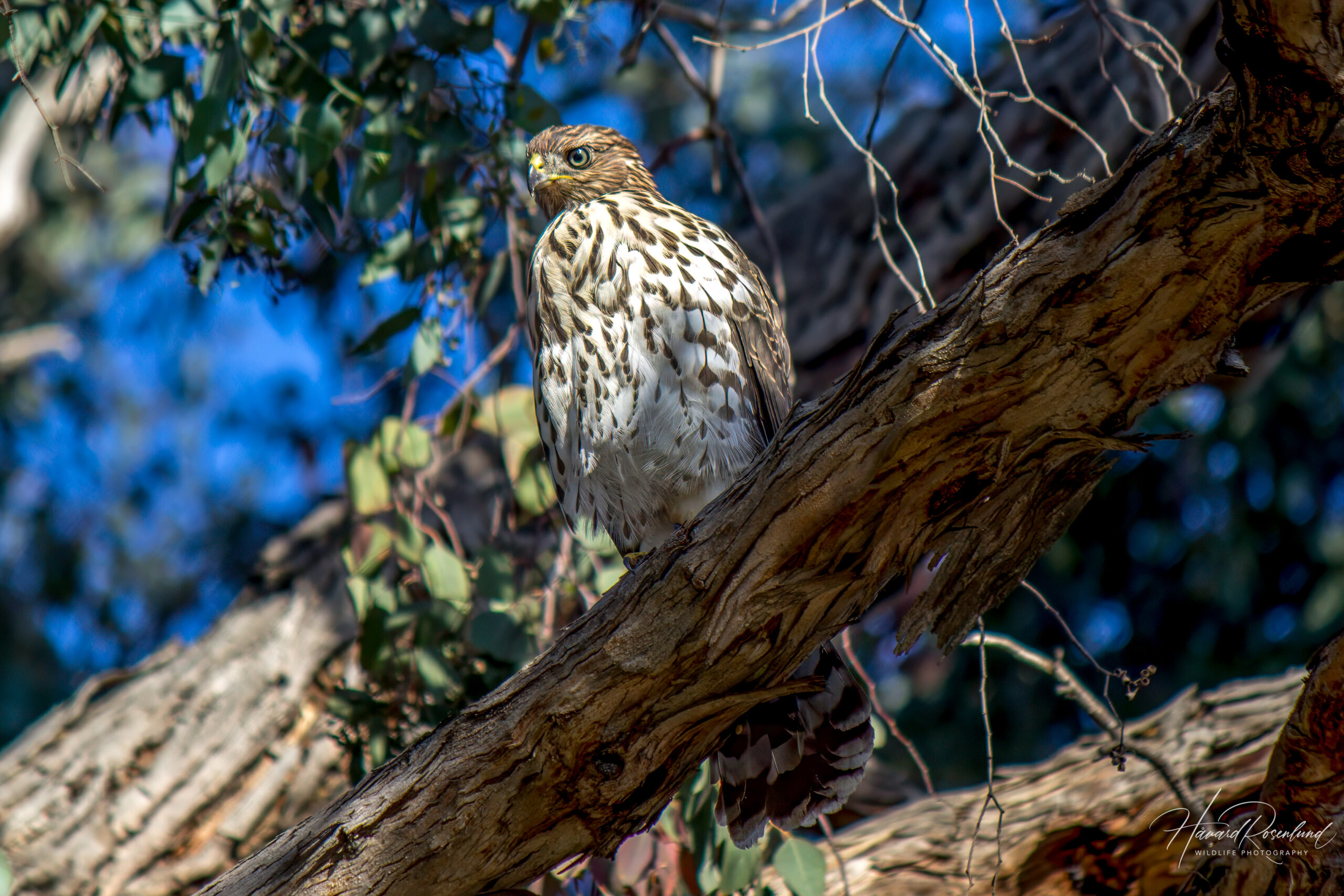
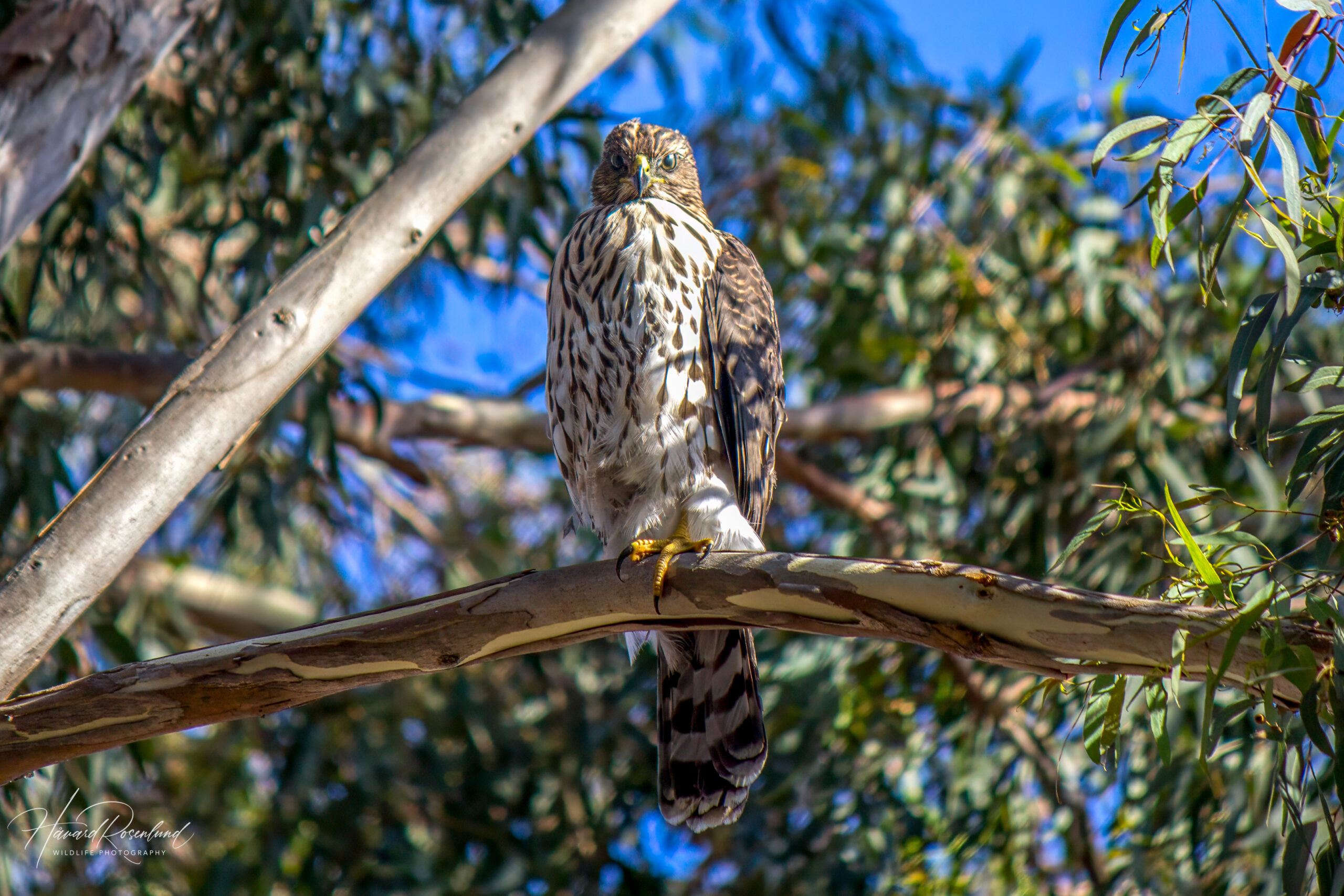
Cooper's hawk (Astur cooperii) is a medium-sized North American woodland hawk with short, rounded wings and a long, rounded tail—an agile build for pursuing prey between trees. Adults are blue-grey above with a dark cap, reddish barring across the underparts and red eyes. Juveniles are brown above with crisp brown streaking on a white breast and yellow eyes.
Females are substantially larger than males. Males are about 37–39 cm long and weigh 220–410 g, while females are roughly 42–45 cm and 330–680 g. The species is often confused with the smaller sharp-shinned hawk, but Cooper's hawks generally have a larger, more projecting head and a more rounded tail with a broad white tip.
Taxonomy
Cooper's hawk was traditionally placed in the large genus Accipiter as Accipiter cooperii. Modern phylogenetic work showed that the old broad Accipiter grouping contained several distinct lineages, and Cooper's hawk is now placed in the resurrected genus Astur.
The current scientific name is therefore Astur cooperii. The older combination remains common in field guides, research papers and older databases, but refers to the same species rather than a former split or subspecies.
Habitat
Cooper's hawks use woodland, forest edge and riparian woodland, but also parks, planted suburbs and urban neighbourhoods with enough mature trees. Nesting cover is important, while gaps, streets, gardens and woodland edges provide space for rapid attacks on prey.
The species has adapted particularly well to many North American towns and cities. Mature street trees can provide nest sites, while abundant pigeons, doves and songbirds create reliable prey populations.
Diet
Birds form most of the diet, ranging from small songbirds to pigeons, doves, jays, woodpeckers and quail. Small mammals such as squirrels, chipmunks, mice and bats are also taken, together with occasional reptiles and insects.
The strong size difference between the sexes affects prey choice. Larger females can regularly handle heavier prey than males, reducing some overlap in the prey used by members of a breeding pair.
Hunting
Cooper's hawks rely on surprise, acceleration and manoeuvrability rather than prolonged pursuit in open air. They fly low through cover, thread rapidly between branches and use the long tail as a rudder during sharp turns.
A bird may approach behind vegetation or a hedge and rise suddenly over the obstacle to surprise prey on the far side. Such high-speed hunting through clutter is risky: healed fractures are unusually frequent in these woodland hawks, a reminder of how physically demanding the hunting style can be.
After a kill, Cooper's hawks may mantle over the prey by spreading their wings to hide it from potential thieves. This behaviour is especially common when crows are nearby.
Migration
Migration varies with latitude. Many Cooper's hawks in southern parts of the range are resident, while birds from Canada and the northern United States move south in autumn and return north in spring.
Migration is therefore partial rather than uniform across the species. Juveniles are especially conspicuous among migrants, and some birds move into urban or more southerly habitats for winter rather than undertaking very long-distance movements.
Breeding
Breeding pairs are monogamous and territorial. Courtship includes slow display flights with deliberate wingbeats and glides, while the male also performs bowing displays to the female. Nests are built high in trees, often in dense woodland. The male does much of the early construction and brings material, while the female increasingly arranges the nest as laying approaches.
A clutch usually contains two to six eggs. Incubation lasts about 30–36 days and is performed mainly by the female while the male supplies food. After hatching, the female stays close to the young at first and the male continues bringing prey. The chicks leave the nest after roughly 27–34 days but remain dependent while their flight and hunting skills develop.
Disease
Trichomoniasis, caused by the protozoan Trichomonas gallinae, can be a major problem for young Cooper's hawks. In Tucson, Arizona, 85% of young examined at urban nests carried the parasite, compared with 9% at nests outside the city, while breeding adults were rarely infected. The disease was an important cause of mortality among urban young.
Doves are important carriers of the parasite and made up 57% of prey delivered to young at urban nests in Tucson, compared with only 4% at rural nests. This provides a direct route for a prey-rich urban environment to create a biological cost for the hawks that exploit it.
Relationship with humans
Cooper's hawks have become conspicuous urban predators in many North American cities. In Tucson, Arizona, an urban breeding population was able to maintain itself without continual immigration from surrounding areas, showing how successfully the species can exploit mature trees and abundant urban prey.
City life also creates hazards. Collisions with windows, vehicles and other human-made objects account for many recorded urban deaths. Backyard bird feeders can indirectly concentrate prey for hawks, even though the hawks themselves are not attracted to the seed.
Status
Cooper's hawk is classified as least concern on the IUCN Red List. Populations recovered strongly after declines in the mid-twentieth century, when shooting and organochlorine pesticides such as DDT affected the species.
The long-term population trend in North America is positive, and Cooper's hawks have expanded successfully into many suburban and urban landscapes where mature trees and abundant prey provide suitable breeding habitat.
Image gallery
Loading map and observations…
Have you seen this species?
Independent species archive
Did you find this species page useful?
Wildlife Vagabond is independently built and maintained. Voluntary support helps cover hosting, maps, data storage and continued improvements to the species archive.
Support Wildlife VagabondSpecies content will remain freely available.
References
Information about the species’ global distribution and status is based primarily on global Red List data. See the references below for details.
- Avibase. (n.d.). AviList 2025 / Avibase – Cooper's Hawk (Astur cooperii), current taxonomy. https://avibase.bsc-eoc.org/species.jsp?avibaseid=EB98812F50A648A1&lang=EN
- BirdLife International. (n.d.). Cooper's Hawk species factsheet. https://datazone.birdlife.org/species/factsheet/coopers-hawk-astur-cooperii
- Boal, C. W., Mannan, R. W., & Hudelson, K. S. (1998). Trichomoniasis in Cooper's hawks from Arizona. Journal of wildlife diseases, 34(3), 590-3. https://doi.org/10.7589/0090-3558-34.3.590
- Cornell Lab of Ornithology. (n.d.). Cooper's Hawk Life History. https://www.allaboutbirds.org/guide/Coopers_Hawk/lifehistory
- Estes, W. A., & Mannan, R. W. (2003). Feeding Behavior of Cooper's Hawks at Urban and Rural Nests in Southeastern Arizona. The Condor, 105(1), 107-116. https://doi.org/10.1093/condor/105.1.107
- International Union for Conservation of Nature. (n.d.). Cooper's Hawk. The IUCN Red List of Threatened Species. https://www.iucnredlist.org/species/22695656/93521264
- Mannan, R. W., Steidl, R. J., & Boal, C. W. (2008). Identifying habitat sinks: a case study of Cooper’s hawks in an urban environment. Urban Ecosystems, 11(2), 141-148. https://doi.org/10.1007/s11252-008-0056-9
- Roth, T. C., & Lima, S. L. (2003). Hunting Behavior and Diet of Cooper's Hawks: An Urban View of the Small-Bird-In-Winter Paradigm. The Condor, 105(3), 474-483. https://doi.org/10.1093/condor/105.3.474