
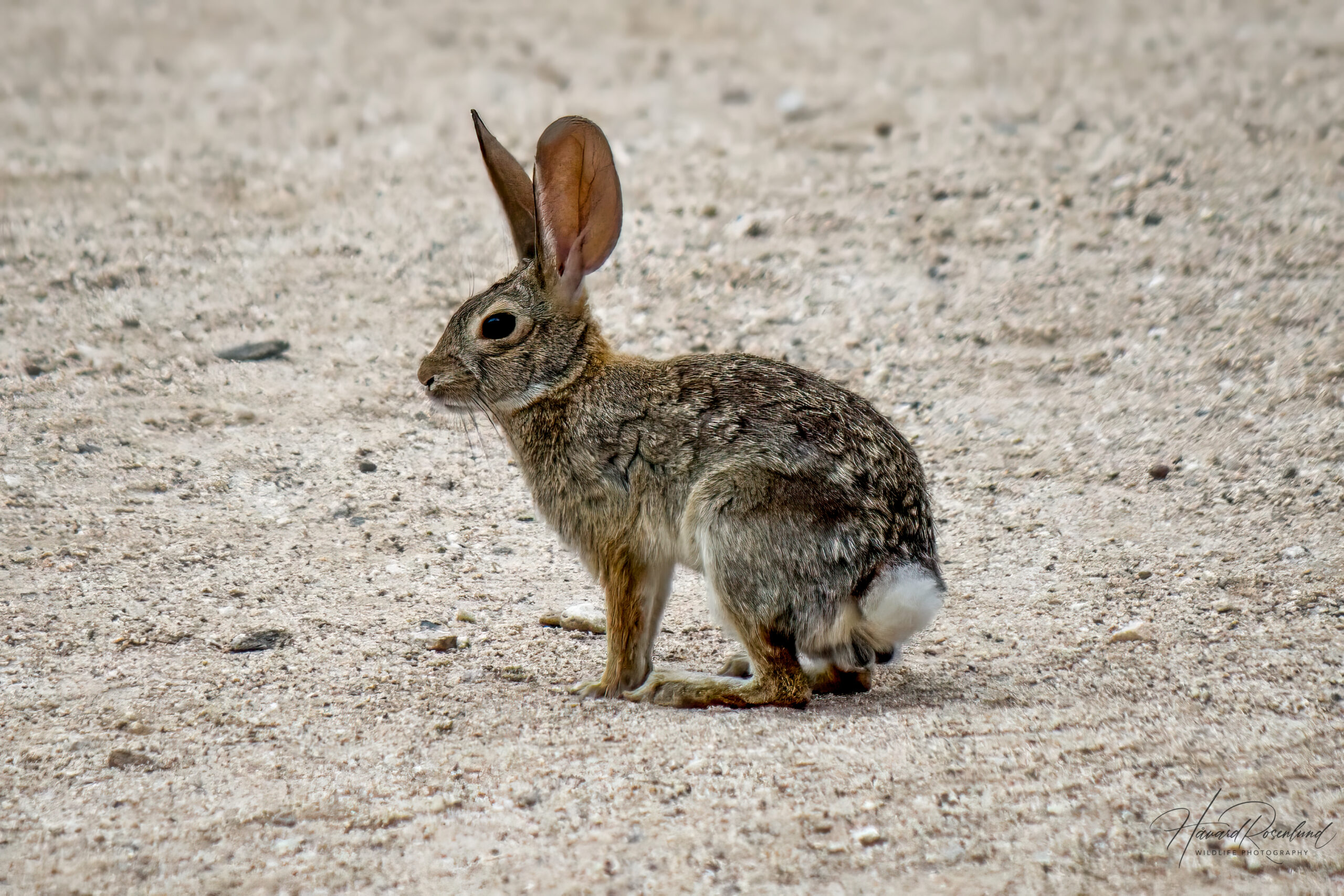
Desert Cottontail
Sylvilagus audubonii
At a glance
Habitat
- Desert scrub, dry grassland, shrubland, riparian cover, pinyon–juniper woodland and urban edges
Diet
- Grasses, herbs, leaves, twigs, bark, flowers and cacti
Activity
- Mostly crepuscular; also nocturnal in hot weather
Size
- Length: about 33–43 cm Weight: roughly 450–1,250 g; occasionally heavier
Range
- Western and central United States south through northern and central Mexico
Description
The desert cottontail or Audubon's cottontail (Sylvilagus audubonii) is a small rabbit of arid and semi-arid western North America. Adults measure about 33–43 cm and commonly weigh roughly 450–1,250 g, although larger individuals occur. Females average slightly larger than males.
The coat is grey-brown above and pale below, often with a warm orange-brown patch on the throat. The ears are relatively long and help release heat, while the short tail has a conspicuous white underside that resembles a ball of cotton when raised.
It resembles the European rabbit (Oryctolagus cuniculus) in general shape but has proportionally longer, more upright ears and does not build permanent communal warrens.
Habitat
Desert cottontails inhabit desert scrub, dry grassland, shrubland, riparian cover, pinyon–juniper woodland and other open habitats with enough brush or grass for concealment. They also use farmland, parks and urban edges. The species occurs from low desert into higher woodland habitats at elevations of about 1,800 m.
Individuals usually rest in shallow depressions beneath vegetation or in burrows made by other animals rather than excavating large permanent burrow systems of their own. Access to shade and dense cover is especially important during hot weather and when escaping predators.
Diet
Desert cottontails are herbivores. They eat grasses, herbs, leaves, twigs, bark, flowers and succulent plants such as cacti. Food choice changes with rainfall and season as fresh growth appears and dries out.
They usually feed in open patches close to cover, nibbling grasses and low plants and switching to tougher leaves, bark, twigs or cacti as fresh vegetation becomes less available. Much of their water comes directly from vegetation and dew, reducing the need to visit exposed drinking sites in dry habitats.
Like other rabbits, desert cottontails practise cecotrophy. Fermentation in the enlarged caecum produces soft, nutrient-rich droppings, called cecotropes, that are re-ingested directly, allowing vitamins, microbial protein and other nutrients to pass through the digestive system a second time. This two-stage use of food is important for extracting nutrients from fibrous plant material and helps rabbits survive on vegetation that can be relatively low in nutritional quality.
Behaviour
Activity is usually greatest around dawn and dusk. During very hot periods desert cottontails rest in shade or below ground during the day and may shift more activity into the night, while cool weather can allow activity at almost any hour.
The species is generally solitary, although home ranges overlap and several animals may gather where food is concentrated. When threatened, a cottontail often freezes first to avoid detection, then dashes towards dense cover in an irregular zigzag. Short bursts of speed can reach roughly 30 km/h.
Reproduction
The mating season is long and varies with latitude, rainfall and food availability. In Arizona it can extend from January into late summer. After a gestation of about 27–30 days, the female digs a shallow nest in the ground, usually about 15–25 cm deep, and lines it with grass and fur before giving birth.
Litters usually contain one to five young, commonly about three. The kits are born blind, nearly hairless and helpless, but develop rapidly and leave the nest after roughly two to three weeks. A female may produce two to six litters in a favourable year, and some young can reach sexual maturity at around three months of age.
Mortality is high and many individuals do not survive their first year. A high reproductive rate is therefore an important part of the species' life history.
Predation
Desert cottontails are important prey for a wide range of predators, including coyotes (Canis latrans), bobcats (Lynx rufus), cougars (Puma concolor), foxes, badgers, birds of prey and large snakes. Domestic cats and dogs can add further predation pressure near settlements.
The combination of frequent breeding, rapid juvenile development and high mortality allows cottontail populations to persist despite heavy predation and makes the species an important link between desert vegetation and many larger predators.
Status
The desert cottontail is classified as least concern on the IUCN Red List, based on the assessment published in 2019. It remains widespread and common across much of the western and central United States and northern and central Mexico, although the assessment indicates that the population is decreasing overall.
Habitat conversion, intensive grazing, road mortality, hunting and predation by free-ranging pets can affect local populations. Rabbit haemorrhagic disease virus 2 has also caused outbreaks among wild lagomorphs in western North America since 2020 and has been detected in desert cottontails. Its long-term population effects remain uncertain.
Image gallery
Loading map and observations…
Have you seen this species?
Independent species archive
Did you find this species page useful?
Wildlife Vagabond is independently built and maintained. Voluntary support helps cover hosting, maps, data storage and continued improvements to the species archive.
Support Wildlife VagabondSpecies content will remain freely available.
References
Information about the species’ global distribution and status is based primarily on global Red List data. See the references below for details.
- Animal Diversity Web. (n.d.). Sylvilagus audubonii: morphology, diet, behaviour and reproduction. https://animaldiversity.org/accounts/Sylvilagus_audubonii/
- Chapman, J. A., & Willner, G. R. (1978). Sylvilagus audubonii. Mammalian Species(106), 1–4. https://doi.org/10.2307/0.106.1
- International Union for Conservation of Nature. (2019). Sylvilagus audubonii. The IUCN Red List of Threatened Species. https://www.iucnredlist.org/species/41297/45190821
- Mammal Diversity Database. (n.d.). Sylvilagus audubonii: current taxonomy and distribution. American Society of Mammalogists. https://www.mammaldiversity.org/taxon/1001124/
- National Park Service. (n.d.). , Organ Pipe Cactus National Monument. Desert cottontail ecology and behaviour. https://www.nps.gov/orpi/learn/nature/other-small-mammals.htm
- National Park Service. (n.d.). , White Sands National Park. Desert Cottontail: identification, habitat, diet and reproduction. https://www.nps.gov/whsa/learn/nature/desert-cottontail.htm
- Ringenberg, J. M., Weir, K., Linder, T., & Lenoch, J. (2024). Detections of Rabbit Hemorrhagic Disease Virus 2 (RHDV2) Following the 2020 Outbreak in Wild Lagomorphs across the Western United States. Viruses, 16(7), 1106. https://doi.org/10.3390/v16071106