
Little Heron
Butorides atricapilla
At a glance
Habitat
- Mangroves, riverbanks, lakes, ponds, marshes, reservoirs and other wetlands with dense waterside cover
Diet
- Small fish, crustaceans, aquatic insects, amphibians and other small aquatic prey
Activity
- Active by day and around dawn and dusk
Size
- Length: 35–48 cm; wingspan 52–60 cm Weight: 130–250 g
Range
- Old World tropics and subtropics, from Africa and the Middle East across South and East Asia to Australasia
Description
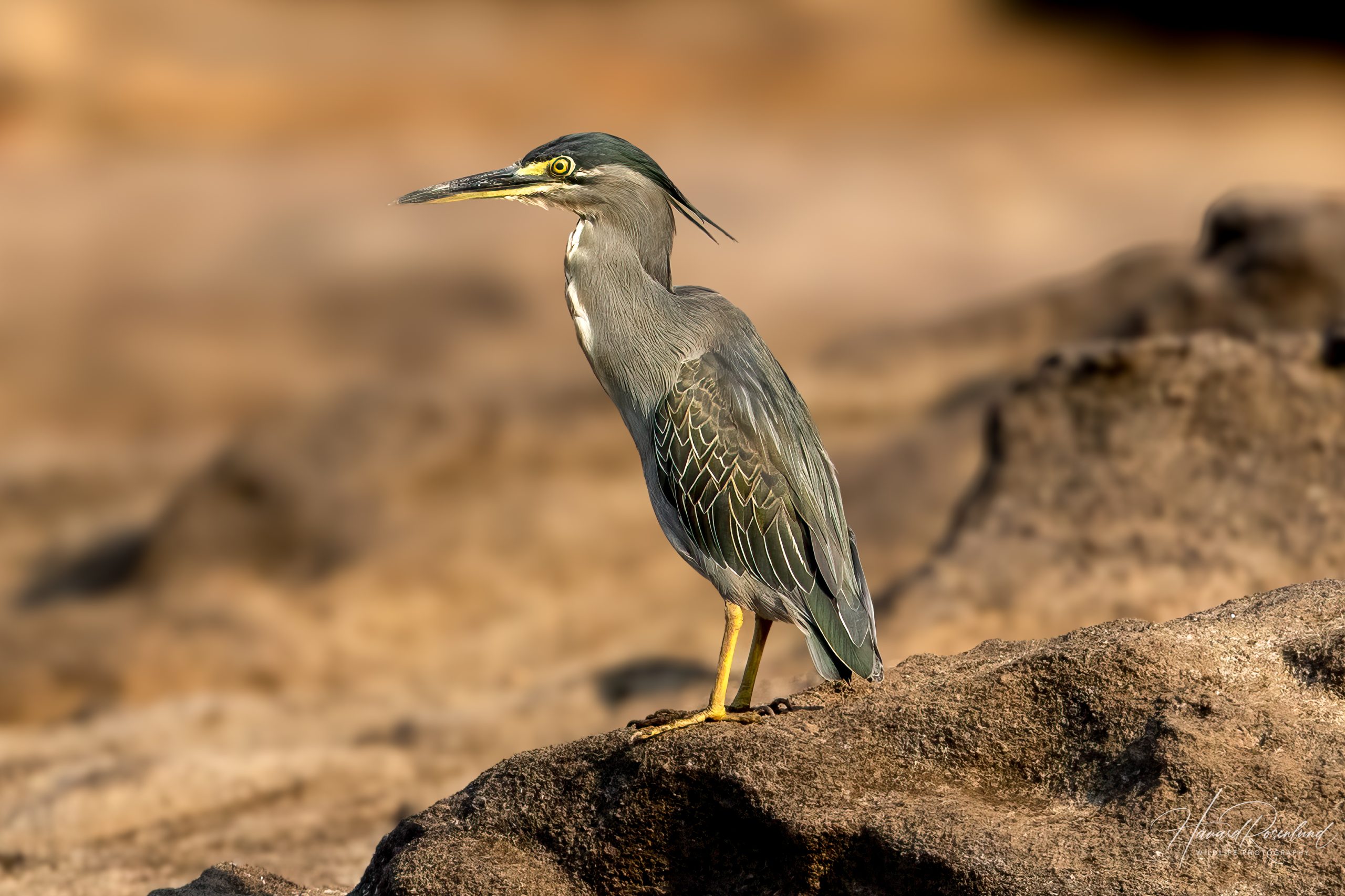
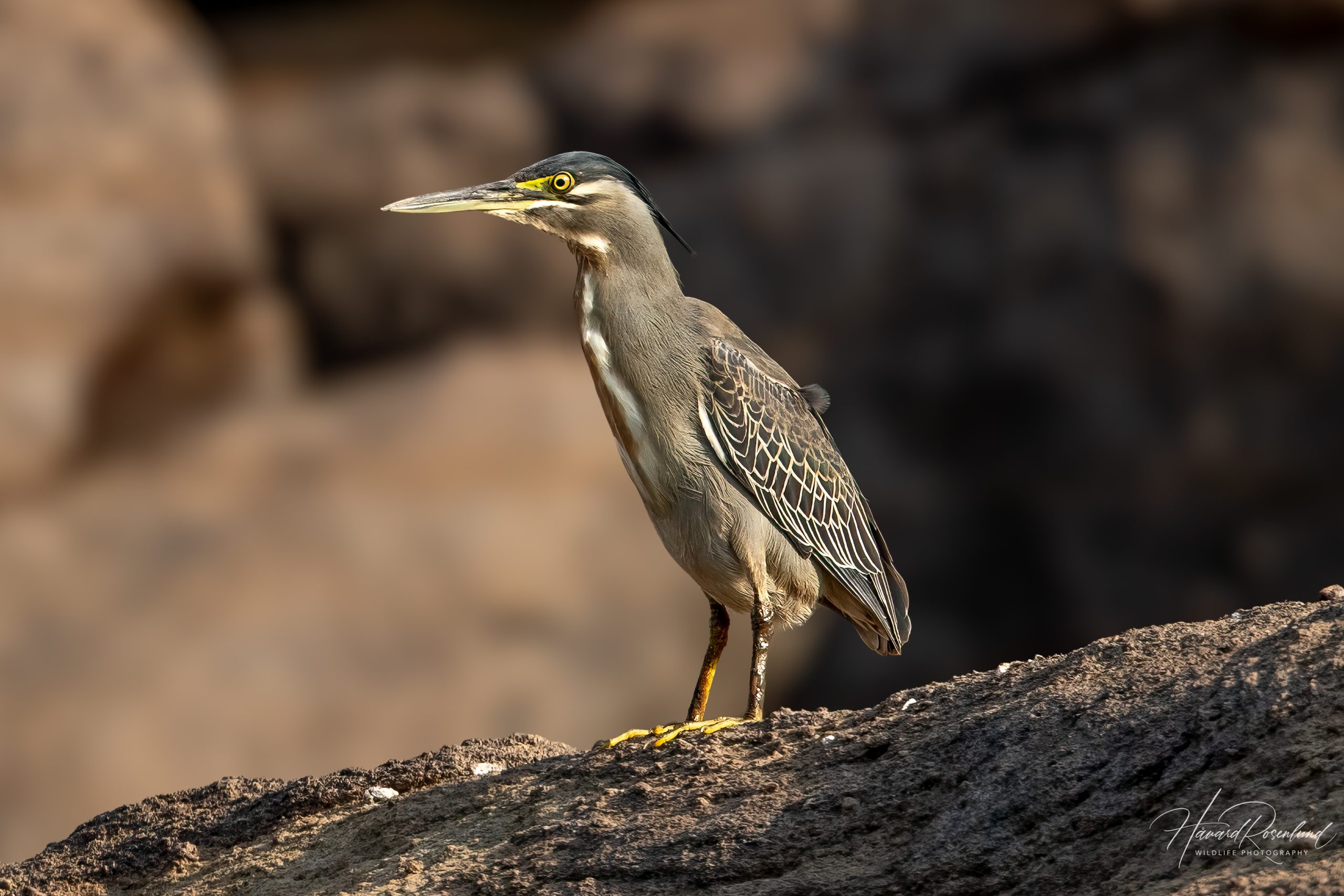
The little heron (Butorides atricapilla) is a small, stocky heron of the Old World tropics and subtropics, measuring about 35–48 cm in length, with a wingspan of roughly 52–60 cm and a mass of around 130–250 g. It has a compact body, relatively short legs, a long pointed bill and a dark crown. Plumage varies substantially across its wide Old World range, but Indian birds typically show dark grey-green upperparts, a darker crown and wings, and a streaked grey-brown to whitish neck and underparts.
It is often seen crouched low beside water, where the neck can appear very short until the bird strikes at prey. Juveniles are browner and more heavily streaked than adults.
Taxonomy
Until 2025, most global checklists treated Butorides striata as a single pantropical species ranging from South America through Africa and Asia to Australasia. AviList and the 2025 eBird/Clements update split this complex into striated heron (B. striata) in South America, lava heron (B. sundevalli) in the Galápagos and little heron (B. atricapilla) across the Old World.
A phylogenetic study published in 2026 analysed thousands of ultraconserved regions of nuclear DNA across Butorides and found a clear biogeographic separation between Old World and New World lineages, supporting the split. The Old World birds formerly called striated heron are therefore part of B. atricapilla. Older field guides, studies and conservation assessments may still use B. striata for these same Asian populations.
Habitat
Little herons use a broad range of freshwater and coastal wetlands, including mangroves, wooded riverbanks, marshes, ponds, lakes, reservoirs, canals and sheltered coastal lagoons. They favour places where dense vegetation, roots, rocks or low branches provide both concealment and hunting perches close to shallow water.
Most birds remain close to cover rather than feeding far out in open water. This allows the species to occupy quite small wetlands, including village ponds and vegetated drainage channels, as long as prey and sheltered edges remain available.
Diet
Small fish are important prey, together with crustaceans, aquatic insects, frogs, tadpoles and other small animals found in shallow water and along muddy margins. The exact balance changes with habitat and local availability.
Hunting
Little herons usually hunt from a low perch or by standing motionless at the water’s edge before extending the neck rapidly to seize prey. They may also walk slowly through shallow water or among exposed roots while watching for movement.
Bait-fishing is also documented in the species. A study published in 1988 in southern Japan found that individual birds used natural and artificial bait to attract fish, with differences in bait use and fishing success linked mainly to the quality of their feeding territories; individual skill also appeared to play a role.
A 2016 observation at a roadside pond in Gujarat documented a bird repeatedly dropping insects onto the water and catching three fish that approached the bait.
Behaviour
Little herons are usually solitary and can be difficult to detect even where they live close to people. They often remain motionless in dense waterside cover and fly low over the water when disturbed, with broad rounded wings and the neck drawn back.
Activity can occur throughout the day but is often pronounced around dawn and dusk, especially in hot climates. Calls are harsh and abrupt and are frequently heard when a bird flushes or moves between feeding areas.
Breeding
Breeding timing varies greatly across the wide Old World range and often follows local rainfall and wetland conditions. Pairs build a small platform of sticks in a tree, shrub, mangrove or dense waterside vegetation, usually above or close to water. The species may nest alone or near other herons.
Clutches usually contain two to five pale blue-green eggs. Both parents incubate for about 19–25 days and feed the young by regurgitation. The chicks hatch poorly developed and remain dependent in and around the nest; they become capable of flight at around five weeks of age.
Status
Under the modern split used on this page, little heron has not yet received a separate IUCN Red List assessment as Butorides atricapilla and is therefore shown here as not evaluated. The older, broader Butorides striata concept that included the Old World populations was assessed as Least Concern.
State of India’s Birds 2025 still uses the older species concept, but the Indian records belong to the population now treated as little heron. The updated estimates show a long-term national decline of about 37.9%, while the current annual estimate is a small decline of about 0.5% with no clear recent direction. The population is classified as Moderate Priority and as a wetland specialist.
Image gallery
Loading map and observations…
Have you seen this species?
Independent species archive
Did you find this species page useful?
Wildlife Vagabond is independently built and maintained. Voluntary support helps cover hosting, maps, data storage and continued improvements to the species archive.
Support Wildlife VagabondSpecies content will remain freely available.
References
Information about the species’ global distribution and status is based primarily on global Red List data. See the references below for details.
- AviList. (n.d.). v2025 – Global avian checklist. https://www.avilist.org/
- BirdLife International. (n.d.). Green-backed/Striated Heron (Butorides striata), broader pre-split IUCN concept. https://datazone.birdlife.org/species/factsheet/green-backed-heron-butorides-striata
- Cornell Lab of Ornithology. (2025). split of Striated Heron into Striated, Lava and Little Herons. https://www.birds.cornell.edu/clementschecklist/updates-and-corrections-october-2025/
- Cornell Lab of Ornithology. (n.d.). eBird/Clements 2025 – Little Heron (Butorides atricapilla) groups. https://www.birds.cornell.edu/clementschecklist/updates-and-corrections-october-2025-page-3/
- Higuchi, H. (1986). Bait‐fishing by the Green‐backed Heron Ardeola striata in Japan. Ibis, 128(2), 285-290. https://doi.org/10.1111/j.1474-919X.1986.tb02677.x
- Higuchi, H. (1988). Individual differences in bait‐fishing by the Green‐backed Heron Ardeola striata associated with territory quality. Ibis, 130(1), 39-44. https://doi.org/10.1111/j.1474-919X.1988.tb00953.x
- International Union for Conservation of Nature. (n.d.). Butorides striata under the broader pre-split concept. The IUCN Red List of Threatened Species. https://www.iucnredlist.org/species/22728182/163804848
- Joshi. (2016). Observation of bait-fishing using insects by Striated Heron. Flamingo, 14(4), 13. https://www.researchgate.net/publication/344407436_Observation_of_bait-fishing_using_insects_by_Striated_Heron
- Macaulay Library, Cornell Lab of Ornithology. (n.d.). Macaulay Library/eBird – Little Heron (Butorides atricapilla). https://media.ebird.org/catalog?taxonCode=strher1&view=grid
- Mendales, E. Z., McCormack, J. E., Castañeda Cepeda, J. S., Dumbacher, J. P., & Chaves, J. A. (2026). Global phylogenetic relationships of Butorides herons (Aves: Ardeidae) reveal the evolutionary history and taxonomic status of the Galápagos Lava Heron. Molecular Phylogenetics and Evolution, 220, 108600. https://doi.org/10.1016/j.ympev.2026.108600
- State of India's Birds. (2025). State of India’s Birds (2025 update) – Striated Heron, representing the Indian population now treated as Little Heron. https://stateofindiasbirds.in/species/strher/