
Red-naped Ibis
Pseudibis papillosa
At a glance
Habitat
- Wetlands, shallow water, wet grassland, fallow fields and other open country; also uses farmland and human-dominated landscapes
Diet
- Insects and other invertebrates, frogs, small reptiles, fish and other small animals; also some plant food
Activity
- Diurnal
Size
- Length: ~60–68 cm Weight: ~1.1 kg
Range
- Indian subcontinent, mainly Pakistan, India and Nepal with more local occurrence eastward
Description
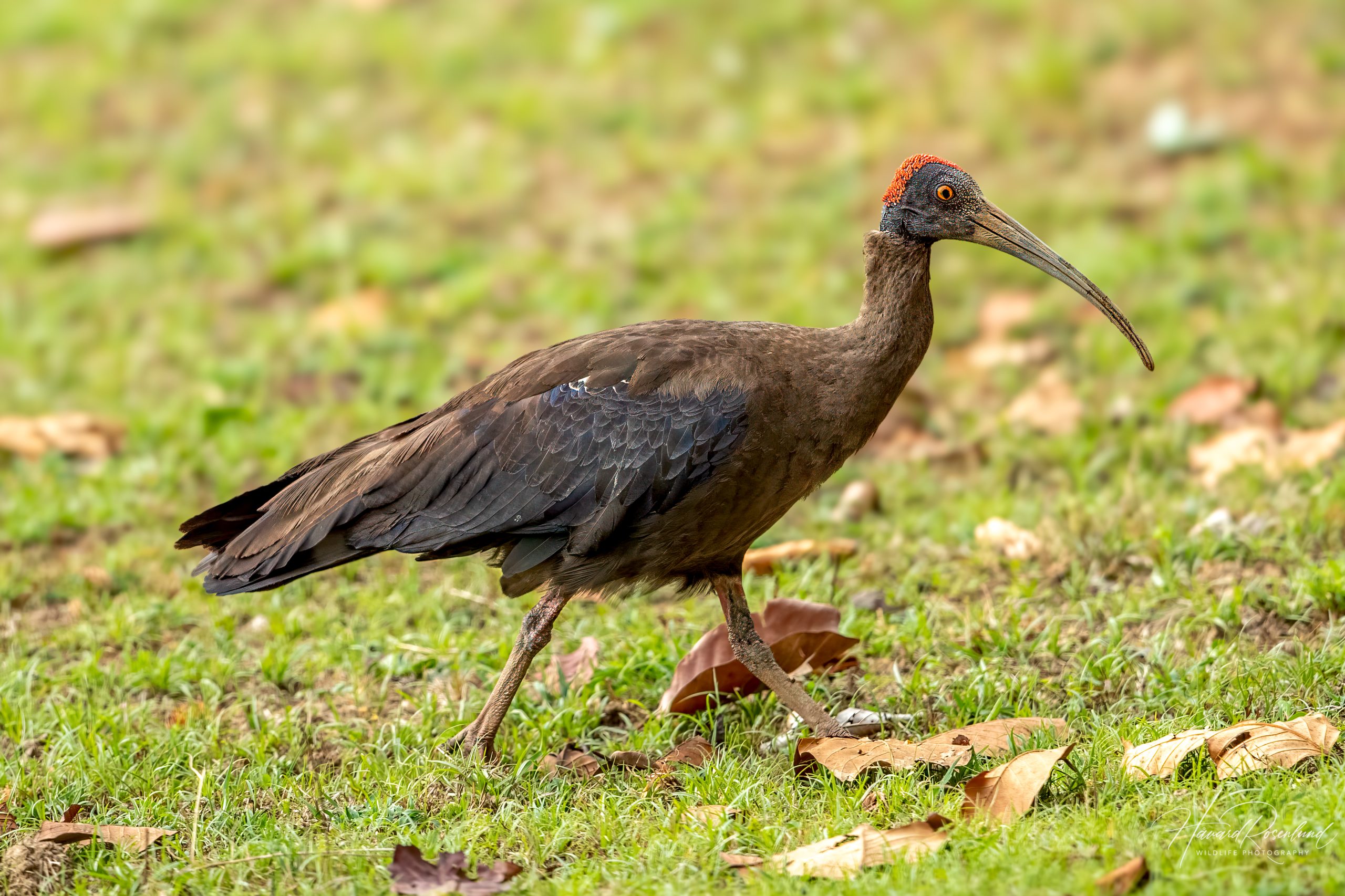
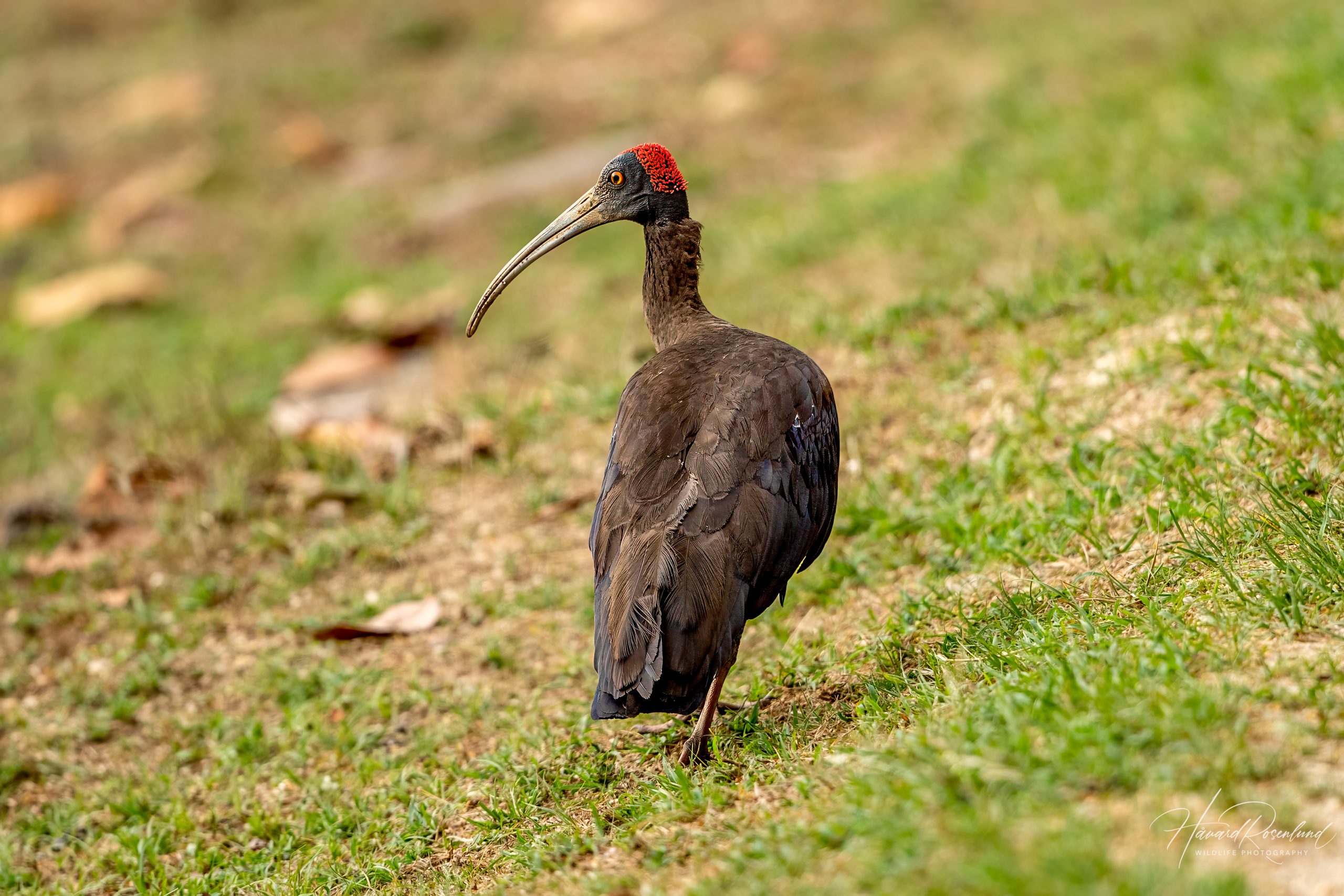
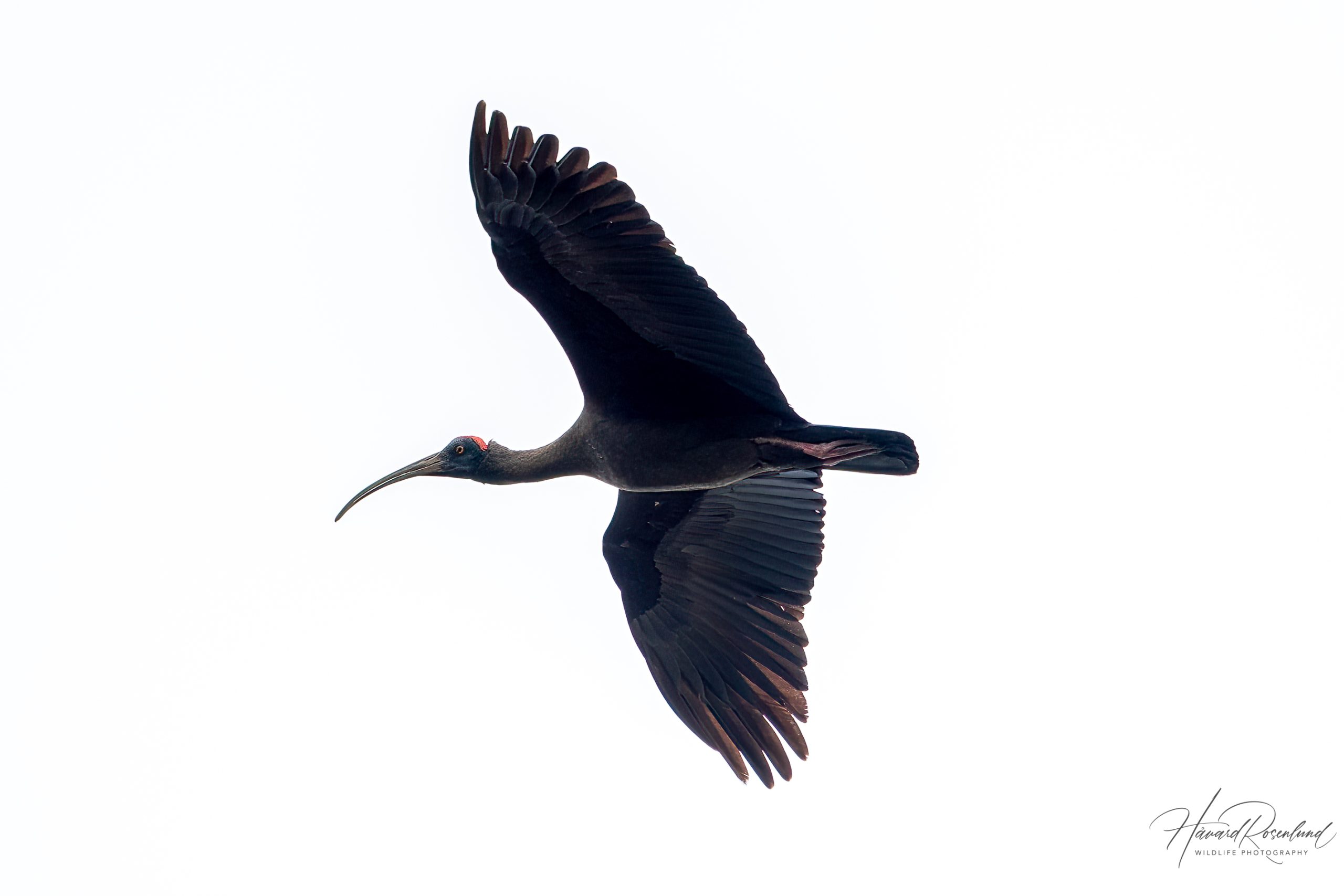
The red-naped ibis (Pseudibis papillosa) is a large, dark ibis native to the Indian subcontinent. Adults are about 60–68 cm long, have a wingspan of roughly 90–115 cm and weigh around 1.1 kg. The body is dark brown to black, the wings show a strong metallic green and purple sheen, and a conspicuous white patch is visible on the shoulder. The long downcurved bill and reddish legs give the bird a typical ibis silhouette.
The most distinctive feature is the bare black head topped by a bright crimson patch of warty skin across the crown and nape. Unlike many other ibises, the species is often found well away from large open water bodies and may be encountered walking through wet grassland, fallow fields and other open country.
Habitat
Red-naped ibises use wetlands, river margins, shallow pools, wet grassland, grazing areas and farmland. A study in Rajasthan found far more ibises throughout the year in landscapes rich in wetlands than in areas dominated by agriculture, showing how important wetlands are even for this flexible species.
Within agricultural landscapes, fallow fields can still be important. In the same study most birds seen away from wetlands were in fallow fields, while none were recorded in standing crops. The combination of wetlands and open feeding ground therefore appears much more valuable than intensive cropland alone.
Diet
The red-naped ibis feeds on insects and other invertebrates, frogs, small reptiles, fish and other small animals, and also takes some seeds and plant material.
Foraging
The long bill is more than a simple pair of forceps. Like other probing ibises, the red-naped ibis has a dense sensory system near the bill tip that can detect tiny vibrations produced by hidden prey in mud or soil. This remote-touch system allows a bird to locate an animal without seeing it directly and helps explain why probing remains effective in opaque water and soft ground.
Birds walk slowly across wet ground, shallow water or open soil and probe repeatedly with the long bill, often sweeping it from side to side while searching beneath the surface. Studies in western India have documented several additional techniques, including probing at different depths, pecking from the surface and dragging or flipping material with the bill.
The species can also exploit unusual feeding sites such as wastewater areas and refuse. There is even a published record of a red-naped ibis feeding on flower nectar, illustrating how broad its opportunistic feeding behaviour can become.
Behaviour
Red-naped ibises are mainly active by day. They often forage alone, in pairs or in small groups, but may gather more densely where food is concentrated. At night they can roost communally in trees or on small islands, so a bird that appears solitary while feeding may still join other ibises at a shared resting site after dusk.
Between bouts of foraging, the birds rest and preen in open areas and move readily between wetlands and nearby dry ground during the day. This combination of solitary or loose daytime activity and communal roosting gives the species a more flexible social pattern than its often isolated appearance suggests.
Breeding
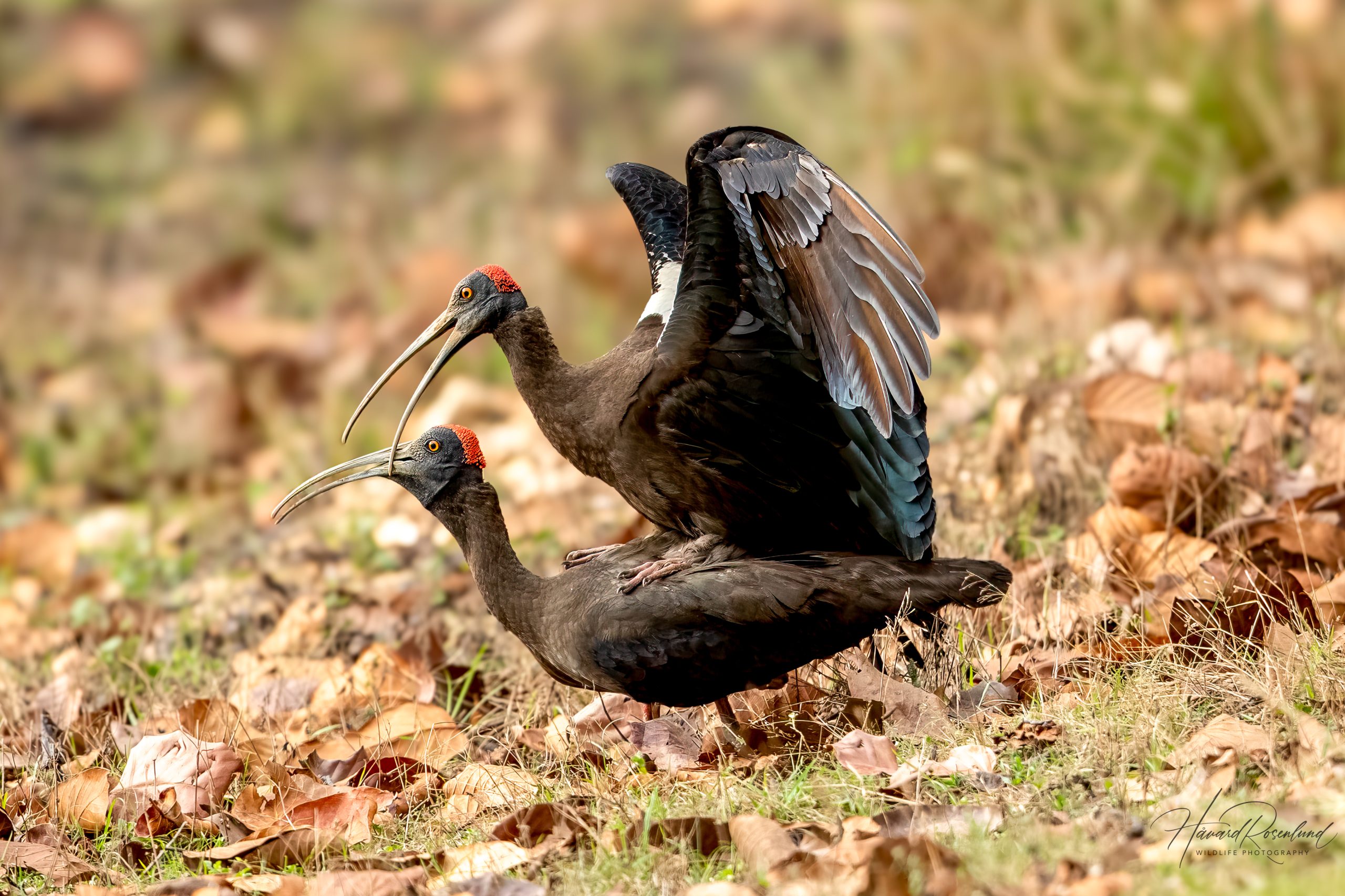
Red-naped ibises usually nest as isolated pairs rather than in large colonies. The nest is a large stick platform high in a tree, often in an open landscape where the adults can fly directly to nearby feeding areas. Clutches are generally small, usually two to four eggs, and both adults take part in nesting duties and care of the young.
A small breeding study published in 2019 followed six nests in agricultural landscapes in Punjab. Breeding activity was recorded from March to November, with most nests found between March and July. In nests where incubation could be followed, it lasted about 30–32 days. Both parents shared incubation and feeding, and the young became capable of flight after around 45–50 days.
A survey of agricultural landscapes in Nepal from 2018 to 2022 recorded 14 nests across eight districts in 2022. More than half were outside protected areas, and large trees were clearly important: silk-cotton trees (Bombax ceiba) held half of the recorded nests and sal (Shorea robusta) almost a third. The average nest tree was over 20 m tall.
The species can also adapt when such trees are scarce. Surveys along a highway in Haryana in 2023 found nests on 26 electricity pylons and one mobile-phone tower, generally 15–20 m above the ground. This shows considerable flexibility, while large trees remain important natural nesting sites.
Status
The red-naped ibis is classified as least concern on the IUCN Red List. It is endemic to the Indian subcontinent and remains widespread, although abundance varies considerably between landscapes and the species is much less numerous in some neighbouring countries than in India.
In India the population has increased strongly over the long term, while the trend in recent years has been approximately stable. The species is therefore doing well across much of the country, but wetlands and large nesting trees remain important parts of its habitat.
Image gallery
Loading map and observations…
Have you seen this species?
Independent species archive
Did you find this species page useful?
Wildlife Vagabond is independently built and maintained. Voluntary support helps cover hosting, maps, data storage and continued improvements to the species archive.
Support Wildlife VagabondSpecies content will remain freely available.
References
Information about the species’ global distribution and status is based primarily on global Red List data. See the references below for details.
- Ameta, H., Koli, V. K., Kittur, S., & Sundar, K. S. G. (2022). Is the Red-naped Ibis Pseudibis papillosa a waterbird? Distribution, abundance and habitat use in landscapes with two different dominant land uses in Udaipur district, Rajasthan, India. SIS Conservation, 4, 30–39. https://storkibisspoonbill.org/publications/sis-conservation-issue-4/
- Asawra, K., & Koli, V. K. (2025). Foraging strategies of three co-occurring ibis species (Black-headed, Glossy and Red-naped) in a semi-arid landscape of western India. Avian Biology Research, 18(1), 12-20. https://doi.org/10.1177/17581559251314345
- BirdLife International. (n.d.). Red-naped Ibis species factsheet. https://datazone.birdlife.org/species/factsheet/red-naped-ibis-pseudibis-papillosa
- du Toit, C. J., Chinsamy, A., & Cunningham, S. J. (2022). Comparative morphology and soft tissue histology of the remote‐touch bill‐tip organ in three ibis species of differing foraging ecology. Journal of Anatomy, 241(4), 966-980. https://doi.org/10.1111/joa.13734
- International Union for Conservation of Nature. (n.d.). Red-naped Ibis. The IUCN Red List of Threatened Species. https://www.iucnredlist.org/species/22697528/93619283
- Katuwal & Quan. (2022). Status of the Red-naped Ibis Pseudibis papillosa in agricultural landscapes of Nepal. SIS Conservation, 4, 24–29. https://storkibisspoonbill.org/publications/sis-conservation-issue-4/
- Mittal. (2025). Nesting of red-naped ibis Pseudibis papillosa on power transmission pylons along NH 152, near village Thana, Haryana, India. International Journal of Fauna and Biological Studies 12(2). https://www.faunajournal.com/archives/2025.v12.i2.B.1091/nesting-of-red-naped-ibis-pseudibis-papillosa-on-power-transmission-pylons-along-nh-152-near-village-thana-haryana-india
- Rajesh & Kumar. (2019). Breeding ecology of Black Ibis Pseudibis papillosa in agro ecosystem of Punjab, India. Journal of Experimental Zoology India, 22, 1151–1155. https://connectjournals.com/file_full_text/2996502H_1151-1155.pdf
- State of India's Birds. (2025). 2025 – Red-naped Ibis. https://stateofindiasbirds.in/species/renibi1/
- Tiwary & Sundar. (2022). Spotlight on the Red-naped Ibis Pseudibis papillosa. SIS Conservation, 4, 15–23. https://storkibisspoonbill.org/publications/sis-conservation-issue-4/