
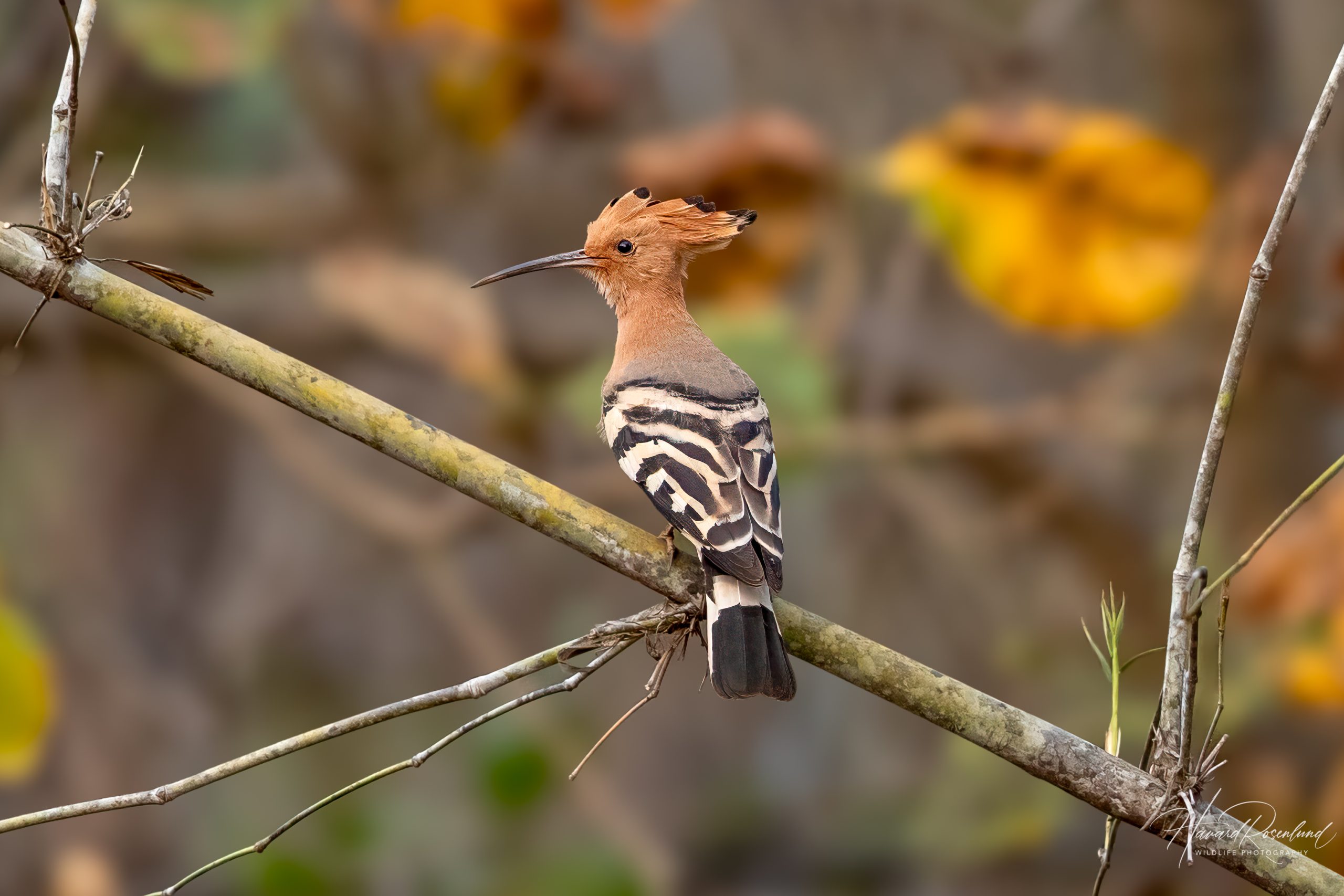
Eurasian Hoopoe
Upupa epops
At a glance
Habitat
- Open woodland, savanna, grassland, orchards, vineyards and farmland
Diet
- Mainly insects and other small invertebrates; occasionally small reptiles and amphibians
Activity
- Diurnal
Size
- Length: 25–32 cm Weight: 55–87 g
Range
- Europe, Asia and North Africa
Description
The Eurasian hoopoe (Upupa epops) is one of the most distinctive birds of Europe and Asia, with a long, slender, slightly downcurved bill, a prominent fan-shaped crest and boldly black-and-white barred wings and tail. The body is warm cinnamon to rusty orange. Adults are about 25–32 cm long, with a wingspan of roughly 44–48 cm, and commonly weigh around 55–87 g.
When the crest is raised, each feather ends in a black tip separated from the cinnamon base by a conspicuous pale band. The African form traditionally treated as African hoopoe (Upupa africana) is generally darker and lacks this clear pale band on the crest feathers.
Taxonomy
Modern global checklists do not all use the same species limits for hoopoes. AviList 2025 treats the African form as Upupa epops africana within a broadly defined Upupa epops, for which it uses the English name Common Hoopoe. The traditional split is retained here, with the African form presented separately as Upupa africana.
The African form is geographically and visually distinctive, but current global authorities do not unanimously recognise it as a separate species from U. epops.
Habitat
Eurasian hoopoes favour open landscapes that combine short vegetation or bare ground for feeding with cavities for nesting. Typical habitats include open woodland, savanna-like country, grassland, orchards, vineyards, pastures, parks and traditional farmland.
Soft or loose soil is especially valuable because much of the food is obtained by probing below the surface. Landscapes with old trees, walls or buildings can remain suitable even when strongly influenced by people, provided both feeding ground and nest cavities are available.
Diet
The diet consists mainly of insects and other small invertebrates, especially beetles, larvae, pupae, crickets and caterpillars. Small reptiles and amphibians are taken occasionally, and small amounts of plant material can also occur.
A study published in 2022 examined gut contents from 20 hoopoes, ten of each sex, in Okara District, Punjab, Pakistan. Beetles and grasshopper larvae dominated, while moth and mole-cricket larvae and seeds of Salvadora persica were also recorded. Food composition did not differ significantly between males and females.
Foraging
Most feeding takes place while walking across bare ground or short vegetation. The long, slightly downcurved bill is pushed into soil, leaf litter and animal dung to locate hidden prey. Food grasped near the narrow bill tip is often tossed backwards into the mouth before being swallowed, while larger items can be beaten or manipulated against the ground.
In parts of southern Europe the hoopoe shows a striking specialisation on buried pupae of the pine processionary moth (Thaumetopoea pityocampa). A study in a black-pine stand in northern Italy published in 2000 estimated that hoopoes took 74.1% of pupae at monitored pupation sites in 1993 and 68.3% in 1994, with predation strongest in the upper soil layers. A 2008 study in pine plantations in south-western France likewise found strong selection for short grass along sandy tracks as feeding habitat, and foraging intensity increased where processionary-moth abundance was higher.
Behaviour
Hoopoes are usually seen alone or in pairs, with family groups sometimes remaining together for a period after breeding. The flight is strongly undulating, and the broad rounded wings give the bird a distinctive butterfly-like appearance. When alert, excited or disturbed, the normally folded crest can be raised into a conspicuous fan and lowered again just as quickly.
The soft, repeated “oop-oop-oop” call carries well across open country and is the source of the English name “hoopoe”. Males use these repeated calls to mark territories and may chase rivals away from feeding and nesting areas.
Migration
Movement varies greatly across the range. Northern populations in Europe and Asia are migratory and move south after breeding, whereas many birds in warmer regions are resident or make shorter seasonal movements. Migrants from Europe and northern Asia winter mainly in Africa, the Middle East and South Asia before returning north in spring.
A multi-sensor tracking study published in 2018 followed five hoopoes breeding in Switzerland and showed that migration was predominantly nocturnal: across individuals, the median share of migratory flight occurring at night was 88%. Every flight lasting more than four hours began in the evening, and 90% of these departures occurred between one hour before and two hours after sunset. Thus a bird that is normally active by day becomes primarily nocturnal during long migratory flights.
Breeding
Breeding timing varies geographically. In European populations it generally begins in April, and the last young usually fledge by August. Hoopoes nest in cavities in trees, cliffs, walls, buildings and other structures, usually with little nest material. A typical clutch contains about seven or eight eggs, although four to twelve have been recorded. The female performs the incubation, which usually lasts about 15–16 days, while the male supplies food. Both parents feed the young after hatching, and the young normally remain in the nest for about 26–29 days.
The nest is famous for its strong smell, but this is more than poor hygiene. Incubating females produce a dark secretion from the uropygial gland that contains symbiotic bacteria producing antimicrobial substances. Females smear this secretion onto the eggs, whose shells contain microscopic crypts that retain it. A 2014 experiment showed that preventing females from using the secretion left the crypts largely unfilled and increased bacterial penetration through the eggshell; the abundance of symbiotic bacteria was also positively associated with hatching success. A study published in 2024 on U. e. longirostris in Hainan, China, likewise found that enterococci isolated from nesting females and nestlings had greater antimicrobial activity than those from non-nesting birds.
Another remarkable aspect of breeding was quantified in a study published in 2022 in Spain and Austria. Because the eggs hatch asynchronously, the youngest chick can be much smaller than its siblings. Females sometimes used a very small last-hatched chick to feed older nestlings, and sibling cannibalism was recorded in 51.7% of the Spanish cases studied but only 5.9% in Austria. The behaviour therefore appears to be a flexible form of brood reduction under particular conditions rather than a universal feature of every hoopoe nest.
Cultural significance
The hoopoe has an unusually prominent place in the cultural history of the Middle East. In the Qur'an, the hoopoe, or hudhud, acts as a messenger and scout for Solomon, bringing him news of the kingdom of Sheba and its queen. The episode became an important motif in later Persian and Arabic literature and tradition.
The species also has modern symbolic importance. In 2008 it was chosen by a public vote as the national bird of Israel, where it is a familiar resident. The species therefore has a long history as a religious, literary and national symbol.
Status
The broader Upupa epops species concept used by the IUCN Red List is classified as least concern. It has a very large range and is not considered globally threatened.
Because the IUCN treatment includes the African form that is presented separately here, the global status is not an independent assessment of the narrower Eurasian form alone. Local populations can nevertheless decline through loss of nesting cavities, intensive pesticide use and simplification of traditional farmland.
Image gallery
Loading map and observations…
Have you seen this species?
Independent species archive
Did you find this species page useful?
Wildlife Vagabond is independently built and maintained. Voluntary support helps cover hosting, maps, data storage and continued improvements to the species archive.
Support Wildlife VagabondSpecies content will remain freely available.
References
Information about the species’ global distribution and status is based primarily on global Red List data. See the references below for details.
- AviList. (n.d.). Upupa epops taxonomy. https://explore.avilist.org/
- Barbaro, L., Couzi, L., Bretagnolle, V., Nezan, J., & Vetillard, F. (2008). Multi-scale habitat selection and foraging ecology of the eurasian hoopoe (Upupa epops) in pine plantations. Biodiversity and Conservation, 17(5), 1073-1087. https://doi.org/10.1007/s10531-007-9241-z
- Battisti, A., Bernardi, M., & Ghiraldo, C. (2000). Predation by the hoopoe (Upupa epops) on pupae of Thaumetopoea pityocampa and the likelyinfluence on other natural enemies. BioControl, 45(3), 311-323. https://doi.org/10.1023/A:1009992321465
- BirdLife International. (n.d.). Common Hoopoe species factsheet. https://datazone.birdlife.org/species/factsheet/common-hoopoe-upupa-epops
- British Trust for Ornithology. (n.d.). BirdFacts – Hoopoe. https://www.bto.org/learn/about-birds/birdfacts/hoopoe
- Encyclopaedia Iranica. (n.d.). Belqis, Solomon and the hoopoe in Islamic tradition. https://www.iranicaonline.org/articles/belqis-the-queen-of-sheba-saba-whose-meetings-with-solomon-solayman-are-a-favorite-theme-in-persian-and-arabic-literat/
- International Union for Conservation of Nature. (n.d.). Upupa epops. The IUCN Red List of Threatened Species. https://www.iucnredlist.org/species/22682655/181836360
- Liechti, F., Bauer, S., Dhanjal-Adams, K. L., Emmenegger, T., Zehtindjiev, P., & Hahn, S. (2018). Miniaturized multi-sensor loggers provide new insight into year-round flight behaviour of small trans-Sahara avian migrants. Movement Ecology, 6(1), 19. https://doi.org/10.1186/s40462-018-0137-1
- Martín‐Vivaldi, M., Soler, J. J., Peralta‐Sánchez, J. M., Arco, L., Martín‐Platero, A. M., Martínez‐Bueno, M., Ruiz‐Rodríguez, M., & Valdivia, E. (2014). Special structures of hoopoe eggshells enhance the adhesion of symbiont‐carrying uropygial secretion that increase hatching success. Journal of Animal Ecology, 83(6), 1289-1301. https://doi.org/10.1111/1365-2656.12243
- Soler, J. J., Barón, M. D., Martínez-Renau, E., Zhang, L., Liang, W., & Martín-Vivaldi, M. (2024). Nesting hoopoes cultivate in their uropygial gland the microbial symbionts with the highest antimicrobial capacity. Scientific Reports, 14(1), 30797. https://doi.org/10.1038/s41598-024-81062-1
- Soler, J. J., Martín-Vivaldi, M., Nuhlíčková, S., Ruiz-Castellano, C., Mazorra-Alonso, M., Martínez-Renau, E., Eckenfellner, M., Svetlík, J., & Hoi, H. (2022). Avian sibling cannibalism: Hoopoe mothers regularly use their last hatched nestlings to feed older siblings. Zoological Research, 43(2), 265–274. https://doi.org/10.24272/j.issn.2095-8137.2021.434
- Tahir, R., Zafar, W., Aslam, M. W., Waheed, A., Umar, A., Fatima, S., Javed, T., Liaqat, T., Ditta, A., Ashfaq, M., Zaman, M., Nawaz, A., Khan, T., Wajid, M., & Khan, M. S. (2022). Morphometric parameters and food preference in relation to sex and reference hematological values for from Pakistan. Journal of advanced veterinary and animal research, 9(2), 290-294. https://doi.org/10.5455/javar.2022.i595
- The Knesset. (n.d.). Knesset – Hoopoe as Israel’s national bird. https://m.knesset.gov.il/EN/About/Pages/Exhibit70.aspx