
Indian Grey Hornbill
Ocyceros birostris
At a glance
Habitat
- Deciduous forest, open woodland, thorn scrub, cultivation and wooded urban areas, especially where fruiting trees are abundant
Diet
- Mainly fruit, especially figs; also insects and occasional small vertebrates
Activity
- Diurnal
Size
- Length: 50-61 cm Weight: ca. 375 g
Range
- Indian subcontinent from north-eastern Pakistan and southern Nepal through most of India to north-western Bangladesh
Description
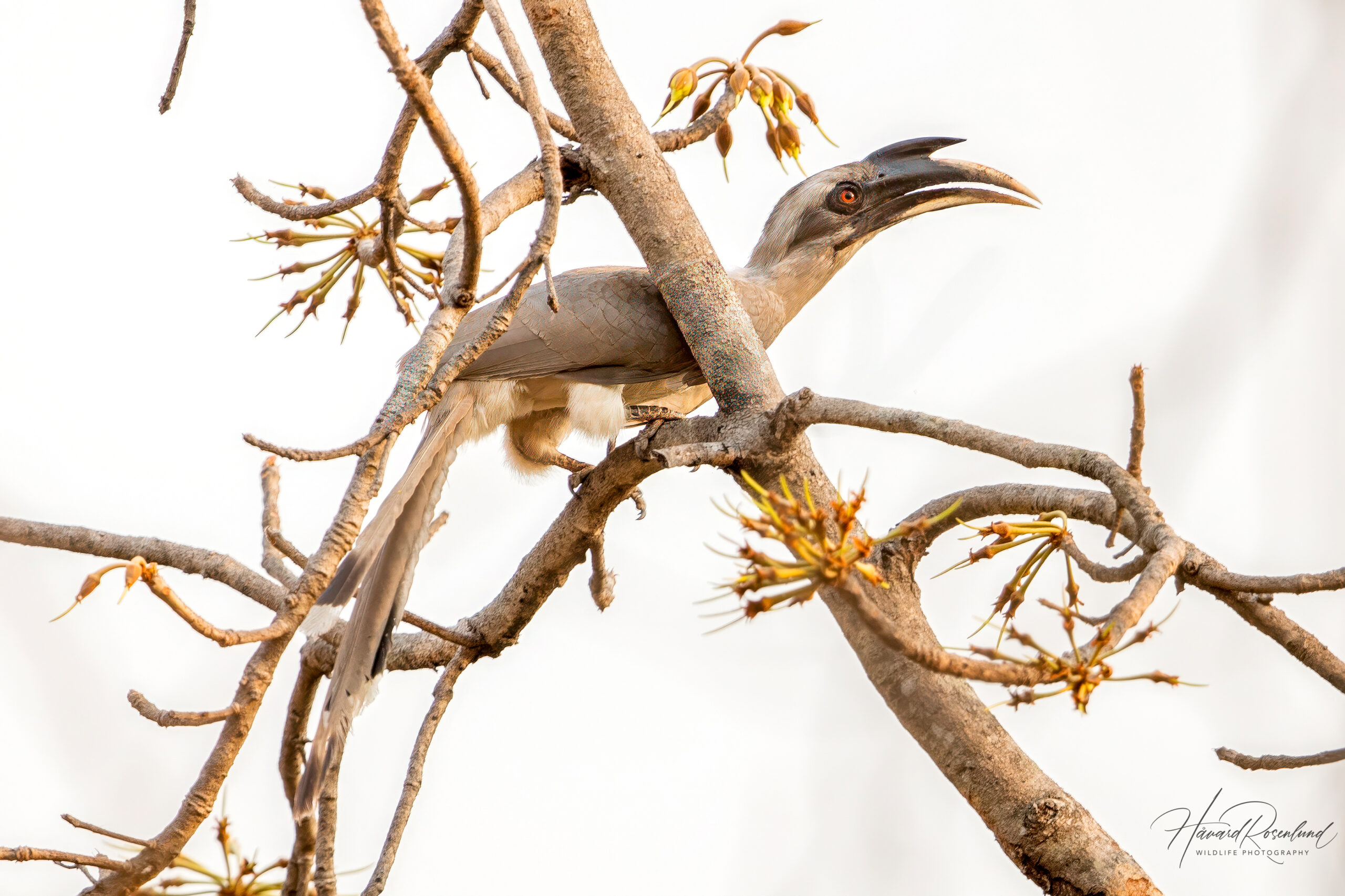
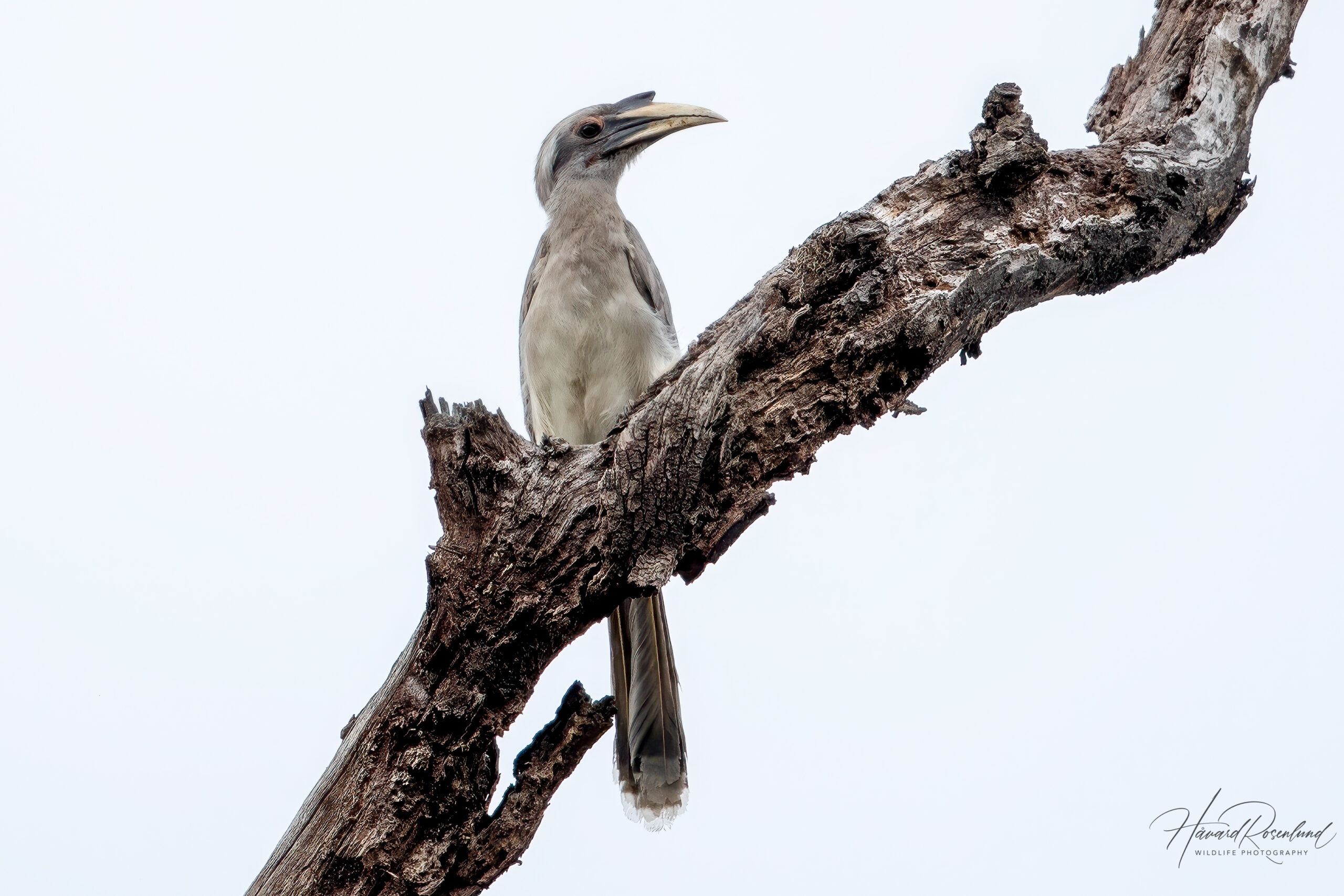
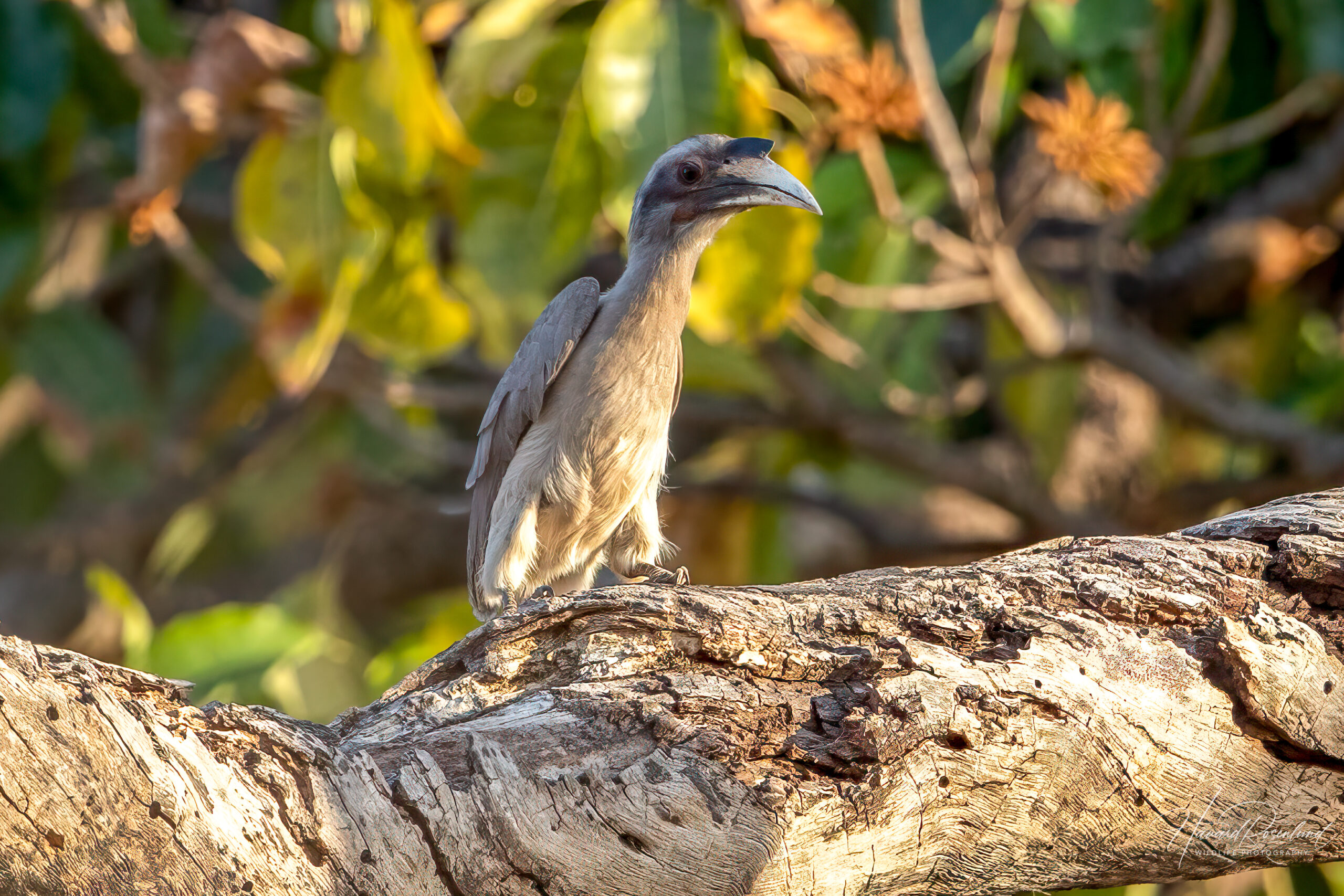
The Indian grey hornbill (Ocyceros birostris) is a medium-sized hornbill of the Indian subcontinent. Adults are about 50–61 cm long and males weigh around 375 g. The plumage is mostly brownish-grey, with a long graduated tail ending in a broad white tip. Males have a larger, narrow black casque with a pointed front and a mostly dark bill, while females are smaller with a reduced casque. Juveniles initially lack the adult casque.
In south-western India it can overlap with the Malabar grey hornbill (Ocyceros griseus). The Indian grey hornbill has a dark bill and more obvious casque, whereas adult Malabar grey hornbills have a yellowish bill and lack a comparable casque. The much larger Malabar pied hornbill (Anthracoceros coronatus) is strongly black and white and is unlikely to be confused at close range.
Habitat
Indian grey hornbills use deciduous forest, open woodland, thorn scrub, orchards, cultivated landscapes, parks and well-wooded towns. They are unusually tolerant of open and human-modified environments for a hornbill and can persist even in large cities where mature trees remain.
Large old trees are nevertheless crucial. Fruiting trees provide much of the food supply, while trees with suitable natural cavities are needed for breeding. A landscape can therefore appear green and still become unsuitable if mature cavity-bearing trees disappear.
Diet
Fruit dominates the diet, with figs especially important, but the species also takes insects and occasional small vertebrates. A detailed study in the Eastern Ghats found fruit to dominate the non-breeding diet, while animal prey became more important when males were provisioning the sealed-in female and growing chicks.
Most food is taken in trees, but birds may descend for fallen fruit or terrestrial prey. The ability to exploit both wild and cultivated fruit helps explain the species' success in orchards, parks and wooded urban areas.
Seed dispersal
Fruit eating makes the Indian grey hornbill an important seed disperser. A study in the Eastern Ghats recovered more than 3,000 intact seeds beneath active nests, representing numerous plant species. In germination trials, seeds of 15 of 16 tested plant species germinated more successfully after passing through hornbills than untreated seeds.
The birds therefore do more than simply consume fruit. By moving seeds between feeding trees and roosting or nesting sites, they can contribute directly to forest regeneration. This role is especially valuable for larger-fruited plants whose seeds may be too large for many smaller birds to transport effectively.
Breeding
Like other hornbills, the Indian grey hornbill has an extraordinary breeding system. The pair uses a natural cavity in a mature tree, after which the female seals herself inside with a mixture of mud, droppings, bark and other material, leaving only a narrow slit. The male then supplies all food through this opening while the female incubates and later cares for the chicks.
Work in urban Nagpur, central India, found females entering the sealed cavity from early March into early April and remaining enclosed for an average of about 65 days. In this species the female normally leaves before the chicks; the opening is then sealed again while the young continue developing inside. The complete nesting cycle in that study averaged about 94 days.
Life inside a sealed cavity also requires unusual nest sanitation. The female can eject droppings forcefully through the narrow opening, while males remove waste near the entrance and may deliver pieces of bark that help absorb material inside the nest. These behaviours allow the family to remain enclosed for weeks while reducing the accumulation of waste.
The breeding system makes old cavity-bearing trees indispensable. Even in cities where food is abundant and the species tolerates people well, removal of mature nest trees can eliminate breeding opportunities.
Status
The Indian grey hornbill is classified as least concern on the IUCN Red List. It has a very large range across the Indian subcontinent and is sufficiently adaptable to occupy both natural and heavily modified habitats.
State of India’s Birds 2025 places the species in the low conservation-priority category. The national long-term estimate shows a rapid increase of about 142%, while the recent annual estimate is about +1.7% and is classified as stable. Local populations still depend on mature fruiting and cavity-bearing trees, but the national picture is currently strongly positive.
Image gallery
Loading map and observations…
Have you seen this species?
Independent species archive
Did you find this species page useful?
Wildlife Vagabond is independently built and maintained. Voluntary support helps cover hosting, maps, data storage and continued improvements to the species archive.
Support Wildlife VagabondSpecies content will remain freely available.
References
Information about the species’ global distribution and status is based primarily on global Red List data. See the references below for details.
- BirdLife International. (n.d.). Indian Grey Hornbill species factsheet. https://datazone.birdlife.org/species/factsheet/indian-grey-hornbill-ocyceros-birostris
- Charde, Kasambe & Tarar. (2011). Breeding behaviour of Indian Grey Hornbill in Central India. https://www.researchgate.net/publication/267548328_BREEDING_BEHAVIOUR_OF_INDIAN_GREY_HORNBILL_IN_CENTRAL_INDIA
- Charde, P., Kasambe, R., Pimplapure, A., & Tarar, J. L. (2011). Nest sanitation in Indian Grey Hornbill in Central India. The Raffles Bulletin of Zoology(Supplement 24), 65–67. https://www.researchgate.net/publication/279757601_NEST_SANITATION_IN_INDIAN_GREY_HORNBILL_IN_CENTRAL_INDIA
- International Union for Conservation of Nature. (n.d.). Indian Grey Hornbill. The IUCN Red List of Threatened Species. https://www.iucnredlist.org/species/22682429/184951065
- IUCN SSC Hornbill Specialist Group. (n.d.). IUCN Hornbill Specialist Group – Indian Grey Hornbill. https://iucnhornbills.org/indian-grey-hornbill-2/
- Santhoshkumar & Balasubramanian. (2010). Breeding behaviour and nest tree use. https://www.biodiversitylibrary.org/part/283628
- Santhoshkumar & Balasubramanian. (2011). Seed dispersal by the Indian Grey Hornbill. https://www.researchgate.net/publication/287762186_Seed_dispersal_by_the_Indian_grey_hornbill_Ocyceros_Birostris_in_Eastern_Ghats_India
- Santhoshkumar & Balasubramanian. (2014). Food habits of Indian Grey Hornbill. https://www.bnhsjournal.in/index.php/bnhs/article/view/71745
- State of India's Birds. (2025). State of India’s Birds 2025 – Indian Grey Hornbill. https://stateofindiasbirds.in/species/inghor2/