
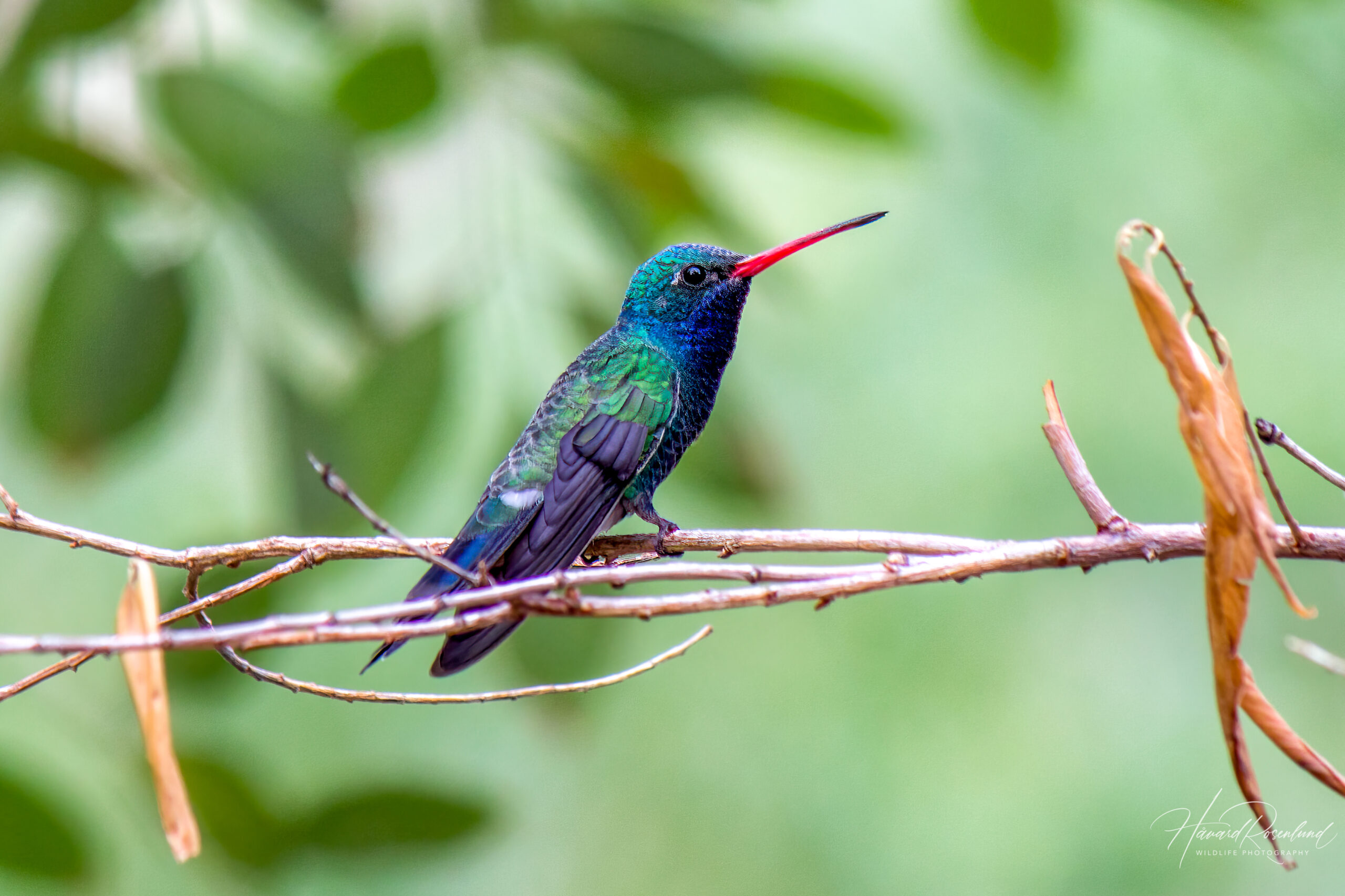
Broad-billed Hummingbird
Cynanthus latirostris
At a glance
Habitat
- Riparian canyons, thorn forest, tropical deciduous forest, desert scrub, gardens and flower-rich mountain habitats
Diet
- Nectar from many flowering plants, supplemented with small insects and spiders
Activity
- Diurnal
Size
- Length: 8–10 cm Weight: 3–4 g
Range
- Mainly Mexico, extending north into southeastern Arizona and southwestern New Mexico during the breeding season
Description
The broad-billed hummingbird (Cynanthus latirostris) is a small, brilliantly coloured hummingbird of Mexico and the southwestern United States. Adults are about 8–10 cm long and weigh only 3–4 g. Males are metallic green with an intense blue throat and a broad red bill tipped in black. Females are greener above and greyish below, with a white line behind the eye and a darker bill.
Most of the population occurs in Mexico. The species reaches the United States mainly in southeastern Arizona and southwestern New Mexico, where it is a characteristic hummingbird of wooded desert canyons and riparian vegetation.
Taxonomy
The limits of the broad-billed hummingbird have changed as isolated populations in the Cynanthus complex have been re-evaluated. Two populations formerly included within C. latirostris are now recognised as separate species: the Tres Marias hummingbird (Cynanthus lawrencei) of the Tres Marías Islands and the turquoise-crowned hummingbird (C. doubledayi) of southwestern Mexico.
The modern concept of C. latirostris therefore has a narrower Mexican range than in many older field guides and distribution accounts. Three subspecies remain within the species as currently defined.
Habitat
Broad-billed hummingbirds occupy a wide range of habitats. In the United States they breed mainly along streams in mountain canyons with sycamores, cottonwoods and willows, generally at lower and middle elevations. In Mexico they occur from lowland thorn forest and tropical deciduous forest to mountain canyons, desert scrub, gardens and other flower-rich habitats.
After breeding, some birds move upslope to follow later flowering plants. The species readily uses human-modified areas where flowering vegetation, trees and suitable nesting cover remain available.
Diet
Nectar is the main energy source. Small insects and spiders provide essential protein and other nutrients, especially for growing young.
Foraging
Broad-billed hummingbirds visit a wide variety of flowers, including agaves, ocotillo, desert willow and many other tubular blooms. The long tongue rapidly collects nectar while the bird hovers or briefly perches near flowers. Small insects and spiders are caught in the air or picked from foliage and spider webs.
Individuals may defend rich flower patches or feeders against other hummingbirds, although the intensity of defence changes with season and food availability.
Not all feeding areas are defended. Birds can also use a repeated circuit between scattered flowers, a strategy known as traplining, revisiting blooms as nectar is replenished.
Migration
Movement patterns vary across the range. Many birds in Mexico are resident or make local and altitudinal movements, while much of the population breeding in the United States moves south after breeding.
Post-breeding birds can also shift upslope or across the landscape to follow flowering peaks before longer-distance movements begin. This combination of migration and shorter seasonal movements helps the species track highly variable nectar resources.
Breeding
The male takes no part in nest building, incubation or chick care. During courtship he hovers in front of a female and repeatedly swings from side to side in a pendulum-like arc, sometimes followed by a steep ascent and chase. Males may also display near one another in small, loose groups.
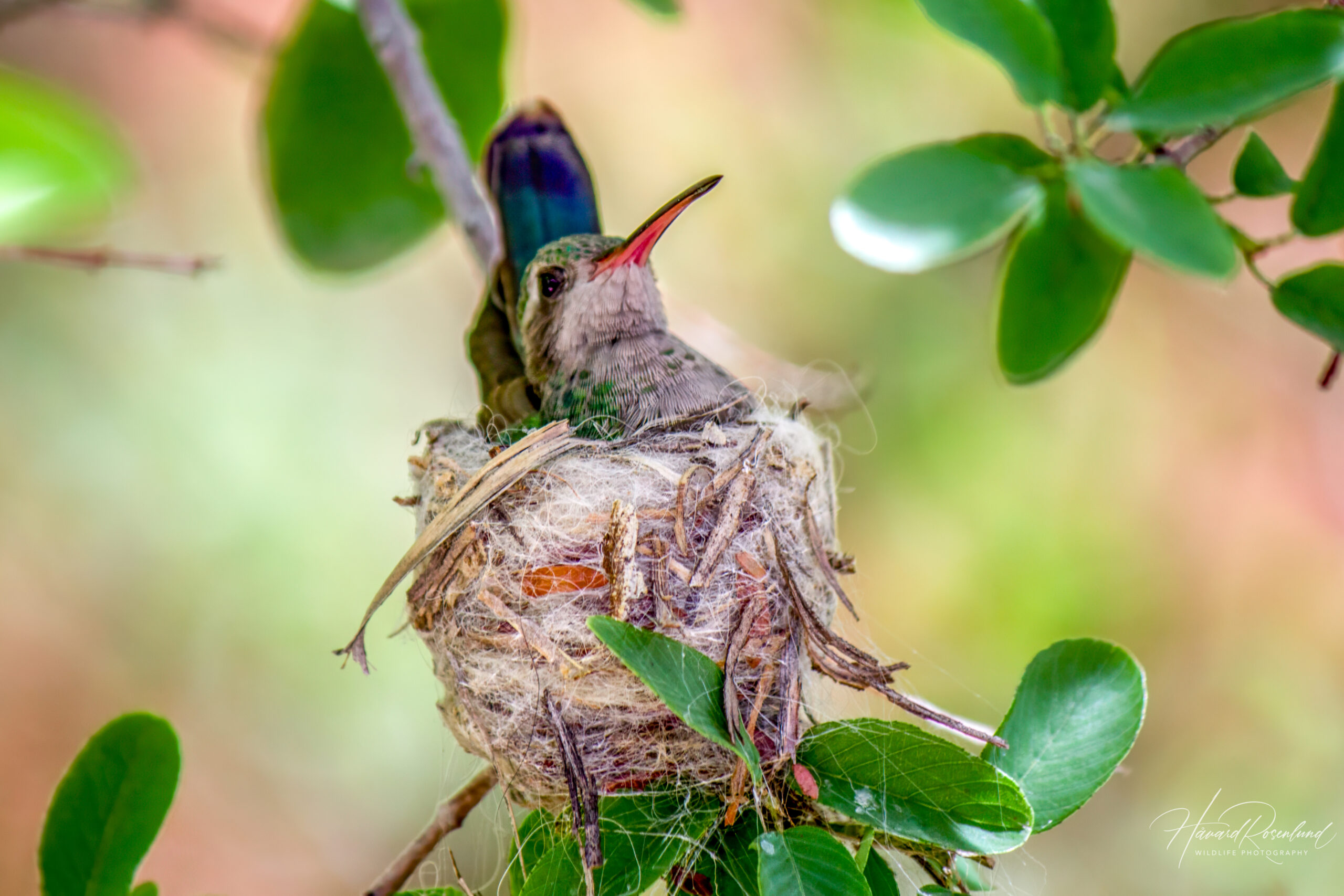
The female selects the nest site and builds a tiny cup from bark strips, grasses and leaves, lining it with soft plant fibres and binding the structure with spider silk. In the United States nests are often placed on thin, downward-hanging branches near streams. Two broods are often attempted in a season there, with nesting activity extending from about mid-April into August.
A clutch normally contains two white eggs, although three has been recorded. The exact incubation period in the wild is poorly documented but is estimated at about 15–19 days. The altricial young remain in the nest for roughly 20–26 days, and field observations indicate that the female may continue feeding them for another 7–14 days after fledging.
Relationship with humans
Broad-billed hummingbirds readily visit gardens and hummingbird feeders within their range. Flower-rich gardens can provide additional feeding opportunities, particularly in towns close to natural canyon and desert vegetation.
Native flowering plants and riparian vegetation provide a wider range of nectar sources and insects than feeders alone, as well as shelter and nesting sites.
Status
The broad-billed hummingbird is classified as least concern on the IUCN Red List. It remains widespread and common across much of Mexico and extends regularly into the southwestern United States.
For 2012–2022, the eBird trend model estimated a range-wide increase of about 16.9%. Riparian vegetation and diverse native flowering habitats remain especially important for breeding and feeding birds.
Image gallery
Loading map and observations…
Have you seen this species?
Independent species archive
Did you find this species page useful?
Wildlife Vagabond is independently built and maintained. Voluntary support helps cover hosting, maps, data storage and continued improvements to the species archive.
Support Wildlife VagabondSpecies content will remain freely available.
References
Information about the species’ global distribution and status is based primarily on global Red List data. See the references below for details.
- Avibase. (n.d.). AviList 2025b / Avibase – Broad-billed Hummingbird (Cynanthus latirostris), current taxonomy. https://avibase.bsc-eoc.org/species.jsp?avibaseid=C29BA98599C519EA&lang=EN
- Avibase. (n.d.). Tres Marias Hummingbird (Cynanthus lawrencei), current taxonomic treatment. https://avibase.bsc-eoc.org/species.jsp?avibaseid=74CFA678
- Avibase. (n.d.). Turquoise-crowned Hummingbird (Cynanthus doubledayi), current taxonomic treatment. https://avibase.bsc-eoc.org/species.jsp?avibaseid=052BEA40
- BirdLife International. (n.d.). Broad-billed Hummingbird species factsheet. https://datazone.birdlife.org/species/factsheet/broad-billed-hummingbird-cynanthus-latirostris
- Cornell Lab of Ornithology. (n.d.). Broad-billed Hummingbird life history. https://www.allaboutbirds.org/guide/Broad-billed_Hummingbird/lifehistory
- eBird. (n.d.). eBird Status and Trends – Broad-billed Hummingbird, 2012–2022 trend. https://science.ebird.org/en/status-and-trends/species/brbhum/trends-map
- International Union for Conservation of Nature. (n.d.). Broad-billed Hummingbird. The IUCN Red List of Threatened Species. https://www.iucnredlist.org/species/22725767/168975036
- Powers, D. R., & Wethington, S. M. (2022). Broad-billed Hummingbird (Cynanthus latirostris). Birds of the World. https://doi.org/10.2173/bow.brbhum.01.2