
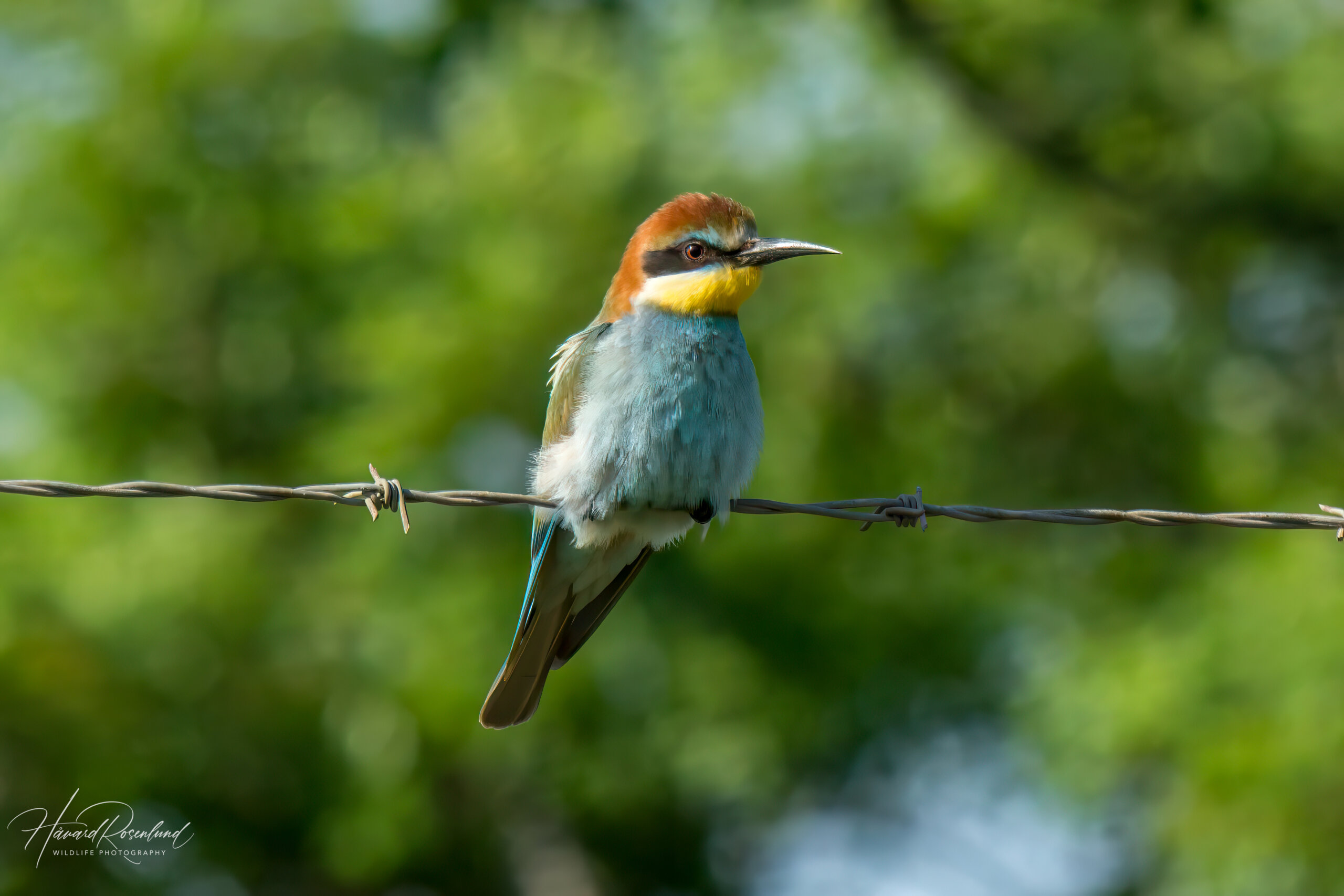
European Bee-eater
Merops apiaster
At a glance
Habitat
- Warm open country, grassland, wetlands, riverbanks, quarries and farmland
Diet
- Flying insects, especially bees, wasps, hornets, dragonflies and beetles
Activity
- Diurnal
Size
- Length: 27–30 cm Weight: 44–78 g
Range
- Breeds in southern and central Europe, North Africa, western and central Asia, and southern Africa; winters mainly in sub-Saharan Africa
Description
The European bee-eater (Merops apiaster) is a colourful, highly social bee-eater with a breeding range stretching from southern and central Europe through North Africa and western and central Asia, together with a separate breeding population in southern Africa. Adults are about 27–30 cm long and usually weigh 44–78 g.
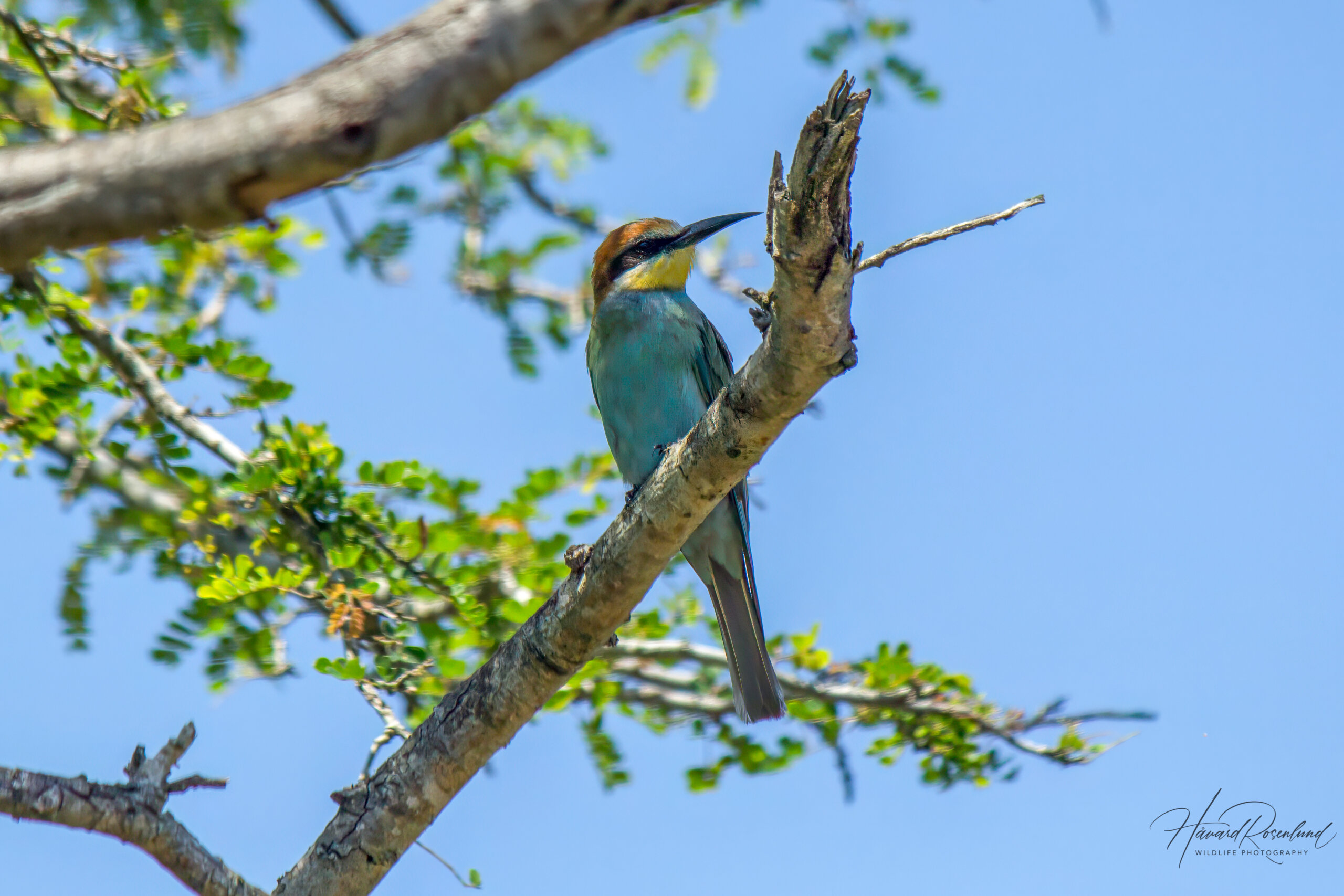
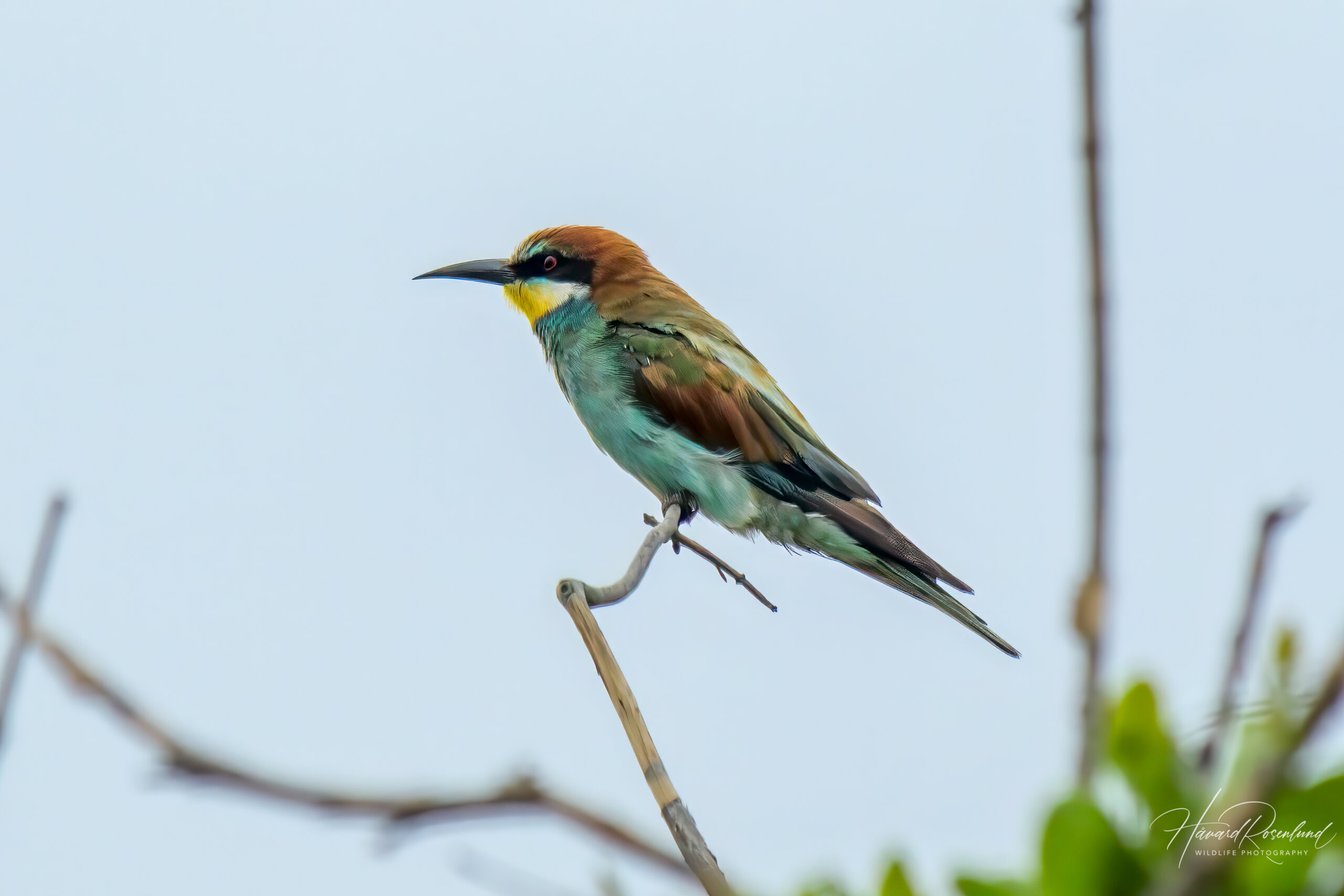
The plumage combines a yellow throat, turquoise underparts, chestnut crown and nape, golden-brown back, green and blue wings, a broad black eye-mask and red irises. Males and females are very similar, although females often show more green on the shoulder coverts. Juveniles are duller and greener above and lack the elongated central tail feathers of adults.
Habitat
European bee-eaters favour warm, open landscapes with abundant flying insects and exposed perches such as trees, fences or wires. Breeding habitat also requires suitable soil for nest tunnels, including sandy or earthen banks, river cuttings, quarries, road embankments and sometimes flat ground.
Colonies are often associated with rivers, wetlands, grassland, farmland and other open areas where both insects and nesting substrates are available. The species has also taken advantage of artificial banks and excavations, although such sites can disappear quickly when land use changes.
Diet
European bee-eaters catch insects in flight, especially bees, wasps and hornets, but also dragonflies, butterflies, beetles and many other large flying insects. A bird often launches from an exposed perch, catches an insect in the air and returns to the same or a nearby perch.
Stinging insects are usually rubbed and struck against the perch before swallowing, which helps remove the sting and discharge venom. European bee-eaters have, for example, been documented preying on the invasive yellow-legged hornet (Vespa velutina) in Europe.
Social behaviour
European bee-eaters are strongly social throughout much of the year. They feed and migrate in flocks and usually breed colonially, with anything from a few neighbouring nests to colonies of more than one hundred pairs.
Pairs are generally monogamous, although occasional polygamy is known. Cooperative breeding also occurs. Some pairs receive help from a non-breeding relative, often a son from an earlier brood or another close male relative, which assists with feeding the chicks. A family group can therefore include more than the breeding pair and their current brood.
Migration
Most European and western Asian breeders are long-distance migrants that cross the Mediterranean and Sahara to spend the non-breeding season in sub-Saharan Africa. Tracking studies reveal strong migratory connectivity: birds from western Europe mainly head towards West Africa, while eastern European populations travel much farther south into eastern and southern Africa.
The separate breeding population in southern Africa follows an almost opposite annual cycle. The first birds return to their southern African breeding grounds from late August through September, and breeding takes place mainly from September to January. After breeding, they begin moving north from late January, with many reaching non-breeding areas farther north in Africa over the following months.
At the same time, European bee-eaters that breed in Europe and Asia move south into southern Africa, with most arriving during September and October. These birds do not breed there; they spend the northern winter in Africa and begin migrating north again in March and April. Birds from the two populations can therefore occur in the same region during part of the year even though one population is breeding while the other is not.
The difference in breeding season is striking. Bee-eaters in Europe and western Asia breed mainly from late spring into summer, roughly from late April to July, whereas the southern African population breeds from September to January. This reduces opportunities for interbreeding even where the populations overlap geographically. It is a form of temporal prezygotic isolation—a reproductive barrier acting before fertilisation—and, together with other differences, could contribute to the populations becoming increasingly genetically distinct over evolutionary time.
Breeding
Breeding seasons differ markedly between populations. In Europe and western Asia, breeding takes place mainly from late spring into summer, roughly from late April to July, whereas the southern African population breeds from September to January.
European bee-eaters excavate long tunnels ending in a nest chamber. Both members of the pair dig, often over several days, and neighbouring pairs may form dense colonies in the same bank. Nest tunnels can extend well over a metre into suitable soil.
Clutches commonly contain about four to seven white eggs. Both parents incubate and feed the young, with incubation lasting roughly three weeks and the chicks remaining in the nest for about a month after hatching. Where helpers are present, they also contribute food.
Because the birds depend on exposed soil faces, a breeding colony can appear quickly when a quarry, road cutting or eroded bank creates suitable habitat—and disappear just as quickly if the bank is flattened, overgrown or disturbed during nesting.
Status
The European bee-eater is listed as Least Concern on the IUCN Red List. The BirdLife assessment published in 2019 estimated a global population of about 18.4–28 million mature individuals, and the species still has an extremely large range.
Local colonies can nevertheless be affected by loss of nesting banks, agricultural intensification, reduced insect abundance and persecution around apiaries. Climate change may create new breeding opportunities farther north while simultaneously altering conditions along migration routes and in African non-breeding areas, so a favourable global status does not mean every population is equally secure.
Image gallery
Loading map and observations…
Have you seen this species?
Independent species archive
Did you find this species page useful?
Wildlife Vagabond is independently built and maintained. Voluntary support helps cover hosting, maps, data storage and continued improvements to the species archive.
Support Wildlife VagabondSpecies content will remain freely available.
References
Information about the species’ global distribution and status is based primarily on global Red List data. See the references below for details.
- Abdul-Wahab, C., Costa, J. S., D’Mello, F., & Häkkinen, H. (2024). Connected impacts: combining migration tracking data with species distribution models reveals the complex potential impacts of climate change on European bee-eaters. Journal of Ornithology, 165(4), 1063-1076. https://doi.org/10.1007/s10336-024-02190-z
- BirdLife International. (n.d.). European Bee-eater Merops apiaster species factsheet. https://datazone.birdlife.org/species/factsheet/european-bee-eater-merops-apiaster
- Brooke, R. K., & Herroelen, P. (1988). The nonbreeding range of southern African-bred European bee-eaters <i>Merops apiaster</i>. Ostrich, 59(2), 63-66. https://doi.org/10.1080/00306525.1988.9633698
- European-African Bird Migration Atlas. (n.d.). Merops apiaster. https://migrationatlas.org/node/1617
- Hahn, S., Alves, J. A., Bedev, K., Costa, J. S., Emmenegger, T., Schulze, M., Tamm, P., Zehtindjiev, P., & Dhanjal‐Adams, K. L. (2020). Range‐wide migration corridors and non‐breeding areas of a northward expanding Afro‐Palaearctic migrant, the European Bee‐eater Merops apiaster. Ibis, 162(2), 345-355. https://doi.org/10.1111/ibi.12752
- International Union for Conservation of Nature. (2019). Merops apiaster. The IUCN Red List of Threatened Species. https://www.iucnredlist.org/species/22683756/155512816
- Onofre, N., Portugal e Castro, M. I., Nave, A., Cadima, I. S. P., Ferreira, M., & Godinho, J. (2023). On the Evidence of the European Bee-Eater (Merops apiaster) as a Predator of the Yellow-Legged Hornet (Vespa velutina) and Its Possible Contribution as a Biocontrol Agent. Animals, 13(12), 1906. https://doi.org/10.3390/ani13121906