
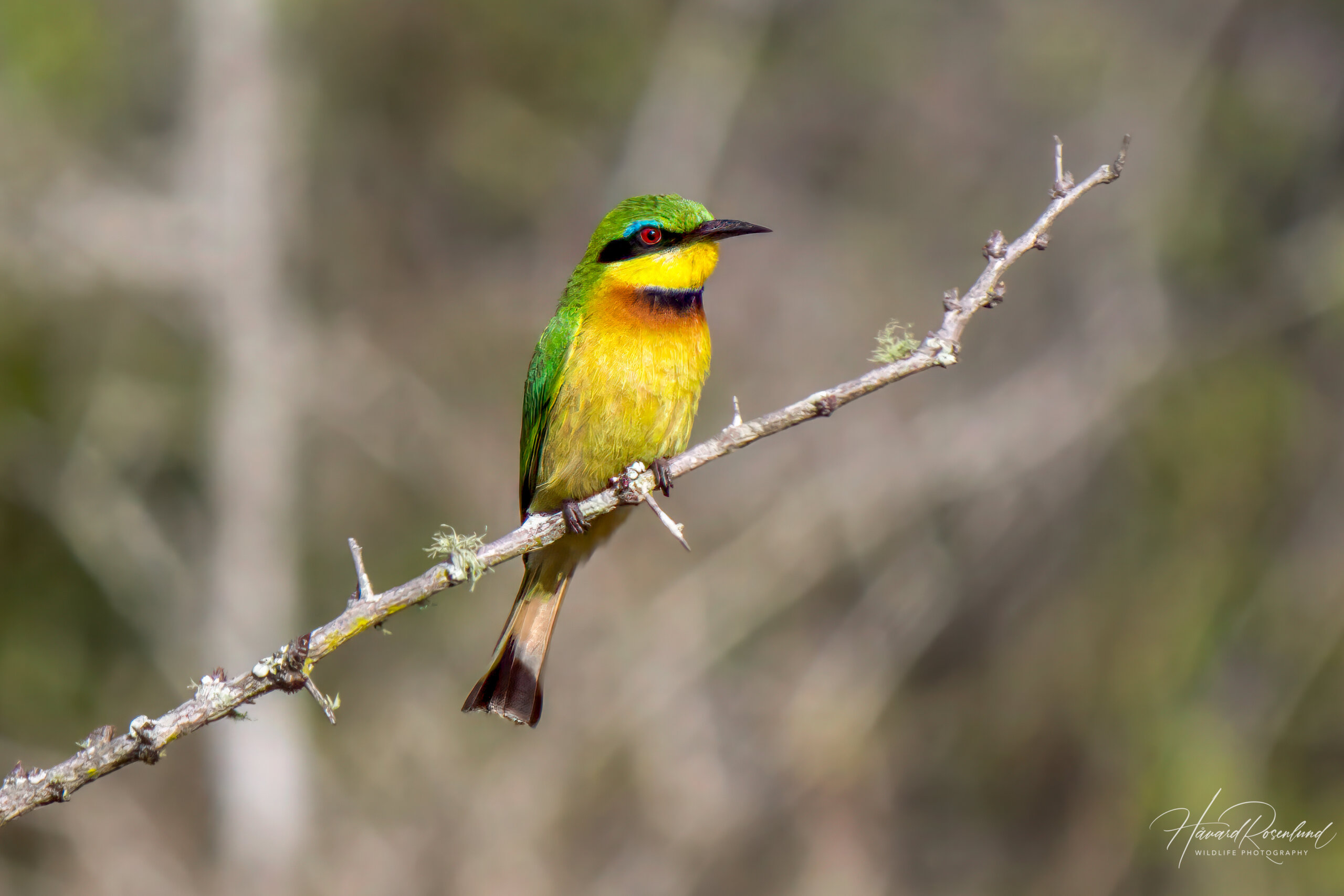
Little Bee-eater
Merops pusillus
At a glance
Habitat
- Open savanna, woodland edges, wetland margins and farmland with low perches
Diet
- Flying insects, especially bees and wasps; also beetles, flies and dragonflies
Activity
- Diurnal
Size
- Length: 15–17 cm Weight: 14–18 g
Range
- Sub-Saharan Africa
Description
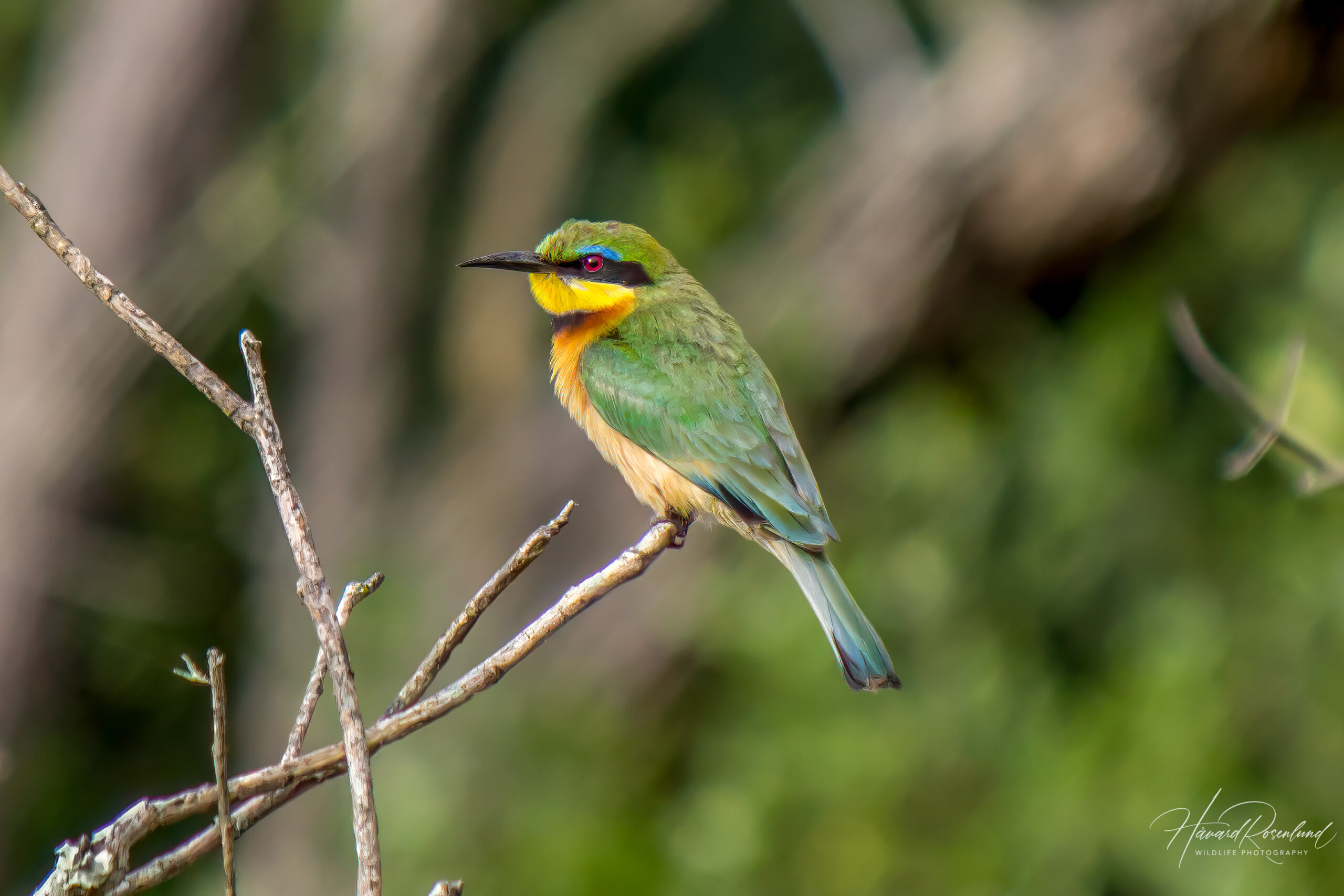
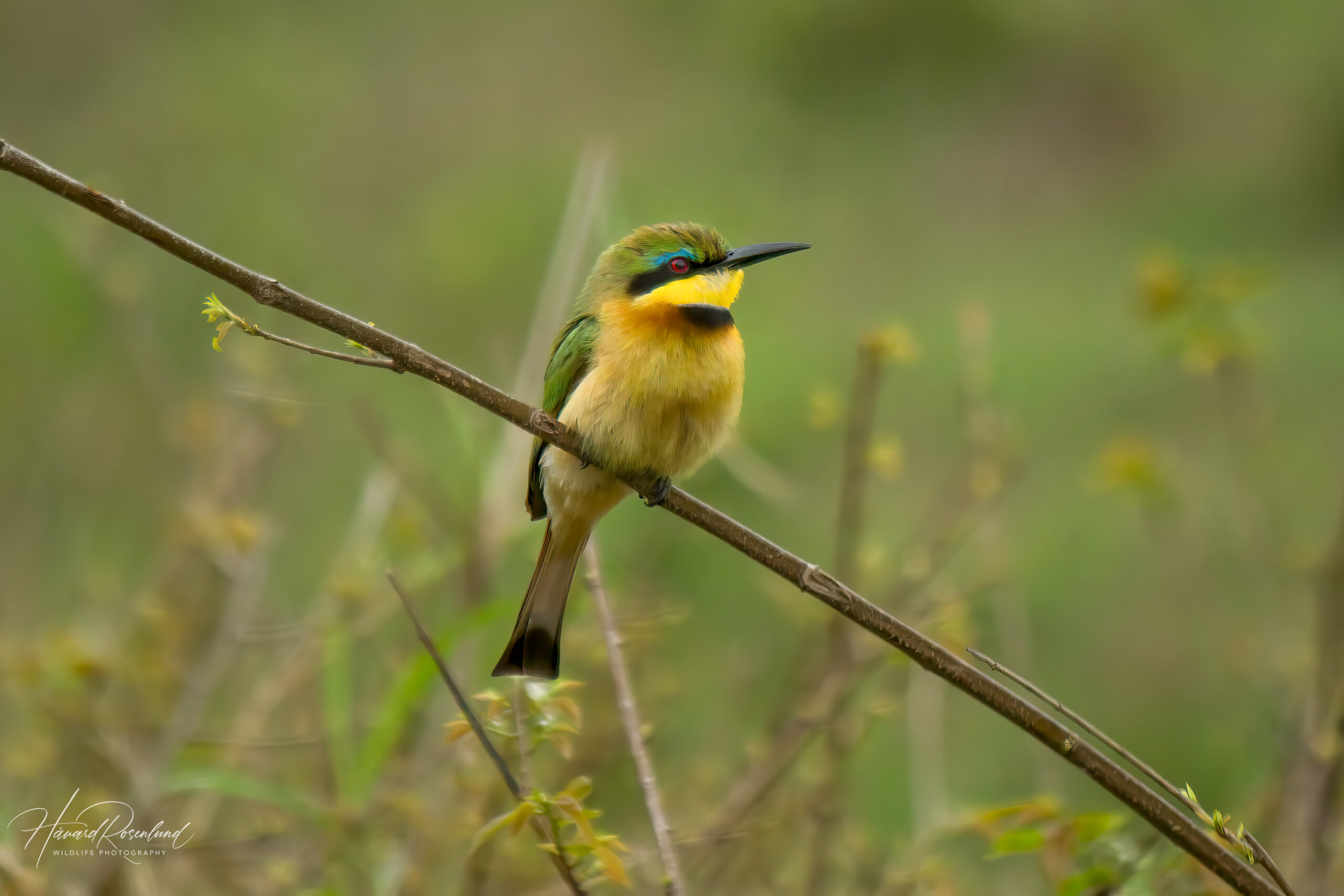
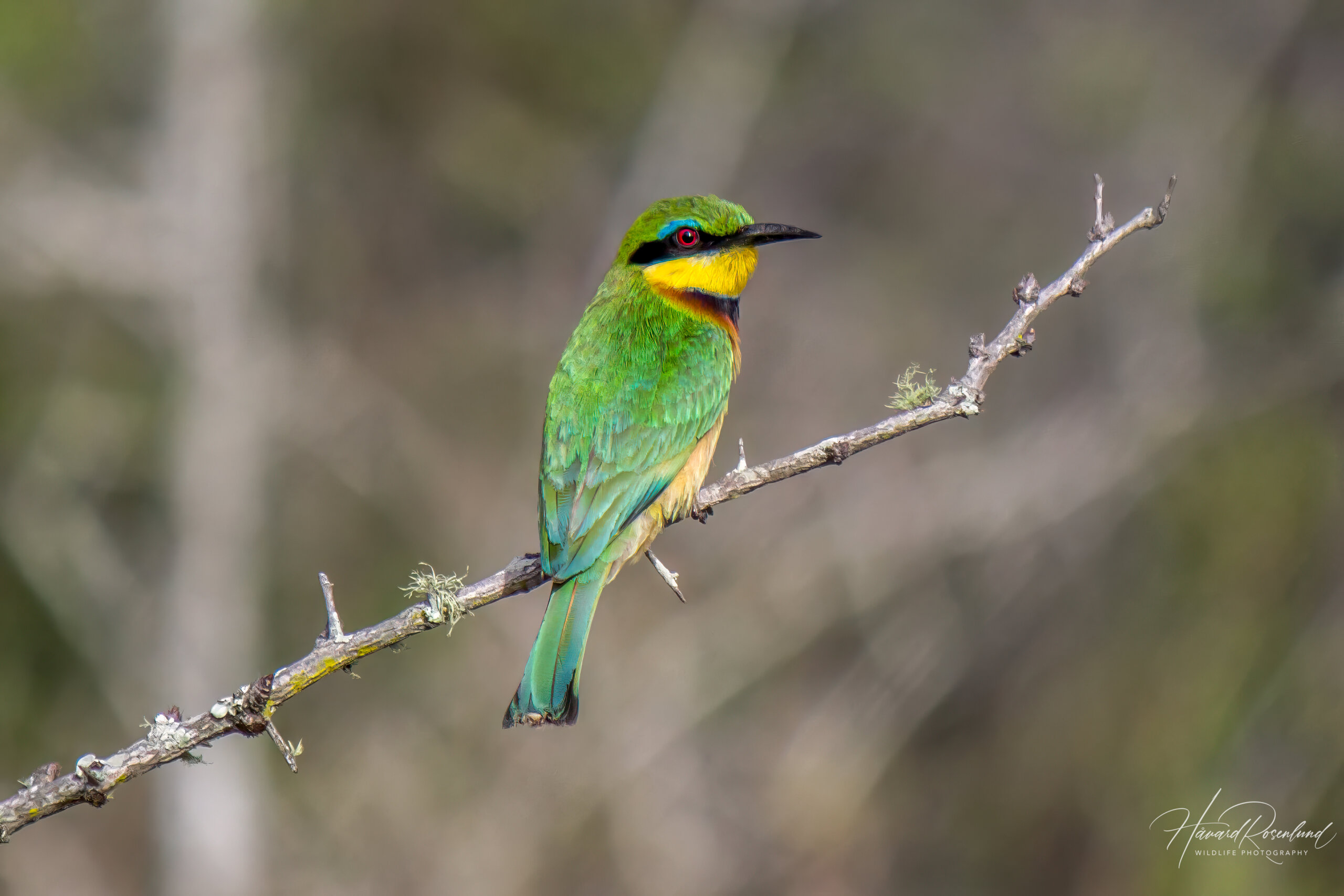
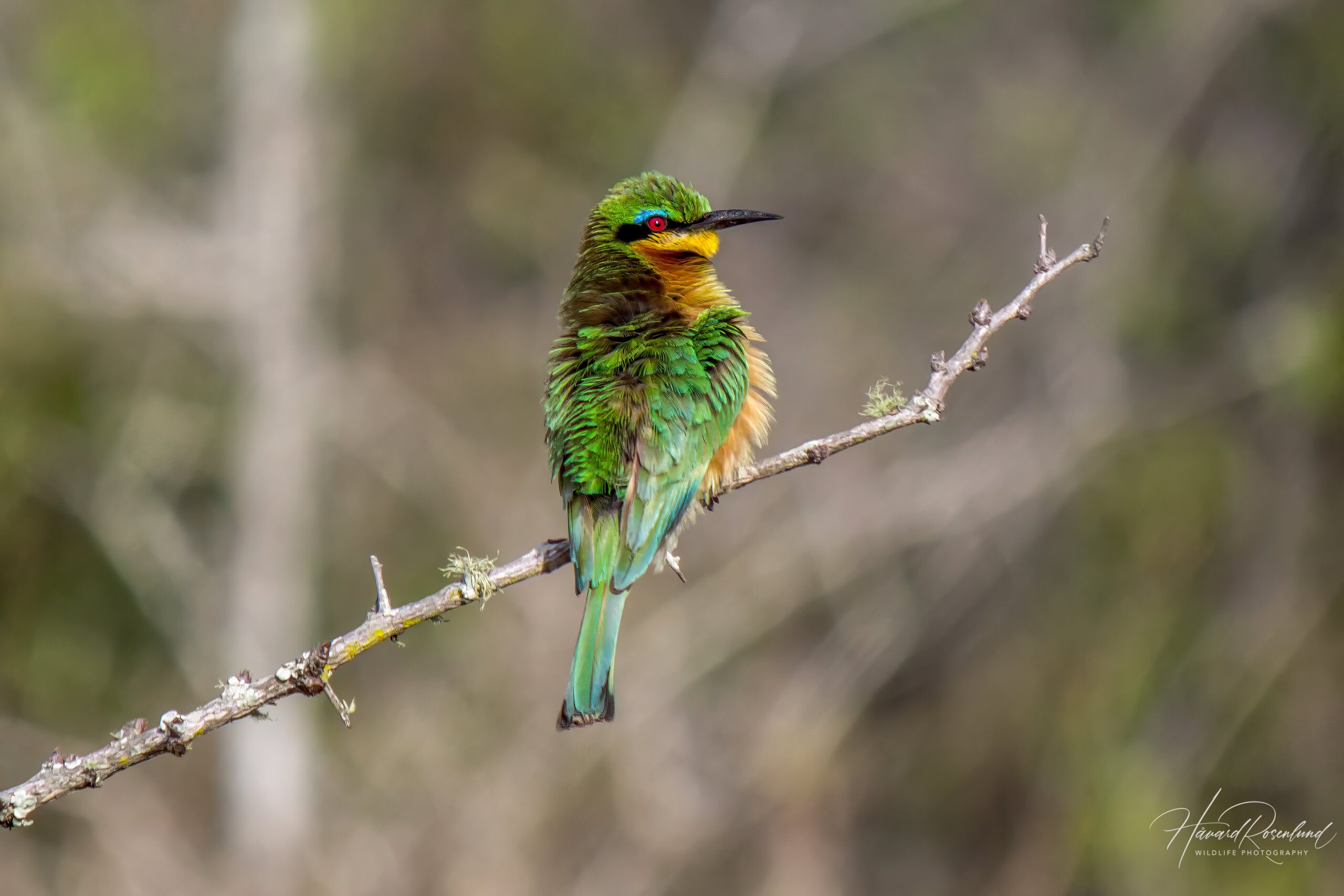
The little bee-eater (Merops pusillus) is Africa’s smallest bee-eater, measuring about 15–17 cm and weighing roughly 14–18 g. It is a compact, colourful bird with green upperparts, a broad black eye-stripe through the red eye and a narrow blue brow. The yellow throat is bordered below by a black gorget, while the breast and belly are warm orange-brown. In flight, the orange underwings show a dark trailing edge.
Habitat
Little bee-eaters favour open habitats with bushes, low trees and exposed perches, often near water. They occur in savanna, woodland edges, wetland margins, farmland and other lightly wooded country.
Diet
The diet consists of small flying insects. Bees and wasps are particularly important, but beetles, flies, dragonflies and other insects are also taken. A study of breeding-season diet found that more than half of identified prey were bees, wasps and other related insects.
Foraging
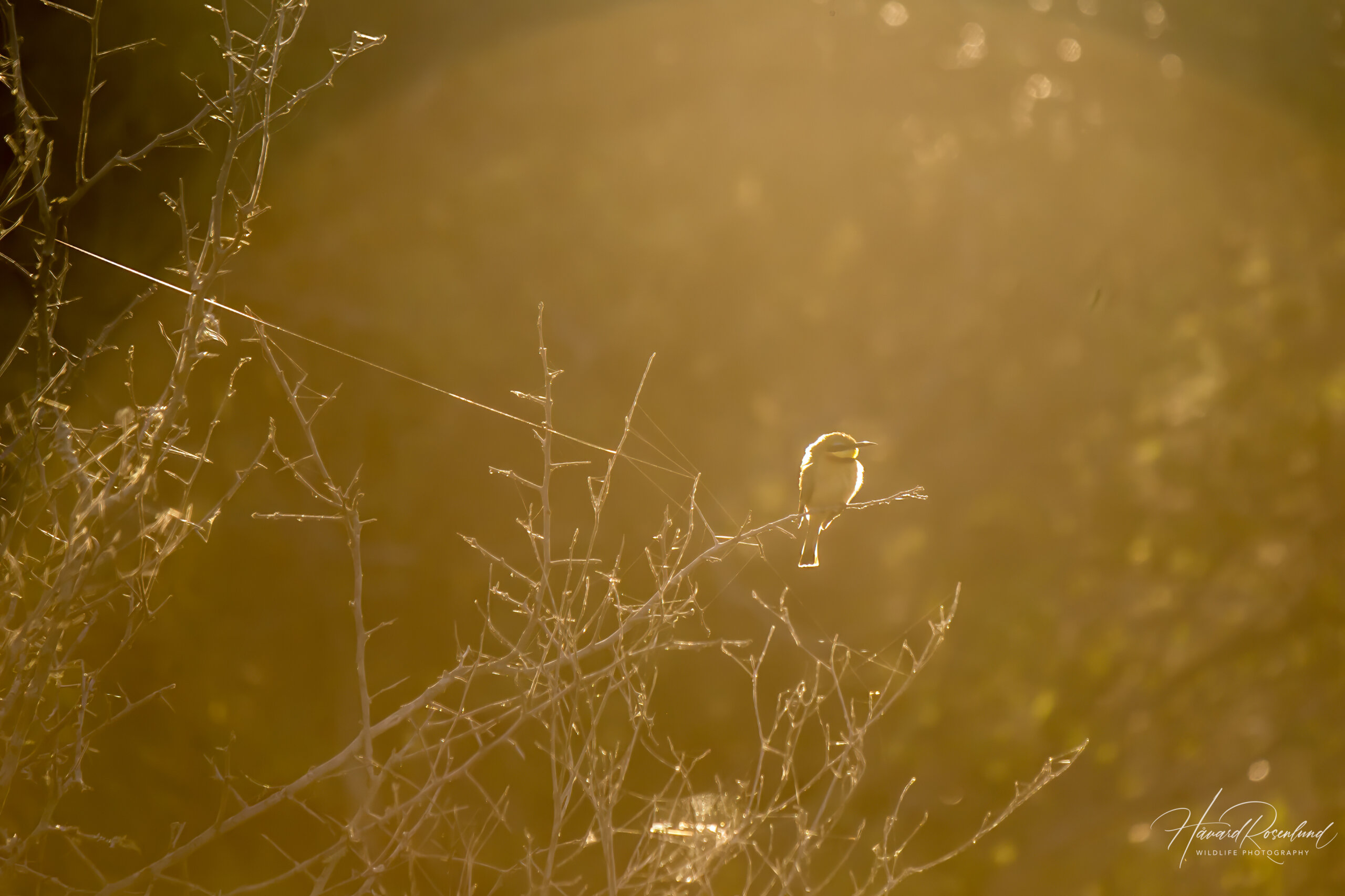
Little bee-eaters usually hunt from low, exposed perches. A bird spots passing prey, makes a short flight after it and commonly returns to the same or a nearby twig before swallowing the insect.
Stinging insects are handled carefully. The bird repeatedly strikes and rubs the prey against the perch before eating it, which helps discharge venom and remove or damage the sting. This characteristic handling allows bee-eaters to exploit bees and wasps that many other insect-eating birds avoid.
Behaviour
Little bee-eaters are usually encountered alone, in pairs or in small groups. They are less strongly colonial than many other bee-eaters and spend much of the day quietly watching from low perches between short feeding flights.
Breeding
Little bee-eaters usually nest as isolated pairs rather than forming large breeding colonies. Both birds excavate a tunnel in sandy soil, often around 50–130 cm long. Nests can be dug into banks, into the roofs or sides of abandoned aardvark or other mammal burrows, and occasionally into other suitable sandy sites, including sand bunkers on golf courses.
Breeding timing varies across the range and often follows local rainfall. In southern Africa, egg-laying peaks around the end of the dry season and beginning of the rains, commonly from about September to November. A clutch usually contains two to six white eggs, incubated by both sexes for roughly 18–20 days.
In parts of southern Africa the little bee-eater is an important host of the greater honeyguide (Indicator indicator), a brood parasite that lays its eggs in the nests of other birds. Female honeyguides puncture host eggs when laying their own. If bee-eater eggs survive, the honeyguide chick hatches first and can kill the younger host chicks with specialised hooks on its bill. Long-term work in Zambia has made little bee-eaters one of the best-studied hosts for understanding this unusually violent relationship between honeyguide and host.
Status
The little bee-eater is widespread across sub-Saharan Africa and remains listed as Least Concern on the IUCN Red List. Its enormous range keeps it well away from being considered threatened on the basis of geographic distribution, although the current population trend is considered decreasing.
Changes in insect abundance can affect the species quickly. Studies associated with insecticide-based tsetse control found that spraying could sharply reduce day-flying insects and feeding rates, and one severe short-term food shortage was followed by breeding failure at several nests. Local insect loss and heavy pesticide use can therefore reduce food availability and breeding success in a bird that catches its prey in the air.
Image gallery
Loading map and observations…
Have you seen this species?
Independent species archive
Did you find this species page useful?
Wildlife Vagabond is independently built and maintained. Voluntary support helps cover hosting, maps, data storage and continued improvements to the species archive.
Support Wildlife VagabondSpecies content will remain freely available.
References
Information about the species’ global distribution and status is based primarily on global Red List data. See the references below for details.
- BirdLife International. (n.d.). Little Bee-eater Merops pusillus species factsheet. https://datazone.birdlife.org/species/factsheet/little-bee-eater-merops-pusillus
- Douthwaite, R., & Fry, C. (1982). Food and feeding behaviour of the little bee-eater Merops pusillus in relation to tsetse fly control by insecticides. Biological Conservation, 23(1), 71-78. https://doi.org/10.1016/0006-3207(82)90054-4
- FAO. (n.d.). Non-target effects of insecticides used in tsetse control operations. https://www.fao.org/4/u6600t/u6600T07.htm
- International Union for Conservation of Nature. (n.d.). Merops pusillus (Little Bee-eater). The IUCN Red List of Threatened Species. https://www.iucnredlist.org/species/22683688/92995977
- Spottiswoode, C. N., & Koorevaar, J. (2012). A stab in the dark: chick killing by brood parasitic honeyguides. Biology Letters, 8(2), 241-244. https://doi.org/10.1098/rsbl.2011.0739
- Spottiswoode, C. N., Stryjewski, K. F., Quader, S., Colebrook-Robjent, J. F. R., & Sorenson, M. D. (2011). Ancient host specificity within a single species of brood parasitic bird. Proceedings of the National Academy of Sciences, 108(43), 17738-17742. https://doi.org/10.1073/pnas.1109630108
- Tobias, J. A., Sheard, C., Pigot, A. L., Devenish, A. J. M., Yang, J., Sayol, F., Neate‐Clegg, M. H. C., Alioravainen, N., Weeks, T. L., Barber, R. A., Walkden, P. A., MacGregor, H. E. A., Jones, S. E. I., Vincent, C., Phillips, A. G., Marples, N. M., Montaño‐Centellas, F. A., Leandro‐Silva, V., Claramunt, S., … Schleuning, M. (2022). AVONET: morphological, ecological and geographical data for all birds. Ecology Letters, 25(3), 581-597. https://doi.org/10.1111/ele.13898