
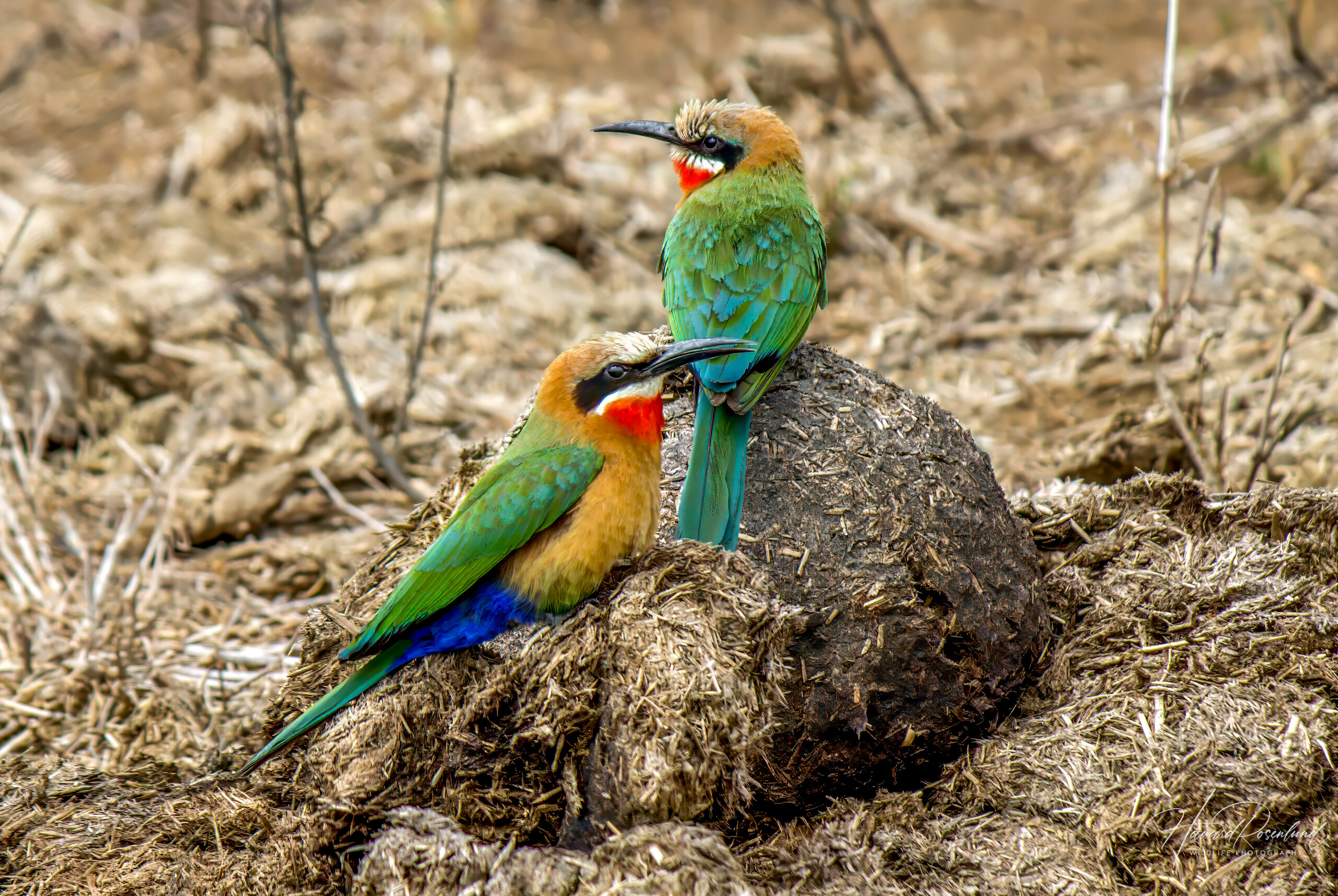
White-fronted Bee-eater
Merops bullockoides
At a glance
Habitat
- Open savanna, riverbanks, gullies and other country with exposed earthen nesting banks
Diet
- Flying insects, especially bees, wasps and other hymenopterans
Activity
- Diurnal
Size
- Length: 21.5–23.5 cm Weight: 28–38 g
Range
- Central, eastern and southern Africa, mostly south of the equator
Description
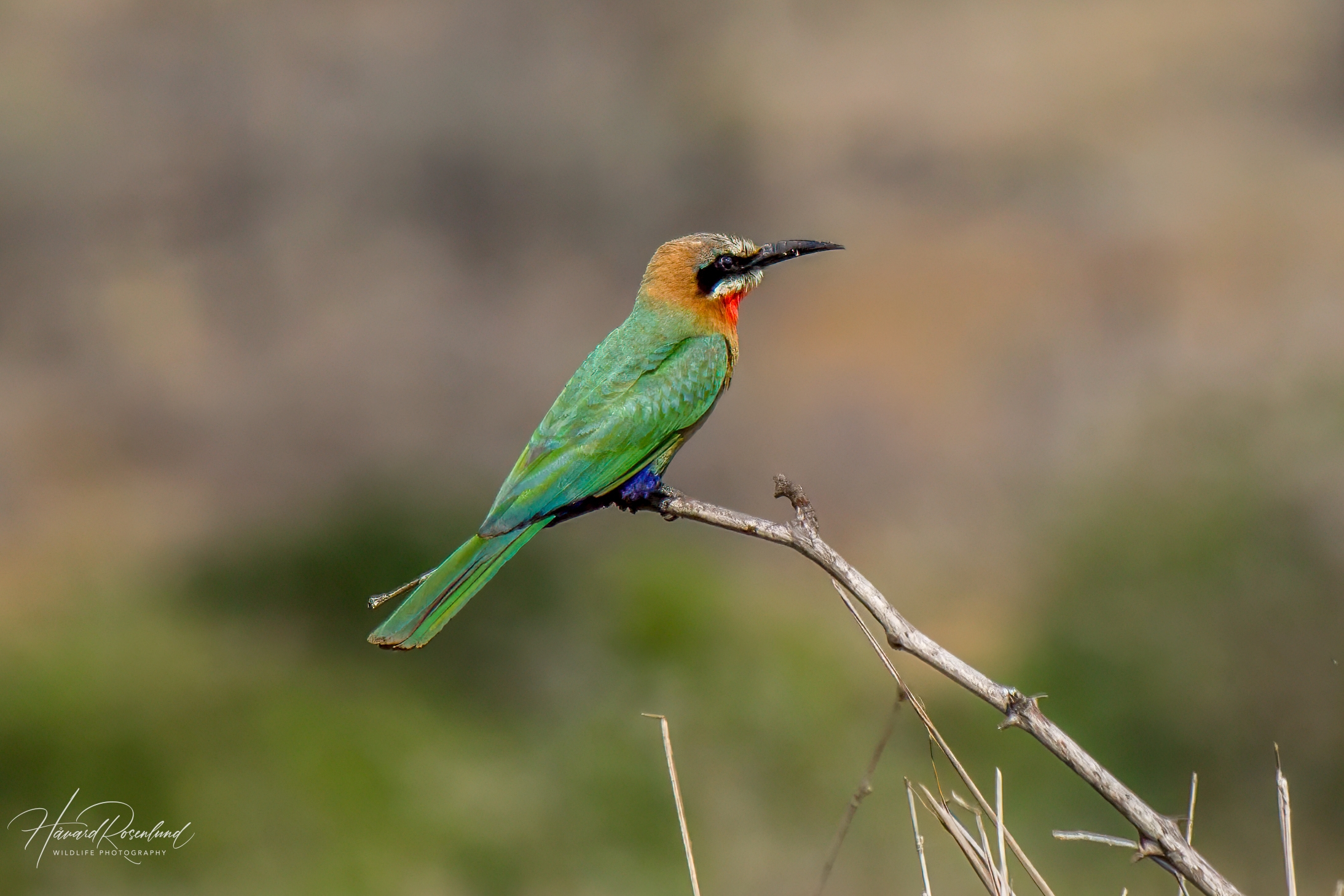
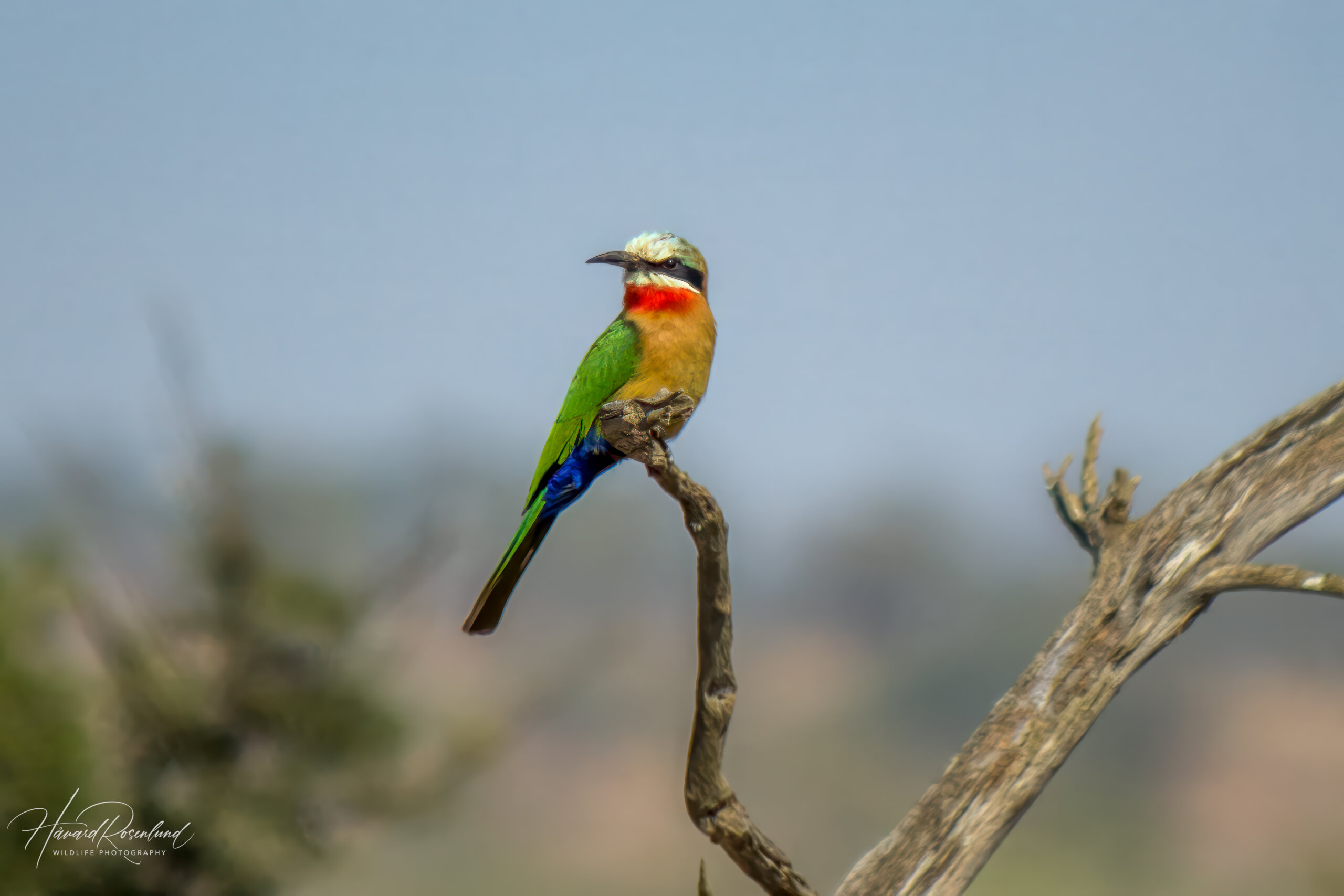
The white-fronted bee-eater (Merops bullockoides) is a distinctive bee-eater of central, eastern and southern Africa, found mainly south of the equator. It measures about 21.5–23.5 cm and weighs 28–38 g. The forehead is white, a black mask runs through the eyes, and the bright red throat is bordered above by a narrow white line. The back and wings are green, the crown and much of the underparts are cinnamon-coloured, and the lower belly and undertail are deep blue.
Habitat
White-fronted bee-eaters inhabit open country, especially savanna with low trees and bushes that provide exposed hunting perches. They are strongly associated with rivers, gullies and other areas with vertical or sloping earthen banks suitable for excavating nesting tunnels.
Diet
The diet consists almost entirely of flying insects. Bees, wasps and other hymenopterans are particularly important; one well-known dietary estimate found that about 87–90% of prey belonged to this group, although the exact composition varies with season and locality. Other flying insects are taken when available.
Foraging
White-fronted bee-eaters most often hunt from an exposed perch. A bird watches for passing insects, launches into a short aerial pursuit and commonly returns to the same or a nearby perch to handle and swallow the prey. They also glide and hover briefly before snatching insects below and can sometimes forage high above the ground during local movements.
During breeding, the colony acts as a fixed base: birds collect one prey item at a time and carry it back. A field study in Kenya showed that as travel time from the colony increased, birds became more selective, spent longer finding food and tended to return with larger insects. The farther they had to fly, the more worthwhile it became to bring back a larger prey item.
Social behaviour
White-fronted bee-eaters have one of the best-studied cooperative breeding systems of any bird. In cooperative breeding, non-breeding relatives help the breeding pair with activities such as nest excavation, incubation and chick care. The birds breed, roost and socialise in large colonies that may contain around a hundred birds or several hundred in particularly large groups. Each colony is divided into closely connected extended-family clans.
A clan typically contains about three to six family units. These groups average around seven individuals and can include several generations, sometimes as many as four. Each family is centred on a breeding pair, while one to several non-breeding relatives may remain as helpers. More than half of breeding attempts in classic long-term studies received help from at least one additional adult.
Helpers also feed the female and chicks. They preferentially help close relatives, and the additional food they deliver can substantially increase breeding success.
The clans are not confined to the nesting bank. Each can defend its own group foraging area, sometimes several kilometres from the colony. Cooperation can also involve conflict. Long-term work in Kenya showed that older males, usually fathers, sometimes disrupted breeding attempts by adult sons; sons whose attempts failed were then more likely to return and help at the father's nest. Close relatives can therefore be important partners while still competing over opportunities to breed.
Breeding
Pairs excavate nesting tunnels in riverbanks, gullies and other earthen faces, often close to many neighbouring pairs. In southern Africa, egg laying is concentrated around the late dry season and beginning of the rains, commonly from about August to November, although timing varies locally with food availability and rainfall.
Clutches usually contain two to five eggs. Both parents and, where present, helpers share incubation and chick care. Incubation lasts about 21 days, and the young leave the tunnel roughly 20–28 days after hatching. Juveniles may disperse after breeding or remain with their family and become helpers in a later season.
The birds raising a chick are not always its biological parents. Studies found that roughly 9–12% of offspring were not genetically related to one or both of the birds acting as parents. Mating outside the pair bond, sometimes involving forced copulation, can result in another male fathering the young. Brood parasitism also occurs within the species: a female may lay in another pair's nest and sometimes remove an egg already present before laying her own. A social pair can therefore end up incubating and raising a chick that is not genetically theirs.
Status
The white-fronted bee-eater remains listed as Least Concern on the IUCN Red List. The species has a large range and remains common in much of its suitable habitat.
Breeding colonies can nevertheless be vulnerable locally because many pairs depend on the same exposed banks. Severe or repeated human disturbance can cause colonies to abandon breeding sites, while erosion-control work, quarrying or alteration of riverbanks can remove suitable nesting habitat. Declines in flying insects would also reduce food availability.
Image gallery
Loading map and observations…
Have you seen this species?
Independent species archive
Did you find this species page useful?
Wildlife Vagabond is independently built and maintained. Voluntary support helps cover hosting, maps, data storage and continued improvements to the species archive.
Support Wildlife VagabondSpecies content will remain freely available.
References
Information about the species’ global distribution and status is based primarily on global Red List data. See the references below for details.
- BirdLife International. (n.d.). White-fronted Bee-eater Merops bullockoides species factsheet. https://datazone.birdlife.org/species/factsheet/white-fronted-bee-eater-merops-bullockoides
- Emlen & Wrege. (1991). Breeding biology of white-fronted bee-eaters at Nakuru: the influence of helpers on breeder fitness. Journal of Animal Ecology, 60, 309–326. https://www.jstor.org/stable/5462
- Emlen, S. T., & Wrege, P. H. (1986). Forced Copulations and Intra‐specific Parasitism: Two Costs of Social Living in the White‐fronted Bee‐eater. Ethology, 71(1), 2-29. https://doi.org/10.1111/j.1439-0310.1986.tb00566.x
- Emlen, S. T., & Wrege, P. H. (1988). The role of kinship in helping decisions among white-fronted bee-eaters. Behavioral Ecology and Sociobiology, 23(5), 305-315. https://doi.org/10.1007/BF00300577
- Emlen, S. T., & Wrege, P. H. (1992). Parent–offspring conflict and the recruitment of helpers among bee-eaters. Nature, 356(6367), 331-333. https://doi.org/10.1038/356331a0
- Hegner, R. E., Emlen, S. T., & Demong, N. J. (1982). Spatial organization of the white-fronted bee-eater. Nature, 298(5871), 264-266. https://doi.org/10.1038/298264a0
- Hegner, R. E. (1982). Central place foraging in the white-fronted bee-eater. Animal Behaviour, 30(4), 953-963. https://doi.org/10.1016/S0003-3472(82)80183-8
- International Union for Conservation of Nature. (n.d.). Merops bullockoides (White-fronted Bee-eater). The IUCN Red List of Threatened Species. https://www.iucnredlist.org/species/22683684/92995705
- Wrege, P. H., & Emlen, S. T. (1987). Biochemical determination of parental uncertainty in white-fronted bee-eaters. Behavioral Ecology and Sociobiology, 20(3), 153-160. https://doi.org/10.1007/BF00299728
- Wrege, P. H., & Emlen, S. T. (1991). Breeding Seasonality and Reproductive Success of White-Fronted Bee-Eaters in Kenya. The Auk, 108(3), 673-687. https://doi.org/10.2307/4088107
- Wrege, P. H., & Emlen, S. T. (1994). Family structure influences mate choice in white-fronted bee-eaters. Behavioral Ecology and Sociobiology, 35(3), 185-191. https://doi.org/10.1007/BF00167958