
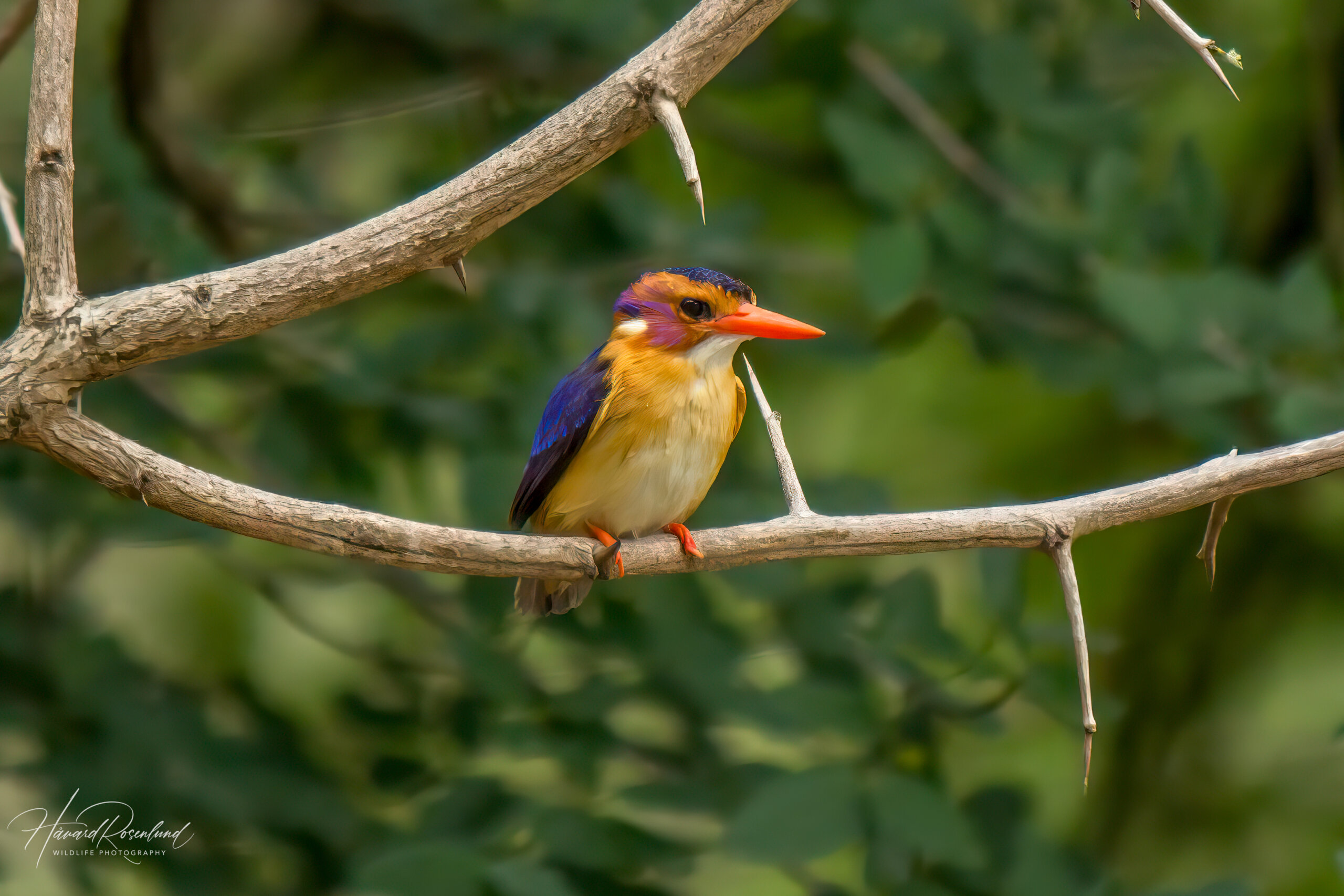
African Pygmy Kingfisher
Ispidina picta
At a glance
Habitat
- Woodland, savanna, riverine forest, coastal bush, plantations and gardens
Diet
- Mostly insects and spiders; also small frogs, lizards, skinks, millipedes and crabs
Activity
- Diurnal; hunts mainly from low perches
Size
- Length: about 12 cm Weight: 9–16 g
Range
- Widespread across sub-Saharan Africa; southern and some northern populations are intra-African migrants
Description
The African pygmy kingfisher (Ispidina picta) is one of Africa's smallest kingfishers, measuring about 12 cm and weighing roughly 9–16 g; only the African dwarf kingfisher (Ispidina lecontei) is smaller. Its brilliant blue upperparts, orange-rufous underparts, violet ear-coverts and red-orange bill make it striking despite its size. Adults have a dark blue crown, while juveniles are duller and initially have a dark bill.
It can be confused with the African dwarf kingfisher, which has a rufous rather than dark blue crown, and with the larger malachite kingfisher (Corythornis cristatus), which lacks the same violet wash on the sides of the head.
Taxonomy
Three subspecies are currently recognised: I. p. picta, I. p. ferrugina and the southern I. p. natalensis. Birds in South Africa belong to I. p. natalensis.
A genetic and morphometric study published in 2022 found clear genetic differences between the sampled picta and natalensis populations, which appear to have diverged about 1.74 million years ago. Genetic differences within each lineage were small, suggesting that populations within each lineage remain genetically connected. The study also found sexual dimorphism in body measurements within natalensis, even though males and females look alike in plumage. It did not propose a species split, and current checklists continue to treat these forms as subspecies of Ispidina picta.
Habitat
Unlike many familiar kingfishers, the African pygmy kingfisher is primarily a woodland and scrub bird rather than a species tied to open water. It occurs in savanna, riverine forest, coastal bush, woodland, plantations and well-vegetated gardens.
Low branches, shrubs and other sheltered perches are particularly useful because the bird spends much of its time watching the ground and vegetation from close range.
Diet
The diet is dominated by terrestrial invertebrates, including grasshoppers, crickets, beetles, flies, moths, spiders and millipedes. Small frogs, skinks and other lizards are also taken, and crabs have been recorded.
Fish form only a small and occasional part of the diet, despite the species belonging to a family strongly associated with fishing.
Hunting
African pygmy kingfishers usually hunt from low perches. A bird watches the ground or nearby vegetation, drops rapidly onto prey and then returns to a perch. The prey may be crushed in the bill or beaten against the perch before being swallowed.
Behaviour
Individuals are usually encountered alone or in pairs and can remain surprisingly inconspicuous inside dense vegetation despite the bright plumage. The species is active by day and often gives sharp, high calls as it moves through woodland and scrub.
Migration
Movement patterns vary across Africa. The species includes resident, partially migratory and migratory populations, and seasonal movements are known in both northern picta and southern natalensis.
In South Africa, natalensis usually arrives around September and October, breeds through the austral summer and leaves again around March. After breeding these birds move north, while northern picta populations can move south after their breeding season. The exact migration routes are still not fully known.
Breeding
African pygmy kingfishers form monogamous pairs during the breeding season. Breeding timing varies across the range, and in southern Africa egg-laying occurs mainly from October to December. Both sexes excavate a nesting tunnel in an earthen bank, erosion gully, trench, pit or sometimes a termite mound.
Clutches usually contain three to six eggs, and both parents incubate and feed the young. Incubation and nestling periods both appear to last about 18 days, although detailed field data remain limited. The young become independent soon after fledging.
Status
The African pygmy kingfisher is classified as least concern and remains widespread across suitable habitats in sub-Saharan Africa.
Local woodland loss and degradation can reduce populations, but the broad range and ability to use several woodland and partly modified habitats make the species less vulnerable to local habitat change.
Image gallery
Loading map and observations…
Have you seen this species?
Independent species archive
Did you find this species page useful?
Wildlife Vagabond is independently built and maintained. Voluntary support helps cover hosting, maps, data storage and continued improvements to the species archive.
Support Wildlife VagabondSpecies content will remain freely available.
References
Information about the species’ global distribution and status is based primarily on global Red List data. See the references below for details.
- Avibase. (n.d.). Ispidina picta – African Pygmy Kingfisher: taxonomy and geographic variation. https://avibase.bsc-eoc.org/species.jsp?avibaseid=C0998BB90475C36D&lang=EN
- BirdLife International. (n.d.). African Pygmy-kingfisher (Ispidina picta) species factsheet. https://datazone.birdlife.org/species/factsheet/african-pygmy-kingfisher-ispidina-picta
- Dalton, D. L., Nupen, L. J., Mwale, M., Pretorius, C., Kropff, A. S., Monchusi, B. A., Labuschagne, K., & Osinubi, S. T. (2022). First steps to success: identification of divergence among the northern and the southern lineages of African Pygmy Kingfisher (Ispidina picta) (Coraciiformes: Alcedinidae). Journal of Ornithology, 163(4), 931-943. https://doi.org/10.1007/s10336-022-01996-z
- International Union for Conservation of Nature. (n.d.). African Pygmy Kingfisher (Ispidina picta). The IUCN Red List of Threatened Species. https://www.iucnredlist.org/species/22683165/92977099
- SANBI Biodiversity Explorer. (n.d.). Ispidina picta – African pygmy-kingfisher. https://www.biodiversityexplorer.info/birds/alcedinidae/ispidina_picta.htm