
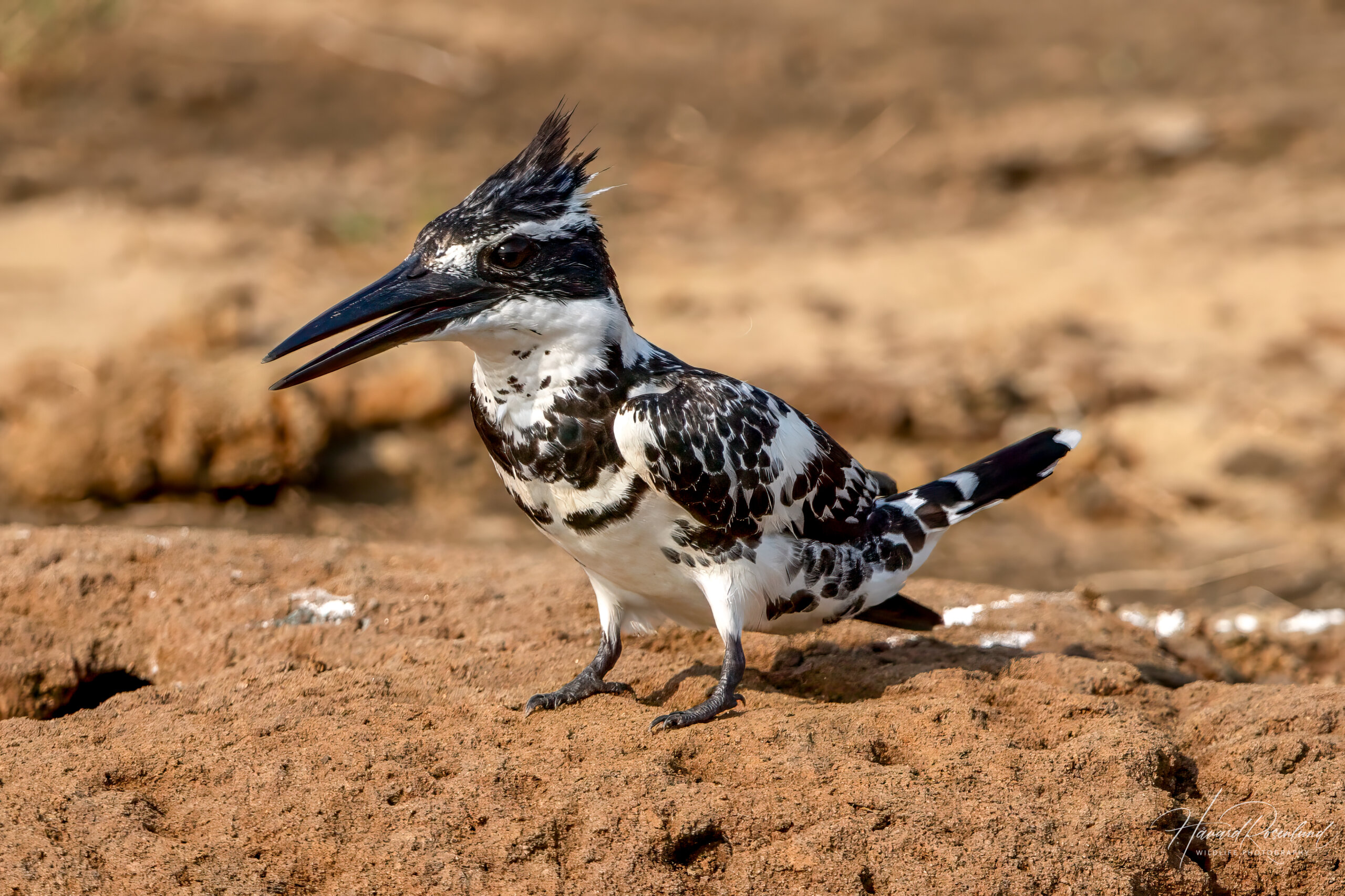
Pied Kingfisher
Ceryle rudis
At a glance
Habitat
- Rivers, lakes, reservoirs, estuaries, lagoons, mangroves and sheltered coasts with clear, fish-rich water
Diet
- Predominantly fish; also aquatic insects, crustaceans and occasional amphibians
Activity
- Diurnal; hunts both from perches and by sustained hovering above the water
Size
- Length: 25–29 cm Weight: 70–110 g
Range
- Widespread across sub-Saharan Africa, the Nile region, the Middle East and much of South and parts of East Asia
Description
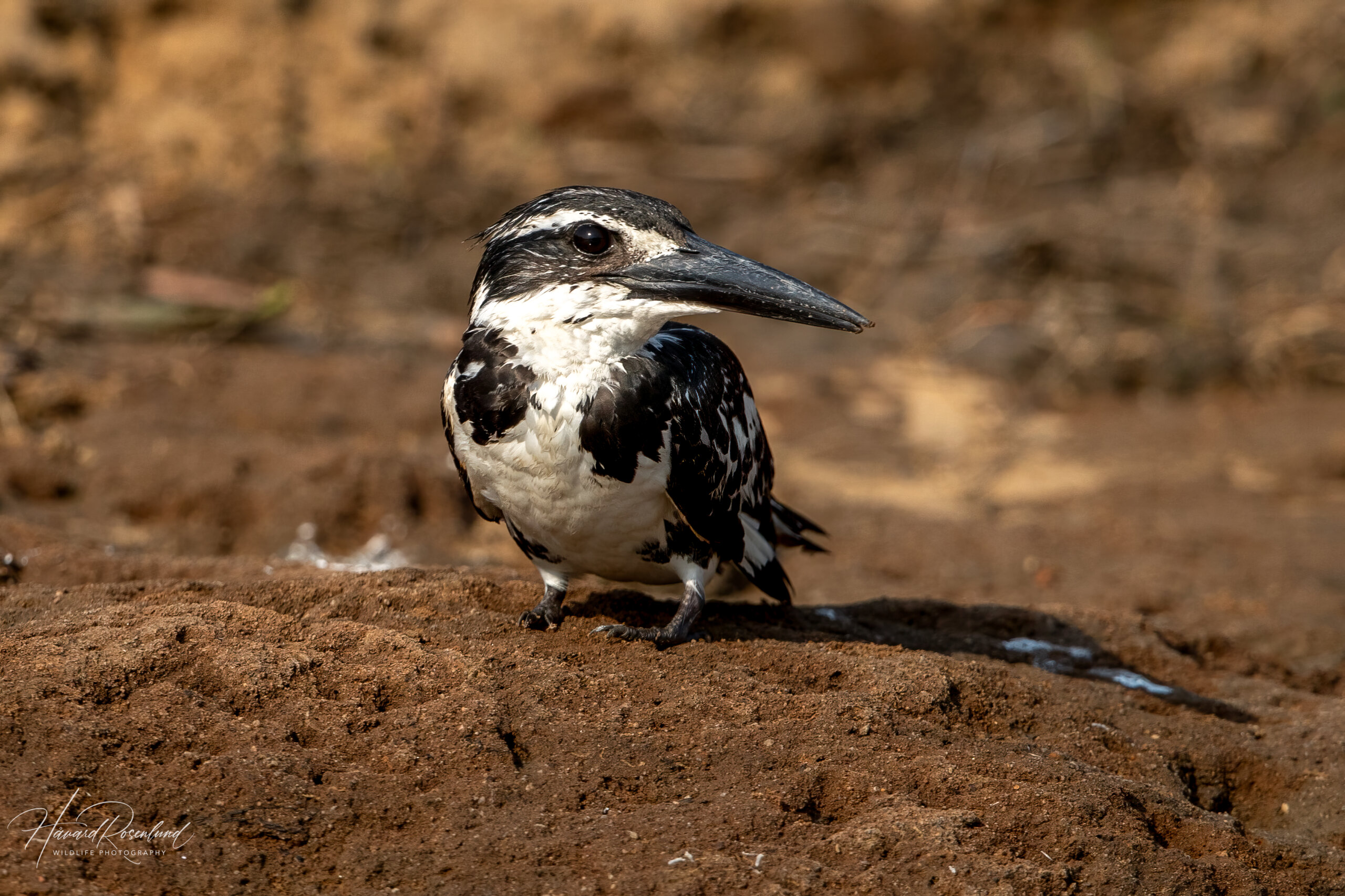
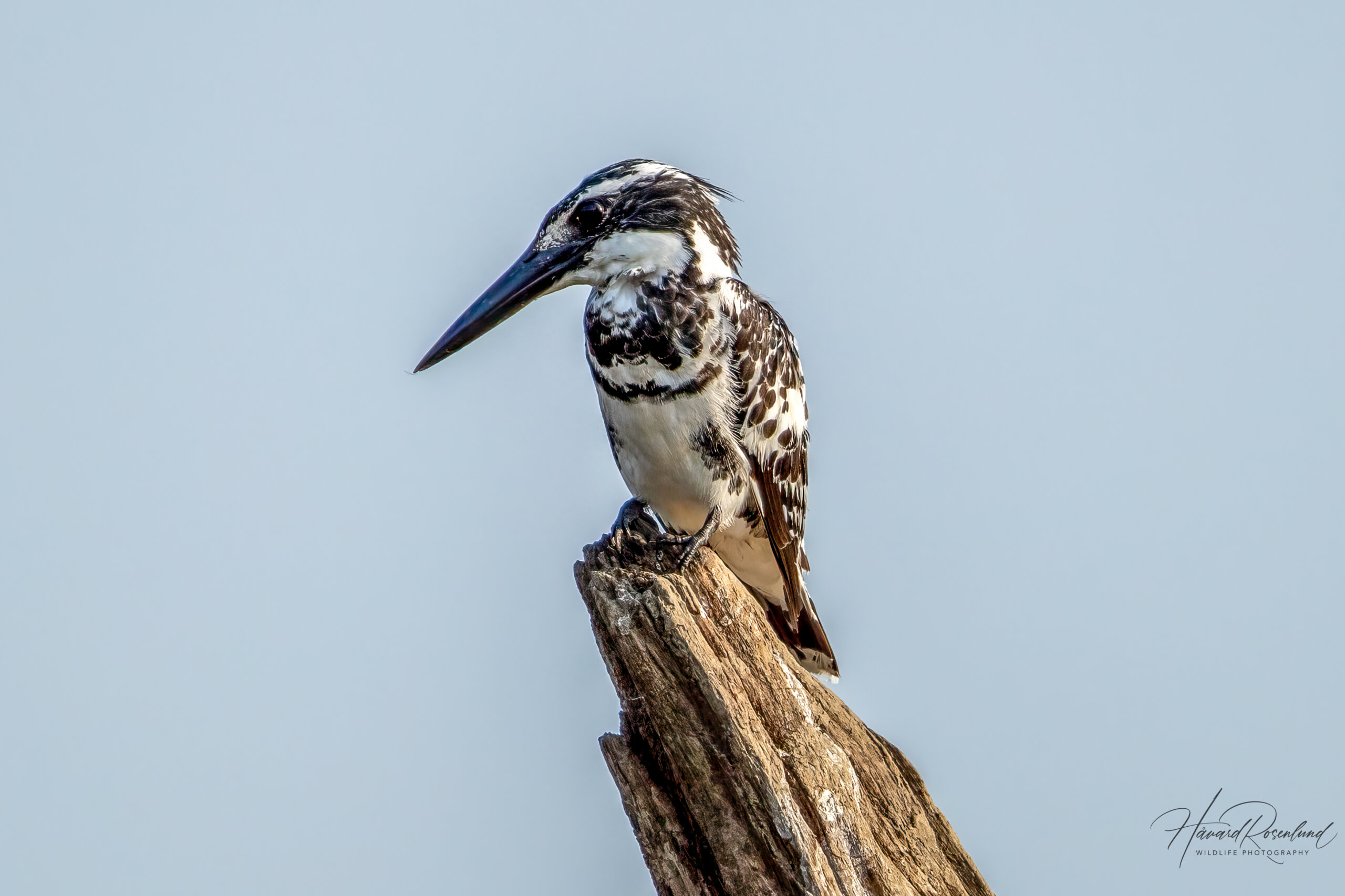
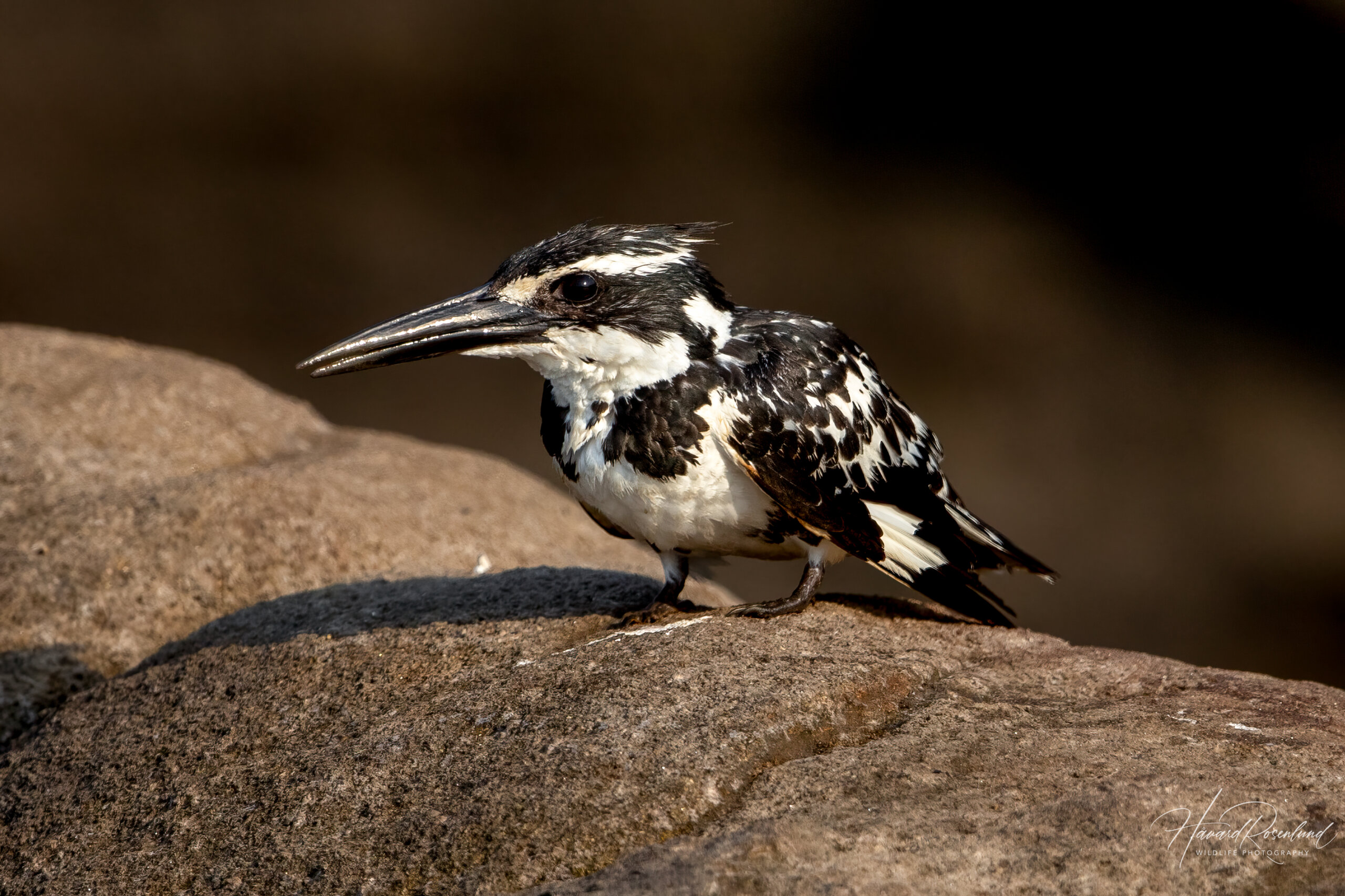
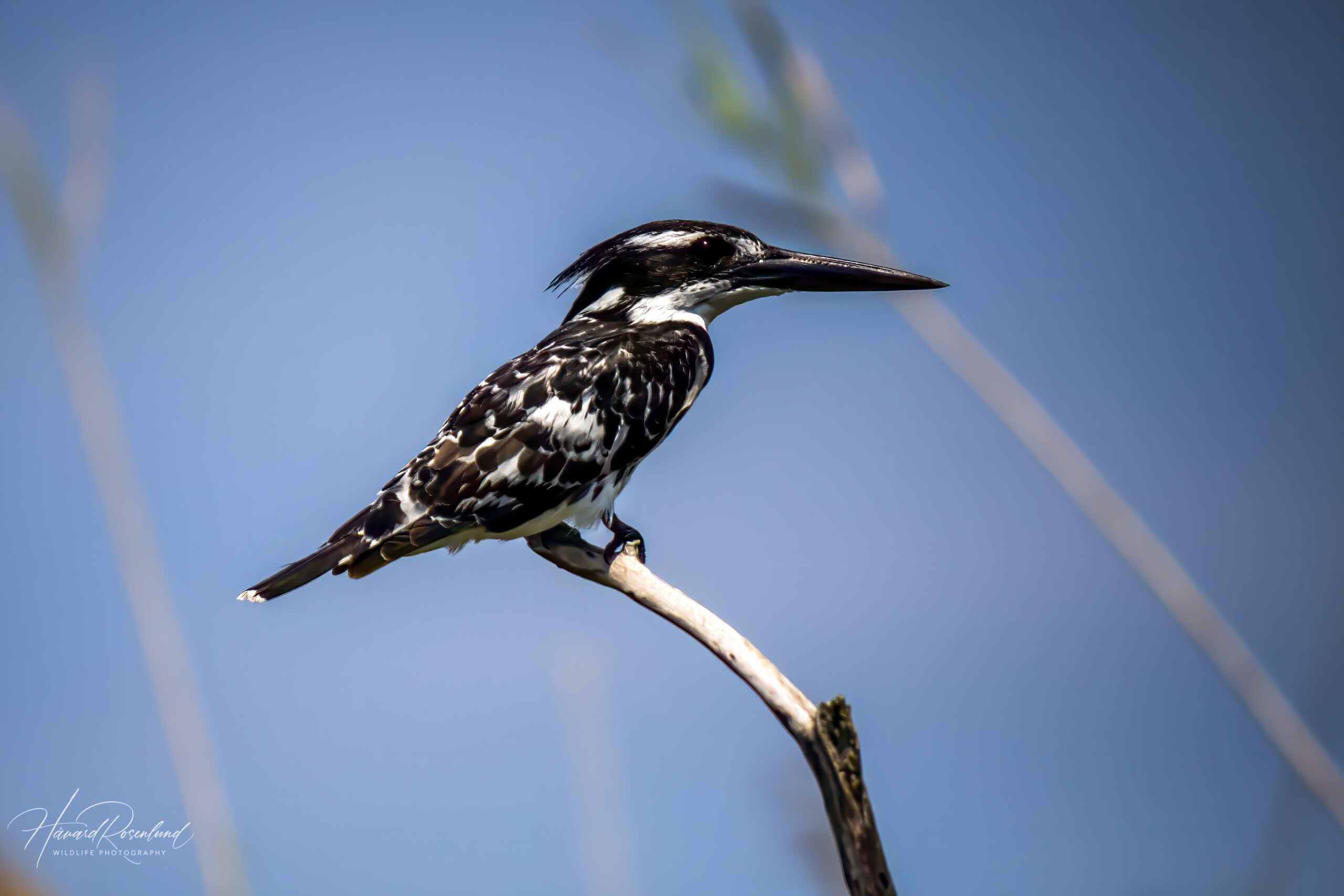
The pied kingfisher (Ceryle rudis) is a medium-sized water kingfisher with an unusually broad distribution across Africa and Asia. It measures about 25–29 cm and weighs roughly 70–110 g. The sharply contrasting black-and-white plumage is distinctive, with a shaggy crest, dark mask and white-spotted black upperparts.
The sexes are readily separated by the breast pattern. Males have two dark bands across the chest, whereas females have a single incomplete band. The species is the only living member of the genus Ceryle.
Habitat
Pied kingfishers use almost any open water that provides sufficient small fish, including rivers, lakes, reservoirs, irrigation canals, estuaries, lagoons, mangroves and sheltered coasts. Their ability to hover lets them exploit open water far from the shoreline or in places where suitable hunting perches are absent.
The species also adapts readily to dams, reservoirs and other artificial water bodies where water quality and fish populations remain suitable. Steep sandy or earthen banks are additionally important where birds breed.
Diet
Fish dominate the diet, usually relatively small individuals that can be captured near the surface. Aquatic insects, crustaceans and occasional amphibians are also taken. Small fish may be swallowed in flight, while larger catches are carried to a perch and struck against a hard surface before being swallowed head first.
Hunting
The pied kingfisher uses two conspicuous fishing strategies. It may watch from a branch or other perch and plunge after prey, or remain in sustained hovering flight several metres above the water before diving almost vertically. Perch hunting uses less energy, while hovering gives access to open water where there are no suitable lookout points.
An experiment published in 2023 in South Africa showed that access to good perches made pied kingfishers hunt about four times more often in an area, without making each hunt more successful. The perches therefore clearly make a hunting area easier to exploit.
A study from 2014–2015 at fish ponds in Israel, based on 139 observed hovering bouts, showed that pied kingfishers often remained almost stationary even in little or no wind while keeping the head remarkably stable as the wings and body moved beneath it. This helps them track fish below the surface and compensate for refraction at the boundary between air and water.
Behaviour
Most pied kingfisher populations are resident or make local movements rather than long migrations. Birds may shift between nearby river stretches, lakes and coastal feeding areas as water levels and fish availability change.
They are often seen alone or in pairs, but loose groups can gather where fishing is especially productive. Birds may also assemble at communal night roosts before dispersing again to feeding areas after dawn.
Breeding
Pied kingfishers usually form monogamous pairs and excavate a nesting tunnel in a steep earthen or sandy bank. Both sexes take part in digging. The tunnel often extends around a metre into the bank and ends in a wider chamber where four or five eggs are typically laid. Incubation lasts about 18 days and is carried out mainly by the female. The chicks remain in the burrow for roughly 24–29 days. By about 38–43 days of age they can dive and feed for themselves, although they may continue to receive food from adults for one to two months after fledging.
Long-term research over eight breeding seasons from 1976 to 1983 at Lake Naivasha and Lake Victoria in Kenya showed a flexible system of cooperative breeding. Related males that help their parents are regularly accepted and may invest heavily in nest defence and feeding the chicks. Unrelated males can also join as helpers, but are especially accepted when conditions are poor and the breeding pair has difficulty raising the young alone.
This flexible system links social behaviour directly to both kinship and local conditions: extra help can improve breeding success because the chicks receive more food when the parents are under greater pressure.
Status
The pied kingfisher is globally classified as Least Concern on the IUCN Red List. It has an exceptionally large range and remains common across much of Africa and Asia, including on many human-made water bodies.
Water pollution, disturbance or destruction of nesting banks and changes in fish populations can affect numbers locally. These pressures do not currently threaten the species across its range as a whole.
Image gallery
Loading map and observations…
Have you seen this species?
Independent species archive
Did you find this species page useful?
Wildlife Vagabond is independently built and maintained. Voluntary support helps cover hosting, maps, data storage and continued improvements to the species archive.
Support Wildlife VagabondSpecies content will remain freely available.
References
Information about the species’ global distribution and status is based primarily on global Red List data. See the references below for details.
- AviList. (2026). v2025b. https://www.avilist.org/checklist/v2025b/
- Biodiversity Explorer. (n.d.). Pied Kingfisher (Roberts-based species account). Iziko Museums of South Africa. https://www.biodiversityexplorer.info/birds/cerylidae/ceryle_rudis.htm
- BirdLife International. (n.d.). Pied Kingfisher species factsheet. https://datazone.birdlife.org/species/factsheet/pied-kingfisher-ceryle-rudis
- International Union for Conservation of Nature. (n.d.). Pied Kingfisher. The IUCN Red List of Threatened Species. https://www.iucnredlist.org/species/22683645/110626699
- Katzir, G., Berman, D., Nathan, M., & Weihs, D. (2018). Sustained hovering, head stabilization and vision through the water surface in the Pied kingfisher (<i>Ceryle rudis</i>). bioRxiv. https://doi.org/10.1101/409201
- Malan, G., & Heimstadt, M. (2023). The role of experimental perches on the hover and perch hunting preferences of the Pied Kingfisher Ceryle rudis. Ostrich, 94(1), 65-69. https://doi.org/10.2989/00306525.2023.2187893
- Reyer, H.-U. (1984). Investment and relatedness: A cost/benefit analysis of breeding and helping in the pied kingfisher (Ceryle rudis). Animal Behaviour, 32(4), 1163-1178. https://doi.org/10.1016/S0003-3472(84)80233-X
- Reyer. (1990). Pied Kingfishers: ecological causes and reproductive consequences of cooperative breeding. https://www.cambridge.org/core/books/cooperative-breeding-in-birds/pied-kingfishers-ecological-causes-and-reproductive-consequences-of-cooperative-breeding/58F73FB9CF70ED4AA75A0AC26B938B79
- Woodall, P. F. (2020). Pied Kingfisher (Ceryle rudis). Birds of the World. https://doi.org/10.2173/bow.piekin1.01