
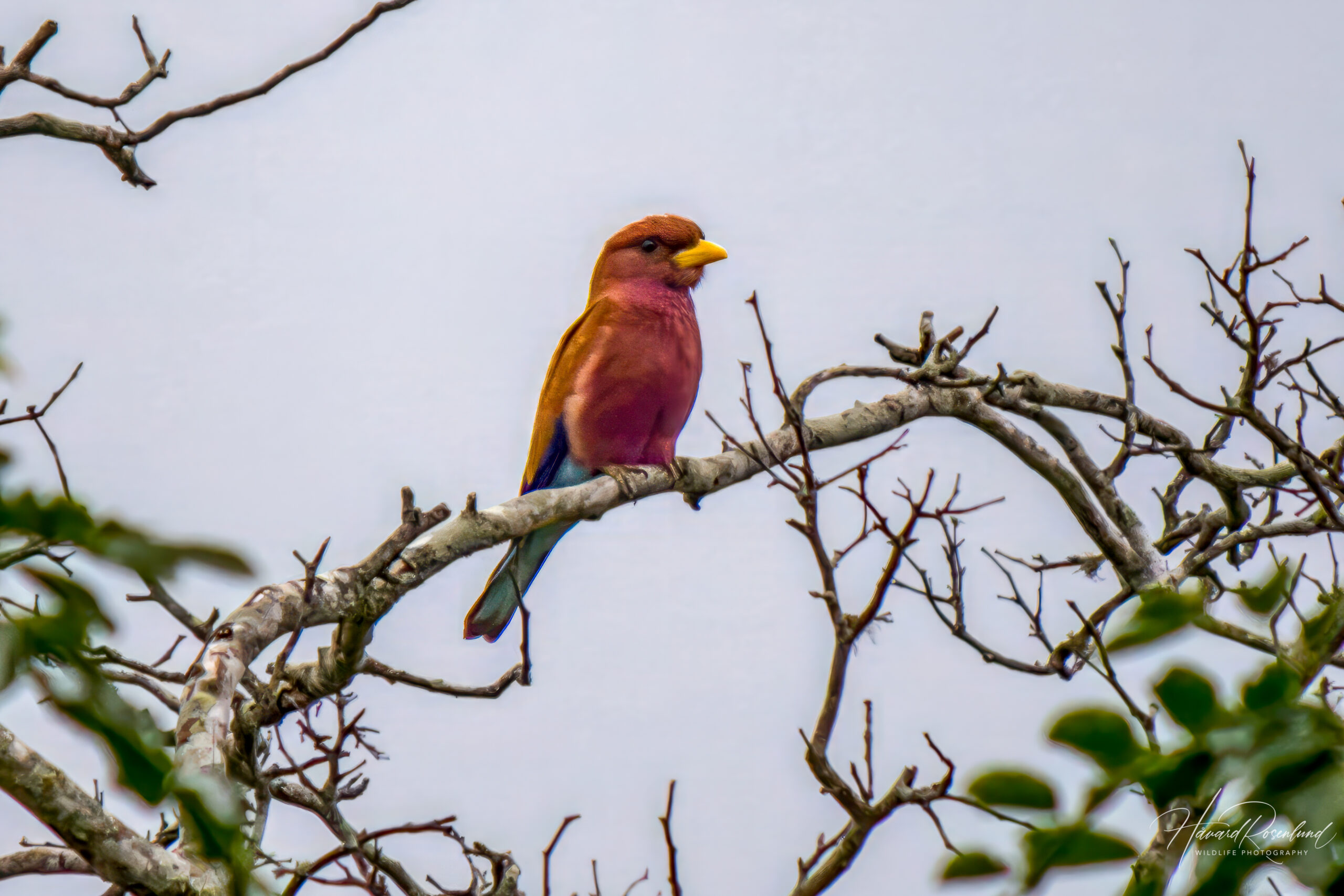
Broad-billed Roller
Eurystomus glaucurus
At a glance
Habitat
- Savanna, open woodland, forest edges, clearings and riverine woodland
Diet
- Flying insects, especially winged termites and ants; also beetles and true bugs
Activity
- Diurnal; strongly aerial forager
Size
- Length: 27–29 cm Weight: 94–109 g
Range
- Tropical and subtropical Africa and Madagascar; many populations are seasonal migrants
Description
The broad-billed roller (Eurystomus glaucurus) is a stocky African roller with a strikingly broad yellow bill. Adults are about 27–29 cm long and weigh roughly 94–109 g. The head, back and underparts are warm cinnamon-brown to purplish brown, contrasting with deep blue wings and tail. In flight, the blue wing panels become much more conspicuous than when the bird is perched.
The broad, flattened bill reflects a different feeding style from the more ground-oriented Coracias rollers. Broad-billed rollers feed largely by pursuing insects in open air above woodland and savanna.
Habitat
Broad-billed rollers use savanna, open woodland, forest edges, clearings and riverine woodland, usually where large trees provide exposed perches and nesting cavities. They occur widely across tropical Africa and also breed on Madagascar.
The species is most characteristic of landscapes with a mixture of open airspace and mature trees. Tall perches give birds a clear view of insect activity, while old trees supply the cavities needed for breeding.
Diet
The diet is dominated by flying insects, especially swarming winged termites and ants, together with beetles, true bugs and other large aerial prey.
Hunting
Broad-billed rollers launch from high perches and pursue insects with fast, powerful flight, often swallowing prey while still on the wing. The broad bill is well suited to seizing large flying insects in open air.
Large feeding aggregations can form when insects swarm in enormous numbers. At termite or ant swarms, many rollers may gather in the same area, and flocks of more than 100 birds have been reported. The birds then repeatedly circle through the densest concentrations of prey.
Broad-billed rollers can also drink on the wing, dipping the bill into the water surface while flying.
Migration
Movement patterns vary greatly across the range. Some tropical African populations are resident, while others are seasonal intra-African migrants. Birds breeding in southern Africa are mainly summer visitors, arriving around the rainy season when flying insects become abundant.
The Madagascar population follows a particularly clear cycle. It breeds on Madagascar, and many birds move to central and eastern mainland Africa after breeding, returning to the island for the next breeding season.
Breeding
Breeding is closely associated with the rainy season, when flying insects become abundant. Broad-billed rollers nest in unlined cavities, usually natural holes in trees about 5–15 m above the ground, although cavities in buildings are sometimes used. Suitable holes can be a limited resource and may be contested with other cavity-nesting birds.
Clutches contain two to four eggs. Both parents take part in incubation and feed the young. In rollers, incubation generally lasts around 17–20 days, and the young leave the nest after roughly 25–30 days. These timings are not well documented specifically for the broad-billed roller, but breeding is timed to periods of high insect abundance.
Status
The broad-billed roller is classified as least concern on the IUCN Red List. It has a very large distribution across tropical Africa and Madagascar and remains locally common in suitable woodland and savanna.
Local populations depend on mature trees for perches and nest cavities as well as seasonal insect abundance. Removal of large trees and degradation of wooded habitats can therefore make local habitat less suitable, even though no severe range-wide threat is currently recognised.
Image gallery
Loading map and observations…
Have you seen this species?
Independent species archive
Did you find this species page useful?
Wildlife Vagabond is independently built and maintained. Voluntary support helps cover hosting, maps, data storage and continued improvements to the species archive.
Support Wildlife VagabondSpecies content will remain freely available.
References
Information about the species’ global distribution and status is based primarily on global Red List data. See the references below for details.
- Avibase. (n.d.). subspecies, distribution and seasonal movements. https://avibase.bsc-eoc.org/species.jsp?avibaseid=4F01F4165EC3954E
- Biodiversity Explorer – Eurystomus glaucurus. (n.d.). habitat, diet and breeding, based on Roberts Birds of Southern Africa. https://www.biodiversityexplorer.info/birds/coraciidae/eurystomus_glaucurus.htm
- BirdLife International. (n.d.). Broad-billed Roller species factsheet. https://datazone.birdlife.org/species/factsheet/broad-billed-roller-eurystomus-glaucurus
- International Union for Conservation of Nature. (n.d.). Broad-billed Roller (Eurystomus glaucurus). The IUCN Red List of Threatened Species. https://www.iucnredlist.org/species/22682912/92968062
- Oiseaux.net. (n.d.). Broad-billed Roller: biometrics and general biology. https://www.oiseaux.net/en/broad-billed.roller.html