
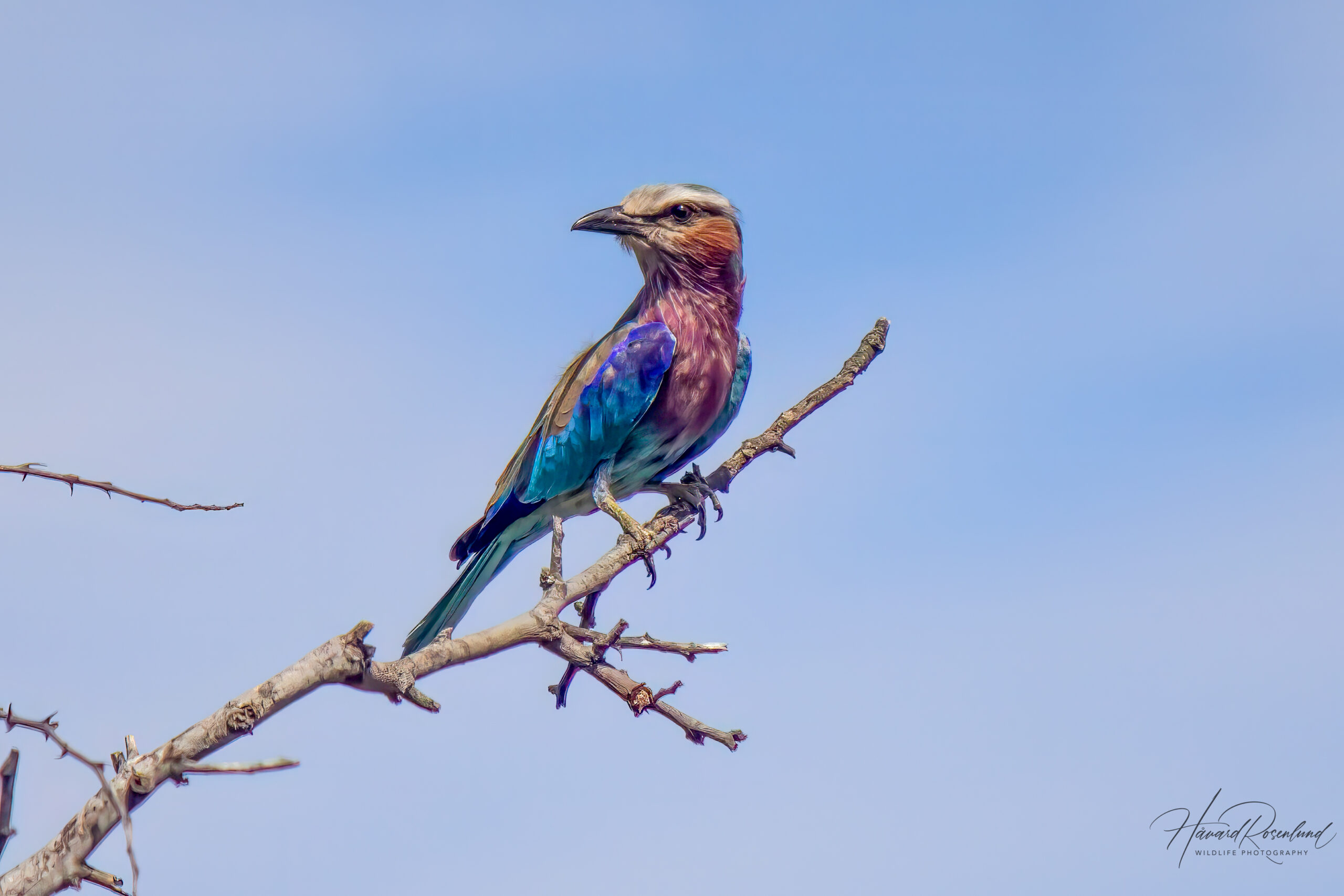
Lilac-breasted Roller
Coracias caudatus
At a glance
Habitat
- Open savanna, thornveld, grassland and open woodland with scattered trees or other elevated perches
Diet
- Mainly large insects and other invertebrates; also scorpions, centipedes, frogs, lizards, small snakes, birds and rodents
Activity
- Diurnal; usually hunts from an exposed perch
Size
- Length: 35–38 cm Weight: 87–135 g
Range
- Widespread across eastern and southern Africa, with a northeastern form extending through the Horn of Africa
Description
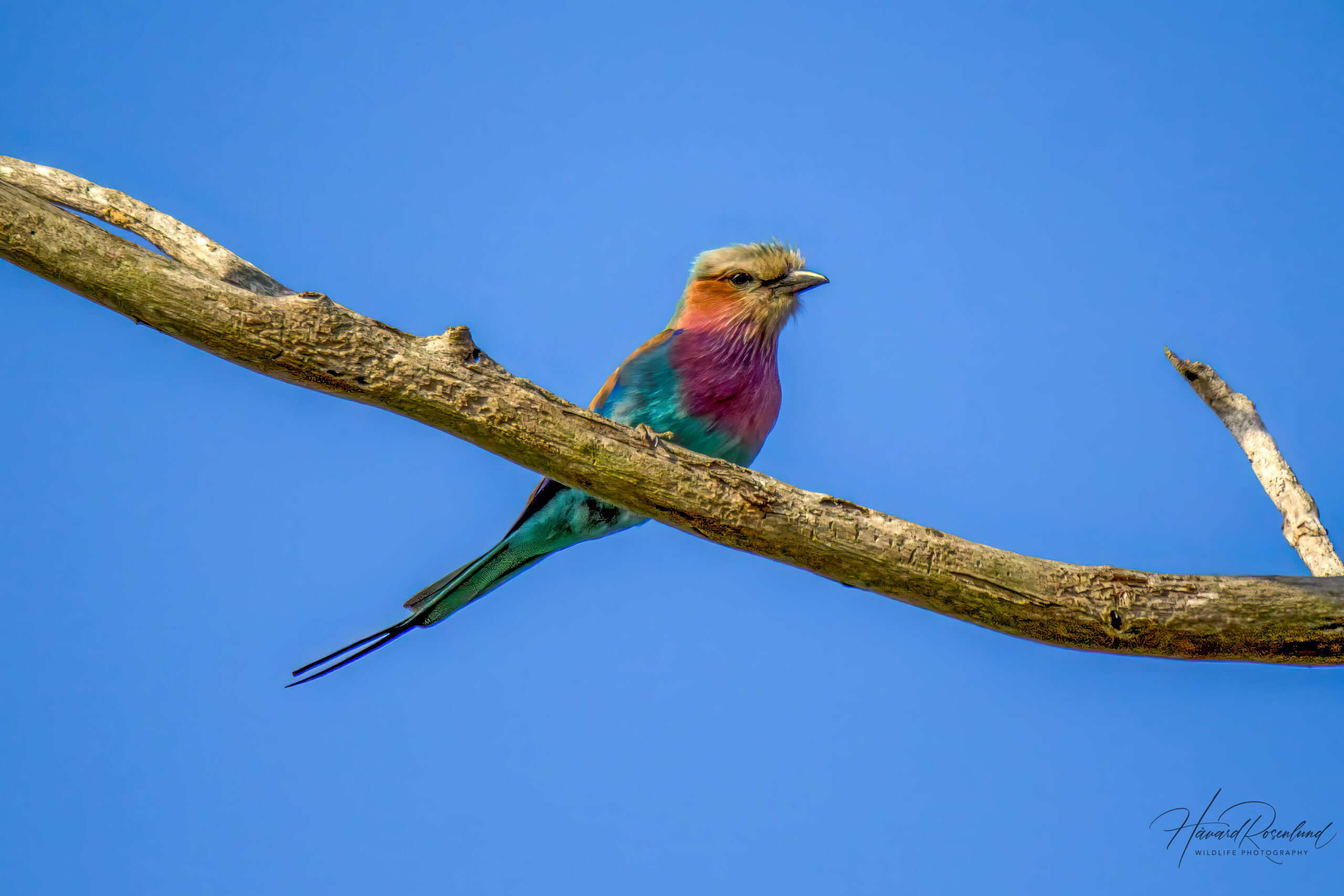
The lilac-breasted roller (Coracias caudatus) is one of Africa’s most distinctive open-country birds. Adults measure about 35–38 cm including the elongated outer tail feathers and weigh roughly 87–135 g. The plumage combines a greenish crown, white forehead and chin, lilac throat and breast, turquoise underparts, rich blue wings and a warm brown back. Males and females look alike.
Two subspecies are recognised. C. c. caudatus occupies much of eastern and southern Africa, while C. c. lorti occurs farther northeast around the Horn of Africa and northeastern Kenya and has less extensive lilac colouring on the breast.
Habitat
Lilac-breasted rollers favour open savanna, thornveld, grassland and open woodland where scattered trees, dead branches, fence posts or utility lines provide clear hunting perches. They are especially characteristic of landscapes that combine open ground for detecting prey with elevated vantage points and mature trees containing nesting cavities.
Diet
Large insects and other invertebrates dominate the diet, including grasshoppers, beetles, spiders, scorpions, centipedes and millipedes. Frogs, lizards, small snakes, birds and rodents are also taken.
A study published in 2023, based on photographs from southern Africa, found that lilac-breasted rollers ate a broader range of prey during summer, when migratory European rollers (Coracias garrulus) were also present. The two species nevertheless had an 84% overlap in dietary composition, which may indicate substantial competition for prey when they occur together.
Hunting
Lilac-breasted rollers are conspicuous perch-and-wait hunters. A bird typically sits on an exposed branch, post or wire, scans the ground and then drops rapidly onto prey before returning to a perch. Some insects can also be caught in flight.
The species readily exploits temporary feeding opportunities. Birds may gather near the edges of grass or bush fires and take insects and small animals flushed or killed by the flames. Road verges can provide similar open hunting surfaces; in the field observations from the same 2023 study, most prey captures occurred on the road itself.
Behaviour
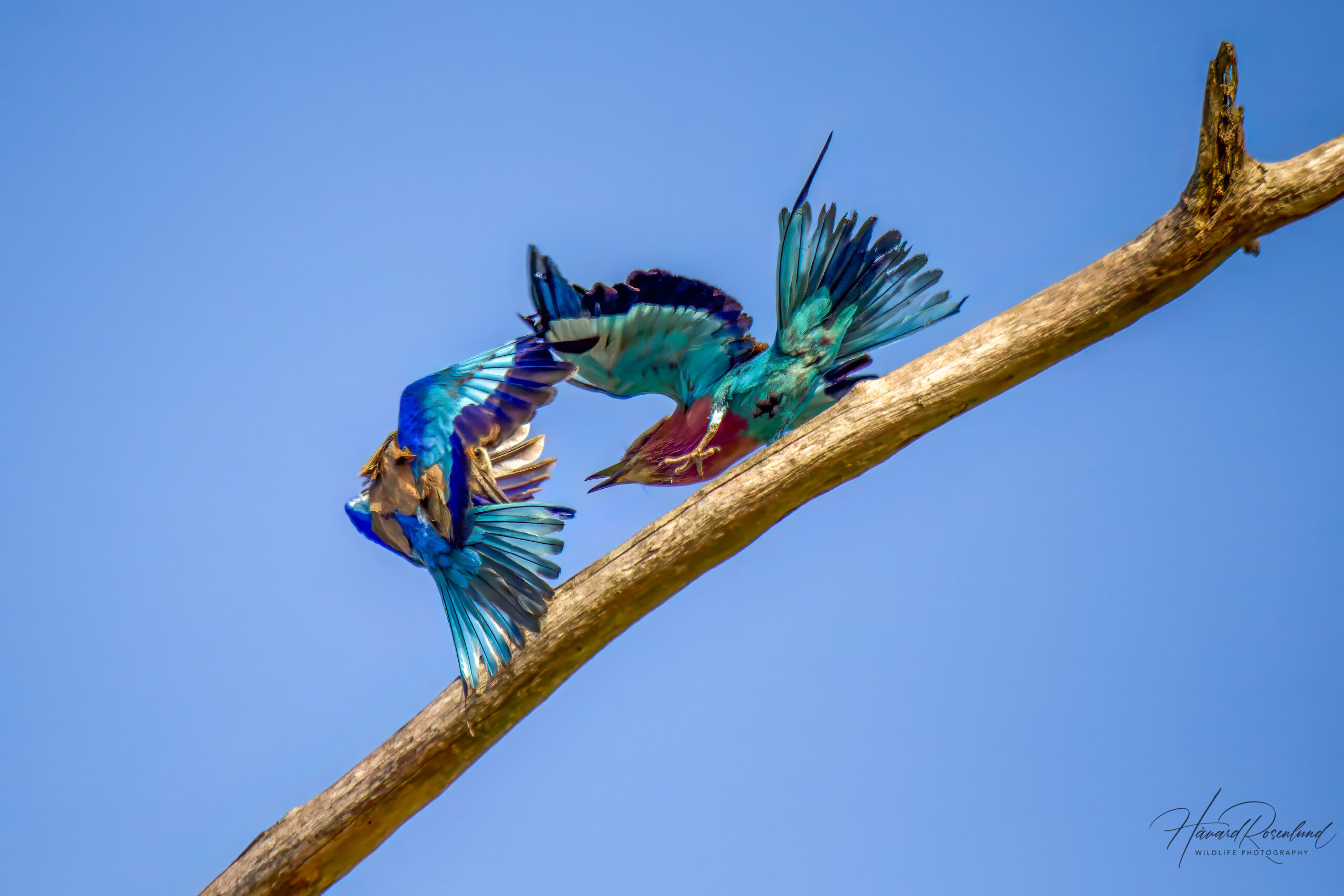
Lilac-breasted rollers are usually encountered alone or in pairs and are strongly territorial. Feeding areas as well as nesting territories may be defended, intruders can be chased aggressively and larger birds may be mobbed when they approach an occupied territory.
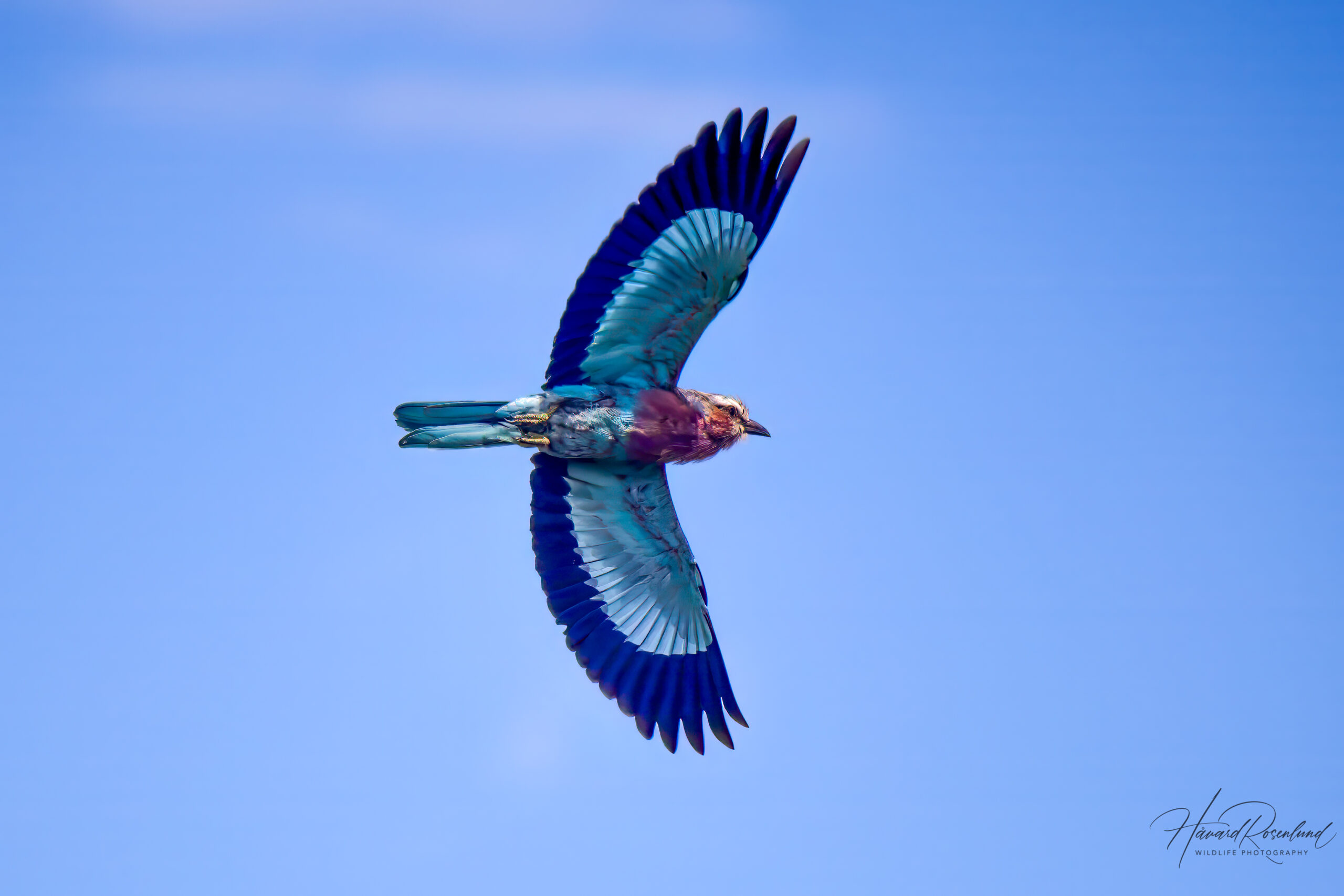
The spectacular rolling flight that gives rollers their English family name is used in both territorial advertisement and breeding display. A bird climbs strongly, dives with partly closed wings and rolls from side to side before levelling out, often calling throughout the performance. Because the display is also directed at territorial rivals, it is not simply a courtship flight.
Breeding
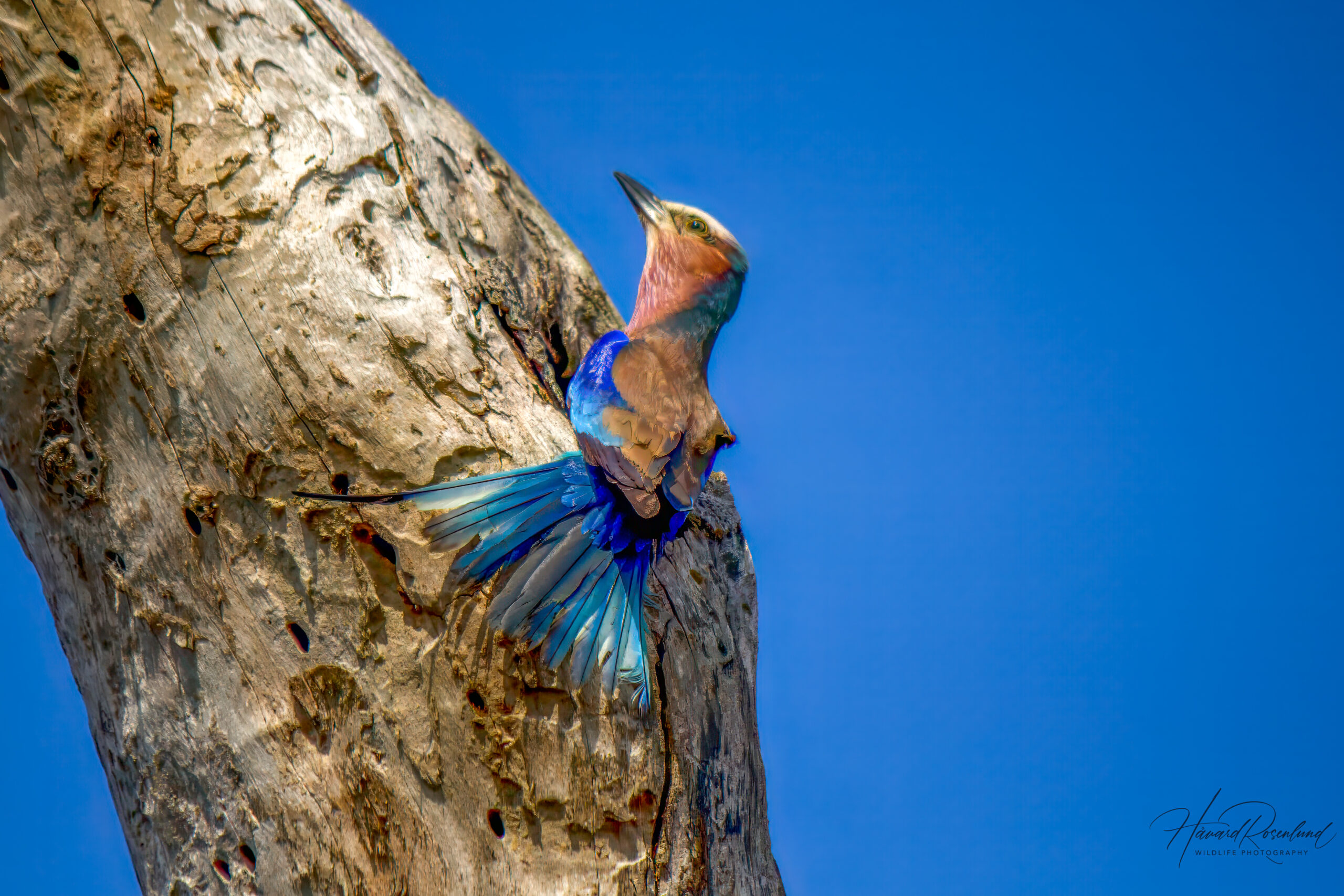
Pairs are monogamous, and the rolling aerial display also forms part of courtship. They usually nest in natural tree cavities and may use old holes made by other cavity-nesting birds. Competition for suitable hollows can be intense, and rollers may displace other occupants. Breeding timing varies geographically; in southern Africa most nesting takes place from late winter through summer.
Two to four eggs are laid and incubated by both parents for about 17–25 days. The chicks remain in the nest for roughly 19 days and continue to depend on their parents for about another 20 days after leaving. The adults defend the nesting area vigorously throughout this period.
Cultural significance
The lilac-breasted roller has become one of the most recognisable symbols of wildlife tourism in East Africa and is widely described as Kenya’s unofficial national bird. Its unusually colourful plumage is often presented as a symbol of the country’s diversity. Kenya has no formally designated national bird, so the association is best understood as a widely used popular symbol rather than an official state designation.
Status
The lilac-breasted roller is globally classified as Least Concern on the IUCN Red List. It has a very large range across eastern and southern Africa and remains common in many protected savannas and open woodland landscapes.
The species is not globally threatened, but local populations can be affected where large cavity-bearing trees are removed or open woodland is heavily transformed. Intensive pesticide use may also reduce local prey availability.
Image gallery
Loading map and observations…
Have you seen this species?
Independent species archive
Did you find this species page useful?
Wildlife Vagabond is independently built and maintained. Voluntary support helps cover hosting, maps, data storage and continued improvements to the species archive.
Support Wildlife VagabondSpecies content will remain freely available.
References
Information about the species’ global distribution and status is based primarily on global Red List data. See the references below for details.
- AviList. (2026). v2025b. https://www.avilist.org/checklist/v2025b/
- Biodiversity Explorer. (n.d.). Lilac-breasted Roller (Roberts-based species account). Iziko Museums of South Africa. https://www.biodiversityexplorer.info/birds/coraciidae/coracias_caudatus.htm
- BirdLife International. (n.d.). Lilac-breasted Roller species factsheet. https://datazone.birdlife.org/species/factsheet/lilac-breasted-roller-coracias-caudatus
- Coraciiformes Taxon Advisory Group. (n.d.). Lilac-breasted Roller species account. https://www.coraciiformestag.com/Roller/caudata/caudata.html
- International Union for Conservation of Nature. (n.d.). Lilac-breasted Roller. The IUCN Red List of Threatened Species. https://www.iucnredlist.org/species/22682874/92966607
- Nupen, L., Gardner, M., Morin, J., Ndou, T., & Dugmore, E. K. (2023). Web-sourced photographic methods reveal dietary composition and shifts in resident and migrant Coracias rollers in southern Africa. Biodiversity Observations, 13, 61-94. https://doi.org/10.15641/bo.1227
- The Standard. (n.d.). Decoding symbols of the nation. https://www.standardmedia.co.ke/sports/amp/sunday-magazine/2000123148/decoding-symbols-of-the-nation