
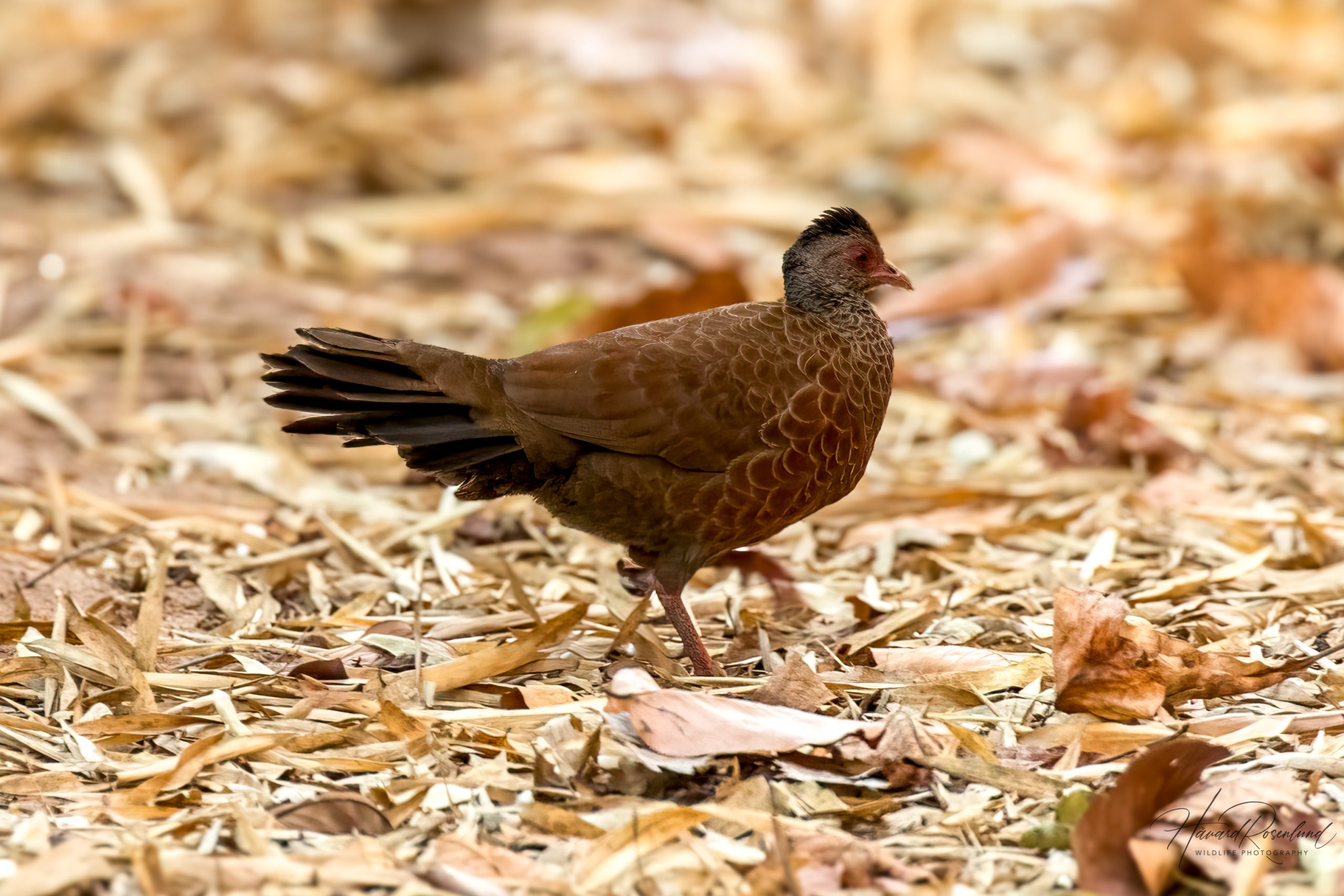
Red Spurfowl
Galloperdix spadicea
At a glance
Habitat
- Forest, dense scrub, bamboo and wooded foothills, usually with thick ground cover
Diet
- Mainly seeds, fruit and other plant material, supplemented by insects and other small invertebrates
Activity
- Mostly diurnal; often most vocal around dawn and dusk
Size
- Length: 36–40 cm Weight: 370 g
Range
- Endemic to mainland India, mainly south of the Ganges
Description
The red spurfowl (Galloperdix spadicea) is a medium-sized, ground-dwelling gamebird endemic to mainland India. Adults are roughly 36–40 cm long and weigh around 370 g. Males are rich chestnut to rufous-brown with a greyer head, while females are duller and more finely marked. The closely related painted spurfowl (Galloperdix lunulata) is more heavily patterned with conspicuous pale spotting.
The strong legs carry the spurs that give the group its name. Males usually have two or three on each leg and occasionally more, while females may also have one or two. The larger male spurs are used in close-range conflict. Despite its sturdy build, the red spurfowl is a shy bird that spends much of its life concealed near the forest floor and is often heard before it is seen.
Habitat
Red spurfowl are forest specialists and occur in a range of wooded habitats, including dry and moist deciduous forest, scrubby woodland, bamboo thickets and forested foothills. Dense undergrowth is particularly important, providing both shelter and feeding cover close to the ground.
The species can also use forest edges and some modified wooded landscapes, but it remains closely tied to vegetation that provides substantial cover. State of India's Birds 2025 estimates that its occupied range within India covers roughly 334,000 km².
Diet
The diet is mainly plant-based, with seeds, fallen fruit and other plant material collected from the forest floor. Insects and other small invertebrates are also taken, particularly when they are easily available in leaf litter and loose soil.
Like many ground-dwelling gamebirds, red spurfowl scratch through leaves and soil with their feet to uncover food. This feeding style keeps them close to dense cover, where they can quickly disappear into vegetation if disturbed.
Behaviour
Red spurfowl are secretive and usually encountered in pairs or small family groups. They spend most of their time walking and running through undergrowth and usually try to escape on foot, taking flight mainly when a threat gets very close.
Calls are often the easiest way to detect the species, especially around dawn and dusk when birds can be particularly vocal. The combination of dense habitat, quiet ground movement and reluctance to remain in the open helps explain why the species can be locally common yet surprisingly difficult to observe.
Breeding
Breeding timing varies across India and is generally concentrated from the first half of the year into the early monsoon period. The nest is a shallow scrape on the ground, usually well hidden beneath bamboo, scrub or other dense vegetation and lined with leaves and grasses.
Clutches usually contain three to five eggs. The female appears to carry out most or all of the incubation, while both adults remain involved with the brood after hatching. The chicks are precocial: they hatch well developed, leave the nest soon afterwards and begin feeding for themselves while following the adults. The incubation period has not been reliably established across the species.
Status
The red spurfowl is classified as least concern on the IUCN Red List and remains widespread across much of its Indian range. State of India's Birds 2025 lists it as a species of low conservation priority and documents a strong association with forest.
The same 2025 assessment points to a possible long-term decline of about 23%, but the uncertainty is large enough that a clear national trend cannot yet be established; the recent annual trend is also unclear. Forest loss and degradation can still reduce local populations even though the species remains Least Concern globally.
Image gallery
Loading map and observations…
Have you seen this species?
Independent species archive
Did you find this species page useful?
Wildlife Vagabond is independently built and maintained. Voluntary support helps cover hosting, maps, data storage and continued improvements to the species archive.
Support Wildlife VagabondSpecies content will remain freely available.
References
Information about the species’ global distribution and status is based primarily on global Red List data. See the references below for details.
- BirdLife International. (n.d.). Red Spurfowl species factsheet. https://datazone.birdlife.org/species/factsheet/red-spurfowl-galloperdix-spadicea
- Birds of India. (n.d.). Galloperdix spadicea (Red Spurfowl). https://www.birdsofindia.org/galloperdix-spadicea
- International Union for Conservation of Nature. (n.d.). Red Spurfowl. The IUCN Red List of Threatened Species. https://www.iucnredlist.org/species/22679131/263699457
- State of India's Birds. (2025). 2025 – Red Spurfowl (Galloperdix spadicea). https://stateofindiasbirds.in/species/tn-redspu1/
- Store norske leksikon. (n.d.). rødsporehøne (Galloperdix spadicea). https://snl.no/rødsporehøne
- Wildlife Institute of India. (n.d.). Wildlife Habitat Relationships in Conservation Areas: Red Spur Fowl. https://digitalrepository.wii.gov.in/server/api/core/bitstreams/2a10057d-dd8e-41cf-a612-a0880033fea0/content