
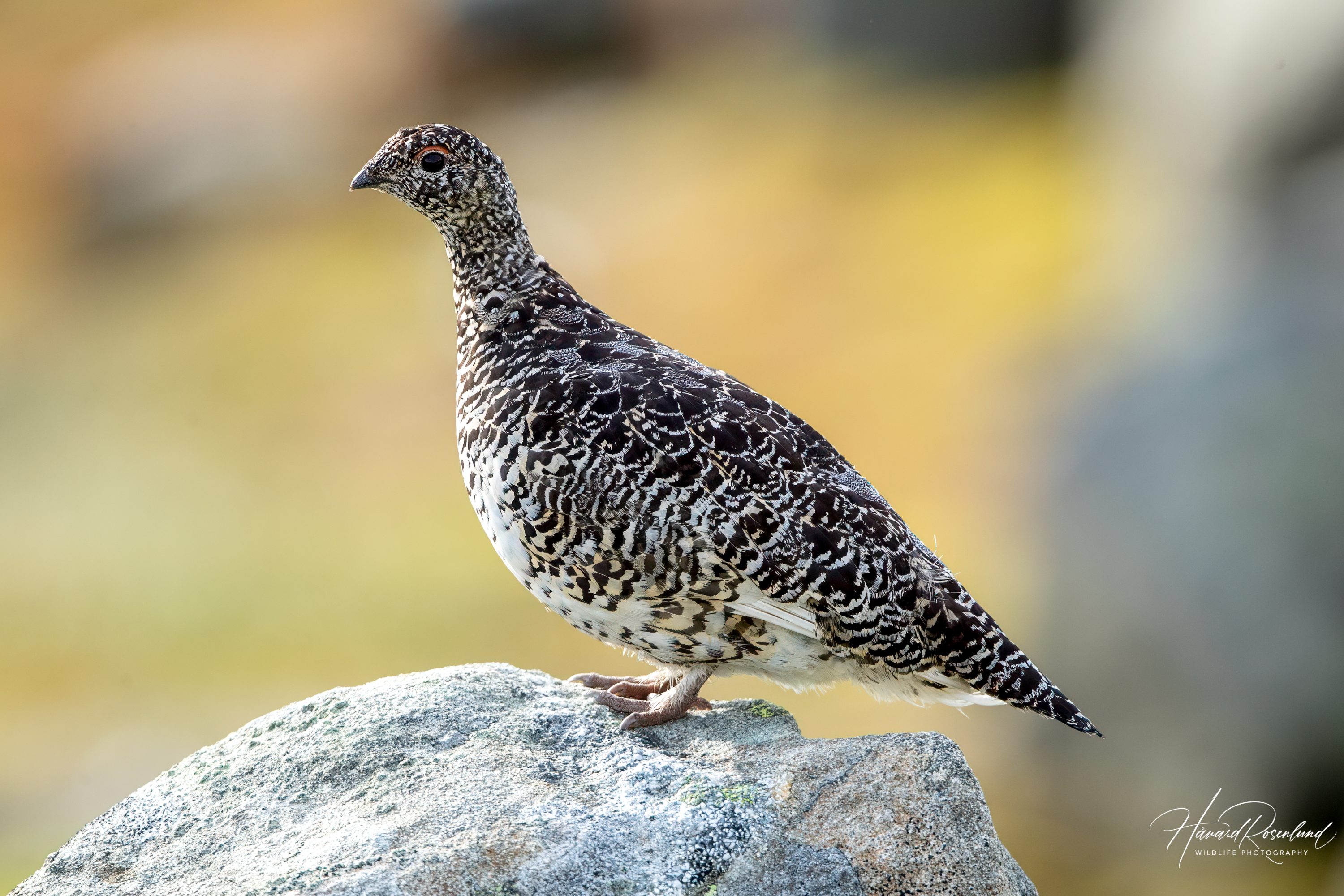
Rock Ptarmigan
Lagopus muta
At a glance
Habitat
- Arctic tundra, alpine heath, rocky slopes, scree and high mountain plateaus, usually above the treeline
Diet
- Buds, leaves, shoots, flowers, berries and seeds; chicks take many insects during early growth
Activity
- Diurnal
Size
- Length: 34–38 cm; wingspan about 55–65 cm Weight: roughly 400–700 g, with substantial seasonal and regional variation
Range
- Circumpolar Arctic and isolated high mountains across Europe, Asia and North America
Description
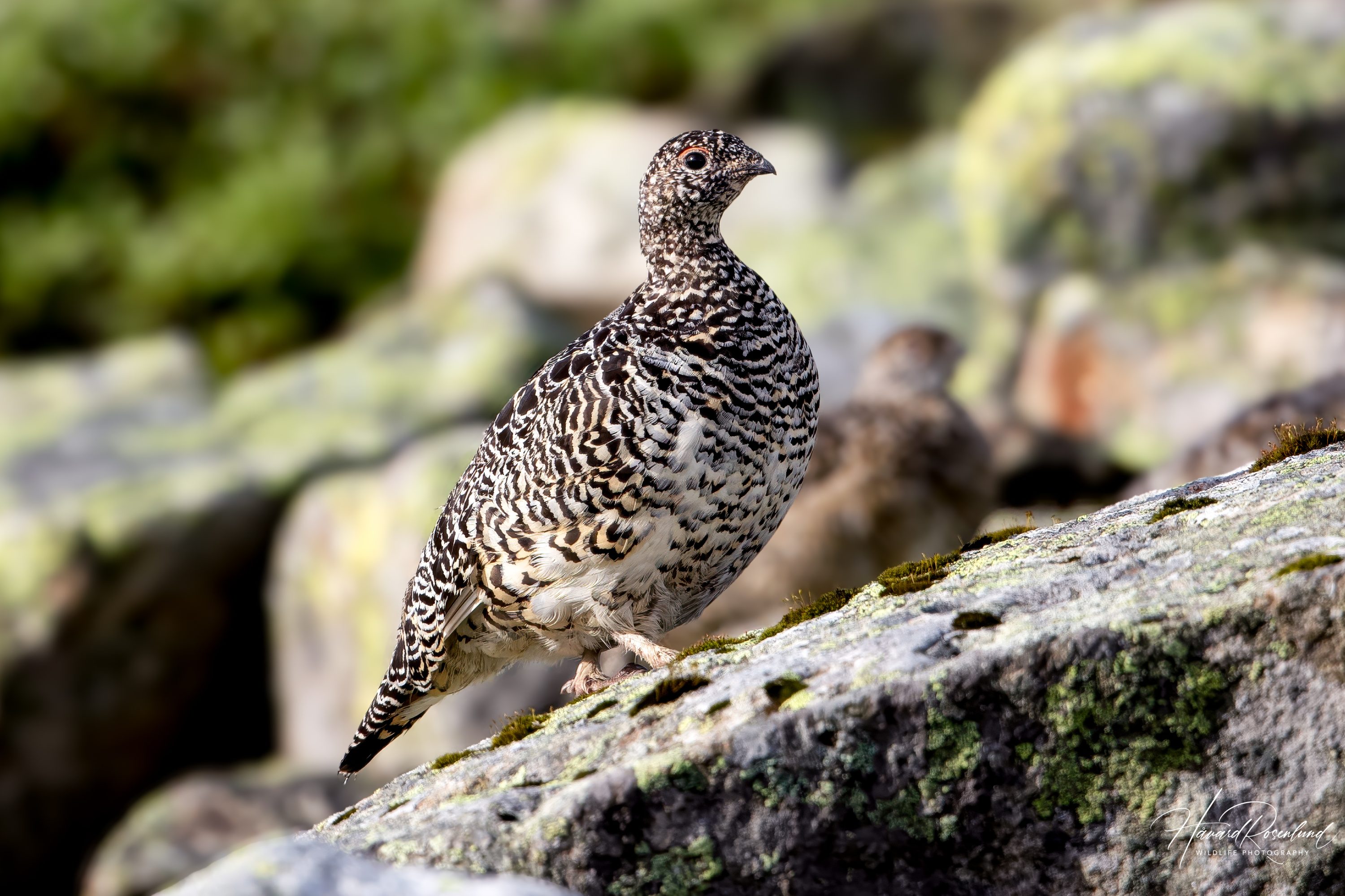
The rock ptarmigan (Lagopus muta) is a compact grouse of Arctic and high-alpine landscapes, about 34–38 cm long with a wingspan of roughly 55–65 cm. Body mass varies strongly with season, sex and region, commonly falling around 400–700 g in mainland populations. The feet and toes are densely feathered, reducing heat loss and spreading the bird’s weight over soft snow.
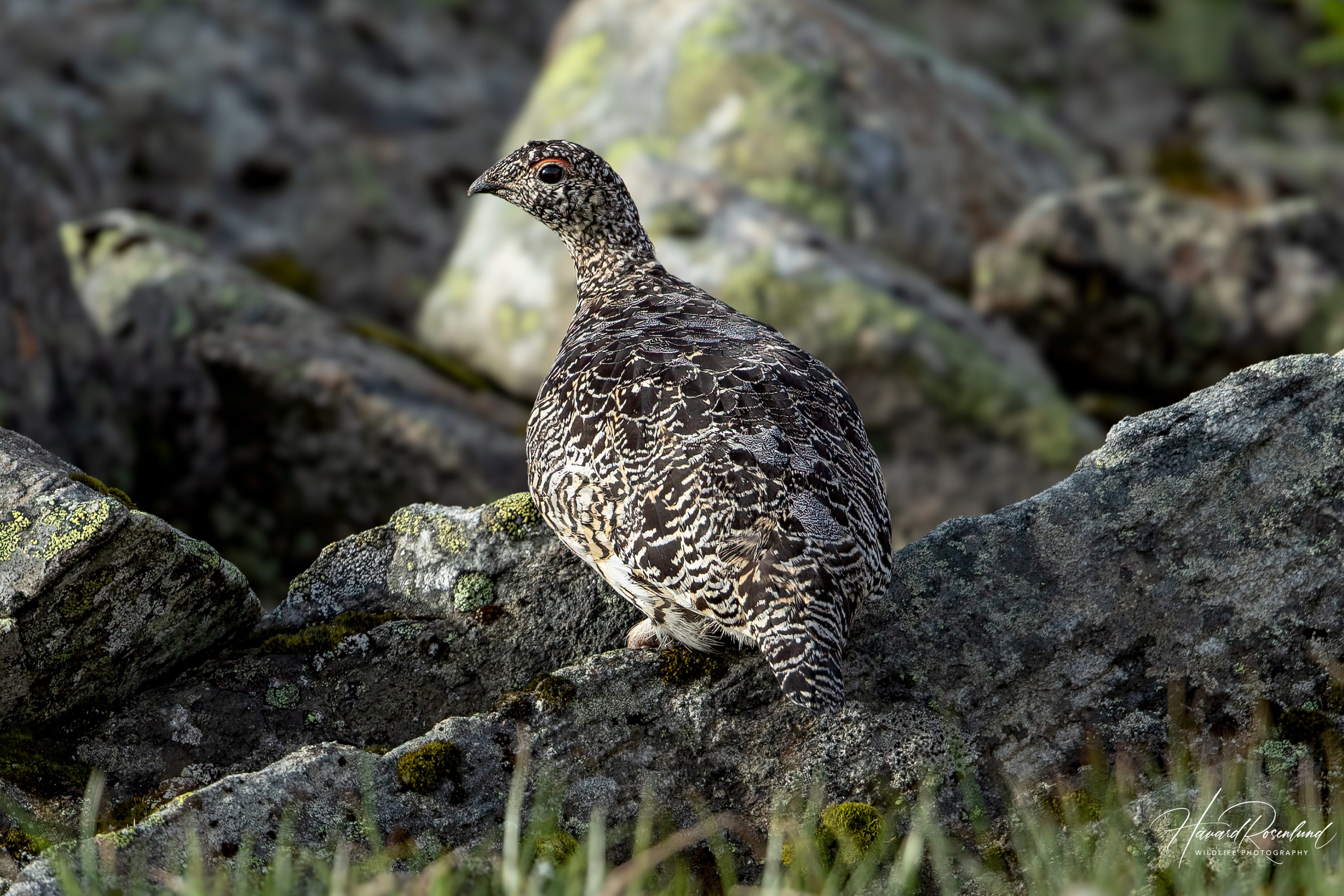
Seasonal plumage is one of the species’ defining adaptations. Winter birds are almost entirely white except for the black tail, while summer plumage becomes finely mottled grey-brown and blends with rock and tundra vegetation. Males retain a conspicuous black line from the bill through the eye in winter. Willow ptarmigan (Lagopus lagopus) is generally larger, browner in summer and more strongly associated with willow and shrub vegetation at lower elevations.
Svalbard supports the larger and heavier endemic subspecies Svalbard ptarmigan (L. m. hyperboreus). It builds substantial fat reserves before winter and can exceed 900 g in body mass.
Habitat
Rock ptarmigan inhabit treeless Arctic tundra and high mountain terrain: wind-exposed ridges, rocky slopes, scree, alpine heath and plateaus with low vegetation. In Arctic regions they can occur close to sea level, whereas farther south they are largely restricted to high elevations above the treeline.
Habitat use shifts through the year as snow, wind and food availability change. Birds may move between exposed ridges where vegetation remains accessible and more sheltered slopes during severe weather, but most populations are resident rather than regular long-distance migrants.
Diet
Adults are predominantly herbivorous. Willow and birch buds and shoots, dwarf shrubs, leaves, flowers, berries and seeds are important foods, with the exact composition changing greatly among regions and seasons. In winter, birds often feed where wind exposes vegetation above or through the snow.
Young chicks require more protein than adults and take large numbers of insects and other small invertebrates during their first weeks. As they grow, the diet shifts progressively toward the plant foods that dominate in adults.
Behaviour
Males occupy territories in spring and use calls, short display flights and postures to mark those territories and drive off rivals. Outside the breeding season territorial behaviour weakens and birds may gather in small or larger flocks.
Most populations make seasonal movements rather than regular long-distance migrations, but these movements can still be substantial. A two-year study published in 2020 followed 84 radio-tagged rock ptarmigan in central Norway. The longest recorded movement between winter and the breeding season was 79.5 km, and birds still tracked in May–July were on average 20.3 km from their winter capture sites.
In winter, birds can dig into soft snow and shelter in snow burrows or tunnels during severe cold, using the insulating snow layer as protection from exposed surface conditions.
Predation
Rock ptarmigan are important prey for several Arctic and alpine predators, but the best-documented relationship is with the gyrfalcon (Falco rusticolus). In Iceland the two species form a tightly coupled predator–prey system: gyrfalcons depend heavily on ptarmigan, and long-term studies show that falcon numbers and reproduction respond to changes in ptarmigan abundance. Arctic foxes (Vulpes lagopus), ravens (Corvus corax) and owls also take eggs, young or adults in parts of the range.
A study published in 2025 from northern Fennoscandia, where both rock and willow ptarmigan occur, found that ptarmigan (Lagopus spp.) accounted for about 98% of prey delivered to monitored gyrfalcon nests. Gyrfalcon breeding success also increased with ptarmigan density.
Camouflage is the ptarmigan's first line of defence. Birds often remain motionless until danger comes close, relying on seasonal plumage that matches snow, rock and tundra vegetation before taking flight.
Breeding
Breeding begins after spring snowmelt opens suitable patches of tundra. The female makes a shallow ground scrape among stones or low vegetation. Clutches are large and vary geographically, commonly containing around five to eleven eggs, with wider extremes documented. The female performs the incubation alone for about 21–23 days.
The chicks hatch covered in down and can walk and feed shortly after leaving the nest, although the female continues to brood, guide and defend them. Insects are especially important during this rapid early growth. Young birds can make short flights after roughly 10–15 days and become independent at around 10–12 weeks.
Relationship with humans
Rock ptarmigan is a harvested game bird in Norway, and hunting adds mortality to populations that already fluctuate strongly from year to year. In the central Norwegian tracking study published in 2020, estimated harvest mortality during the February winter hunt was about 9%.
Ptarmigan hunting has long traditions in Norway, including walk-up shooting and, in some regions, snaring. The effect of harvest depends partly on local abundance and recruitment and can become more important when ptarmigan numbers are low. Norwegian hunting regimes can therefore vary through daily or seasonal quotas and the number of permits made available.
Status
The rock ptarmigan is listed as least concern on the IUCN Red List. Its circumpolar range contains many isolated and regionally distinct populations with very different local trends.
Climate change is a particular concern for southern alpine populations. A study from the western Italian Alps found that delayed autumn snowfall was associated with poorer population performance, possibly because birds in white winter plumage became more conspicuous against snow-free ground. Warming can also reduce suitable alpine habitat.
On mainland Norway, rock ptarmigan is assessed as least concern on the Norwegian Red List 2021. It had been Near Threatened in 2015, but monitoring from 2010–2019 showed a clear increase. The Norwegian breeding population was estimated at roughly 200,000–400,000 individuals in 2015, although natural year-to-year fluctuations are substantial.
The endemic Svalbard subspecies, Svalbard ptarmigan (L. m. hyperboreus), is likewise assessed as least concern. Monitoring recorded an increase in territorial males within the monitored area from 2014 to 2019, while a reliable estimate of the total Svalbard population is still lacking.
Image gallery
Loading map and observations…
Have you seen this species?
Independent species archive
Did you find this species page useful?
Wildlife Vagabond is independently built and maintained. Voluntary support helps cover hosting, maps, data storage and continued improvements to the species archive.
Support Wildlife VagabondSpecies content will remain freely available.
References
Information about the species’ global distribution and status is based primarily on global Red List data. See the references below for details.
- Artsdatabanken. (n.d.). Artsdatabanken – Rock Ptarmigan (Lagopus muta), Norwegian Red List 2021, mainland Norway. https://lister.artsdatabanken.no/rodlisteforarter/2021/31754
- Artsdatabanken. (n.d.). Artsdatabanken – Rock Ptarmigan (Lagopus muta), Norwegian Red List 2021, Svalbard. https://lister.artsdatabanken.no/rodlisteforarter/2021/31845
- AviList. (n.d.). v2025 – Global avian checklist. https://www.avilist.org/
- BirdLife International. (n.d.). Rock Ptarmigan (Lagopus muta) species factsheet. https://datazone.birdlife.org/species/factsheet/rock-ptarmigan-lagopus-muta
- British Trust for Ornithology. (n.d.). Ptarmigan BirdFacts. https://www.bto.org/learn/about-birds/birdfacts/ptarmigan
- Cornell Lab of Ornithology. (n.d.). Rock Ptarmigan overview and behaviour. https://www.allaboutbirds.org/guide/Rock_Ptarmigan/overview
- Imperio, S., Bionda, R., Viterbi, R., & Provenzale, A. (2013). Climate Change and Human Disturbance Can Lead to Local Extinction of Alpine Rock Ptarmigan: New Insight from the Western Italian Alps. PLoS ONE, 8(11), e81598. https://doi.org/10.1371/journal.pone.0081598
- International Union for Conservation of Nature. (n.d.). Lagopus muta. The IUCN Red List of Threatened Species. https://www.iucnredlist.org/species/22679464/281852120
- Lehikoinen, A., Brotons, L., Calladine, J., Campedelli, T., Escandell, V., Flousek, J., Grueneberg, C., Haas, F., Harris, S., Herrando, S., Husby, M., Jiguet, F., Kålås, J. A., Lindström, Å., Lorrillière, R., Molina, B., Pladevall, C., Calvi, G., Sattler, T., … Trautmann, S. (2019). Declining population trends of European mountain birds. Global Change Biology, 25(2), 577-588. https://doi.org/10.1111/gcb.14522
- Nielsen, Ó. K. (1999). Gyrfalcon predation on ptarmigan: numerical and functional responses. Journal of Animal Ecology, 68(5), 1034-1050. https://doi.org/10.1046/j.1365-2656.1999.00351.x
- Nilsen, E. B., Moa, P. F., Brøseth, H., Pedersen, H. C., & Hagen, B. R. (2020). Survival and Migration of Rock Ptarmigan in Central Scandinavia. Frontiers in Ecology and Evolution, 8, 34. https://doi.org/10.3389/fevo.2020.00034
- Nord, A., & Folkow, L. P. (2017). Seasonal variation in the thermal responses to changing environmental temperature in the world's northernmost landbird. Journal of Experimental Biology, jeb.171124. https://doi.org/10.1242/jeb.171124
- Slettenhaar, A. J., Østnes, J. E., Moen, B. C., Kroglund, R. T., Nygård, T., & Nilsen, E. B. (2025). A Picky Predator and Its Prey: How Snow Conditions and Ptarmigan Abundance Impact Gyrfalcon Feeding Behaviour and Breeding Success. Ecology and Evolution, 15(4), e71228. https://doi.org/10.1002/ece3.71228
- Store norske leksikon. (n.d.). Pedersen, H.C. – Fjellrype, Store norske leksikon (updated 2026). https://snl.no/fjellrype