
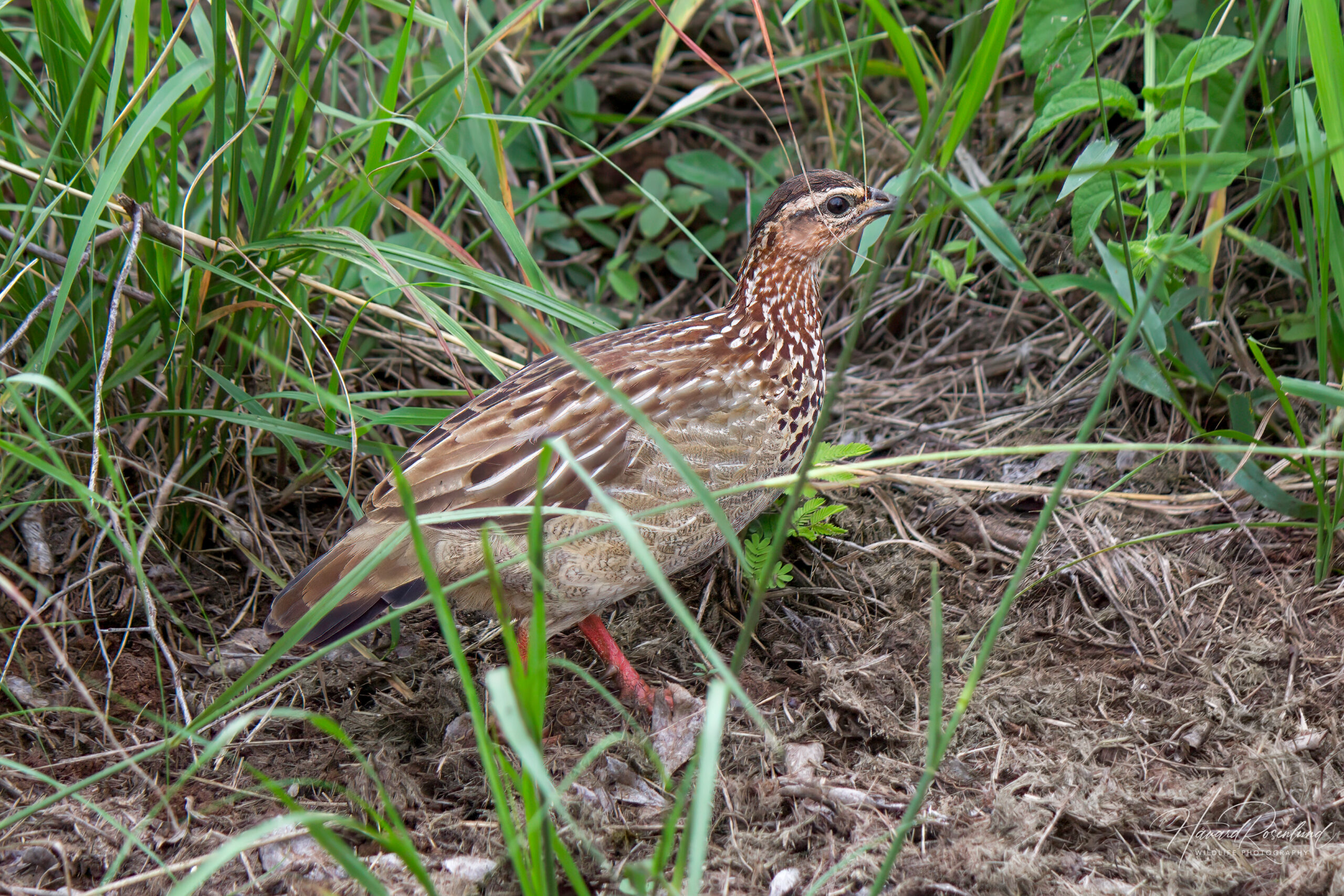
Crested Francolin
Ortygornis sephaena
At a glance
Habitat
- Woodland, wooded savanna, thornveld and scrub with good ground cover
Diet
- Insects and other invertebrates; bulbs, roots, shoots, seeds, fruit and berries
Activity
- Diurnal; most vocal around dawn and dusk
Size
- Length: 30–35 cm Weight: roughly 220–420 g
Range
- Eastern and southern Africa
Description
The crested francolin (Ortygornis sephaena) is a widespread African gamebird. It measures about 30–35 cm and recorded body masses fall roughly between 220 and 420 g, with variation between sex, subspecies and individual condition.
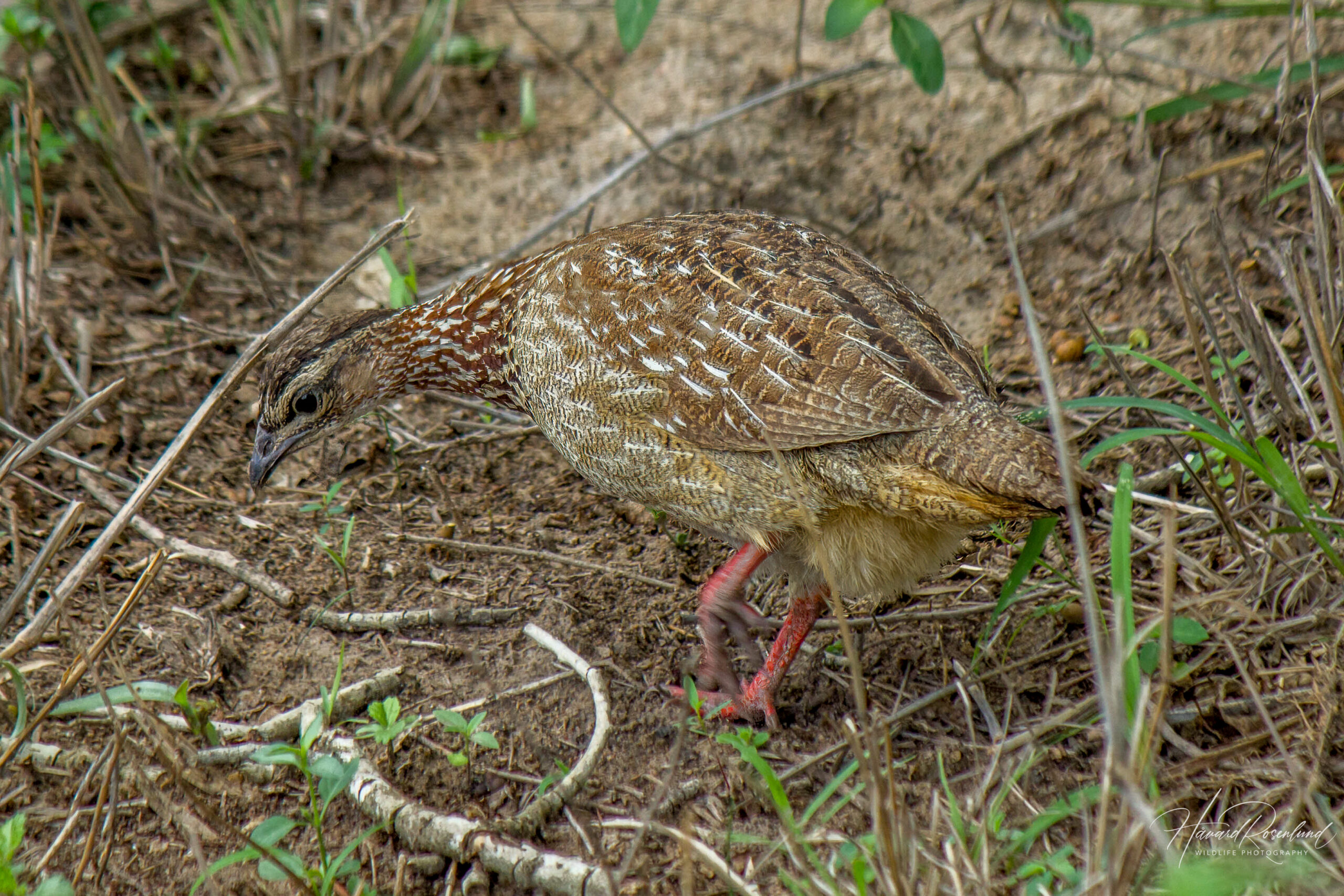
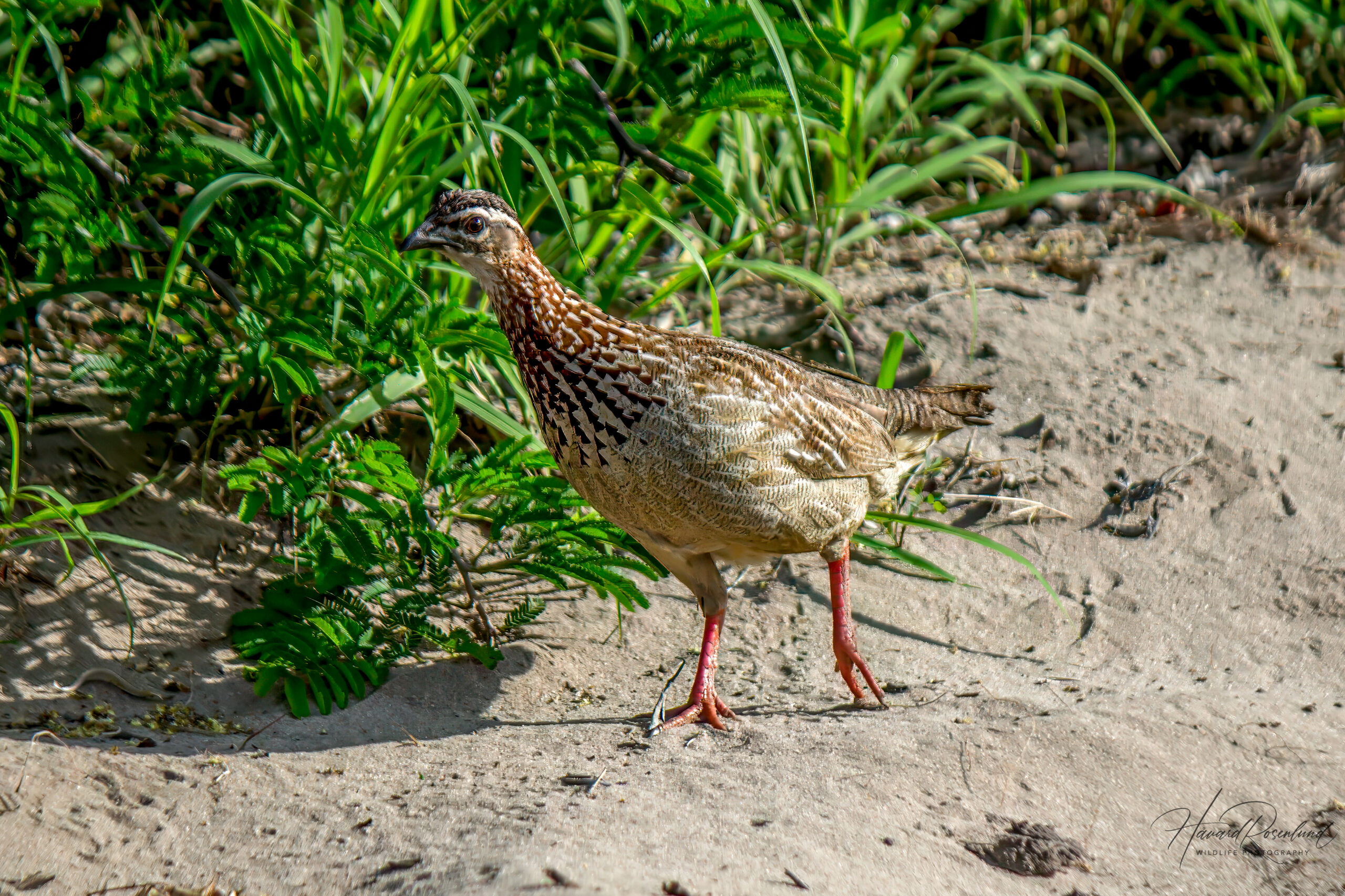
The finely mottled brown plumage provides effective camouflage against the ground and vegetation. Useful features include a broad white eyebrow, a white throat bordered by dark markings, a short crest and the habit of cocking the tail. Females and juveniles are usually duller, and males normally carry one or more leg spurs.
Taxonomy
The species was long placed in Francolinus and later in Dendroperdix, a genus that at the time contained only this species. Studies of its evolutionary relationships showed that it is closely related to the grey francolin (Ortygornis pondicerianus) and swamp francolin (Ortygornis gularis), and modern world checklists now place all three in Ortygornis.
AviList v2025b treats the crested francolin as one species with five subspecies. Some of these forms, particularly O. s. rovuma, have at times been proposed as separate species, so older sources may use a somewhat different species treatment.
Habitat
Crested francolins live in woodland, wooded savanna, thornveld and scrub with enough ground cover. Dense low vegetation is important for concealment, while trees and taller shrubs are also used for calling and roosting.
Diet
The diet changes seasonally. Insects and other invertebrates are particularly important in the wetter, warmer months, while bulbs, corms (swollen underground storage stems), roots, shoots, seeds, leaves, fruit and berries form a larger share during drier periods. Crested francolins obtain most food while walking and scratching on the ground. Chicks depend especially heavily on protein-rich invertebrates during early growth.
Acacia resin can also be an important winter food. A South African winter study of 37 crested francolins from five localities found it to form an important part of the diet. The birds collected the resin directly from bark while perched in trees, so although most food is taken from the ground, seasonal foods can also be obtained above ground.
Behaviour
Crested francolins commonly live in family groups of two to five birds. Long-term work in South Africa found that groups were usually centred on a male–female pair, while later studies showed that males can form temporary groups after breeding before new pairs form for the next breeding season.
The loud, accelerating calls are among the most familiar sounds of bushveld at dawn and dusk. Territorial males call from the ground, rocks or other slightly raised positions and respond strongly to neighbouring birds.
At dusk, neighbouring territorial males often answer one another in regular patterns. Work in Tembe Elephant Park in 2018–2019 showed that these exchanges occurred both outside the main breeding period and around its onset, without becoming more intense in the way expected if attracting females were their primary function. The pattern suggests that established neighbours also use one another's calls to detect unfamiliar intruders. Territorial rivals can therefore simultaneously provide useful information about activity around their shared boundaries.
Breeding
Crested francolins form monogamous breeding pairs that can remain together for up to about ten months. Breeding generally coincides with local rainy periods rather than falling in exactly the same months everywhere; in South Africa, for example, the main breeding period falls within the summer-rainfall season. Males compete over females and may use the spurs on their legs during close encounters.
The nest is a shallow scrape on the ground, lined with grass and leaves and concealed beneath vegetation. The female lays about three to seven eggs and incubates them alone; incubation lasts roughly 19–26 days. The male remains in the general area around the nest and gives warning calls when danger approaches.
The chicks are precocial, meaning they hatch well developed and mobile, and can leave the nest as little as about two hours later. Both parents then guard and guide the family while the chicks feed for themselves.
Status
The crested francolin has a broad distribution in eastern and southern Africa and remains listed as Least Concern on the IUCN Red List. It is still common in many suitable areas and is largely resident.
Local pressures include hunting, poorly timed or overly frequent fires and loss or simplification of woodland and scrub. These impacts can reduce local abundance but are not currently considered severe enough to place the species in a threatened category globally.
Image gallery
Loading map and observations…
Have you seen this species?
Independent species archive
Did you find this species page useful?
Wildlife Vagabond is independently built and maintained. Voluntary support helps cover hosting, maps, data storage and continued improvements to the species archive.
Support Wildlife VagabondSpecies content will remain freely available.
References
Information about the species’ global distribution and status is based primarily on global Red List data. See the references below for details.
- AviList. (2026). The Global Avian Checklist, v2025b. https://www.avilist.org/checklist/v2025b/
- BirdLife International. (n.d.). Crested Francolin Ortygornis sephaena species factsheet. https://datazone.birdlife.org/species/factsheet/crested-francolin-ortygornis-sephaena
- International Union for Conservation of Nature. (n.d.). Ortygornis sephaena (Crested Francolin). The IUCN Red List of Threatened Species. https://www.iucnredlist.org/species/22678752/92787092
- IOC World Bird List. (2021). Taxonomic update moving Crested Francolin from Dendroperdix to Ortygornis. https://www.worldbirdnames.org/new/updates/taxonomy/
- McGowan, Kirwan & Boesman. (2021). Crested Francolin (Ortygornis sephaena), Birds of the World. https://birdsoftheworld.org/bow/species/crefra2/cur/introduction
- Tobias, J. A., Sheard, C., Pigot, A. L., Devenish, A. J. M., Yang, J., Sayol, F., Neate‐Clegg, M. H. C., Alioravainen, N., Weeks, T. L., Barber, R. A., Walkden, P. A., MacGregor, H. E. A., Jones, S. E. I., Vincent, C., Phillips, A. G., Marples, N. M., Montaño‐Centellas, F. A., Leandro‐Silva, V., Claramunt, S., … Schleuning, M. (2022). AVONET: morphological, ecological and geographical data for all birds. Ecology Letters, 25(3), 581-597. https://doi.org/10.1111/ele.13898
- van Niekerk, J. H., & Forcina, G. (2020). Purpose of Crested FrancolinOrtygornis sephaenamale collective calls at dusk based on livestream audio censusing. Ostrich, 91(4), 326-337. https://doi.org/10.2989/00306525.2020.1827463
- van Niekerk, J. H. (2018). Coalition formation, mate selection and pairing behaviour of the Crested Francolin. Ostrich, 89(1), 71-78. https://doi.org/10.2989/00306525.2017.1409289
- van Niekerk. (2001). Notes on the winter diet of the Crested Francolin in South Africa. South African Journal of Wildlife Research, 31, 66–67. https://www.inasp.org.uk/ajol/journals/sajwr/vol31no1-2abs.html
- van Niekerk. (2001). Social and breeding behaviour of the Crested Francolin in the Rustenburg district, South Africa. South African Journal of Wildlife Research, 31, 35–42. https://hdl.handle.net/10520/EJC117117