
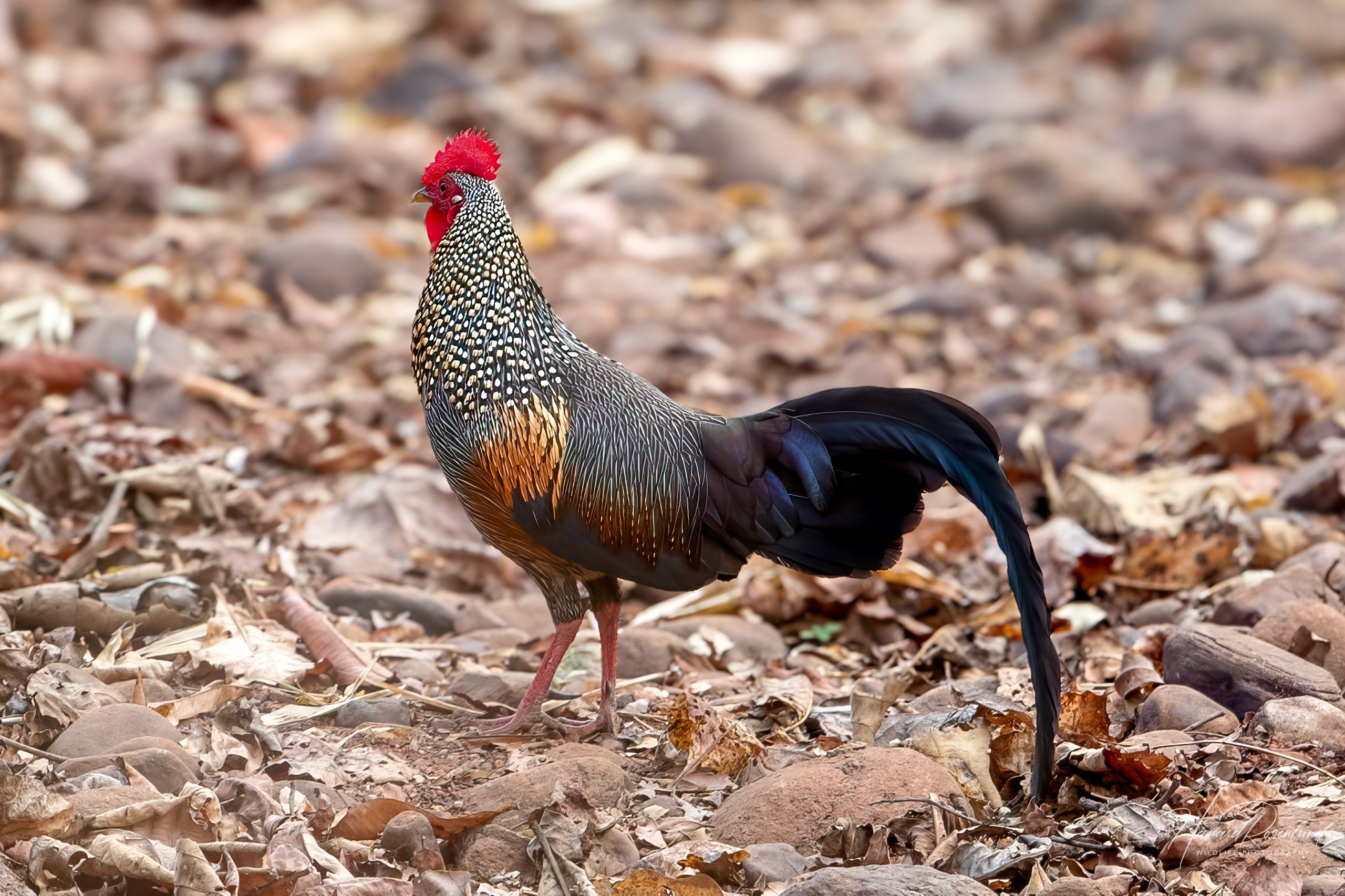
Grey Junglefowl
Gallus sonneratii
At a glance
Habitat
- Moist and dry deciduous forest, bamboo, scrub and wooded country
Diet
- Seeds, grains, fruit, shoots, insects and other small animals
Activity
- Diurnal
Size
- Length: Females 38–43 cm; males up to ca. 80 cm Weight: Females ca. 750 g; males ca. 965 g
Range
- Endemic to India, mainly southern, western and parts of central India
Description
The grey junglefowl (Gallus sonneratii) is endemic to India, where it is widespread in the south and west, including the Western Ghats and parts of the Eastern Ghats, and extends into parts of central India. Males can reach about 80 cm in total length because of their long sickle-shaped tail feathers, while females are usually around 38–43 cm. Typical adult mass is roughly 750 g for females and 965 g for males.
The cock has finely patterned grey and black plumage, a red comb and wattles, and distinctive elongated neck feathers tipped with hard yellowish plates. Outside the main breeding period males become less ornate and lose much of this decorative neck feathering. Females are far more subdued, with brown upperparts and strongly streaked black-and-white underparts. The related red junglefowl (Gallus gallus) is generally warmer red and golden in adult male plumage and lacks the grey junglefowl's characteristic yellow-tipped hackles.
Taxonomy
Gallus sonneratii is one of four living junglefowl species. Domestic chickens descend primarily from red junglefowl (Gallus gallus), but grey junglefowl also contributed genetic material through later hybridisation. A 2008 study traced the genetic variant associated with yellow skin in many domestic chickens to grey junglefowl rather than red junglefowl.
A whole-genome study published in 2024 analysed 149 samples representing all four wild junglefowl species and 13 local domestic-chicken breeds. It identified several additional genomic regions introgressed from grey junglefowl, including regions associated with growth and cellular stress responses. Hybridisation between grey and red junglefowl has also been documented where their ranges meet on the Indian subcontinent. Domestic chickens therefore retain genomic traces of later gene flow among Gallus lineages even though their primary ancestry is from red junglefowl.
Habitat
Grey junglefowl inhabit moist and dry deciduous forest, forest edge, bamboo, scrub and wooded country, from lowlands into hills. They also enter farmland and plantations beside forest but depend on nearby cover for refuge and roosting.
The species is strongly associated with woodland across its Indian range. It is resident rather than migratory, and local abundance can vary with forest structure, rainfall and the availability of food and secure roost sites.
Diet
Grey junglefowl are omnivorous ground foragers. They scratch through leaf litter for seeds, grains, berries, shoots, insects and other small animals. Diet changes with seasonal availability, and bamboo seed can become especially important when locally abundant.
Most feeding takes place on the ground, where the birds use their feet to expose food hidden under leaves and loose soil. Agricultural edges can also provide grain and invertebrates, although nearby forest cover remains important for shelter.
Behaviour
Grey junglefowl are diurnal and commonly move through their habitat in small groups, often remaining close to dense cover while feeding in more open patches. At night they roost above the ground in trees, returning to the forest floor after daybreak. Group composition changes through the year, with adult males sometimes accompanying several females and younger birds remaining with hens after hatching.
When alarmed, the birds often run rapidly into cover but can also burst into strong, fast flight and rise into nearby trees. Vocal communication is conspicuous: males give loud carrying calls, while softer contact and alarm notes help birds maintain contact in vegetation where visual contact is easily lost.
Breeding
Breeding occurs mainly from February to May across much of the range, although timing varies with local rainfall and climate. The mating system can be polygynous, meaning that one male may mate with several females. During courtship males call prominently and perform visual displays that emphasise the comb, wattles, ornamental neck feathers and long tail.
The female makes a concealed ground nest, usually a shallow scrape lined with leaves and feathers. Clutches usually contain 4–6 eggs, though larger clutches are recorded, and incubation lasts approximately 20–21 days. The chicks are precocial — they hatch well developed, leave the nest soon after hatching and follow the female while learning to forage.
Status
The grey junglefowl is classified as least concern on the IUCN Red List. State of India's Birds 2025 estimates a long-term national change of +0.75%, with an uncertainty interval of −25.69 to +36.28%, and a recent annual change of +2.88%, with an interval of −0.19 to +5.95%. Both intervals cross zero, so neither period shows a clear national trend.
Habitat loss and degradation, hunting for meat and trade in ornamental neck feathers remain local pressures. Hybridisation with domestic chickens or red junglefowl may also affect the genetic distinctiveness of some populations, even while the species remains widespread within its Indian range.
Image gallery
Loading map and observations…
Have you seen this species?
Independent species archive
Did you find this species page useful?
Wildlife Vagabond is independently built and maintained. Voluntary support helps cover hosting, maps, data storage and continued improvements to the species archive.
Support Wildlife VagabondSpecies content will remain freely available.
References
Information about the species’ global distribution and status is based primarily on global Red List data. See the references below for details.
- AviList. (n.d.). v2025b – Gallus sonneratii. https://explore.avilist.org/
- BirdLife International. (n.d.). Grey Junglefowl species factsheet. https://datazone.birdlife.org/species/factsheet/grey-junglefowl-gallus-sonneratii
- Eriksson, J., Larson, G., Gunnarsson, U., Bed'hom, B., Tixier-Boichard, M., Strömstedt, L., Wright, D., Jungerius, A., Vereijken, A., Randi, E., Jensen, P., & Andersson, L. (2008). Identification of the yellow skin gene reveals a hybrid origin of the domestic chicken. PLoS genetics, 4(2), e1000010. https://doi.org/10.1371/journal.pgen.1000010
- International Union for Conservation of Nature. (n.d.). Gallus sonneratii. The IUCN Red List of Threatened Species. https://www.iucnredlist.org/species/22679203/92807338
- Lawal, R. A., Martin, S. H., Vanmechelen, K., Vereijken, A., Silva, P., Al-Atiyat, R. M., Aljumaah, R. S., Mwacharo, J. M., Wu, D.-D., Zhang, Y.-P., Hocking, P. M., Smith, J., Wragg, D., & Hanotte, O. (2020). The wild species genome ancestry of domestic chickens. BMC Biology, 18(1), 13. https://doi.org/10.1186/s12915-020-0738-1
- State of India's Birds. (2025). 2025 – Grey Junglefowl. https://stateofindiasbirds.in/species/grejun2/
- Zhao, X., Wen, J., Zhang, X., Zhang, J., Zhu, T., Wang, H., Yang, W., Cao, G., Xiong, W., Liu, Y., Qu, C., Ning, Z., & Qu, L. (2024). Significant genomic introgression from grey junglefowl (Gallus sonneratii) to domestic chickens (Gallus gallus domesticus). Journal of animal science and biotechnology, 15(1), 45. https://doi.org/10.1186/s40104-024-01006-7