
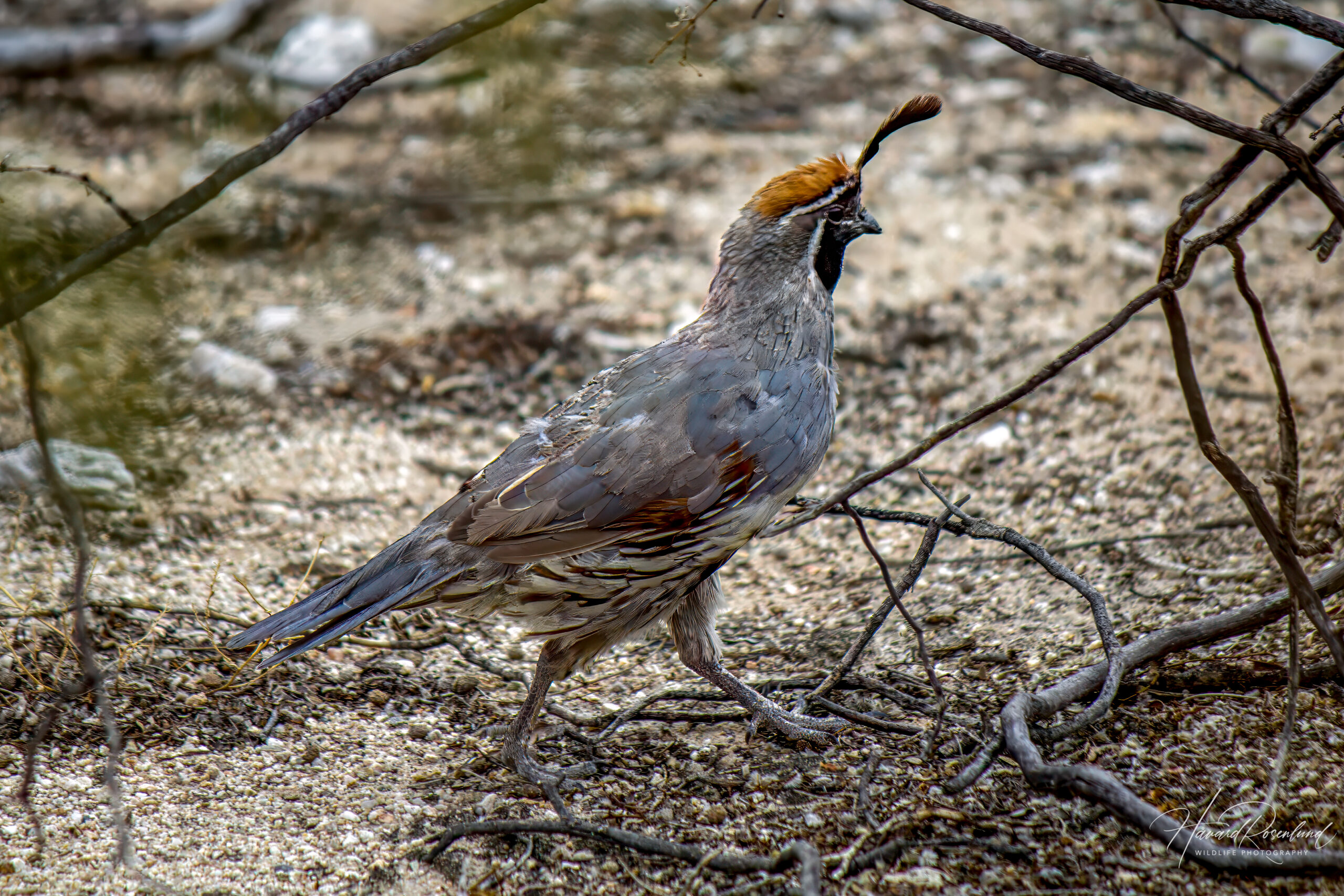
Gambel’s Quail
Callipepla gambelii
At a glance
Habitat
- Desert scrub, thorny washes, riparian thickets and dry agricultural edges
Diet
- Seeds, leaves and other plant matter; also fruit and insects
Activity
- Diurnal; most active in cooler morning and late-afternoon hours
Size
- Length: about 25 cm Weight: 160–200 g
Range
- Southwestern USA and northwestern Mexico; introduced locally in Hawaii
Description
Gambel's quail (Callipepla gambelii) is a compact desert quail of the southwestern United States and northwestern Mexico. Both sexes carry a distinctive forward-curving, comma-shaped topknot, but the male is much more strongly patterned, with a black face and throat, chestnut crown and flanks, and a prominent black belly patch. Females are duller grey-brown and lack the male's black facial and belly markings. Adults are about 25 cm long and typically weigh 160–200 g.
The species closely resembles the California quail (Callipepla californica). Gambel's quail is generally paler and lacks the strongly scaled lower belly of the California quail. The two hybridise where their ranges meet in southeastern California. Introduced populations of Gambel's quail also persist locally on Hawaii.
Habitat
Gambel's quail is strongly associated with warm, arid country containing dense patches of thorny or shrubby cover. It occurs through the Sonoran, Mojave and Chihuahuan deserts, along washes, arroyos, river valleys, springs and desert foothills, and also uses brushy edges around irrigated farmland.
Mesquite, desert hackberry, acacias, yuccas and cacti can provide both food and shelter. Washes and other places with persistent vegetation are especially valuable because they combine cover with food and often better access to moisture.
Diet
Plant material dominates the diet, especially seeds and leaves, with fruit and insects added when available. Chicks feed almost entirely on animal matter during their first days before gradually shifting toward the more plant-based adult diet.
The exact mix of foods changes with rainfall and season as green plants, seeds, fruits and insects become available.
Adults forage mainly on the ground, scratching and picking among leaf litter and bare soil for seeds, green plant material, fruit and small invertebrates. Feeding is concentrated mainly in the cooler morning and late-afternoon hours; during the hottest part of the day the birds usually retreat into shade.
Water balance
Living in hot desert environments makes water balance a major part of Gambel's quail ecology. Dry seeds alone do not provide enough water during the hottest parts of the year, so birds must either drink or obtain additional moisture from green vegetation, fruit and insects.
A field study in the Sonoran Desert found that feeding times, activity and water use shifted with heat and moisture conditions. Vegetation around washes, springs and irrigated areas can therefore provide both food and moisture even when birds do not visit open water every day.
Behaviour
Gambel's quail spends most of its time on the ground and usually escapes danger by running into dense cover, taking a short explosive flight when necessary.
As spring approaches, males become more conspicuous and advertise from exposed perches. Calling and breeding activity respond strongly to seasonal conditions.
Social behaviour
Outside the breeding season Gambel's quail forms coveys, often built around family groups. Broods can merge, and adults sometimes accept young that are not their own. First-year birds may continue to roost and forage with their parents through their first winter, while several family groups can also combine into larger flocks where food and cover are concentrated.
Covey members maintain contact with frequent calls and benefit from many individuals watching for danger. A bird may perch above the group as a lookout while others feed, and the flock often runs for cover as a coordinated group when disturbed. The larger winter groups break apart as breeding pairs form in spring.
Breeding
Breeding is closely linked to seasonal rainfall and food availability. Research in Arizona has shown that reproduction responds strongly to the timing of rainfall and to summer temperatures. Gambel's quail is generally socially monogamous. During courtship a male may perform a food-offering display known as tidbitting, picking up or presenting food while calling to attract the female.
The nest is usually a shallow scrape on the ground, concealed beneath vegetation and lined with plant material. Clutches vary widely, commonly containing 5–15 eggs, with around 10–12 especially typical. Nests with more than 15 eggs often contain eggs laid by more than one female. Incubation averages about 21–23 days and is usually carried out by the female, but a male can take over if she is lost or unavailable.
The precocial chicks leave the nest almost immediately after hatching and follow the adults while feeding for themselves. Both parents brood and guide them, and the male can take a substantial role in care. The young are not fully independent until roughly 2.5–3 months old.
Under favourable conditions some females leave the first brood with the male, pair with another male and lay a second clutch. The original male then continues caring for the first brood while the female begins another nesting attempt.
Status
Gambel's quail remains widespread and numerous across much of its native range and is classified as least concern on the IUCN Red List.
Population abundance can vary greatly from year to year because reproduction responds strongly to rainfall and heat. The eBird model for 2012–2022 showed no clear range-wide increase or decline. Dense desert cover, vegetated washes and other reliable patches of food and shelter remain especially important for local populations.
Image gallery
Loading map and observations…
Have you seen this species?
Independent species archive
Did you find this species page useful?
Wildlife Vagabond is independently built and maintained. Voluntary support helps cover hosting, maps, data storage and continued improvements to the species archive.
Support Wildlife VagabondSpecies content will remain freely available.
References
Information about the species’ global distribution and status is based primarily on global Red List data. See the references below for details.
- BirdLife International. (n.d.). Gambel's Quail species factsheet. https://datazone.birdlife.org/species/factsheet/gambels-quail-callipepla-gambelii
- Cornell Lab of Ornithology. (n.d.). Gambel's Quail life history. https://www.allaboutbirds.org/guide/Gambels_Quail/lifehistory
- eBird. (n.d.). eBird Status and Trends – Gambel's Quail, 2012–2022 trend. https://science.ebird.org/en/status-and-trends/species/gamqua/trends-map
- Gee, J. M., Brown, D. E., Hagelin, J. C., Taylor, M., & Galloway, J. (2020). Gambel's Quail (Callipepla gambelii). In Birds of the World. Cornell Lab of Ornithology. https://doi.org/10.2173/bow.gamqua.01
- Goldstein, D. L., & Nagy, K. A. (1985). Resource Utilization by Desert Quail: Time and Energy, Food and Water. Ecology, 66(2), 378-387. https://doi.org/10.2307/1940387
- Heffelfinger, J. R., Guthery, F. S., Olding, R. J., Cochran, C. L., & McMullen, C. M. (1999). Influence of precipitation timing and summer temperatures on reproduction of Gambel's Quail. The Journal of Wildlife Management, 63(1), 154–161. https://doi.org/10.2307/3802496
- International Union for Conservation of Nature. (n.d.). Gambel's Quail. The IUCN Red List of Threatened Species. https://www.iucnredlist.org/species/22679609/138721794