
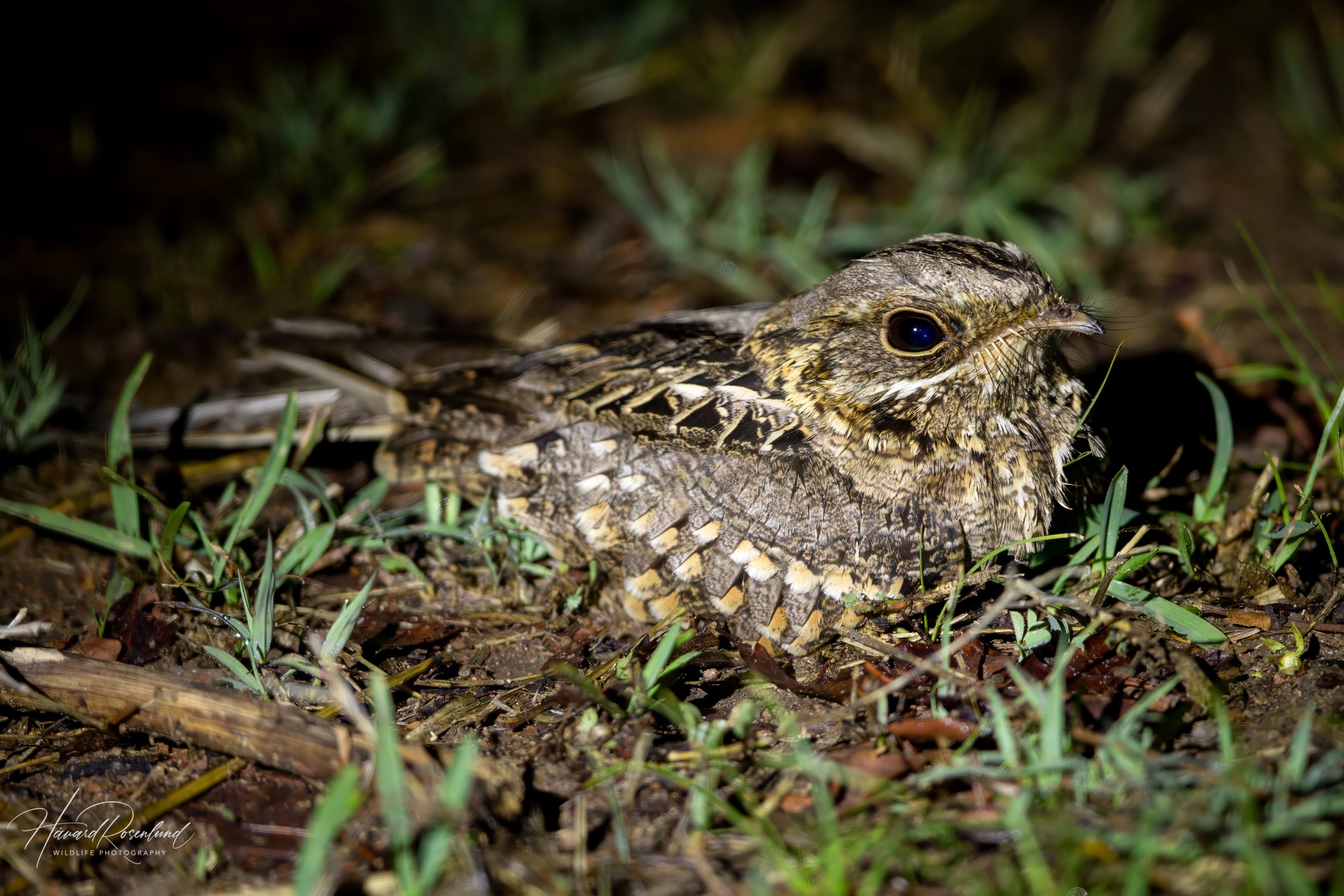
Indian Nightjar
Caprimulgus asiaticus
At a glance
Habitat
- Open woodland, scrub, grassland and cultivated country
Diet
- Flying insects, especially moths, beetles and winged ants
Activity
- Crepuscular and nocturnal
Size
- Length: 23–24 cm Weight: 40–46 g
Range
- South Asia and parts of mainland Southeast Asia
Description
The Indian nightjar (Caprimulgus asiaticus) is a small, short-tailed nightjar of South Asia and parts of mainland Southeast Asia. Adults are about 23–24 cm long and weigh roughly 40–46 g. The plumage is intricately mottled in brown, grey, black and buff, providing extremely effective camouflage against dry leaves and bare ground.
A pale to white moustachial stripe stands out on the otherwise cryptic face. Males also show conspicuous white patches in the wings and white corners to the tail, while females lack or have much reduced white markings. The species is often detected by voice before it is seen: its characteristic series of hollow notes accelerates towards the end, often compared with a small ball bouncing progressively faster.
Habitat
Indian nightjars favour open and semi-open country, including dry woodland, scrub, grassland, forest edges, plantations, gardens and cultivated land. They need open space for aerial feeding combined with concealed daytime resting sites.
During daylight they usually remain motionless on bare ground, among dry leaves or occasionally on a low branch. Their mottled plumage closely matches these substrates, making still birds remarkably difficult to detect.
Diet
The diet consists almost entirely of flying insects, particularly moths, beetles and winged ants. Hunting begins around dusk and continues through the night.
Birds often launch short feeding flights from the ground or a low perch, catching insects in their broad gape. They may also exploit concentrations of insects around tracks, open ground or artificial lights.
Behaviour
The Indian nightjar is crepuscular and nocturnal. During the day it relies on stillness and camouflage and becomes active soon after sunset. Large eyes help it detect prey in low light, while the broad gape allows it to capture flying insects efficiently; the soft plumage produces quiet flight.
Birds are usually encountered alone or in pairs. Vocal activity becomes especially conspicuous around breeding territories: the accelerating song carries well at night and is often the easiest way to locate a bird that may remain almost invisible on the ground.
Breeding
Breeding timing varies across the range; in India it can extend from late winter into the monsoon period. The species builds no conventional nest. Eggs are placed directly on bare ground or among dry leaves, where the adult's plumage and the patterned eggs provide camouflage. Two eggs are usual.
Field observations published in 2020 from Gondia in central India recorded an incubation period of about 19–21 days. The female incubated during the day, while both parents shared incubation at night. The down-covered chicks were able to move short distances within 24 hours of hatching, and the young made their first flight at about 25 days. Both parents fed and brooded the young.
Status
The Indian nightjar is classified as least concern on the IUCN Red List. It has a broad distribution and remains widespread in suitable open woodland, scrub and agricultural landscapes.
Local populations can still be affected by removal of scrub and open woodland, agricultural intensification, disturbance of ground-nesting sites and vehicle collisions where birds use tracks and roads for resting or feeding.
Image gallery
Loading map and observations…
Have you seen this species?
Independent species archive
Did you find this species page useful?
Wildlife Vagabond is independently built and maintained. Voluntary support helps cover hosting, maps, data storage and continued improvements to the species archive.
Support Wildlife VagabondSpecies content will remain freely available.
References
Information about the species’ global distribution and status is based primarily on global Red List data. See the references below for details.
- AviList. (n.d.). Caprimulgus asiaticus taxonomy. https://explore.avilist.org/
- BirdLife International. (n.d.). Indian Nightjar species factsheet. https://datazone.birdlife.org/species/factsheet/indian-nightjar-caprimulgus-asiaticus
- eBird. (n.d.). / Birds of the World – Indian Nightjar. Cornell Lab of Ornithology. https://ebird.org/species/indnig1
- International Union for Conservation of Nature. (n.d.). Caprimulgus asiaticus. The IUCN Red List of Threatened Species. https://www.iucnredlist.org/species/22689969/93253992
- Paliwal, G. T., & Bhandarkar, S. V. (2020). Observations on habitat use and breeding biology of Indian Nightjar: Caprimulgus asiaticus (Lathum, 1790): Caprimulgidae. International Refereed Journal of Engineering and Science, 9(5), 6–9. https://www.researchgate.net/publication/345386826_Observations_on_Habitat_Use_and_Breeding_Biology_of_Indian_Nightjar_Caprimulgus_asiaticus_Lathum_1790_Caprimulgidae
- Tobias, J. A., Sheard, C., Pigot, A. L., Devenish, A. J. M., Yang, J., Sayol, F., Neate‐Clegg, M. H. C., Alioravainen, N., Weeks, T. L., Barber, R. A., Walkden, P. A., MacGregor, H. E. A., Jones, S. E. I., Vincent, C., Phillips, A. G., Marples, N. M., Montaño‐Centellas, F. A., Leandro‐Silva, V., Claramunt, S., … Schleuning, M. (2022). AVONET: morphological, ecological and geographical data for all birds. Ecology Letters, 25(3), 581-597. https://doi.org/10.1111/ele.13898