
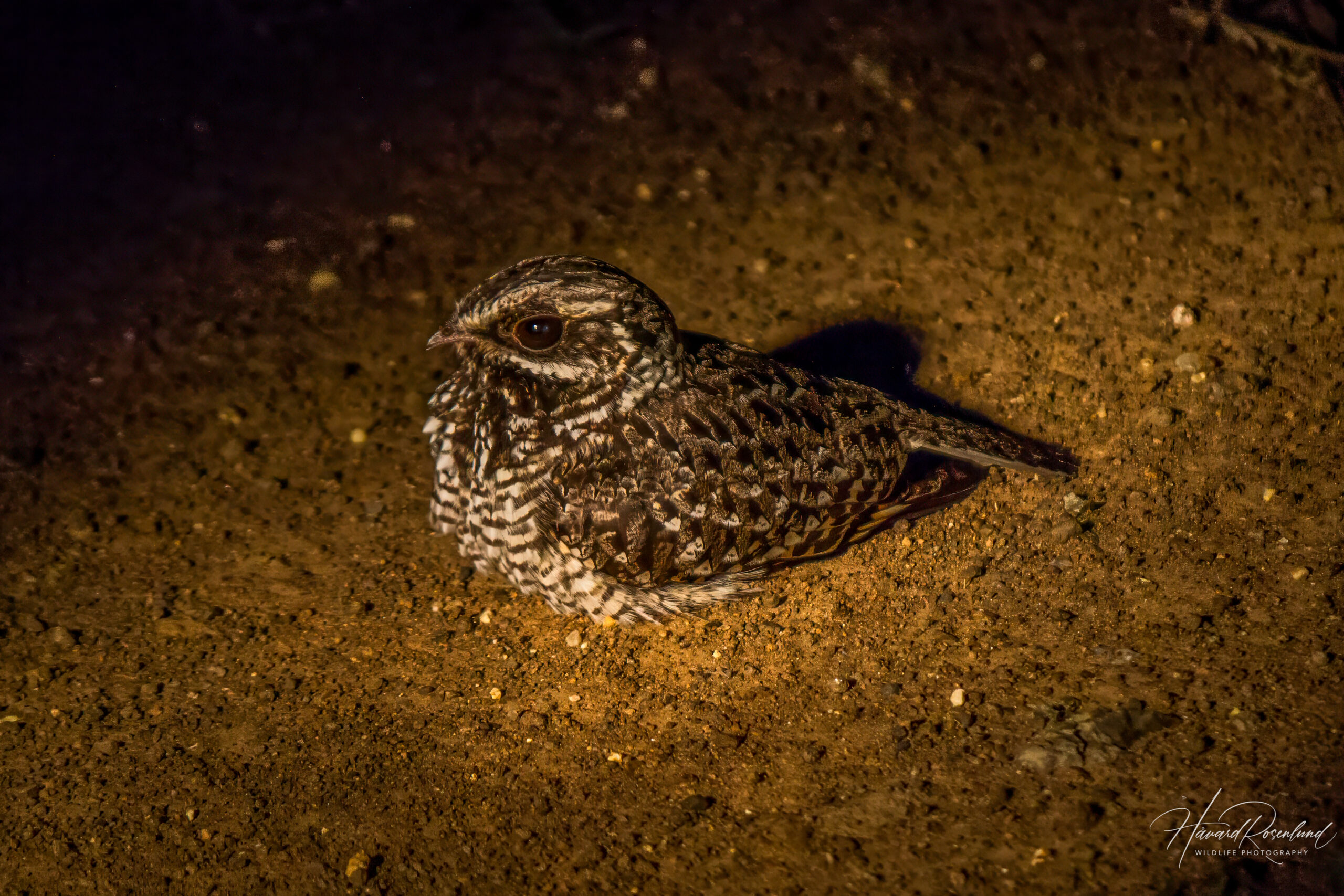
Swamp Nightjar
Caprimulgus natalensis
At a glance
Habitat
- Permanently damp grassland, floodplains, swamps, marshes, vleis and lagoon edges with sparse low vegetation
Diet
- Flying insects, especially beetles and moths; some prey may also be taken from the ground
Activity
- Nocturnal; most active from dusk through the night
Size
- Length: About 23 cm Weight: About 60–65 g
Range
- Highly fragmented distribution across sub-Saharan Africa; the southern African population is concentrated in coastal KwaZulu-Natal and southern Mozambique
Description
The swamp nightjar (Caprimulgus natalensis) is a compact, cryptically patterned nightjar with a highly fragmented distribution across sub-Saharan Africa. Adults are about 23 cm long and weigh roughly 60–65 g. The mottled grey-brown plumage blends closely with dry grass, soil and leaf litter, and the upperparts often have a finely scaled appearance.
The sexes differ most clearly in flight. Males show white markings on the outer tail feathers and wings, while females have buffier markings and lack the same clean white pattern. The species can be confused with the square-tailed nightjar (Caprimulgus fossii), but differs in vocalisations, habitat preference and its more spotted appearance.
Habitat
Swamp nightjars favour permanently wet or damp open habitats maintained by a high water table or groundwater seeping to the surface. These include moist grassland, floodplains, marshes, vleis and lagoon margins. The best sites have sparse, low vegetation with scattered grass tufts rather than dense, tall cover.
Recently burnt areas are generally unsuitable until the vegetation structure recovers. This dependence on a narrow combination of wet ground and open vegetation helps explain the species’ patchy distribution even within apparently extensive wetland landscapes.
Diet
The diet consists mainly of flying insects available between dusk and dawn, especially beetles and moths. Prey is generally swallowed whole. Records of insect pupae in stomach contents show that at least some food is also taken from the ground.
Hunting
A common hunting method is to launch from a resting place on the ground, intercept a passing insect in the air and settle again soon afterwards. Swamp nightjars can also hunt continuously in flight or from low posts.
The species has relatively robust legs and feet for a nightjar. Together with records of insect pupae in stomach contents, this suggests that it can also move on the ground to capture some prey rather than relying entirely on aerial hunting.
Behaviour
Swamp nightjars are nocturnal and become active around dusk. During the day they normally remain motionless on the ground, relying heavily on camouflage. Their song is a distinctive series of loud, repeated chow notes and is one of the best ways to detect them at night.
The species is broadly resident, but individuals can make local movements when conditions change. Fire and flooding may cause birds to leave temporarily unsuitable sites and return after the vegetation and water conditions recover.
Breeding
Pairs are monogamous and nest separately. They do not build a nest: two eggs are normally laid directly on bare sand or clay beside or beneath a grass tuft in an open, treeless area. The incubating adult is extremely difficult to detect because of its camouflage, although exposed eggs can be conspicuous when the bird leaves.
Both parents incubate for slightly less than 20 days, with the female usually taking the daytime shift and the male incubating at night. Both adults brood the young after hatching. Detailed information on chick development and fledging remains surprisingly limited, particularly for the isolated southern African population.
Status
The swamp nightjar is globally classified as Least Concern on the IUCN Red List in the 2024 assessment. The global population size is unknown, and the population is thought to be declining because suitable wet habitat continues to be lost.
In South Africa, Lesotho and Eswatini the situation is more precarious. BirdLife South Africa’s 2025 regional assessment classifies the species as Vulnerable and estimates fewer than 1,000 mature individuals. The regional population is concentrated around iSimangaliso Wetland Park and is geographically isolated from the nearest populations farther north.
Threats
The principal regional threat is loss or alteration of damp grassland and wetland habitat through agriculture, urban development, afforestation and drainage. Inappropriate burning can also remove suitable vegetation structure, at least temporarily. Because the southern population is small and isolated, continued degradation of even a limited number of sites can have disproportionate effects.
Conservation
No conservation programme currently targets the swamp nightjar alone, but much of the southern population occurs inside protected areas. iSimangaliso Wetland Park is especially important and has been estimated to support roughly 400–500 birds, representing a large share of the regional population. BirdLife South Africa identifies continued protection and appropriate management of these reserves as central priorities, and has also highlighted the value of a dedicated species action plan and better population monitoring.
Image gallery
Loading map and observations…
National Red List status
| Country | Status | Assessment | Source |
|---|---|---|---|
| South Africa | VUVulnerable | Regional Red Data Book of Birds of South Africa, Lesotho and Eswatini 2025 | BirdLife South Africa – Regional Red Data Book 2025 |
Have you seen this species?
Independent species archive
Did you find this species page useful?
Wildlife Vagabond is independently built and maintained. Voluntary support helps cover hosting, maps, data storage and continued improvements to the species archive.
Support Wildlife VagabondSpecies content will remain freely available.
References
Information about the species’ global distribution and status is based primarily on global Red List data. See the references below for details.
- BirdLife International. (n.d.). Swamp Nightjar species factsheet. https://datazone.birdlife.org/species/factsheet/swamp-nightjar-caprimulgus-natalensis
- BirdLife South Africa. (2025). Swamp Nightjar, Regional Red Data Book assessment. https://www.birdlife.org.za/red-list/swamp-nightjar/
- Cleere, N., Kirwan, G. M., & Boesman, P. F. D. (2021). Swamp Nightjar (Caprimulgus natalensis). Birds of the World. https://doi.org/10.2173/bow.swanig1.02
- International Union for Conservation of Nature. (2024). Swamp Nightjar. The IUCN Red List of Threatened Species. https://www.iucnredlist.org/species/22689972/263648579
- Jackson, H. (2003). A review of foraging and feeding behaviour, and associated anatomical adaptations, in Afrotropical nightjars. Ostrich, 74(3-4), 187-204. https://doi.org/10.2989/00306520309485392