
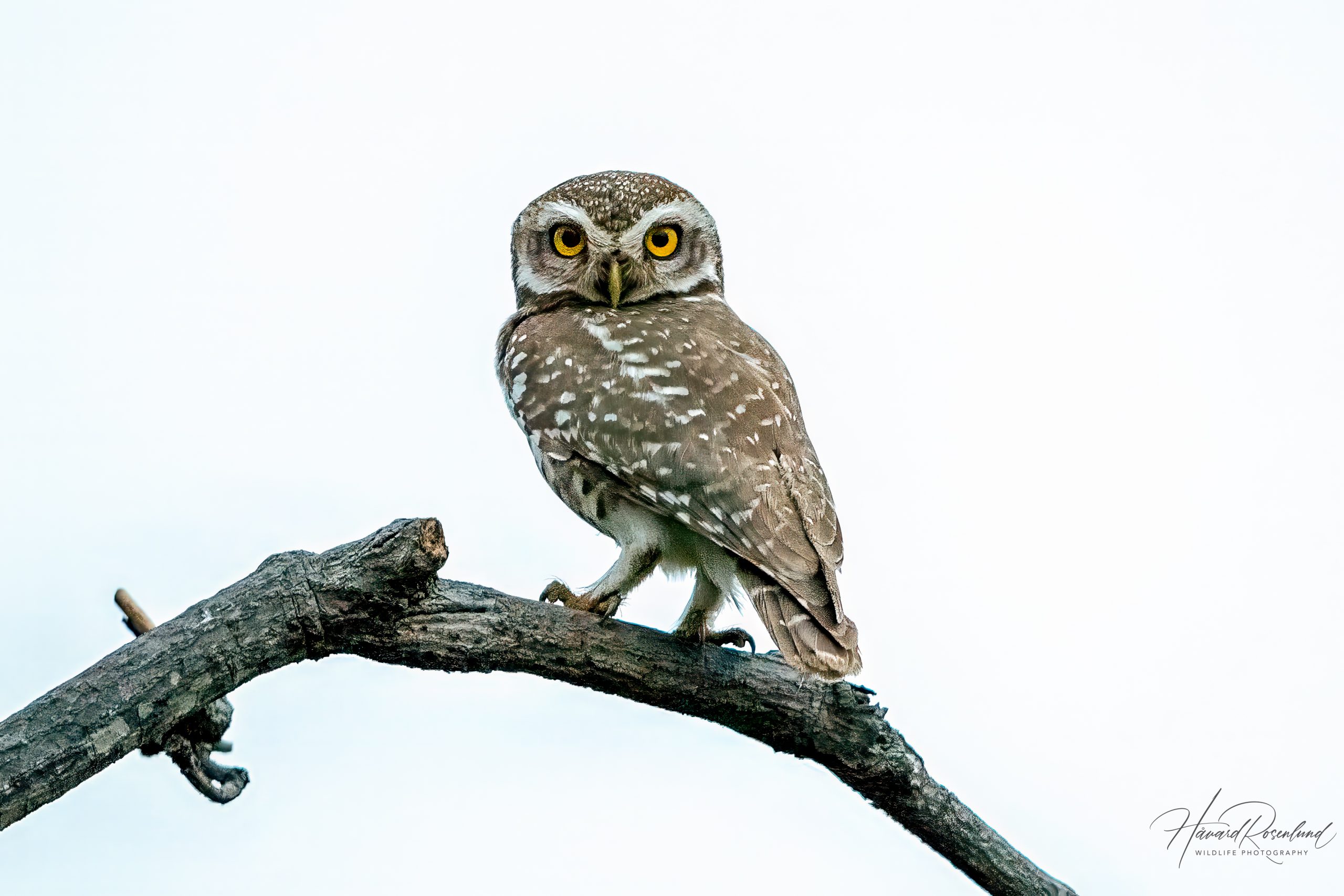
Spotted Owlet
Athene brama
At a glance
Habitat
- Open woodland, farmland, villages, parks, gardens and urban areas
Diet
- Insects, rodents, small birds, reptiles, amphibians and other small animals
Activity
- Crepuscular and nocturnal; often visible by day
Size
- Length: 19–21 cm Weight: 110–114 g
Range
- South Asia from Pakistan and India east into parts of Southeast Asia
Description
The spotted owlet (Athene brama) is a small, stocky owl found from Pakistan and India east into parts of Southeast Asia. It measures about 19–21 cm in length, has a wingspan of roughly 50–55 cm and weighs around 110–114 g, with females generally slightly larger than males.
It has a rounded head without ear tufts, yellow eyes and a greenish-yellow bill. The grey-brown upperparts are heavily spotted white, while the pale underparts are streaked and barred brown. A white neckband and strong white eyebrows give the face a characteristically alert expression. It resembles the little owl (Athene noctua), but is generally greyer, more heavily spotted above and more strongly barred below.
Habitat
Spotted owlets favour open woodland, farmland, villages, parks, gardens and urban areas with old trees or buildings that provide cavities. Their tolerance of human-altered landscapes makes them a familiar owl across much of the Indian subcontinent.
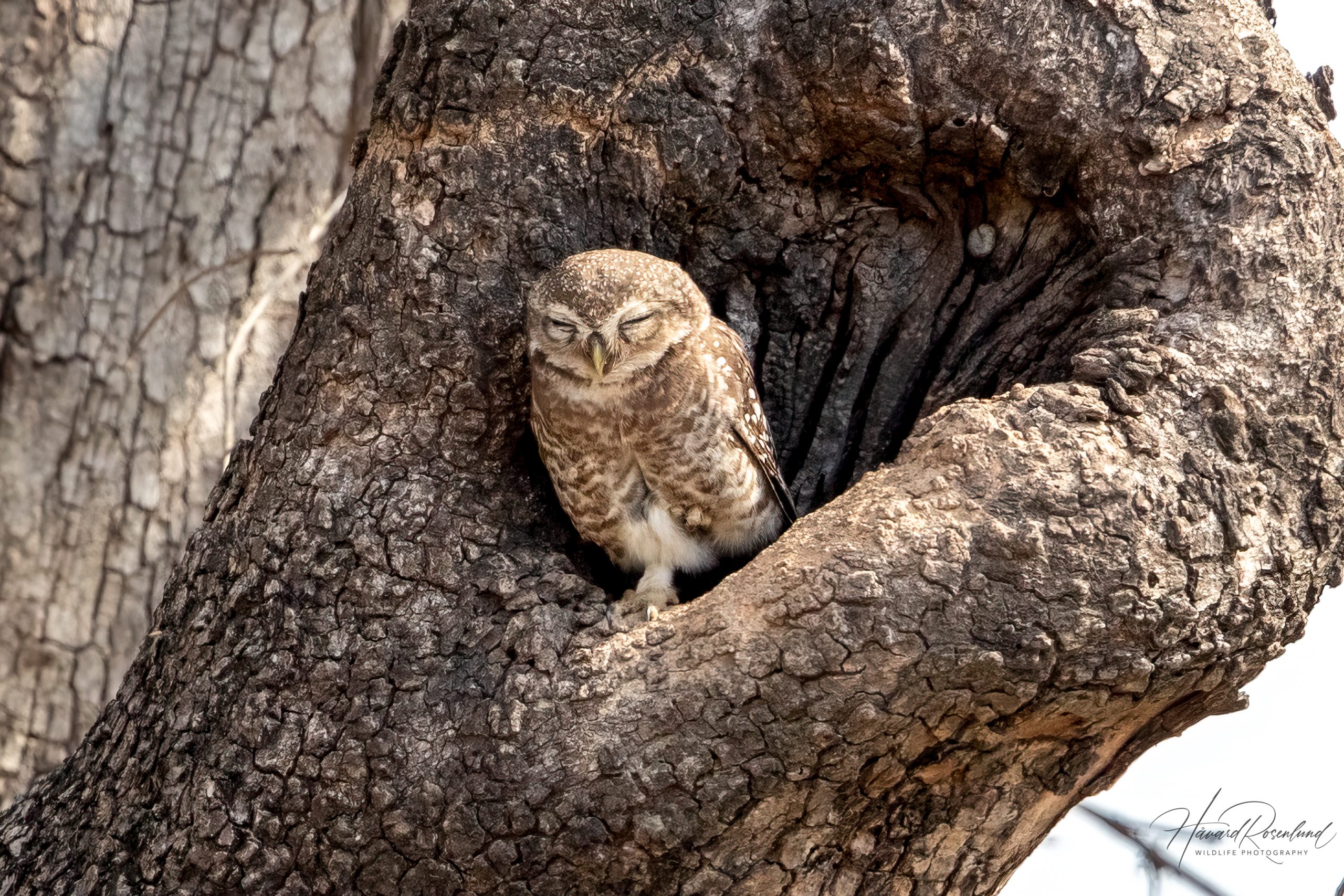
They use tree hollows, rocky cavities and buildings for daytime shelter and nesting. A study published in 2015 examined 229 roosts in Madurai district, southern India, and found that spotted owlets used both open branches and tree cavities. The birds tended to use large trees, making mature trees with broad canopies and suitable cavities important even outside the breeding season.
Diet
Spotted owlets are opportunistic predators. Insects form a large part of the diet, supplemented by rodents, small birds, reptiles, amphibians and other small animals. As in other owls, indigestible remains such as fur, feathers and bones are later regurgitated as pellets.
Hunting
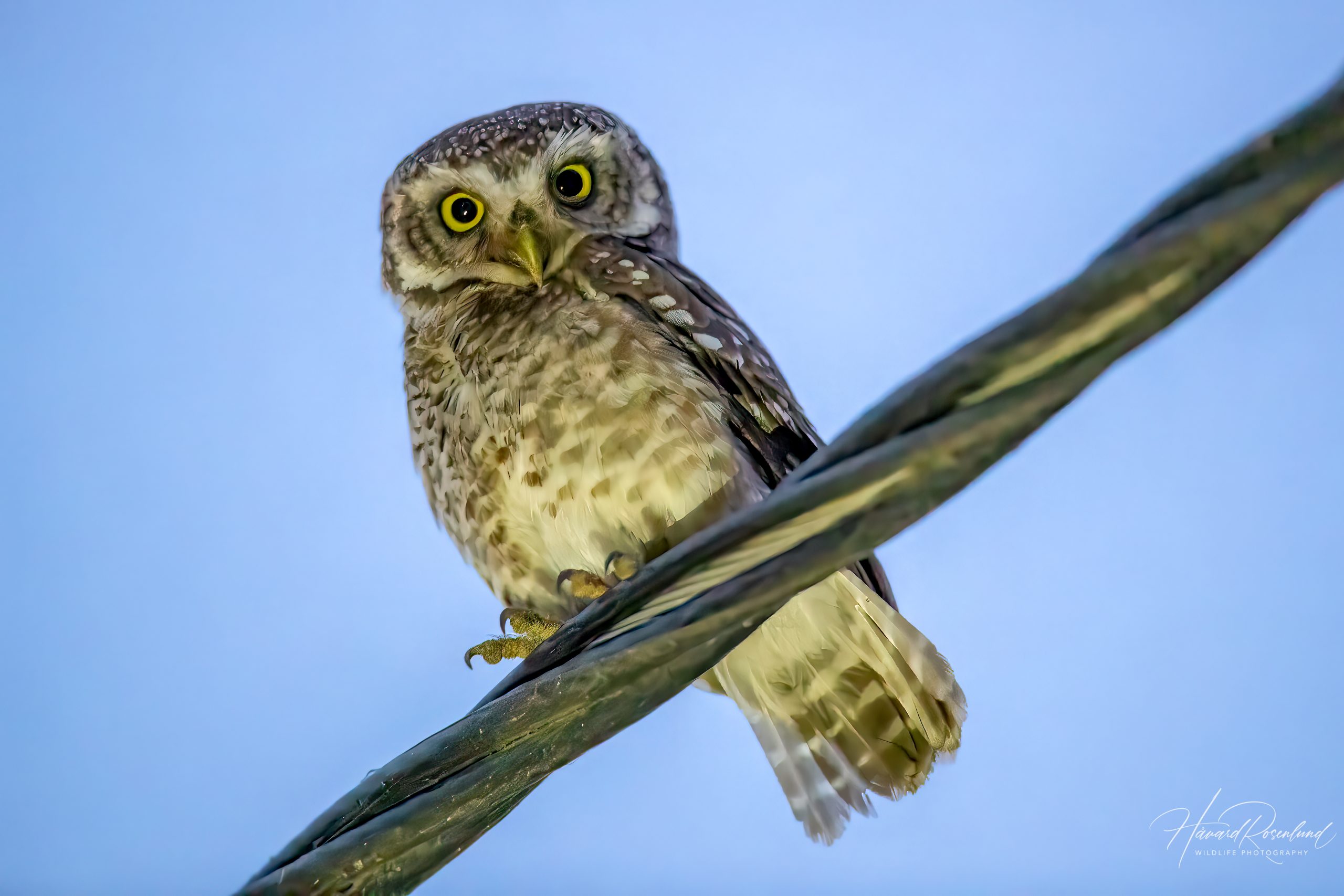
Spotted owlets hunt mainly from dusk through the night and around dawn. A bird commonly watches from a branch, wire or other perch before dropping onto prey on the ground or vegetation, and it can also make short aerial sallies after flying insects.
A study published in 2013 recorded 1,660 observations of perches used while foraging in Madurai district, southern India, and found that 51% were on power lines. Owlets were often seen using lines near street lights, where insects gathered around the light.
Behaviour
During the day, spotted owlets roost in tree hollows, rocky cavities, buildings or on sheltered branches and may sit openly near the entrance to a cavity. Much of this period is spent resting, preening and remaining alert to potential danger. When disturbed, an owlet may stare intently and make conspicuous head-bobbing movements while assessing the source of the disturbance.
The species occurs alone, in pairs or in small family groups, and several birds may roost close together where suitable shelter is abundant. Activity usually increases toward dusk. Calls include sharp repeated notes and chattering sequences, and pairs maintain contact vocally around their roosts and territories.
Breeding
Breeding timing varies regionally but generally falls between November and April. Natural tree hollows are important nest sites, while cavities in buildings and nest boxes are also used. Courtship can include close pair contact, mutual preening, bill contact and ritualised food transfer before mating.
Clutches usually contain 3–5 white eggs, although studies report geographic variation. A study published in 2011 followed breeding in Madurai district, southern India, during 2008–2009 and found a mean incubation period of about 26 days, with both sexes taking part in incubation. Young normally leave the cavity after roughly four to five weeks but remain dependent on their parents for a period afterward.
Status
The spotted owlet is listed as least concern on the IUCN Red List. It has a very large range and remains common in many human-modified landscapes.
Local threats include the removal of old cavity-bearing trees, collisions, pesticides and illegal capture or persecution linked to superstition and wildlife trade. Its ability to live close to people gives the species considerable flexibility, but retaining mature trees and safe nesting and roosting cavities remains especially important in towns and agricultural areas.
Image gallery
Loading map and observations…
Have you seen this species?
Independent species archive
Did you find this species page useful?
Wildlife Vagabond is independently built and maintained. Voluntary support helps cover hosting, maps, data storage and continued improvements to the species archive.
Support Wildlife VagabondSpecies content will remain freely available.
References
Information about the species’ global distribution and status is based primarily on global Red List data. See the references below for details.
- Ali, A. H. M. S., & Santhanakrishnan, R. (2015). Tree and habitat preferences for open limb and cavity roosts of the spotted owletAthene brama(Temminck, 1821) in southern India. Tropical Zoology, 28(1), 23-33. https://doi.org/10.1080/03946975.2015.1006460
- BirdLife International. (n.d.). Spotted Owlet species factsheet. https://datazone.birdlife.org/species/factsheet/spotted-owlet-athene-brama
- International Union for Conservation of Nature. (n.d.). Athene brama. The IUCN Red List of Threatened Species. https://www.iucnredlist.org/species/22689332/93227068
- Mahmood-ul-Hassan et al. (n.d.). 2007 – Nesting and breeding habits of the Spotted Owlet. https://bioone.org/journals/journal-of-raptor-research/volume-41/issue-1/0892-1016_2007_41_50_NABHOT_2.0.CO_2/Nesting-and-Breeding-Habits-of-the-Spotted-Owlet-Athene-brama/10.3356/0892-1016%282007%2941%5B50%3ANABHOT%5D2.0.CO%3B2.full
- Pande, S., Pawashe, A., Mahajan, M. N., Mahabal, A., Yosef, R., & Dahanukar, N. (2011). Biometry based ageing of nestling Indian Spotted Owlets ( Athene brama brama). ZooKeys(132), 75-88. https://doi.org/10.3897/zookeys.132.1346
- Pande et al. (n.d.). Behavioural ethogram of Spotted Owlet. https://bnhsjournal.in/index.php/bnhs/article/view/82356
- Samsoor, A., & Santhanakrishnan, R. (2013). On usage of perches by the Spotted Owlet. TAPROBANICA: The Journal of Asian Biodiversity, 5(2), 154. https://doi.org/10.4038/tapro.v5i2.6295
- Santhanakrishnan, R., Mohamed Samsoor Ali, A., & Anbarasan, U. (2011). Breeding biology of the Spotted Owlet (Athene brama Temminck, 1821) in Madurai district, Tamil Nadu, India. International Journal of Environmental Sciences, 1(7), 1682–1691. https://www.researchgate.net/publication/261726804_Breeding_biology_of_the_Spotted_Owlet_Athene_brama_Temminck_1821_in_Madurai_district_Tamil_Nadu_India