
Plum-headed Parakeet
Psittacula cyanocephala
At a glance
Habitat
- Open and moist deciduous woodland, forest edges, scrub, orchards and cultivated areas with mature cavity-bearing trees
Diet
- Mainly fruit, seeds, buds, flowers and nectar; sometimes feeds on crops
Activity
- Diurnal
Size
- Length: 33–37 cm Weight: 66–80 g
Range
- Indian subcontinent, from the Himalayan foothills through most of India to Sri Lanka
Description
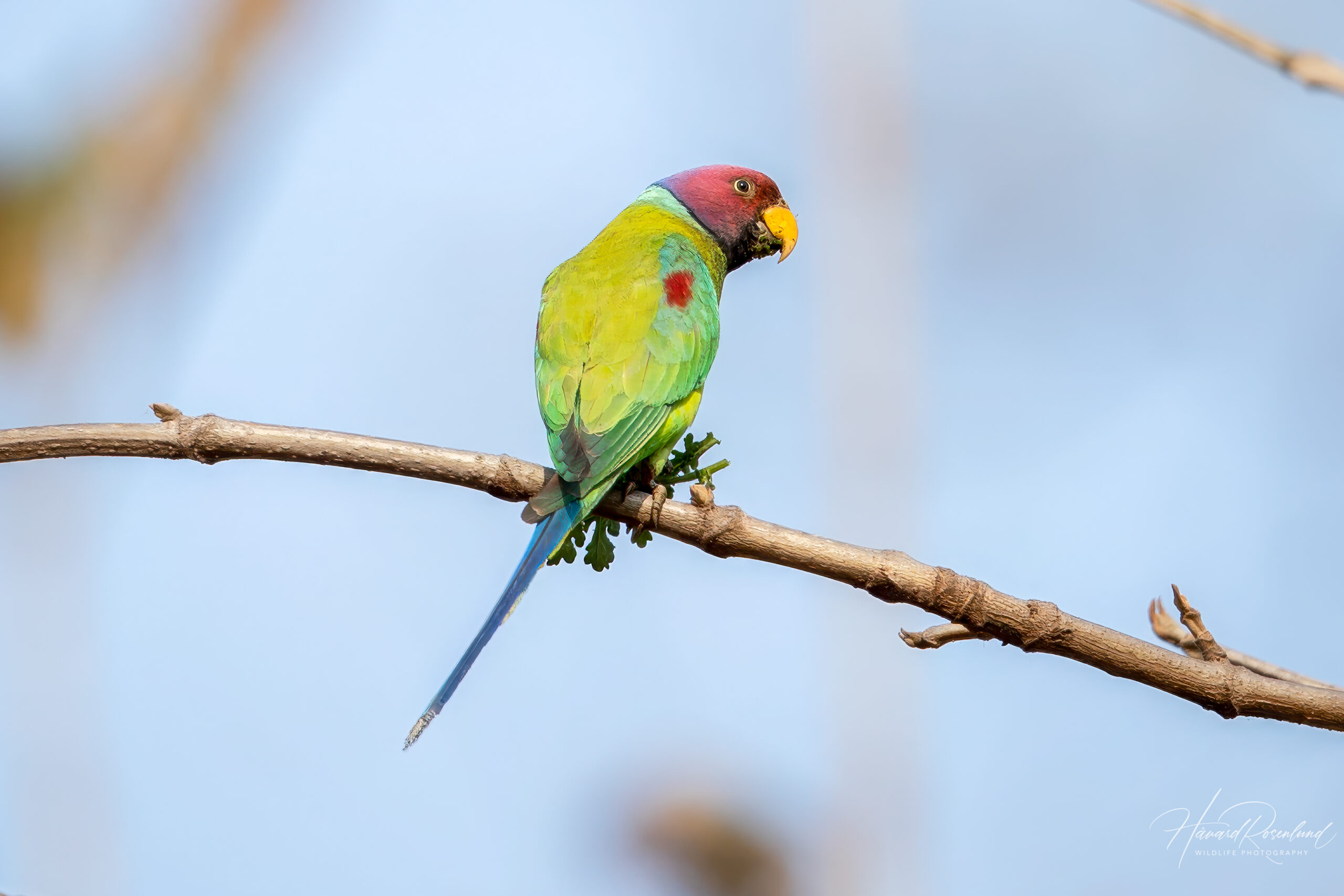
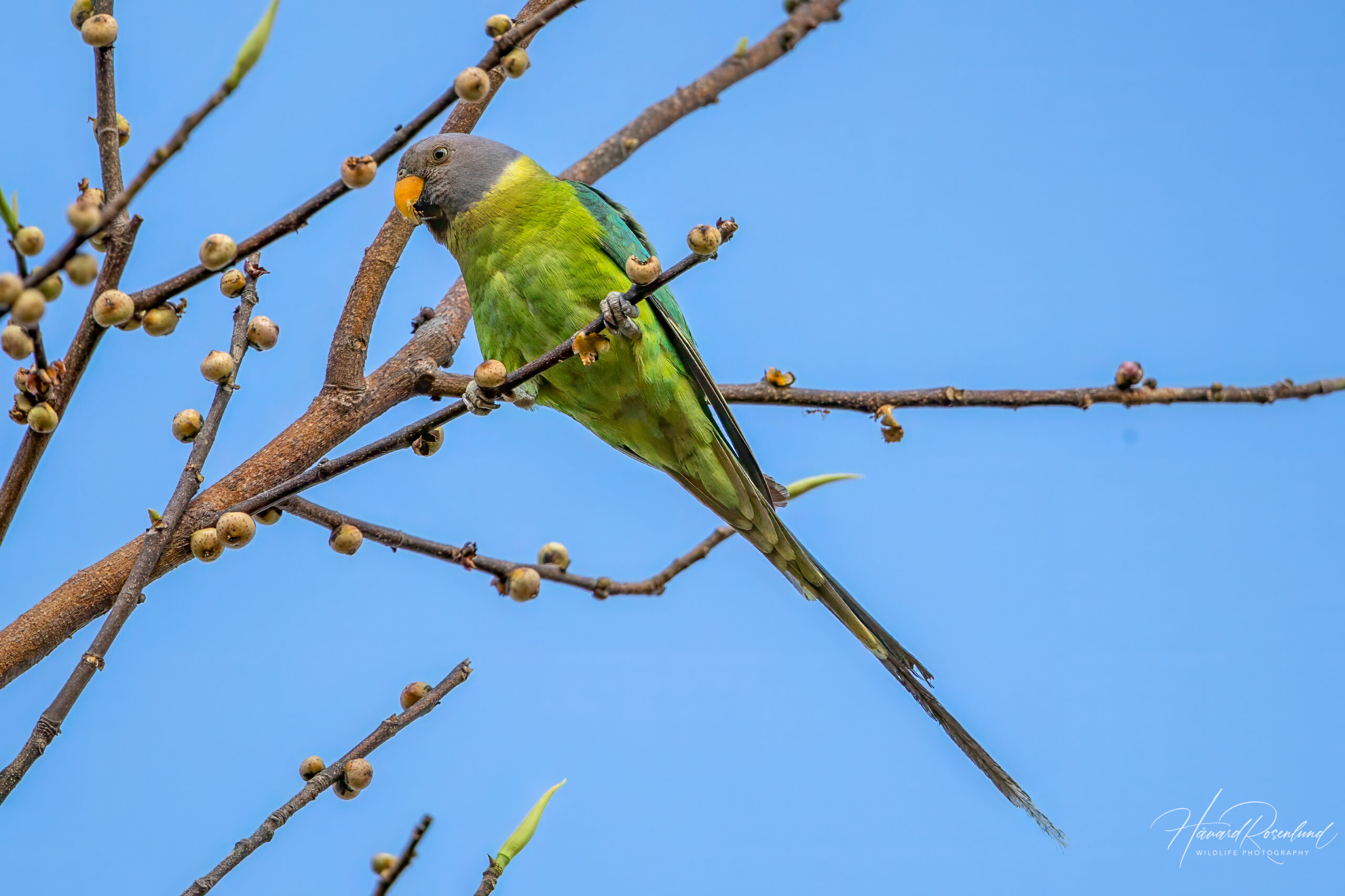
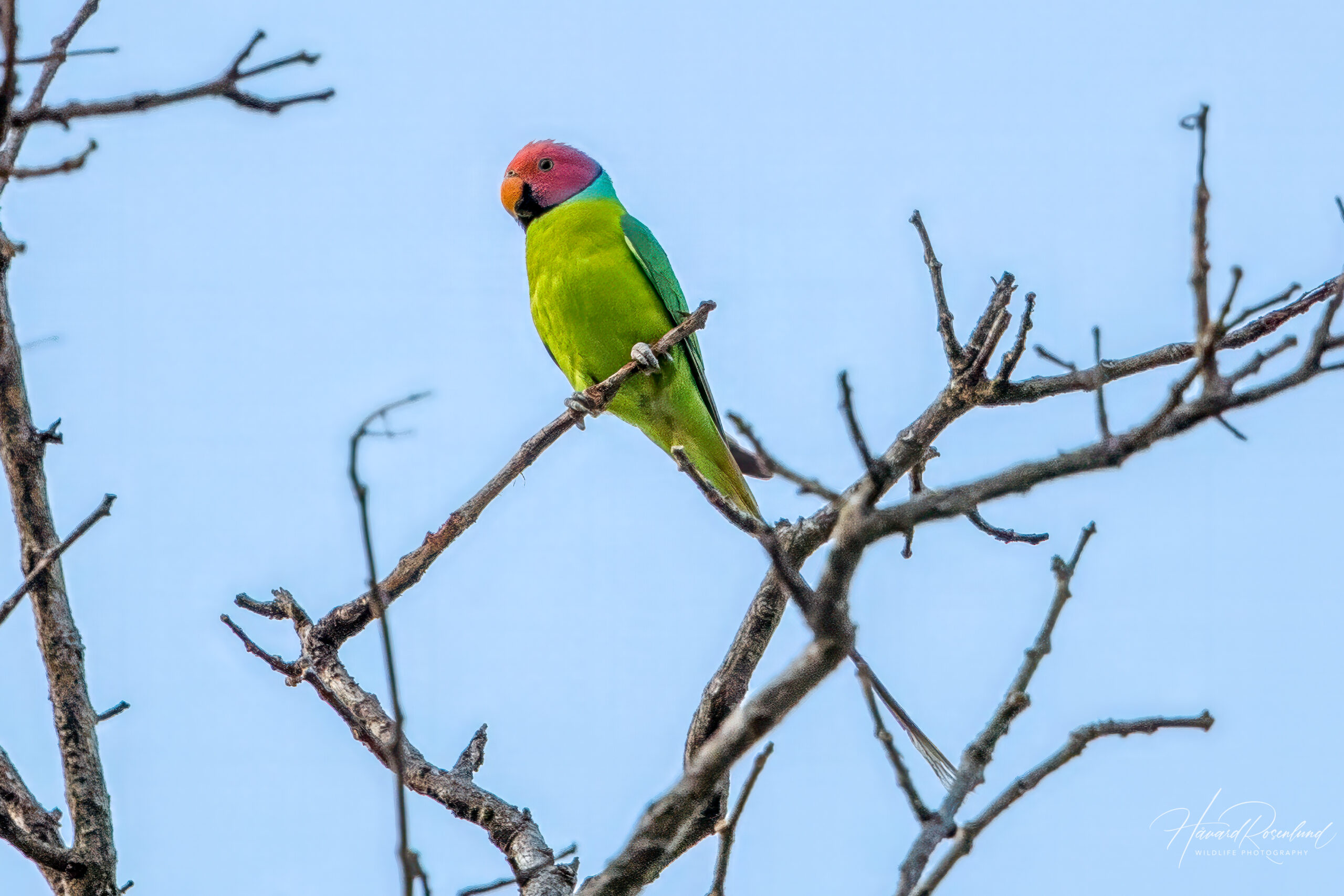
The plum-headed parakeet (Psittacula cyanocephala) is a small, long-tailed parakeet native to the Indian subcontinent. Adults are about 33–37 cm long, much of that length formed by the tapered tail, and weigh roughly 66–80 g. The sexes are unusually easy to distinguish. Adult males have a deep reddish-plum head washed with purple-blue toward the nape, a black chin and neck line, and a dark red shoulder patch. Females have a dull blue-grey head, a yellowish neck collar and no red shoulder patch. Juveniles begin much greener and acquire the adult head colours as they mature.
The closely related blossom-headed parakeet (Psittacula roseata) of Southeast Asia was formerly treated as conspecific. It differs in head colour, shoulder pattern and tail markings and occupies a largely separate range farther east.
Habitat
Plum-headed parakeets occupy moist and dry deciduous woodland, open forest, forest edges, scrub and wooded agricultural mosaics, and they readily visit orchards and cultivated areas. The species is a forest specialist and is more strongly associated with wooded habitats than highly urban-tolerant parakeets such as the rose-ringed parakeet (Psittacula krameri).
Mature trees are important even where the surrounding landscape is partly cultivated. Fruiting trees provide seasonal food, while trunks and large branches with existing cavities provide the nest sites on which the species depends.
Diet
Fruit is particularly important, including figs and other fleshy fruits, but the diet also contains seeds, buds, flowers and nectar. Bamboo seeds have been recorded in Bandhavgarh National Park, and birds may also feed on cultivated grain and fruit where these resources are readily available.
The mix changes with local and seasonal food availability. Flocks move among fruiting and flowering trees and can quickly exploit heavy fruit crops.
Behaviour
Plum-headed parakeets are social and are commonly encountered in pairs, family parties or small flocks. Larger groups can form at abundant food sources and communal roosts, and birds may forage alongside other parakeets where their ranges overlap.
They are agile canopy feeders and use the bill as an additional point of support when climbing through branches or manipulating fruit, seeds and flowers. Flight is fast and direct, and members of a flock maintain contact with clear, musical calls, making moving groups easier to detect than birds feeding quietly in dense foliage.
Breeding
Plum-headed parakeets are secondary cavity nesters and depend on existing holes in trunks or large branches rather than excavating a complete cavity themselves. A 2023 study in wet evergreen and moist deciduous forest in the southern Western Ghats of India recorded nests in 25 trees belonging to 12 species, mostly living trees. Nest entrances averaged about 9.5 m above ground, and the birds generally used the highest suitable cavities available.
Breeding timing varies geographically but across much of India falls mainly from winter into spring. Clutches often contain around four to five eggs, while the Western Ghats study averaged 3.3 eggs. In that population incubation averaged about 25 days and the young remained in the nest for about 68 days. These values can vary among populations.
Status
The plum-headed parakeet is classified as least concern on the IUCN Red List. It remains widespread across the Indian subcontinent and has a very large distribution in India.
Indian monitoring data published in 2025 give a long-term national estimate near zero at about −0.4%, although the long-term trend is classified as inconclusive. The recent annual estimate is about +1.9% and is classified as stable. There is therefore no clear sign of national decline in India.
Image gallery
Loading map and observations…
Have you seen this species?
Independent species archive
Did you find this species page useful?
Wildlife Vagabond is independently built and maintained. Voluntary support helps cover hosting, maps, data storage and continued improvements to the species archive.
Support Wildlife VagabondSpecies content will remain freely available.
References
Information about the species’ global distribution and status is based primarily on global Red List data. See the references below for details.
- BirdLife International. (n.d.). Plum-headed Parakeet species factsheet. https://datazone.birdlife.org/species/factsheet/plum-headed-parakeet-psittacula-cyanocephala
- International Union for Conservation of Nature. (n.d.). Plum-headed Parakeet. The IUCN Red List of Threatened Species. https://www.iucnredlist.org/species/22685481/93075279
- Oiseaux.net. (n.d.). Plum-headed Parakeet. https://www.oiseaux.net/en/plum-headed.parakeet.html
- Patel, B., Sivaraman, S., & Balakrishnan, P. (2023). Nesting Ecology of Plum-headed Parakeet <i>Himalayapsitta cyanocephala</i> (Linnaeus, 1766) in the Southern Western Ghats, India. Journal of the Bombay Natural History Society (JBNHS). https://doi.org/10.17087/jbnhs/2023/v120/154792
- State of India's Birds. (2025). 2025 – Plum-headed Parakeet. https://stateofindiasbirds.in/species/plhpar1/
- World Parrot Trust. (n.d.). Plum-headed Parakeet. https://parrots.org/encyclopedia/plum-headed-parakeet/