
Rose-ringed Parakeet
Psittacula krameri
At a glance
Habitat
- Open woodland, savanna, farmland, orchards, parks and urban areas with mature trees and nesting cavities
Diet
- Seeds, grains, fruit, buds, flowers and nectar; smaller amounts of invertebrates
Activity
- Diurnal
Size
- Length: 38–42 cm Weight: ca. 142 g
Range
- Native to sub-Saharan Africa and the Indian subcontinent; introduced populations established widely in Europe, the Middle East and elsewhere
Description
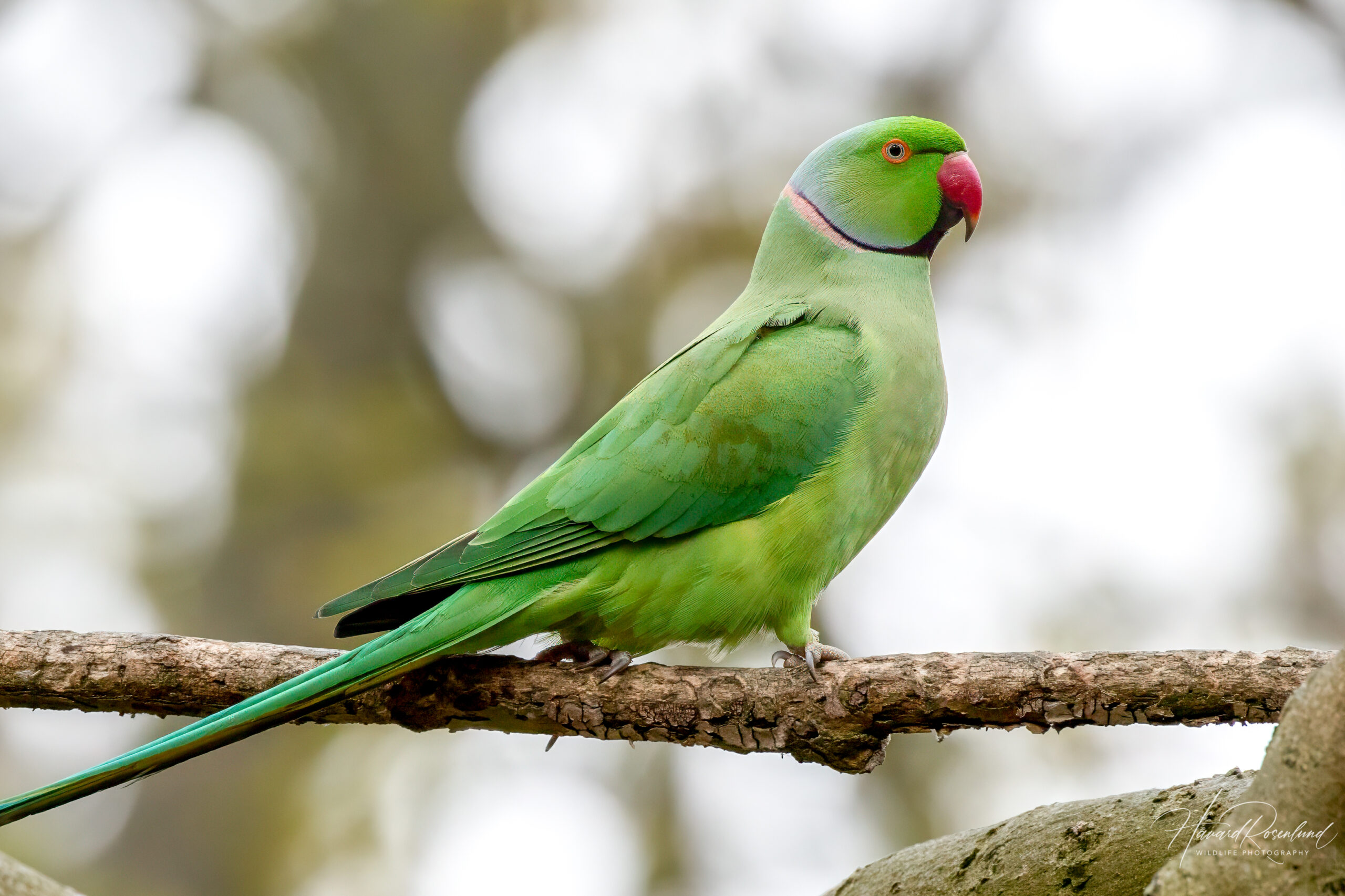
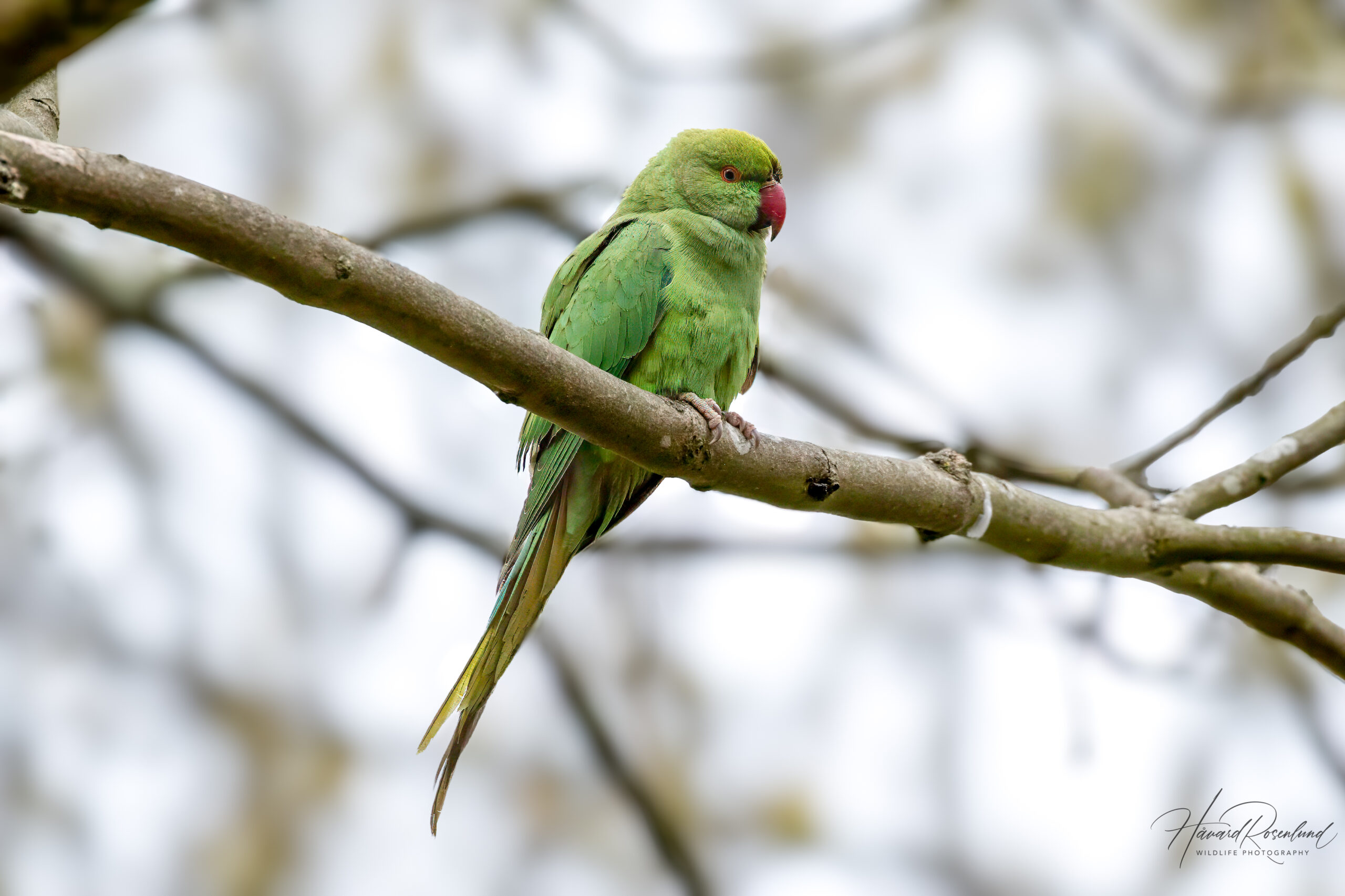
The rose-ringed parakeet (Psittacula krameri) is a slender, long-tailed parrot native to sub-Saharan Africa and the Indian subcontinent. Adults are about 38–42 cm long, much of that length formed by the tapered tail, and weigh around 142 g. The plumage is predominantly green with a red bill. Adult males develop a narrow black throat line and a rose-pink collar around the neck, while females and young birds lack the complete ring.
Several geographically distinct populations occur across the native range, and introduced populations may derive from different source regions. The larger Alexandrine parakeet (Psittacula eupatria) can occur alongside it in South Asia and in some introduced European populations, but is heavier-built, has a much larger bill and shows a conspicuous maroon shoulder patch.
Habitat
Rose-ringed parakeets favour open woodland, savanna, farmland, orchards, parks and other landscapes with mature trees rather than dense closed forest. They readily occupy towns and cities where large trees provide food, roosting sites and nesting cavities.
This tolerance of human-modified landscapes is important in both the native and introduced ranges. Mature trees remain a key resource even in highly urban settings because the species depends on cavities for breeding and often uses traditional communal roosts in large trees.
Diet
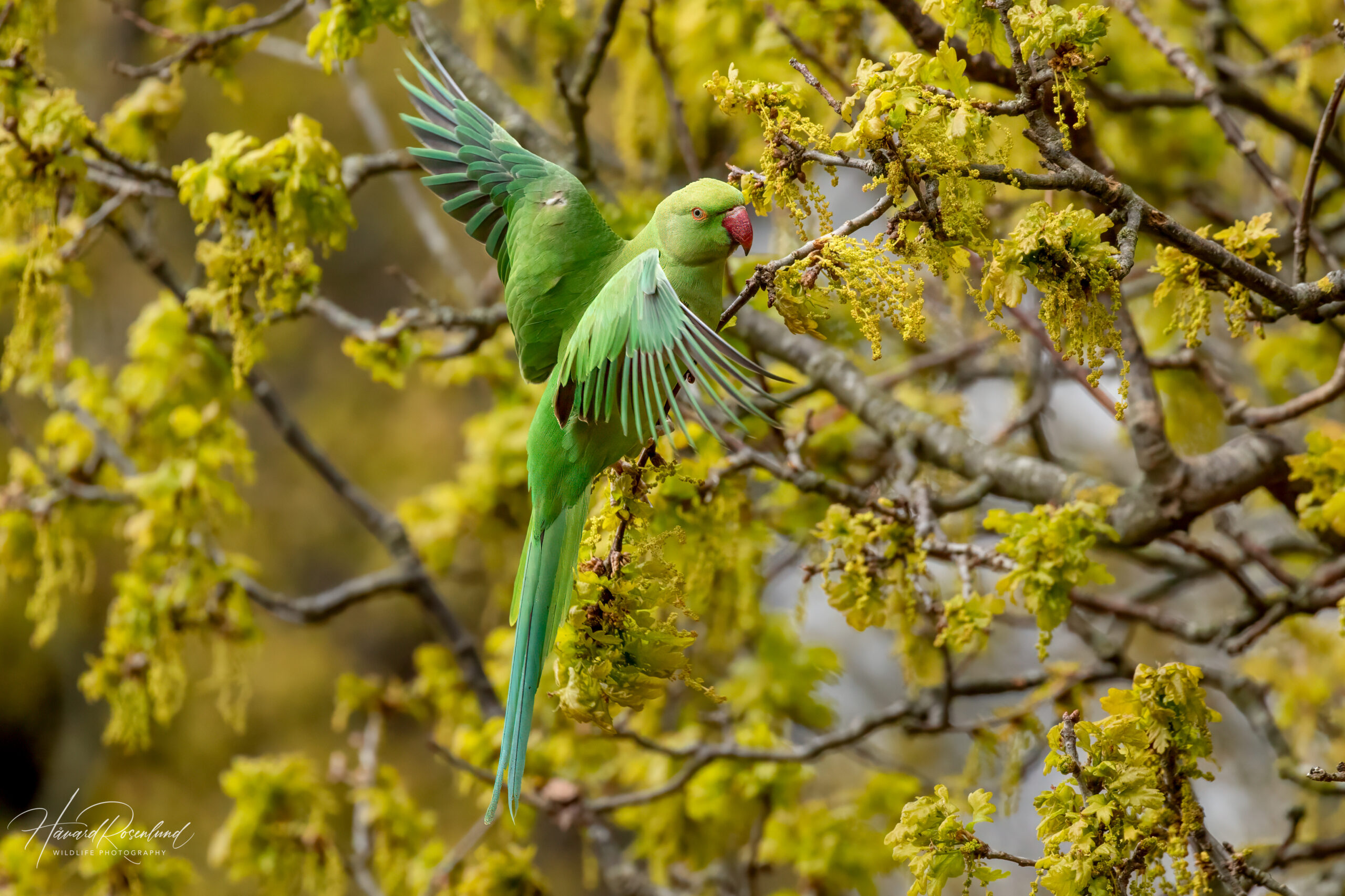
The diet is broad and predominantly plant-based. Seeds, cereal grains, fruit, buds, flowers and nectar are all taken, with smaller amounts of invertebrate food. Cultivated crops and food supplied in gardens can also be important locally.
Seasonal food availability can influence breeding. Work on free-living birds in north-western India found pigeon peas (Cajanus cajan) particularly important during the breeding period, while cereal grains dominated at other times of year.
Behaviour
Rose-ringed parakeets are highly social. Outside the breeding period they often travel and feed in flocks, and large numbers can converge on traditional communal roosts in the evening. These roosts become especially conspicuous at dawn and dusk as birds leave and return in noisy streams.
The species is also highly vocal and behaviourally flexible. Loud contact and flight calls help keep moving flocks together, while birds readily learn to exploit new food sources and human-provided resources. Rapid, direct flight allows flocks to commute efficiently between scattered feeding and roosting sites.
Breeding
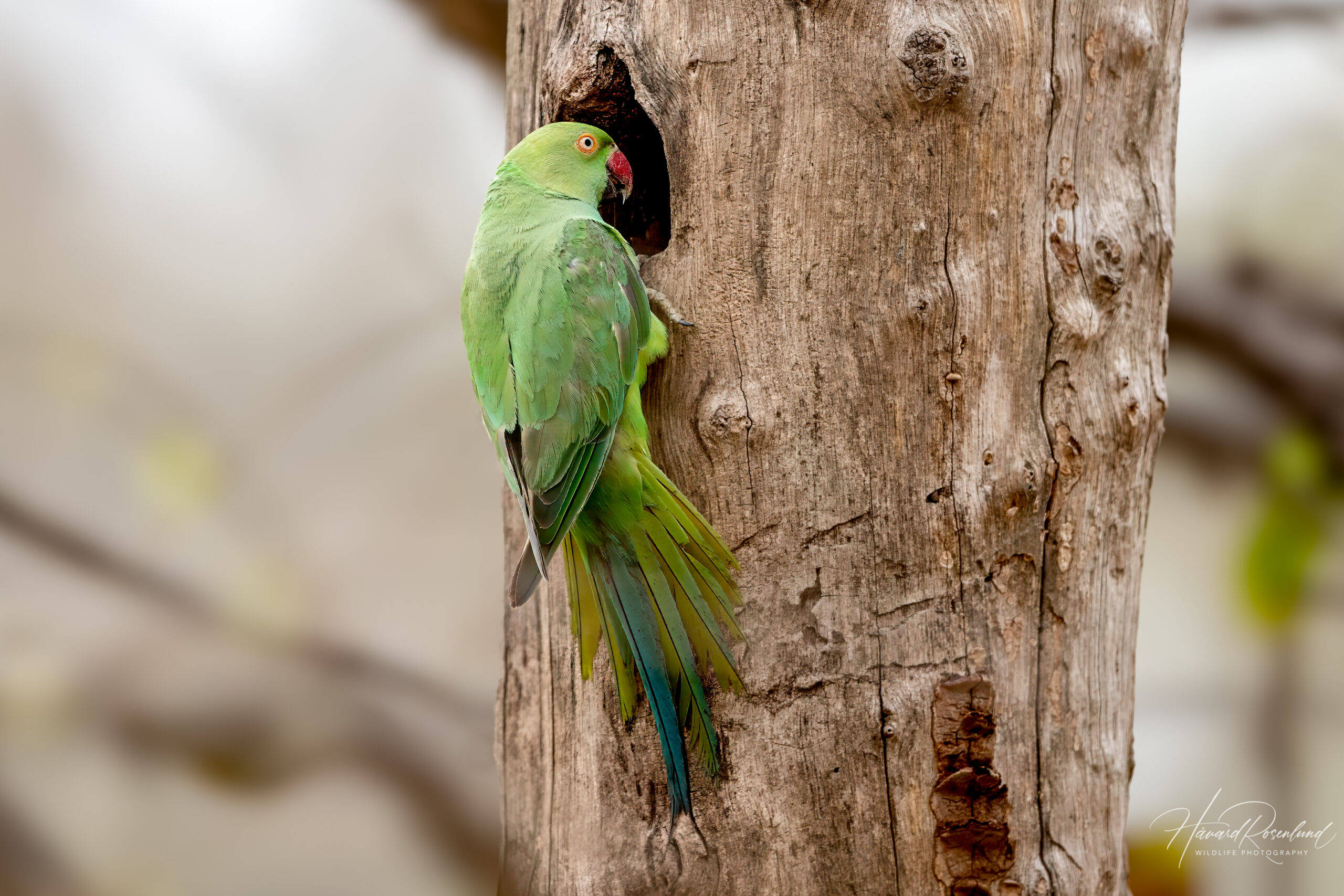
Breeding timing varies strongly with geography. In north-western India pair formation begins from autumn into early winter and breeding activity peaks during the cooler months, whereas introduced populations in temperate Europe breed later in spring. The species is a secondary cavity nester, using holes in mature trees and occasionally cavities in buildings.
A typical clutch contains three to four eggs, although two to six have been recorded. The female incubates for about 22–24 days. The chicks hatch naked and helpless and remain in the cavity for roughly 40–50 days, while both parents provision them.
A study of 108 nests in England found a median clutch of four eggs and 72% overall nest survival. The resulting productivity was sufficient to account for much of the rapid population growth observed there, assuming adult and juvenile survival remained high.
Introduced populations
Few parrots have established introduced populations as successfully as the rose-ringed parakeet. Escapes and releases from captivity have produced self-sustaining populations across Europe, the Middle East and other regions; more than 90 established breeding populations have been reported in Europe. In Britain the species began breeding annually in 1969 and remains centred particularly on London and south-east England.
Its ecological effects are real but context-dependent. Experimental work in Britain found that native garden birds reduced feeding in the presence of parakeets, while research in Belgium documented competition with Eurasian nuthatches (Sitta europaea) for nesting cavities. Comparable population-level effects on native cavity-nesting birds have not been demonstrated in Britain. Introduced populations can therefore create local competition and agricultural damage without implying that the same impact occurs everywhere the species establishes.
Status
The rose-ringed parakeet is classified as least concern on the IUCN Red List. It is widespread and adaptable across its native African and Asian range.
Indian monitoring estimates updated in 2025 are strongly positive: about +61% over the long term and +2.3% per year more recently, with both uncertainty intervals entirely above zero. The 2025 update did not recalculate the displayed trend or conservation-priority categories; the underlying 2023 assessment classified both trends as inconclusive and the species as low conservation priority. Introduced populations can grow even faster: British monitoring shows a 2696% increase in the breeding population between 1995 and 2024, while the most recent national population estimate cited there is about 12,000 breeding pairs from 2016.
Image gallery
Loading map and observations…
Have you seen this species?
Independent species archive
Did you find this species page useful?
Wildlife Vagabond is independently built and maintained. Voluntary support helps cover hosting, maps, data storage and continued improvements to the species archive.
Support Wildlife VagabondSpecies content will remain freely available.
References
Information about the species’ global distribution and status is based primarily on global Red List data. See the references below for details.
- BirdLife International. (n.d.). Rose-ringed Parakeet species factsheet. https://datazone.birdlife.org/species/factsheet/rose-ringed-parakeet-psittacula-krameri
- British Trust for Ornithology. (n.d.). Ring-necked Parakeet BirdFacts. https://www.bto.org/learn/about-birds/birdfacts/ring-necked-parakeet
- Butler, C. J., Cresswell, W., Gosler, A., & Perrins, C. (2013). The breeding biology of Rose-ringed ParakeetsPsittacula krameriin England during a period of rapid population expansion. Bird Study, 60(4), 527-532. https://doi.org/10.1080/00063657.2013.836154
- International Union for Conservation of Nature. (n.d.). Rose-ringed Parakeet. The IUCN Red List of Threatened Species. https://www.iucnredlist.org/species/22685441/132057695
- Peck, H. L., Pringle, H. E., Marshall, H. H., Owens, I. P. F., & Lord, A. M. (2014). Experimental evidence of impacts of an invasive parakeet on foraging behavior of native birds. Behavioral Ecology, 25(3), 582-590. https://doi.org/10.1093/beheco/aru025
- Sailaja, R., Kotak, V. C., Sharp, P. J., Schmedemann, R., & Haase, E. (1988). Environmental, dietary, and hormonal factors in the regulation of seasonal breeding in free-living female Indian rose-ringed parakeets (Psittacula krameri). Hormones and Behavior, 22(4), 518–527. https://doi.org/10.1016/0018-506X(88)90055-4
- Shwartz, A., Strubbe, D., Butler, C. J., Matthysen, E., & Kark, S. (2009). The effect of enemy‐release and climate conditions on invasive birds: a regional test using the rose‐ringed parakeet (Psittacula krameri) as a case study. Diversity and Distributions, 15(2), 310-318. https://doi.org/10.1111/j.1472-4642.2008.00538.x
- State of India's Birds. (2025). State of India’s Birds 2025 – Rose-ringed Parakeet. https://stateofindiasbirds.in/species/rorpar/
- Strubbe, D., & Matthysen, E. (2009). Experimental evidence for nest-site competition between invasive ring-necked parakeets (Psittacula krameri) and native nuthatches (Sitta europaea). Biological Conservation, 142(8), 1588–1594. https://doi.org/10.1016/j.biocon.2009.02.026