
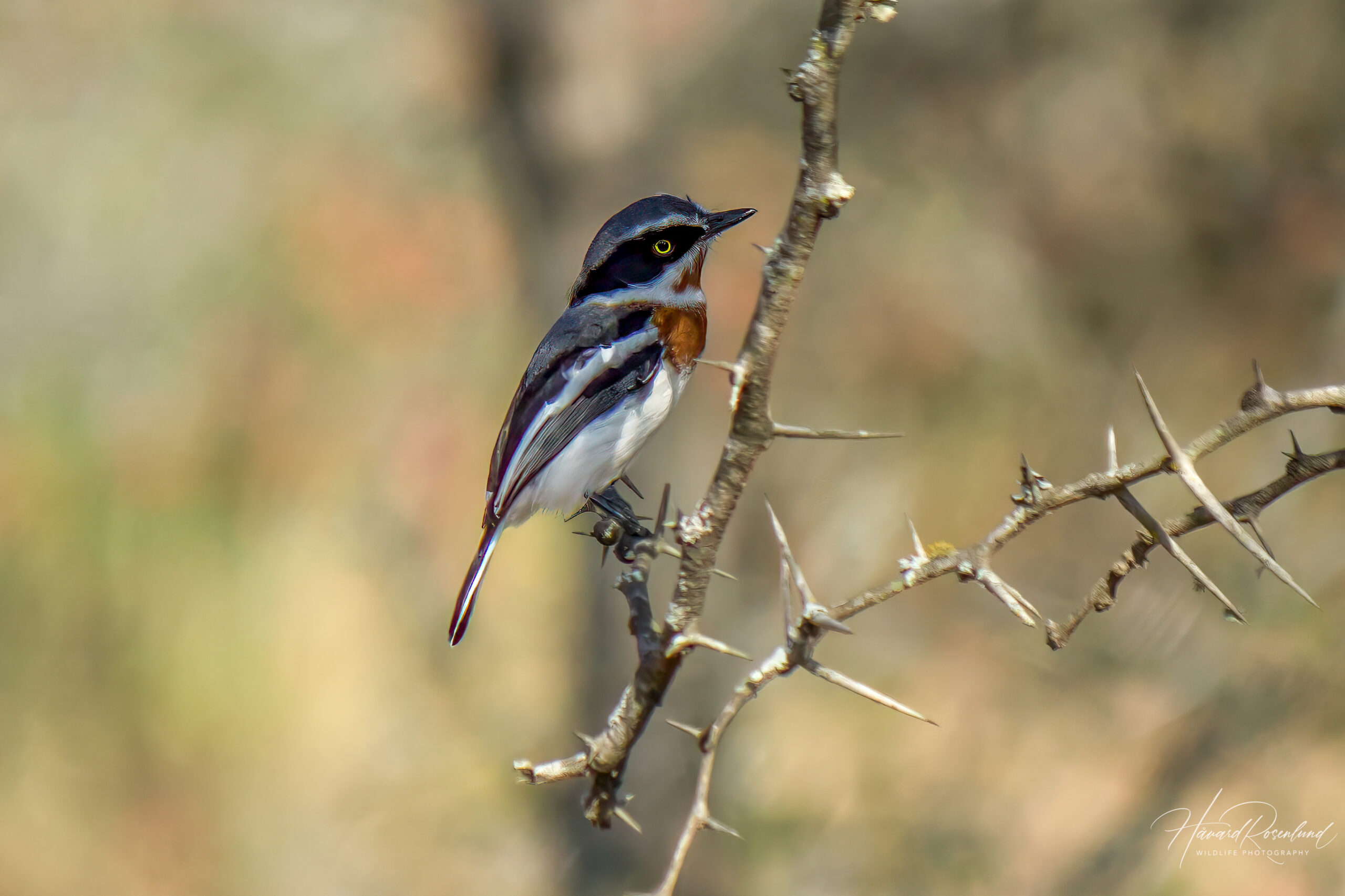
Chinspot Batis
Batis molitor
At a glance
Habitat
- Woodland, wooded savanna, forest edges and thickets, from lowlands to montane areas
Diet
- Insects, spiders and other small invertebrates, caught from foliage and in short aerial sallies
Activity
- Diurnal
Size
- Length: 12–13 cm Weight: 8–14 g
Range
- Central, eastern and southern sub-Saharan Africa, mainly south of the equator
Description
The chinspot batis (Batis molitor) is a small, compact insect-eating passerine widespread in wooded parts of central, eastern and southern Africa. Adults are about 12–13 cm long and typically weigh around 8–14 g. Both sexes have a bold black, white and grey pattern, but they are easy to sex: the male has a broad black breast-band and white throat, while the female has a chestnut breast-band and a distinctive chestnut patch on the throat.
The short tail, broad wing pattern and upright posture are typical of batises. Birds often remain partly concealed in foliage, where their contrasting plumage can be surprisingly difficult to pick out despite the strong pattern.
Habitat
Chinspot batises occupy a broad range of wooded habitats, including dry savanna woodland, moist forest and forest edges, montane woodland and dense thickets. They occur from lowlands into high-elevation habitats and can persist in some lightly modified wooded landscapes.
Habitat use varies across the range. In southern Africa the species is particularly characteristic of wooded savannas and other open woodland, while farther north it can be more closely associated with particular woodland types where it overlaps with other batis species.
Diet
The diet consists mainly of insects, spiders and other small arthropods. At Mlawula Nature Reserve in north-eastern Eswatini, caterpillars and moths were especially important and also dominated the food delivered to nestlings.
Chinspot batises forage actively through branches and foliage, gleaning prey from leaves and bark and making short sallies to catch flying insects. They usually feed within trees and shrubs rather than spending much time on the ground. While searching they frequently change perch and work through the middle and lower levels of woodland, scanning leaves and branches for small prey.
Behaviour
Chinspot batises are generally encountered singly or in pairs. Pairs defend territories and are highly vocal, using repeated whistles and coordinated call-and-response sequences. Duetting helps partners remain in contact in wooded habitat and also plays an important role in territorial advertisement.
Their small size and tendency to remain partly concealed in foliage often make the species easier to hear than to see.
Breeding
Breeding timing varies geographically and is generally linked to seasonal rainfall. Both sexes build the tiny, neat open cup, which is attached to a horizontal branch or fork. It is made from fine plant fibres bound with spider silk and is often decorated externally with lichen, making it remarkably well camouflaged against the branch.
Clutches contain one to four eggs, usually two. The female incubates alone for about 16–18 days, and the male brings her most of her food while she remains on the nest. Both parents feed the chicks, which leave the nest after roughly 16–18 days and may remain dependent on their parents for another 6–14 weeks.
A study published in 2006 from Mlawula Nature Reserve in Eswatini found egg laying from late September to early January, with a strong peak in November. Nesting success exceeded 30%, and pairs commonly built replacement nests after a failed attempt rather than raising a second brood after a successful one. The chinspot batis has also been recorded as a host of Klaas's cuckoo (Chrysococcyx klaas).
Status
The chinspot batis has a broad distribution and occupies several woodland types across sub-Saharan Africa. It is classified as least concern on the IUCN Red List. Its ability to use both dry and moist wooded habitats gives it a relatively broad ecological tolerance, and no major global threat is currently known.
Image gallery
Loading map and observations…
Have you seen this species?
Independent species archive
Did you find this species page useful?
Wildlife Vagabond is independently built and maintained. Voluntary support helps cover hosting, maps, data storage and continued improvements to the species archive.
Support Wildlife VagabondSpecies content will remain freely available.
References
Information about the species’ global distribution and status is based primarily on global Red List data. See the references below for details.
- Biodiversity Explorer. (n.d.). Chinspot Batis. Iziko Museums of South Africa. https://www.biodiversityexplorer.info/birds/platysteiridae/batis_molitor.htm
- BirdLife International. (n.d.). Chinspot Batis species factsheet. https://datazone.birdlife.org/species/factsheet/chinspot-batis-batis-molitor
- International Union for Conservation of Nature. (n.d.). Chinspot Batis. The IUCN Red List of Threatened Species. https://www.iucnredlist.org/species/22707864/94139926
- Monadjem, A. (2006). Aspects of the breeding biology of the Chinspot Batis Batis molitor in Acacia savanna in Swaziland. Ostrich, 77(3-4), 160-163. https://doi.org/10.2989/00306520609485527
- Oiseaux.net. (n.d.). Chinspot Batis. https://www.oiseaux.net/birds/chinspot.batis.html
- Store norske leksikon. (n.d.). Bantubatis. https://snl.no/bantubatis