
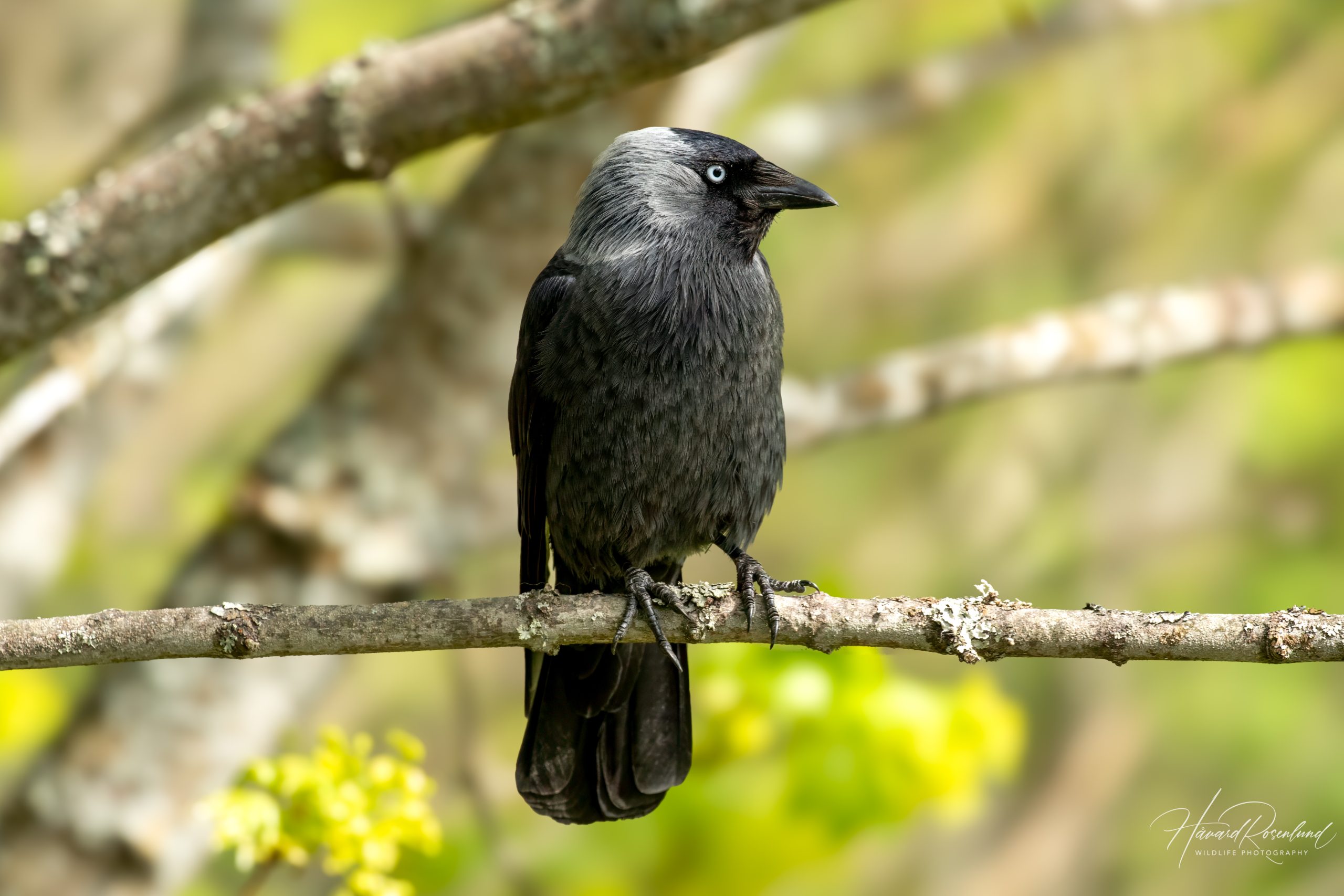
Eurasian Jackdaw
Coloeus monedula
At a glance
Habitat
- Farmland, open woodland, cliffs, towns, parks and other landscapes with suitable nesting cavities
Diet
- Omnivorous; invertebrates, seeds, grain, fruit, carrion, scraps and occasional small vertebrates
Activity
- Diurnal
Size
- Length: 34–39 cm Weight: 204–270 g
Range
- Europe, North Africa and western to central Asia; partly migratory in the north and east
Description
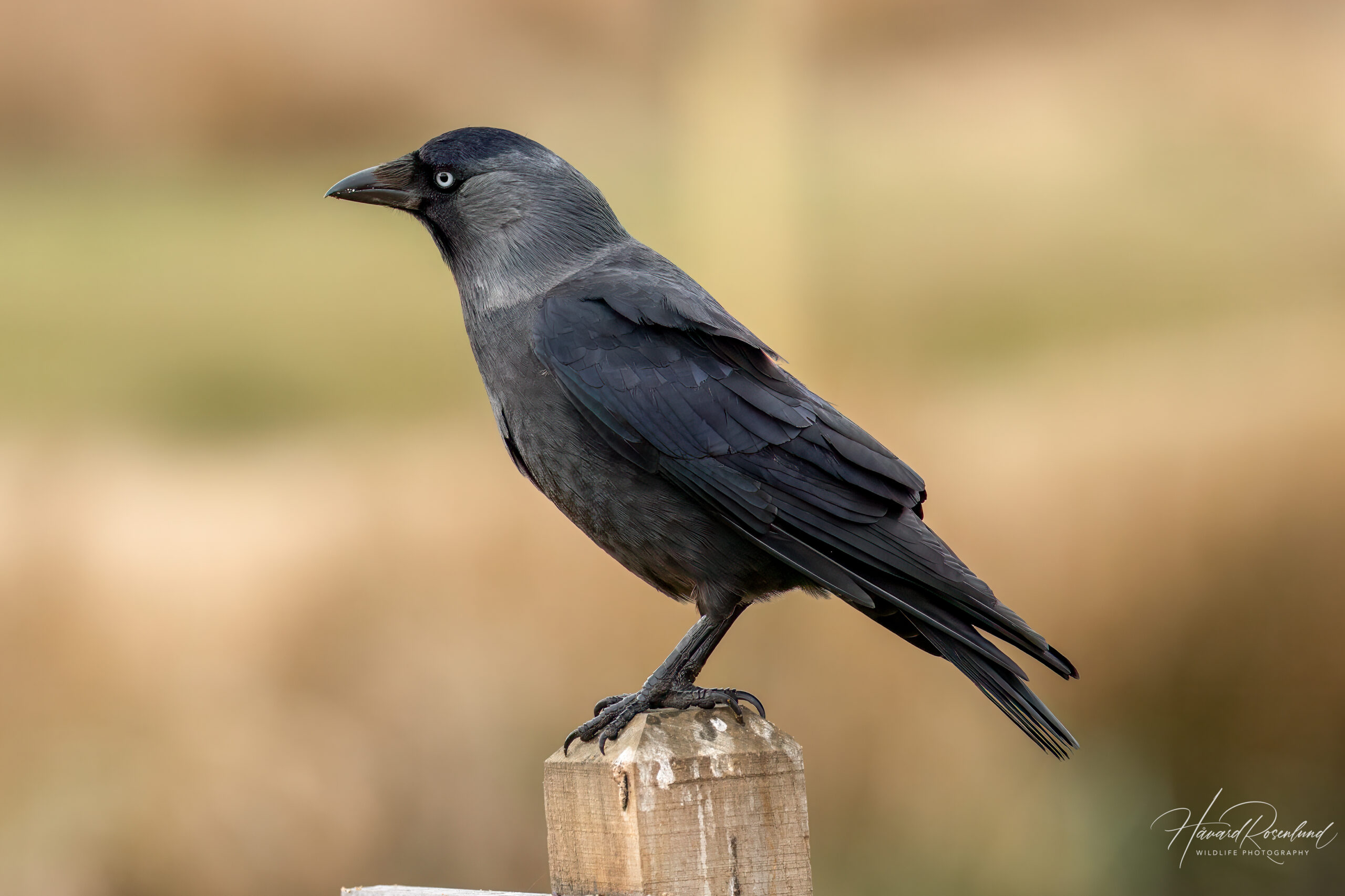
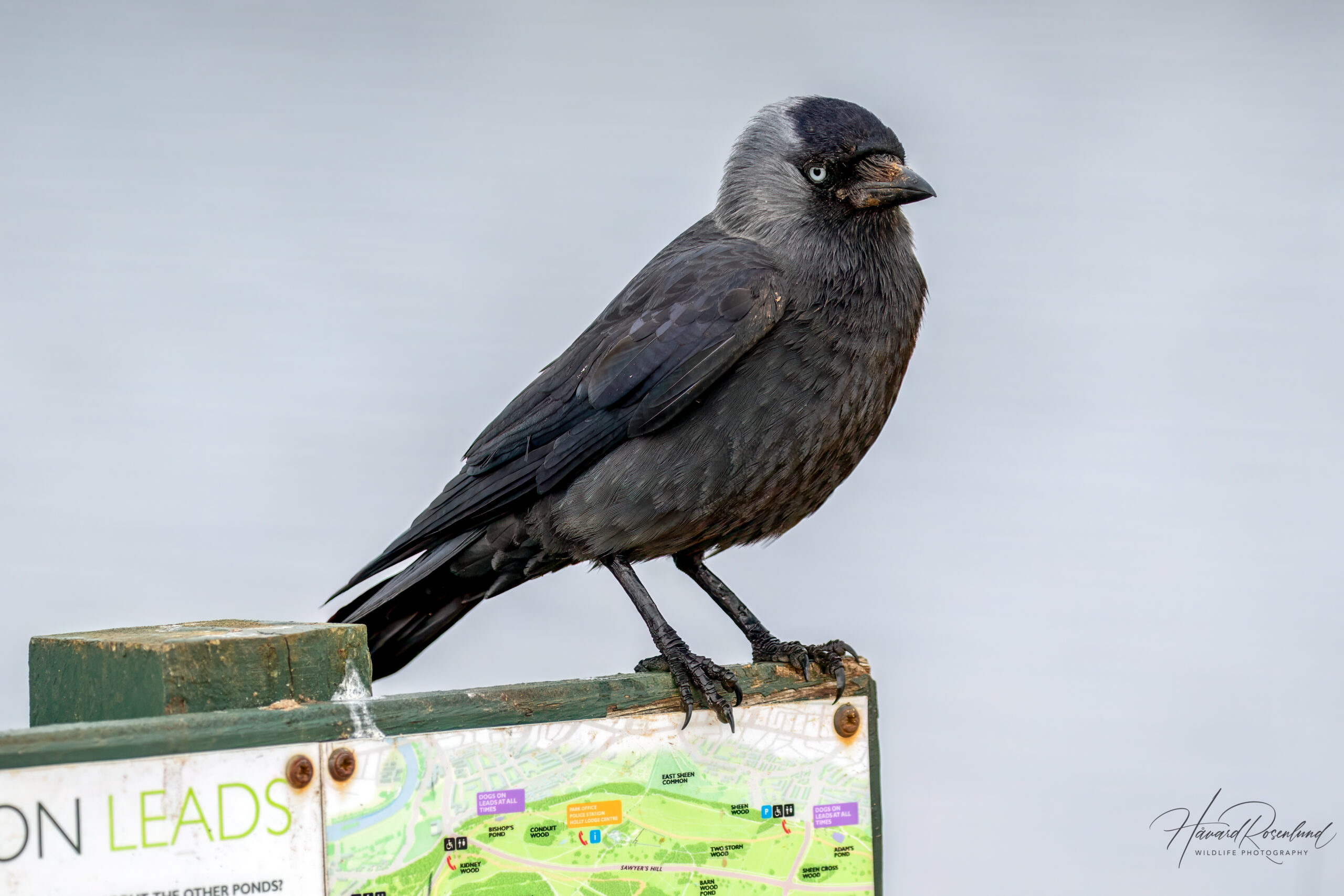
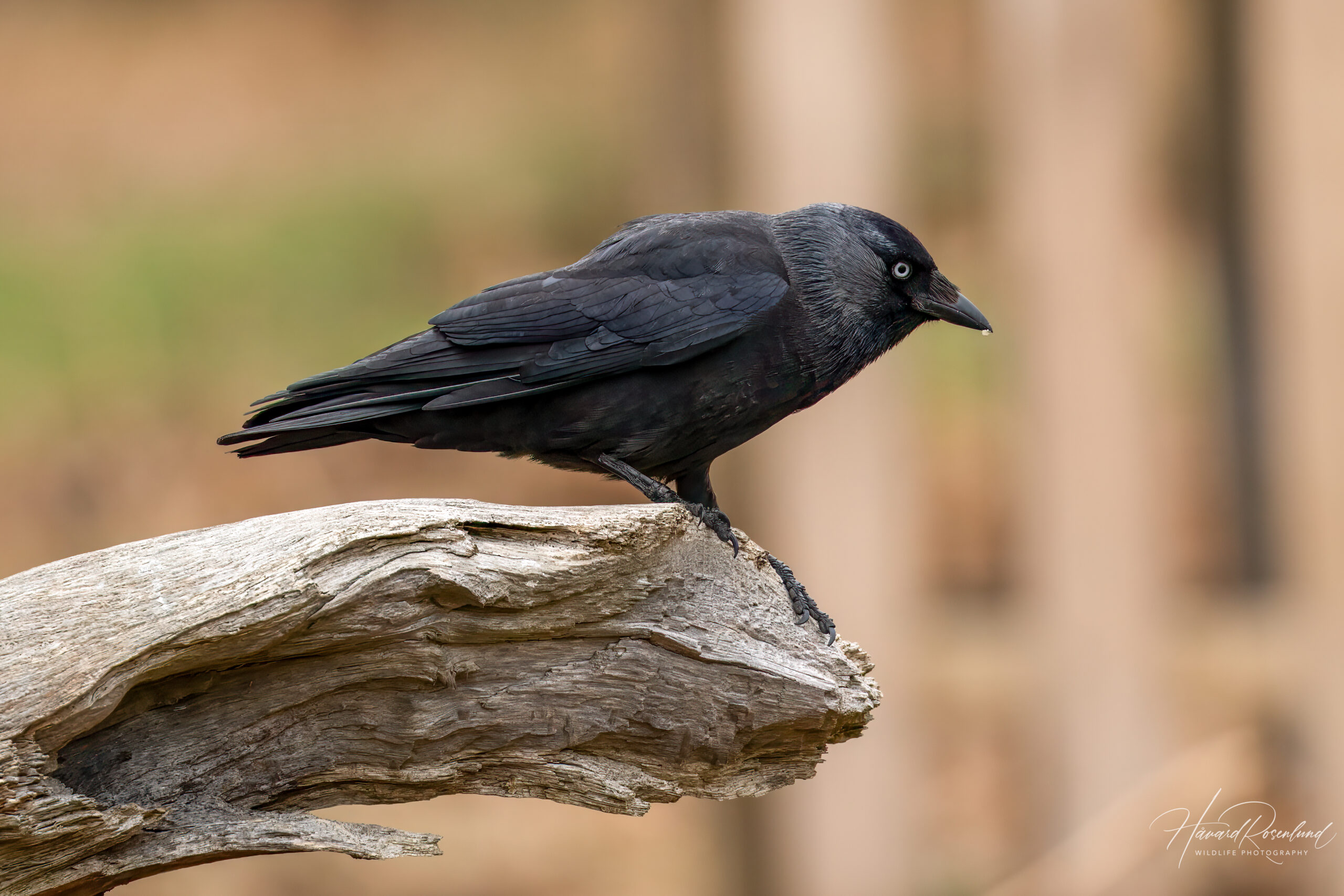
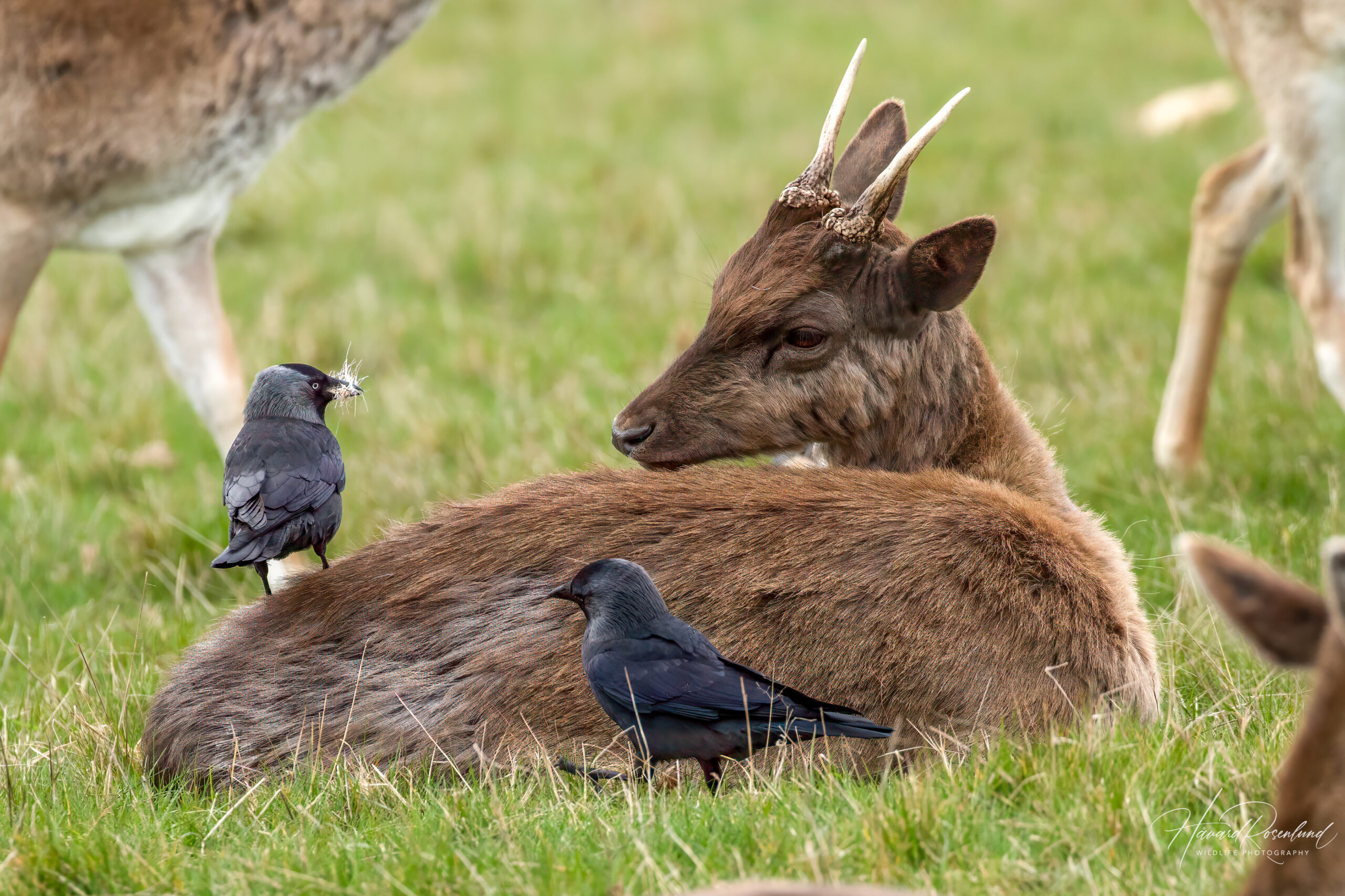
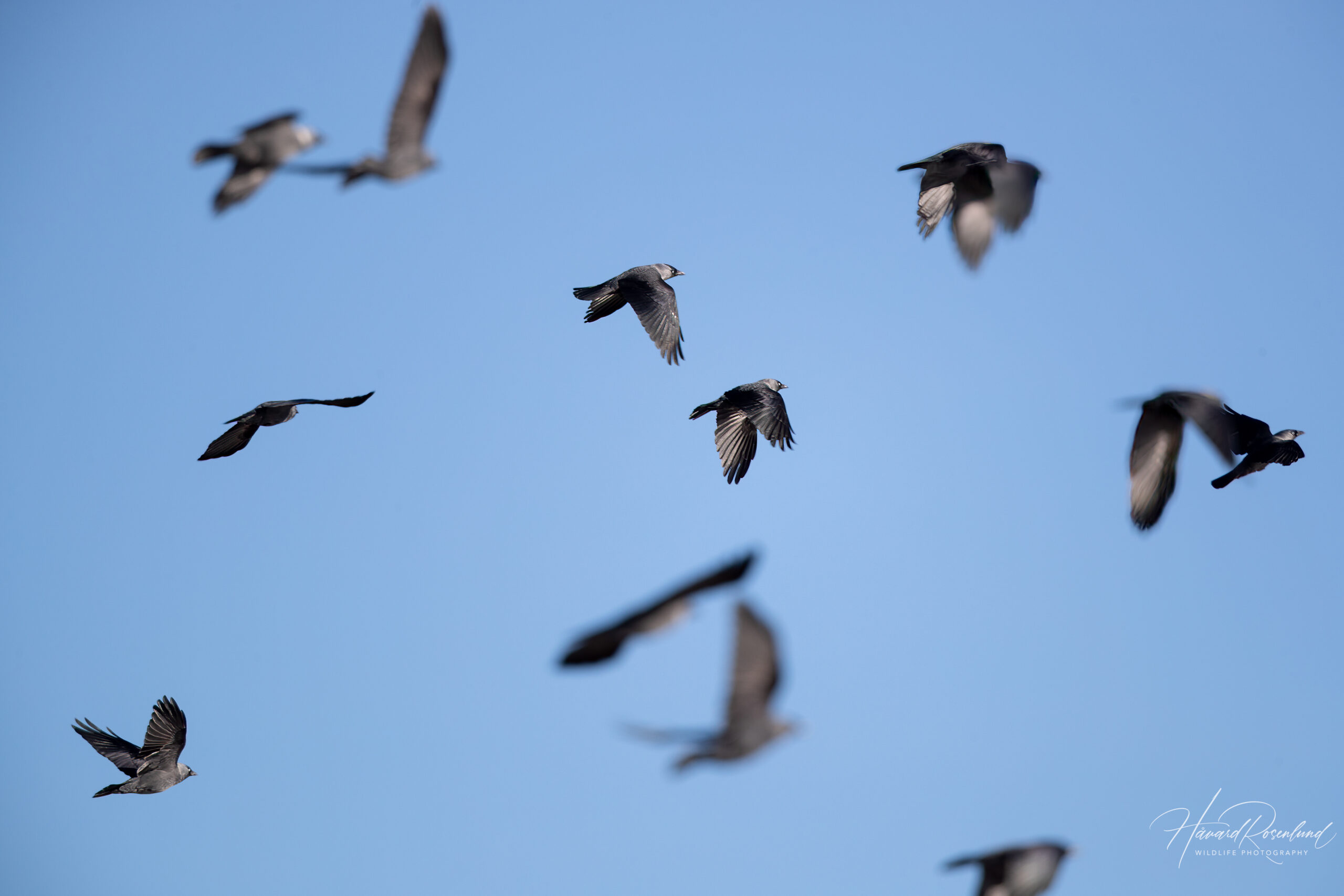
The Eurasian jackdaw (Coloeus monedula) is one of the smallest members of the crow family. Adults are about 34–39 cm long, have a wingspan of around 70 cm and usually weigh roughly 204–270 g. The plumage is mostly glossy black, but the nape and sides of the neck are contrasting grey. The pale grey to whitish iris is especially conspicuous and, together with the compact body, short bill and quick, buoyant flight, makes the species easy to separate from larger crows and ravens.
The species is widespread across Europe and extends through western and central Asia, with smaller populations in North Africa. Its calls are short, sharp and highly characteristic, and vocal activity becomes especially conspicuous when many birds gather together.
Many older sources use the name Corvus monedula. The species is now placed in the smaller genus Coloeus, giving the current combination Coloeus monedula.
Habitat
Jackdaws thrive in open and semi-open landscapes where feeding areas occur close to safe nesting cavities. Farmland, pasture, open woodland, cliffs, villages, towns, parks and historic buildings can all provide suitable habitat.
The species has adapted particularly well to human settlements because old buildings, church towers, chimneys, bridges and other structures can provide abundant nesting cavities. Agricultural and urban landscapes also offer predictable feeding opportunities, allowing jackdaws to live in close proximity to people without being dependent on one single habitat type.
Diet
The diet is highly opportunistic. Jackdaws take beetles, larvae, earthworms and other invertebrates, as well as seeds, grain, fruit, carrion and human food waste. Eggs, nestlings and small vertebrates are taken occasionally.
Much feeding takes place on the ground, often in pairs or social groups. Birds readily exploit freshly disturbed soil, livestock pasture, harvested fields and other places where food becomes exposed, and flocks can move rapidly between temporary feeding opportunities.
Social behaviour
Jackdaws are strongly social throughout the year and form long-lasting pair bonds. A field study published in 2015 found that paired birds remained closely associated even within much larger feeding flocks, while the strength of the bond they displayed varied with season and social context.
The conspicuous pale eyes may themselves have a social function at nest sites. A field experiment published in 2014 showed that a pale-eyed jackdaw visible inside a cavity discouraged other jackdaws from approaching, supporting the idea that the bright iris can advertise that a potential nest hole is already occupied.
Outside breeding, hundreds or even thousands of jackdaws can gather at communal roosts, often together with rooks (Corvus frugilegus). A study published in 2022 found that morning departure is coordinated through rising calling intensity: as more birds call, the flock approaches a point at which many individuals leave almost simultaneously. Playback experiments made roosts depart earlier, showing that the calls themselves help many birds time their departure together.
The pair therefore remains an important social unit even inside much larger groups. At the same time, flock living lets jackdaws respond collectively to feeding opportunities, threats and movements on a scale far beyond the pair.
Intelligence
Jackdaws pay close attention to social information. Experiments published in 2009 showed that they responded differently depending on whether a familiar person was looking toward food and could use communicative cues from people they knew. This demonstrates sensitivity to attention and social signals without requiring the assumption that jackdaws understand human intentions in the same way people do.
Other experiments have tested how jackdaws reason about relationships and hidden information. A study published in 2013 found that birds could use learned relationships to infer the likely order of combinations they had never encountered directly, while work published in 2014 showed that they could keep track of quantities that were no longer visible. Their decisions can therefore depend on learned relationships and mental representations of hidden sets rather than only on what is immediately in front of them.
Migration
Migration varies geographically. Many western European populations are resident or make only short seasonal movements, while birds from northern and eastern parts of the range are more migratory and move south or west in autumn.
Even resident birds can be highly mobile outside breeding, travelling in flocks between feeding grounds and communal roosts. Winter movements therefore combine true migration by some individuals with shorter-distance wandering by others.
Breeding
Jackdaws are cavity nesters. They use holes in old trees, rock faces, ruins, church towers, chimneys, bridges and other structures, and they readily breed in nest boxes. Suitable cavities can be occupied repeatedly over many years, and colonies often form where many nest sites are available close together.
Both partners bring material to the nest, which is built largely from sticks and lined with softer material. A typical clutch contains 4–5 eggs. The female performs the incubation, which lasts about 20 days, while the male supplies food. Both parents feed the young after hatching, and the chicks normally remain in the nest for about 32–33 days before fledging. One brood is typical.
Status
The Eurasian jackdaw is classified as least concern on the IUCN Red List. It has a very large range and remains common across many agricultural and urban landscapes.
Local populations can still change with farming practices, food availability and the supply of old trees or buildings with suitable nesting cavities, but the species remains globally widespread and secure.
Image gallery
Loading map and observations…
Have you seen this species?
Independent species archive
Did you find this species page useful?
Wildlife Vagabond is independently built and maintained. Voluntary support helps cover hosting, maps, data storage and continued improvements to the species archive.
Support Wildlife VagabondSpecies content will remain freely available.
References
Information about the species’ global distribution and status is based primarily on global Red List data. See the references below for details.
- Avibase. (n.d.). / AviList 2025 – Eurasian Jackdaw (Coloeus monedula). https://avibase.bsc-eoc.org/species.jsp?avibaseid=D4C32F8E792B65BA&lang=EN
- BirdLife International. (n.d.). Eurasian Jackdaw species factsheet. https://datazone.birdlife.org/species/factsheet/eurasian-jackdaw-coloeus-monedula
- British Trust for Ornithology. (n.d.). Jackdaw. https://www.bto.org/learn/about-birds/birdfacts/jackdaw
- Davidson, G. L., Clayton, N. S., & Thornton, A. (2014). Salient eyes deter conspecific nest intruders in wild jackdaws (Corvus monedula). Biology Letters, 10(2), 20131077. https://doi.org/10.1098/rsbl.2013.1077
- Dibnah, A. J., Herbert-Read, J. E., Boogert, N. J., McIvor, G. E., Jolles, J. W., & Thornton, A. (2022). Vocally mediated consensus decisions govern mass departures from jackdaw roosts. Current Biology, 32(10), R455-R456. https://doi.org/10.1016/j.cub.2022.04.032
- International Union for Conservation of Nature. (n.d.). Eurasian Jackdaw. The IUCN Red List of Threatened Species. https://www.iucnredlist.org/species/22705929/131943991
- Kubitza, R. J., Bugnyar, T., & Schwab, C. (2015). Pair bond characteristics and maintenance in free‐flying jackdaws Corvus monedula : effects of social context and season. Journal of Avian Biology, 46(2), 206-215. https://doi.org/10.1111/jav.00508
- Mikolasch, S., Kotrschal, K., & Schloegl, C. (2013). Transitive inference in jackdaws (Corvus monedula). Behavioural Processes, 92, 113-117. https://doi.org/10.1016/j.beproc.2012.10.017
- Ujfalussy, D. J., Miklósi, Á., Bugnyar, T., & Kotrschal, K. (2014). Role of mental representations in quantity judgments by jackdaws (Corvus monedula). Journal of Comparative Psychology, 128(1), 11-20. https://doi.org/10.1037/a0034063
- von Bayern, A. M., & Emery, N. J. (2009). Jackdaws Respond to Human Attentional States and Communicative Cues in Different Contexts. Current Biology, 19(7), 602-606. https://doi.org/10.1016/j.cub.2009.02.062