
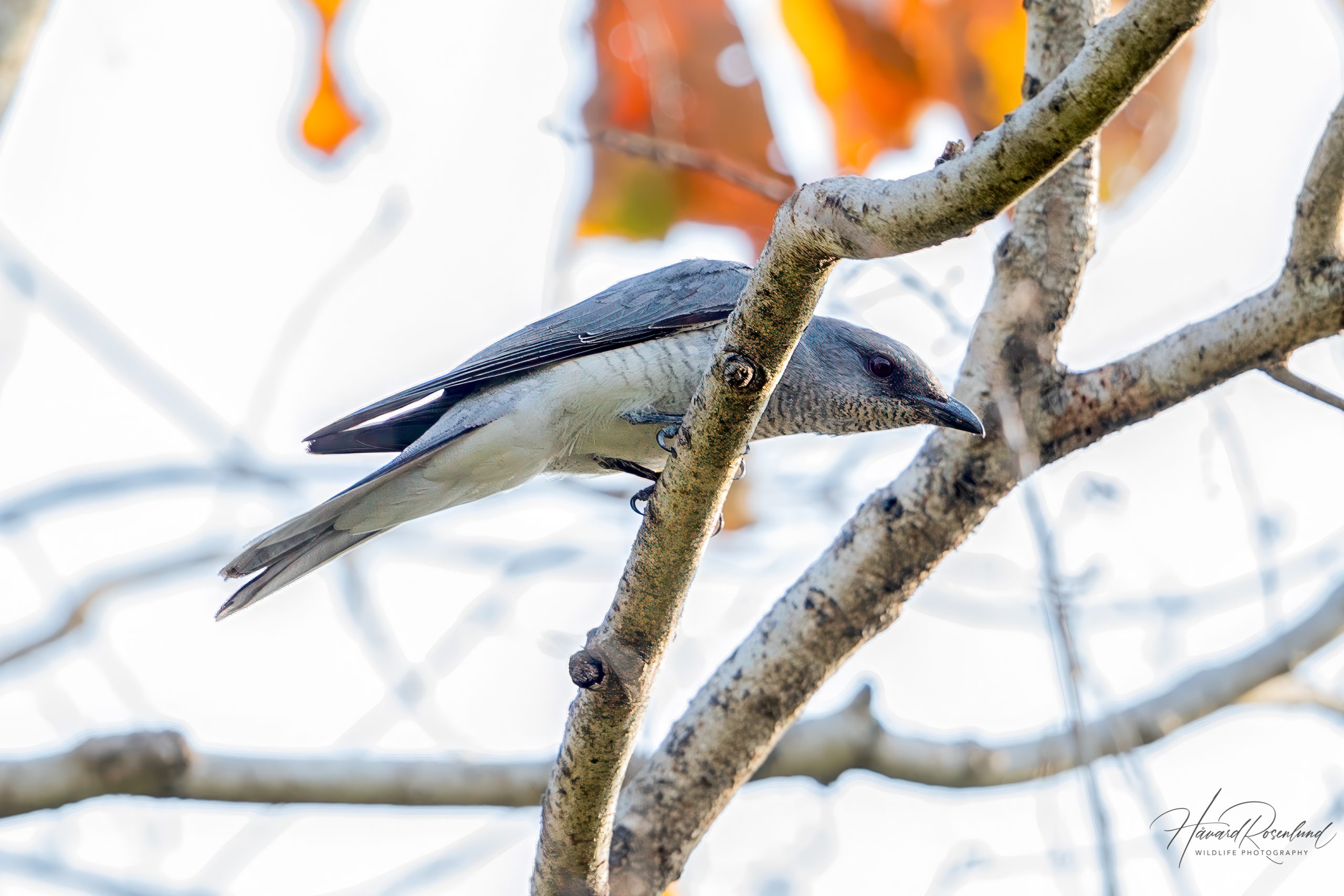
Indian Cuckooshrike
Coracina macei
At a glance
Habitat
- Open forest, woodland, forest edge, plantations and other semi-open tree-rich habitats, from lowlands into foothills
Diet
- Mainly insects and other arthropods taken from foliage and branches; also fruit and berries
Activity
- Diurnal
Size
- Length: ~23–30 cm Weight: ~104–112 g
Range
- Indian subcontinent south of the Himalayas, including much of India and Sri Lanka
Description
The Indian cuckooshrike (Coracina macei) is a medium-sized member of the cuckooshrike family found across much of the Indian subcontinent. Adults are about 23–30 cm long and weigh roughly 104–112 g. The bird has a strong, slightly hooked bill and a long body with broad wings and a fairly long tail.
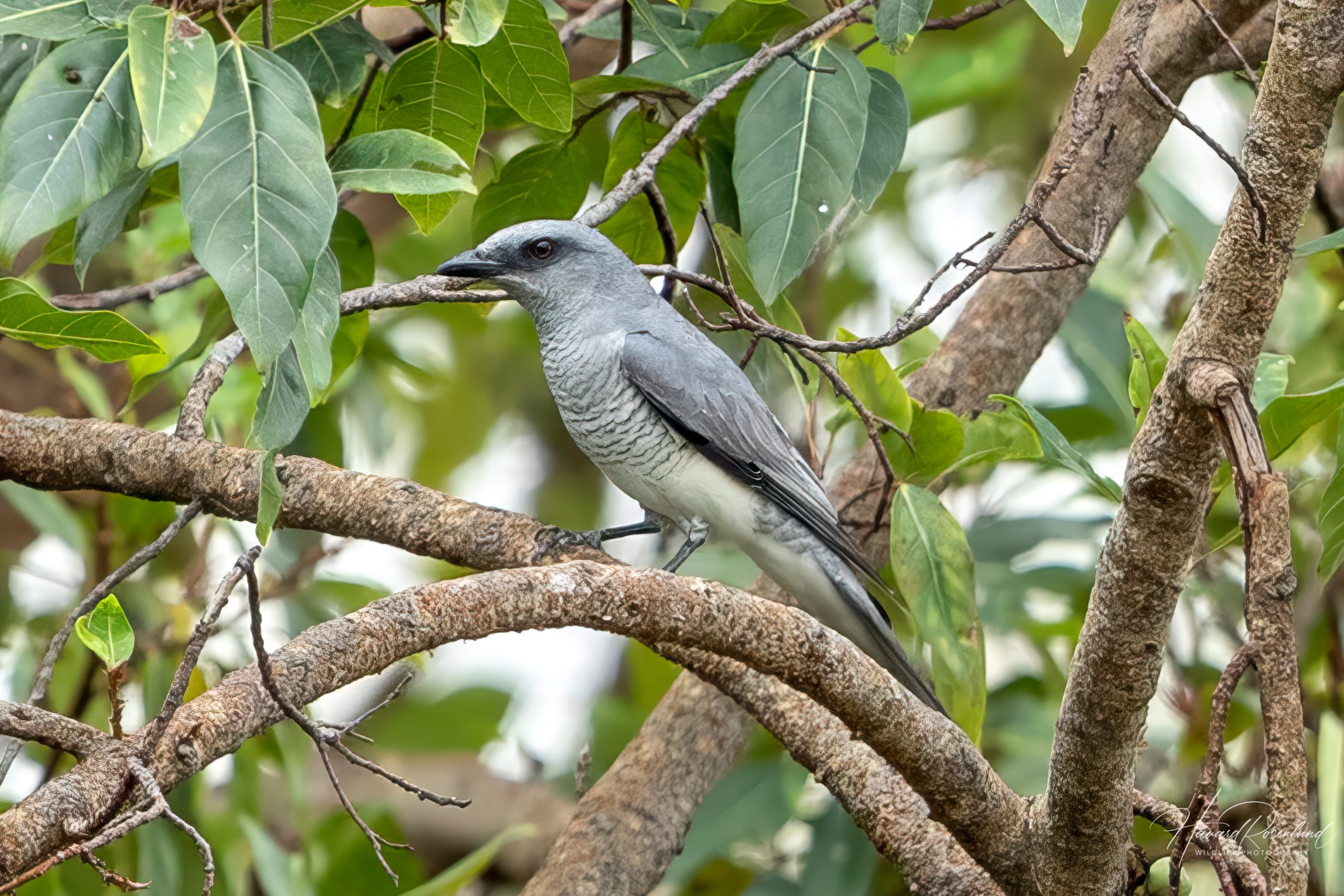
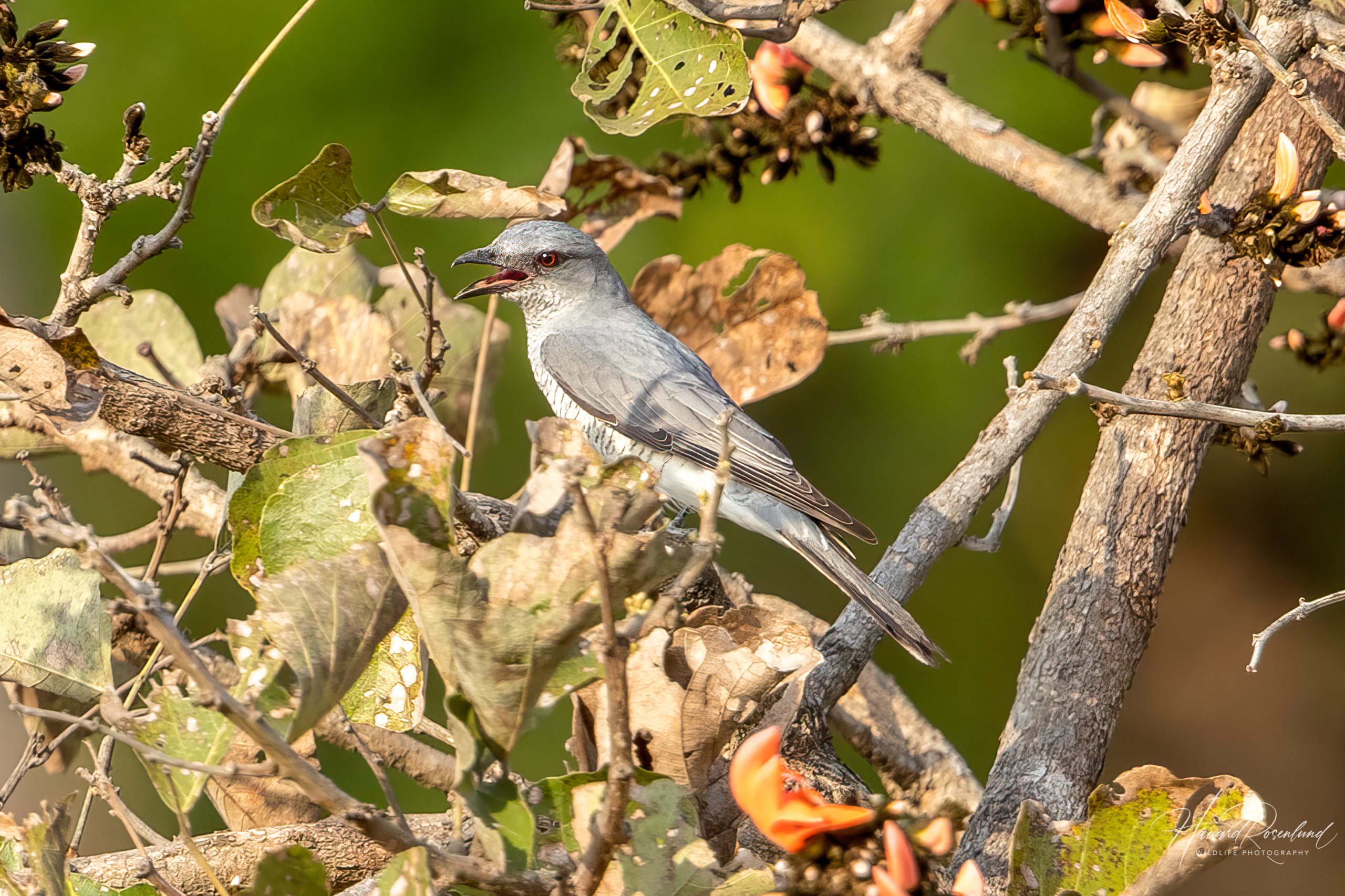
Adult males are mostly grey with a darker mask through the eye and blackish wings and tail. Females are browner or paler grey and show much stronger barring across the throat, breast and belly. Both sexes can appear rather plain at first glance, but the combination of relatively large size, heavy bill and slow, deliberate movements through the canopy is distinctive.
Taxonomy
The English name Large Cuckooshrike was formerly used for a much broader Coracina macei complex extending from the Indian subcontinent into Southeast Asia. A taxonomic revision in 2024 restricted C. macei to the Indian subcontinent, and the English name was changed to Indian Cuckooshrike.
Two subspecies are recognised: C. m. macei in India and C. m. layardi in Sri Lanka. Several former subspecies farther east are now placed in Oriental Cuckooshrike (Coracina javensis), while Malayan Cuckooshrike (C. larutensis) is treated separately. Older field guides and papers may therefore use “Large Cuckooshrike” for birds that no longer belong to this species.
Habitat
Indian cuckooshrikes use a broad range of wooded and semi-open habitats, including dry and moist forest, open woodland, forest edges, savanna, plantations, rural gardens and areas where the original forest has been heavily altered. They occur from the lowlands into foothills and can reach roughly 2,000 m in some parts of the range.
The species can persist in fairly open and modified landscapes as long as enough mature trees and canopy remain for feeding and nesting. It therefore also occurs where woodland is mixed with plantations and more open areas.
Diet
Large insects and other arthropods make up most of the diet. Caterpillars, beetles, grasshoppers, mantids, moths, spiders and other invertebrates are taken, while fruit and berries provide additional food, especially when insect prey is less abundant.
Behaviour
Indian cuckooshrikes are usually encountered alone, in pairs or in small groups. They spend much of their time in the upper parts of trees and can be surprisingly quiet and inconspicuous despite their size. Flight typically alternates several wingbeats with short glides.
Feeding birds move methodically through the canopy, pausing to inspect leaves, branches and trunks before reaching or hopping towards prey. They also make short flights to capture insects in the air and occasionally descend into lower vegetation or onto the ground.
Breeding
Breeding timing varies geographically but is concentrated mainly from spring into the monsoon period across much of India. Pairs become more vocal and territorial, and courtship can include wing-flicking and fluttering movements through the foliage accompanied by loud, piercing calls. The nest is a shallow saucer of twigs, grass and other plant material placed on a horizontal branch or in a fork high in a tree.
Clutches are usually small, often two to three eggs. Incubation lasts about 22 days, and the young leave the nest after roughly three weeks. Both parents take part in nest building, incubation and feeding the young, and the species can breed more than once during the year.
Status
The Indian cuckooshrike is classified as least concern on the IUCN Red List. It remains widespread across much of India and Sri Lanka and can use plantations, gardens and moderately degraded woodland as well as more natural forest.
Local populations can still be affected by loss of mature trees and extensive clearing of wooded habitat. The species tolerates semi-open and human-modified landscapes well but still depends on a well-developed tree layer for feeding and nesting.
Image gallery
Loading map and observations…
Have you seen this species?
Independent species archive
Did you find this species page useful?
Wildlife Vagabond is independently built and maintained. Voluntary support helps cover hosting, maps, data storage and continued improvements to the species archive.
Support Wildlife VagabondSpecies content will remain freely available.
References
Information about the species’ global distribution and status is based primarily on global Red List data. See the references below for details.
- BirdLife International. (2026). IUCN Red List for birds. BirdLife DataZone. https://datazone.birdlife.org
- Clements Checklist – 2024 taxonomy update. (n.d.). Indian Cuckooshrike. https://www.birds.cornell.edu/clementschecklist/updates-and-corrections-october-2024/
- India Biodiversity Portal. (n.d.). Coracina macei. https://indiabiodiversity.org/species/show/239422
- International Ornithologists’ Union. (n.d.). IOC World Bird List – revision of the Coracina macei / javensis complex. https://www.worldbirdnames.org/new/updates/taxonomy/
- International Union for Conservation of Nature. (n.d.). Coracina macei. The IUCN Red List of Threatened Species. https://www.iucnredlist.org/species/183458017/173326100
- Limparungpatthanakij, W., Boesman, P. F. D., & Taylor, B. (2024). Indian Cuckooshrike (Coracina macei). In Birds of the World. Cornell Lab of Ornithology. https://doi.org/10.2173/bow.larcuc1.01
- Oiseaux.net. (n.d.). AVONET 2023 trait data, summarised in Oiseaux.net – Indian Cuckooshrike. https://www.oiseaux.net/en/indian.cuckooshrike.html