
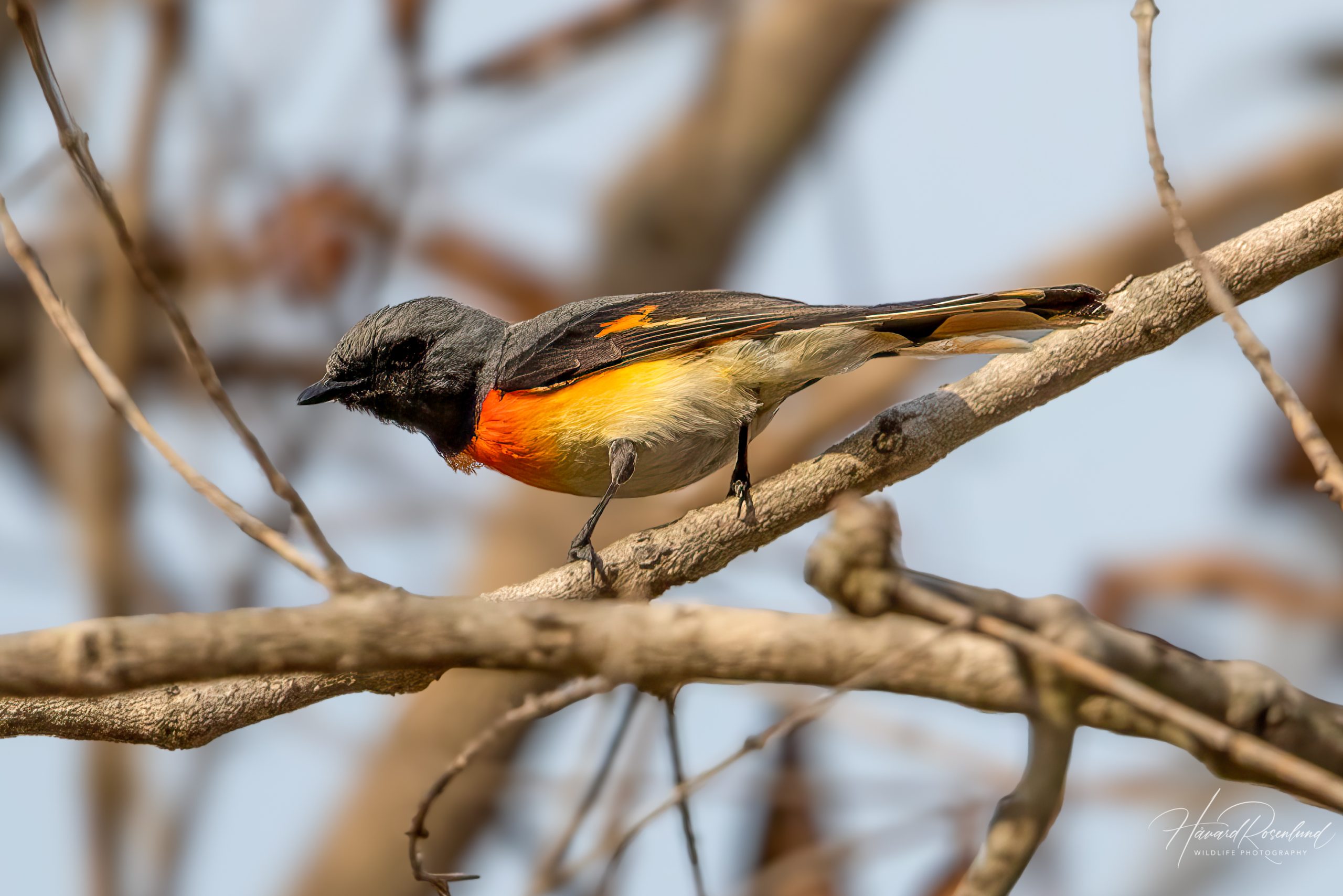
Small Minivet
Pericrocotus cinnamomeus
At a glance
Habitat
- Open woodland, deciduous forest, scrub, plantations, gardens and other tree-rich habitats, including some urban areas
Diet
- Mainly caterpillars, beetles and other insects and arthropods taken from foliage and branches
Activity
- Diurnal
Size
- Length: ~15–16 cm Weight: ~6–12 g
Range
- Indian subcontinent through parts of Southeast Asia, with several geographical subspecies
Description
The small minivet (Pericrocotus cinnamomeus) is a small, colourful member of the cuckooshrike family found across the Indian subcontinent and parts of Southeast Asia. Adults are about 15–16 cm long and weigh roughly 6–12 g.
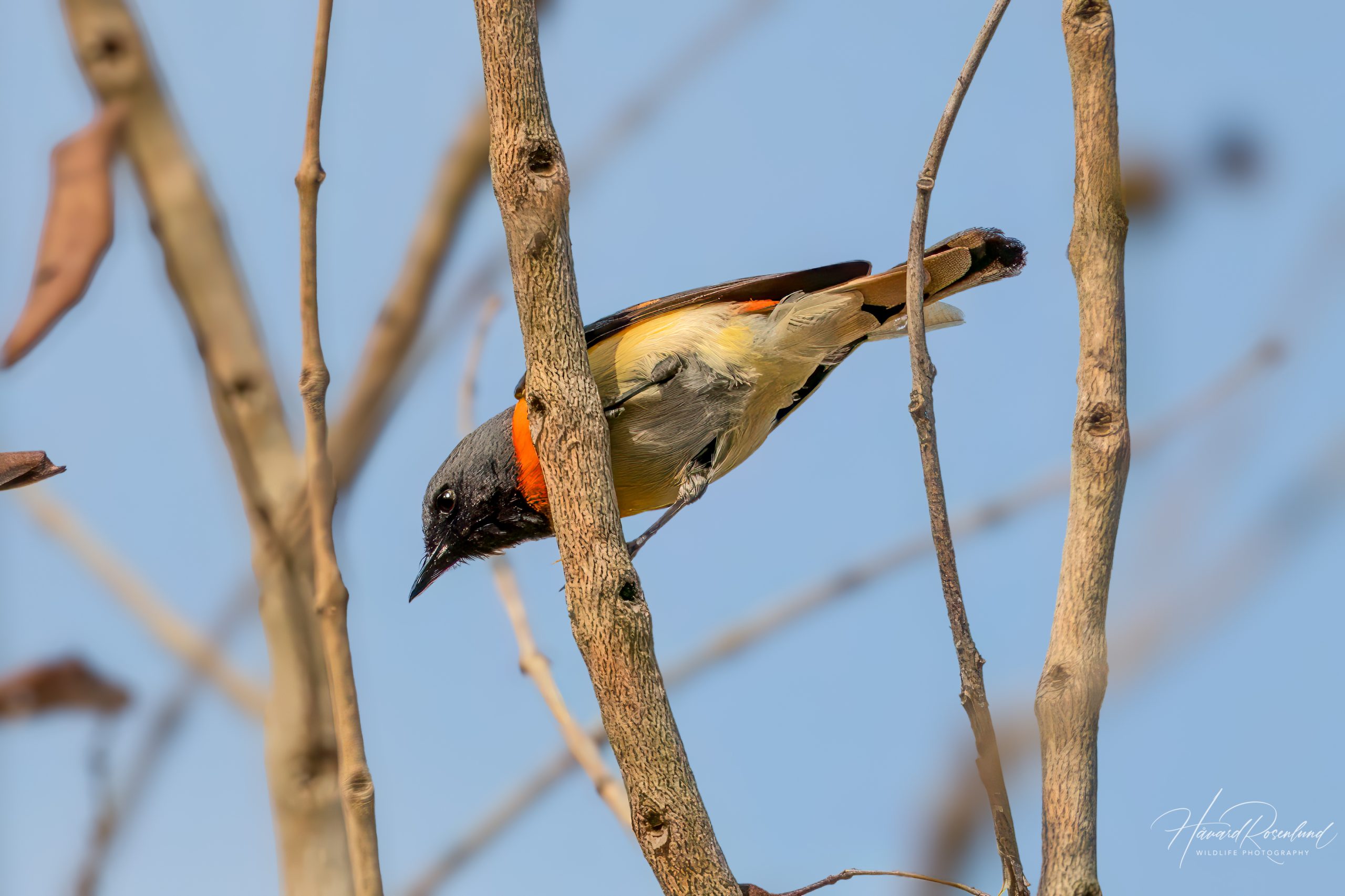
Males have grey upperparts with bright orange to red-orange patches on the wings, rump and underparts, fading paler towards the belly. Females replace the orange with yellow and are generally softer grey above. The small size and paler lower belly help separate the species from larger minivets such as the scarlet minivet (Pericrocotus speciosus).
Habitat
Small minivets use a broad range of tree-rich habitats, including deciduous woodland, open forest, scrub, plantations, orchards, gardens and parks. They are especially common in semi-open landscapes where patches of canopy are broken by edges and clearings.
In India the species is mainly resident, although local movements can occur in response to season and food availability. Its ability to use plantations and gardens gives it some flexibility in human-modified landscapes, provided enough trees remain.
Diet
The diet is dominated by insects and other arthropods, especially caterpillars, beetles and other prey taken from leaves and branches.
Behaviour
Small minivets are active canopy foragers. They move quickly between twigs while inspecting foliage, make short aerial sallies after flying insects and may beat or flick the wings through leaves to disturb hidden prey. Feeding is usually continuous and mobile rather than based on long waits at one perch.
They are often seen in pairs or small flocks and remain in regular contact with thin, high-pitched calls while moving through the treetops. Outside the breeding season they may join mixed-species feeding flocks, especially where several insect-eating species are searching the same canopy.
In mixed flocks, birds can search a larger area while more individuals remain alert for predators. Small minivets regularly join such flocks in many wooded habitats.
Breeding
Breeding timing varies across the range but is concentrated mainly from late winter through the early monsoon period in much of India. The nest is a small cup placed high in a tree, built from fine twigs, plant fibres and spider silk and often decorated with lichens so that it blends into the branch.
Around three eggs are typical, although two to four are known. The female performs most of the incubation, while both adults feed and care for the chicks. A small field study published in 2016 followed two nests at Jahangirnagar University in Bangladesh, containing three and four eggs respectively. In the successful nest all four eggs hatched after 11 days, and three chicks left the nest on day 12. The study also showed that the male could briefly take over incubation when the female left the nest, and that both parents fed the chicks.
After leaving the nest, the chicks remained with their parents nearby; in the 2016 study they were followed for at least the next two days.
Status
The small minivet is classified as least concern on the IUCN Red List and remains widespread.
Indian monitoring published in 2025 indicates a long-term decline of about 32%, while the population has increased by around 1.4% per year in recent years. This suggests a recent improvement after earlier losses, although trends can still vary regionally.
Because the species depends on trees for both feeding and nesting, extensive removal of woodland, large garden trees and plantation canopy can reduce local habitat even when the surrounding landscape remains green.
Image gallery
Loading map and observations…
Have you seen this species?
Independent species archive
Did you find this species page useful?
Wildlife Vagabond is independently built and maintained. Voluntary support helps cover hosting, maps, data storage and continued improvements to the species archive.
Support Wildlife VagabondSpecies content will remain freely available.
References
Information about the species’ global distribution and status is based primarily on global Red List data. See the references below for details.
- BirdLife International. (n.d.). Small Minivet species factsheet. https://datazone.birdlife.org/species/factsheet/small-minivet-pericrocotus-cinnamomeus
- CSIR-National Environmental Engineering Research Institute. (n.d.). CSIR-NEERI Biodiversity Portal – Small Minivet. https://neeriathome.neeri.res.in/biodiversity/smallMinivets.php
- International Union for Conservation of Nature. (n.d.). Small Minivet. The IUCN Red List of Threatened Species. https://www.iucnredlist.org/species/22706741/94086763
- Jahan, Das & Khan. (2016). Nesting behaviour of Yellow-footed Green Pigeon Treron phoenicopterus and Small Minivet Pericrocotus cinnamomeus at Jahangirnagar University Campus, Savar, Bangladesh. BirdingASIA, 26, 84–86. https://www.researchgate.net/publication/316656619_Nesting_behaviour_of_Yellow-footed_Green_Pigeon_Treron_phoenicopterus_and_Small_Minivet_Pericrocotus_cinnamomeus_at_Jahangirnagar_University_Campus_Savar_Bangladesh
- Oiseaux.net. (n.d.). Small Minivet. https://www.oiseaux.net/en/oiseaux/small.minivet.html
- Srinivasan, U., Raza, R. H., & Quader, S. (2012). Patterns of species participation across multiple mixed-species flock types in a tropical forest in northeastern India. Journal of Natural History, 46(43-44), 2749-2762. https://doi.org/10.1080/00222933.2012.717644
- State of India's Birds. (2025). 2025 – Small Minivet. https://stateofindiasbirds.in/species/rj-smamin1/