
Barasingha
Rucervus duvaucelii
At a glance
Habitat
- Tall grasslands, floodplains and wetlands; the central Indian hard-ground population also uses drier meadows and open sal forest
Diet
- Primarily a grazer, feeding mostly on grasses, with aquatic plants and other vegetation also taken
Activity
- Mostly diurnal, with feeding concentrated in the cooler morning and late afternoon
Size
- Length: about 180 cm Weight: about 130–280 kg
Range
- Fragmented populations in northern, north-eastern and central India and south-western Nepal
Description
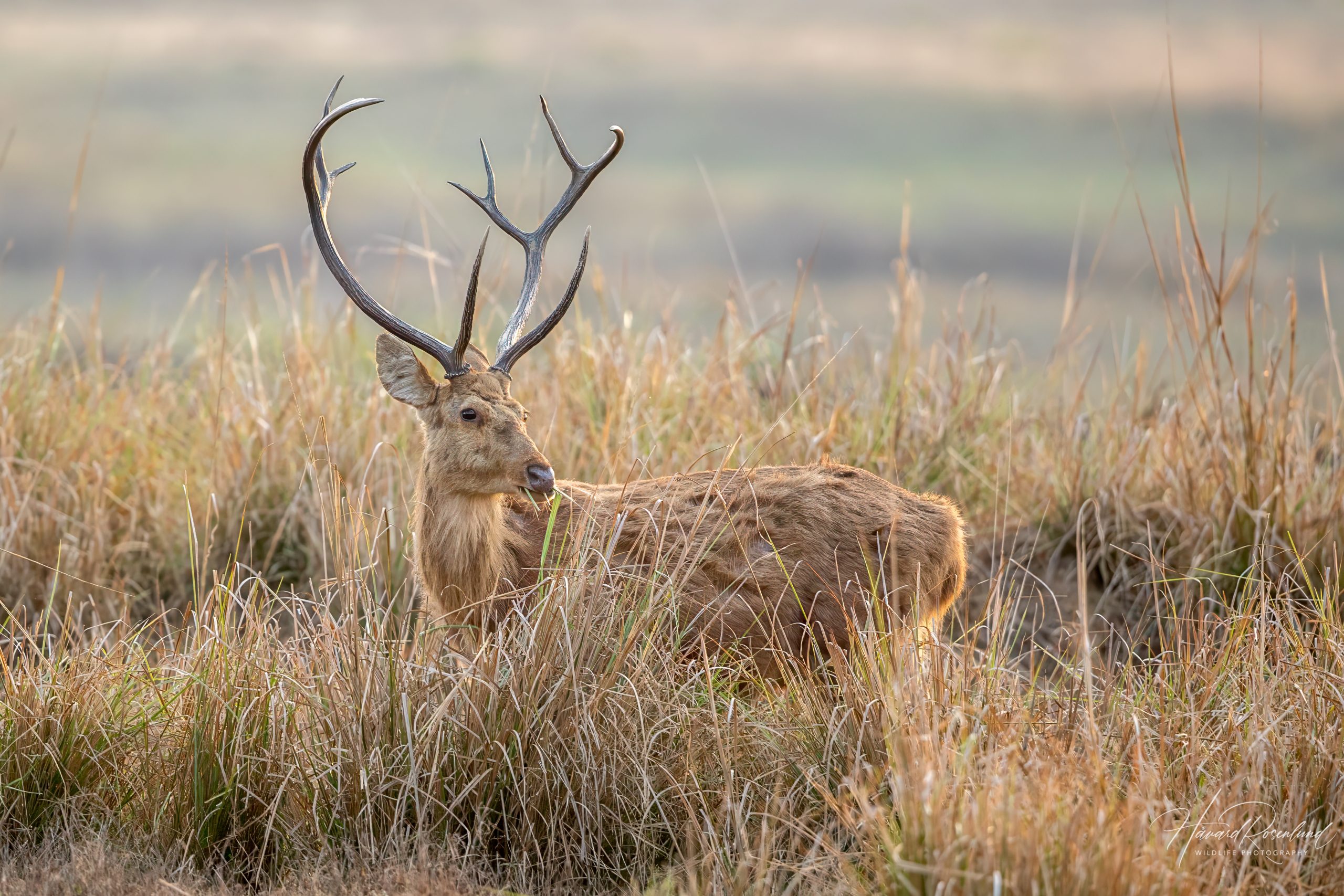
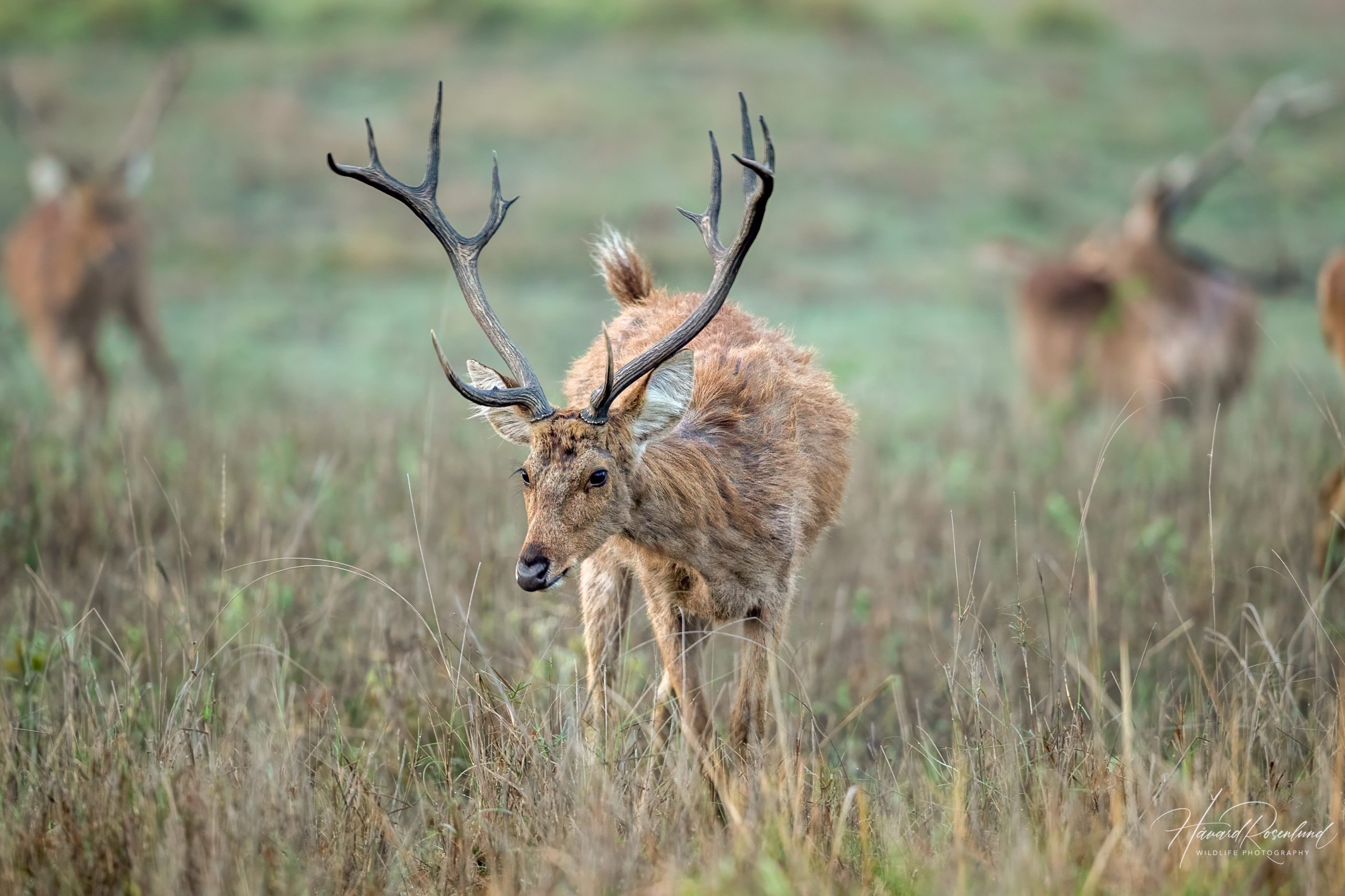
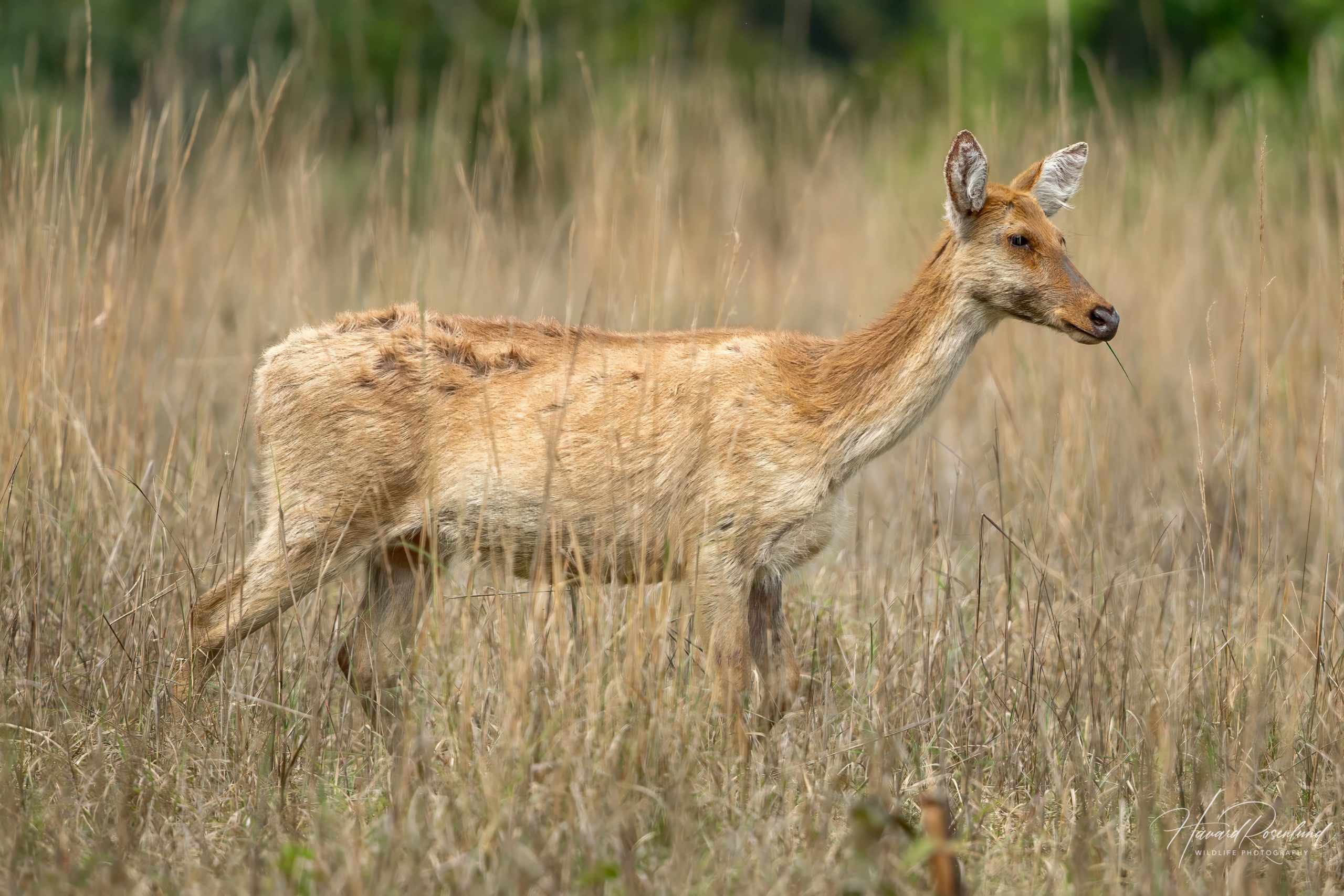
The barasingha (Rucervus duvaucelii), also known as the swamp deer, is a large deer of the Indian subcontinent. Adults have a body length of around 180 cm, and large males can weigh well over 200 kg. The coat ranges from yellowish brown to warm brown and becomes darker and thicker during the cool season. Males carry large, highly branched antlers with many tines. The name barasingha is often translated as “twelve-tined”, although mature stags can carry both more and fewer than twelve points.
The species is lighter-built than the larger sambar (Rusa unicolor) and much more strongly associated with open grassland. Appearance and ecology also differ among populations. The hard-ground form of central India is adapted to firmer, drier meadows than the northern and eastern forms, which mainly occupy floodplains and wet grasslands.
Taxonomy
Three geographically distinct forms are generally treated as subspecies: northern barasingha R. d. duvaucelii in northern India and Nepal, hard-ground barasingha R. d. branderi in central India, and eastern barasingha R. d. ranjitsinhi in Assam. They differ in habitat, appearance and long geographic isolation.
Genetic studies support strong differentiation among the populations, but they are still treated within a single species, Rucervus duvaucelii, rather than as three separate species.
Habitat
Barasingha are grassland specialists, although the different populations use somewhat different environments. In northern India and Nepal the species is closely associated with tall floodplain grasslands, marshes and wetlands. The eastern animals in Assam use wet grasslands along major river systems, while the central Indian population occupies drier meadows and open sal forest in the Kanha–Satpura landscape.
Water, open feeding grounds and large connected grasslands are recurring requirements. A habitat study from western Nepal in 2023 found that suitable areas were concentrated at low elevations, close to water and farther from settlements. Only about 6% of the surveyed landscape was predicted to be suitable, illustrating how strongly the species now depends on a limited network of high-quality grassland habitat.
Diet
Barasingha are primarily grazers. Grasses form most of the diet, with sedges, aquatic plants and other vegetation also eaten depending on season and habitat. In a winter study of the northern subspecies in Dudhwa, grasses made up more than 97% of the plant material identified in the diet.
Feeding is concentrated in the cooler parts of the day. Herds spread across open grasslands and crop short vegetation before resting in taller grass or shade as temperatures rise. The central Indian form remains strongly dependent on productive meadows even though it also moves through open forest.
Behaviour
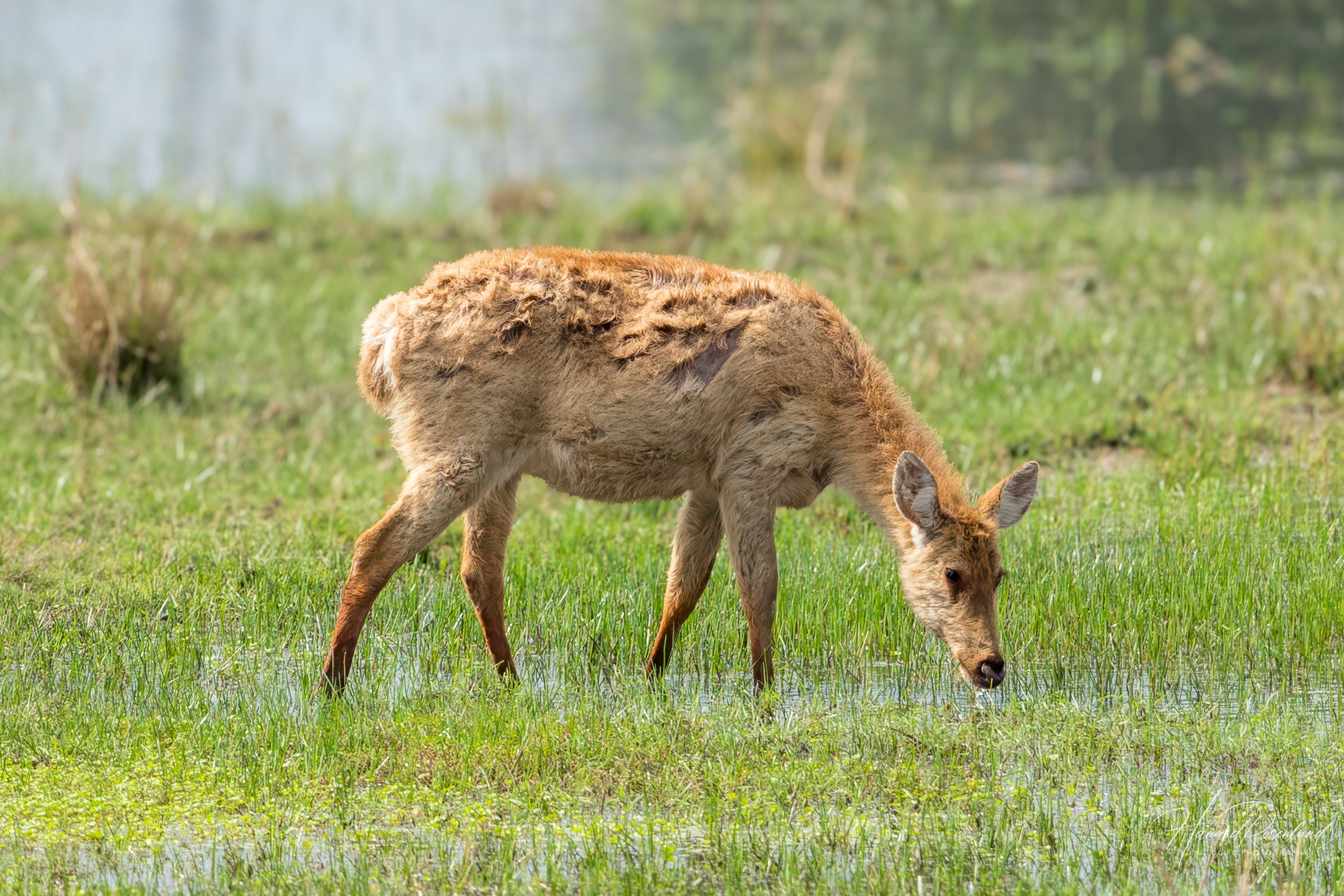
Barasingha are strong swimmers and readily enter shallow water. The central Indian population is distinctive because much of its life is spent on relatively firm ground, unlike the wetter floodplain habitats used more strongly by the other forms.
Social behaviour
Barasingha are social deer. Females, young and younger animals often form herds, while mature males may be more solitary or occur in smaller male groups outside the rut. Herds can grow larger where rich grazing areas bring many animals together. Group composition changes through the year as males join females more regularly during the breeding season.
Predation
Tigers (Panthera tigris) are the main large predator of barasingha where the two species overlap. In Dudhwa Tiger Reserve, barasingha and chital together accounted for about 55% of the prey biomass in the tiger diet, placing swamp deer among the major prey species supporting the predator community in this grassland–forest system.
Open grassland makes adults conspicuous, while tall grass and wetland vegetation provide important escape cover. Newborn calves are particularly vulnerable and spend their first weeks hidden in tall grass.
Reproduction
The rut varies somewhat between regions but is mainly associated with the cool season. Males become more conspicuous and competitive, using calls, scent and antler displays and sparring or fighting for access to females. A dominant stag may gather several females into a breeding group.
After a gestation of about eight months, the female usually gives birth to a single calf. The calf remains hidden in tall grass during its vulnerable first weeks, and the mother returns regularly to nurse it.
Status
The barasingha is classified as vulnerable on the IUCN Red List. The species was once far more widespread across floodplains of the Indian subcontinent but now survives only in fragmented populations in India and Nepal and has disappeared from Pakistan and Bangladesh.
Threats
The main long-term threat is the loss and fragmentation of tall grasslands, floodplains and wetlands through agriculture, settlement and altered river systems. Hunting and poaching caused severe local declines in the past, while small isolated populations remain vulnerable to disease, floods, fire and other sudden events.
The timing of grassland burning can also affect the species. Work in Manas shows that late burning can overlap with the calving period and at the same time favour invasive plants, reducing habitat quality during a particularly vulnerable stage.
Conservation
The hard-ground population of central India has recovered strongly after disappearing from most of its former range and surviving only in Kanha by the mid-20th century. Long-term protection and targeted grassland management rebuilt a strong population in Kanha. Between 2015 and 2023, 98 animals were moved from there to Satpura Tiger Reserve in seven releases. By 2023 the Satpura population had grown to 172 animals, with annual reproduction and generally good body condition.
The eastern population has a similar recent history. Unrest and poaching reduced the population in Manas to fewer than 20 animals. In 2014 and 2017, a total of 36 barasingha were moved from Kaziranga to Manas, and 174 animals were recorded there in 2023. The population remains dependent on open grasslands and wetlands, secure water sources and low poaching pressure. Early controlled patch burning can keep grasslands open with less conflict with the period when calves remain hidden than late burning.
Image gallery
Loading map and observations…
Have you seen this species?
Independent species archive
Did you find this species page useful?
Wildlife Vagabond is independently built and maintained. Voluntary support helps cover hosting, maps, data storage and continued improvements to the species archive.
Support Wildlife VagabondSpecies content will remain freely available.
References
Information about the species’ global distribution and status is based primarily on global Red List data. See the references below for details.
- Dhami, B., Adhikari, B., Panthi, S., & Neupane, B. (2023). Predicting suitable habitat of swamp deer (Rucervus duvaucelii) across the Western Terai Arc Landscape of Nepal. Heliyon, 9(6), e16639. https://doi.org/10.1016/j.heliyon.2023.e16639
- International Union for Conservation of Nature. (n.d.). Barasingha. The IUCN Red List of Threatened Species. https://www.iucnredlist.org/species/4257/22167675
- Islam, N., Barman, R., Saikia, M. K., & Saikia, P. K. (2026). Post-translocation population characteristics and conservation insights for eastern swamp deer Rucervus duvaucelii ranjitsinhi reinforcement in Manas National Park, Assam, India. Scientific Reports, 16(1), 21713. https://doi.org/10.1038/s41598-026-47550-2
- Jaseem, A., Ilyas, O., & Sainy, V. K. (2026). Winter dietary habits of Northern Swamp deer (Rucervus duvaucelii duvaucelii) in Dudhwa Tiger Reserve, Uttar Pradesh, India. Ethology Ecology & Evolution, 38(3), 389-406. https://doi.org/10.1080/03949370.2026.2641225
- Kumar, A., Ghazi, M. G. U., Hussain, S. A., Bhatt, D., & Gupta, S. K. (2017). Mitochondrial and Nuclear DNA Based Genetic Assessment Indicated Distinct Variation and Low Genetic Exchange Among the Three Subspecies of Swamp Deer (Rucervus duvaucelii). Evolutionary Biology, 44(1), 31-42. https://doi.org/10.1007/s11692-016-9387-2
- Lakshmanan, K., Saha, S., Goswami, S., & Awasthi, N. (2026). Reintroduction and conservation of hard-ground swamp deer (Rucervus duvaucelii branderi) in Satpura Tiger Reserve, Central India. Conservation Evidence Journal, 23, 7-14. https://doi.org/10.52201/CEJ23/UAAH2911
- Mammal Diversity Database. (n.d.). Rucervus duvaucelii. American Society of Mammalogists. https://www.mammaldiversity.org/taxon/1006319/
- Wildlife Institute of India. (n.d.). Kanha Tiger Reserve. https://mee-tr.wii.gov.in/Home/Geospatial/kanha-tiger-reserve
- Wildlife Institute of India. (n.d.). Satpura Tiger Reserve. https://mee-tr.wii.gov.in/Home/Geospatial/satpura-tiger-reserve