
Fork-tailed Drongo
Dicrurus adsimilis
At a glance
Habitat
- Savanna woodland, open grassland with scattered trees, farmland, plantations, parks and gardens; avoids dense forest and extreme desert
Diet
- Mainly insects; also small vertebrates and food stolen from other animals
Activity
- Diurnal; typically hunts from exposed perches and follows other foragers
Size
- Length: 23–26 cm Weight: About 50 g
Range
- Widespread across most of sub-Saharan Africa outside the densest forests and driest deserts
Description
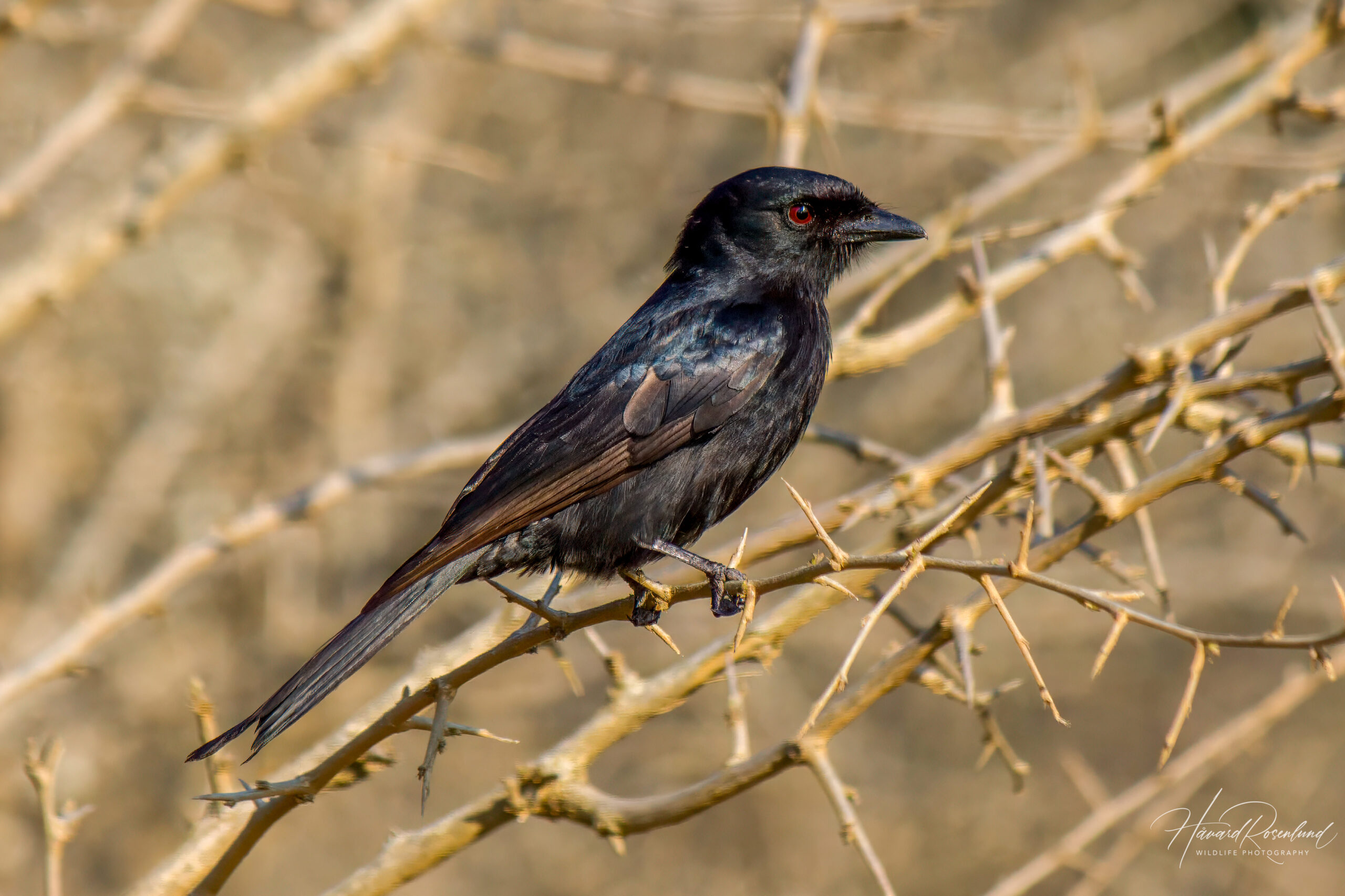
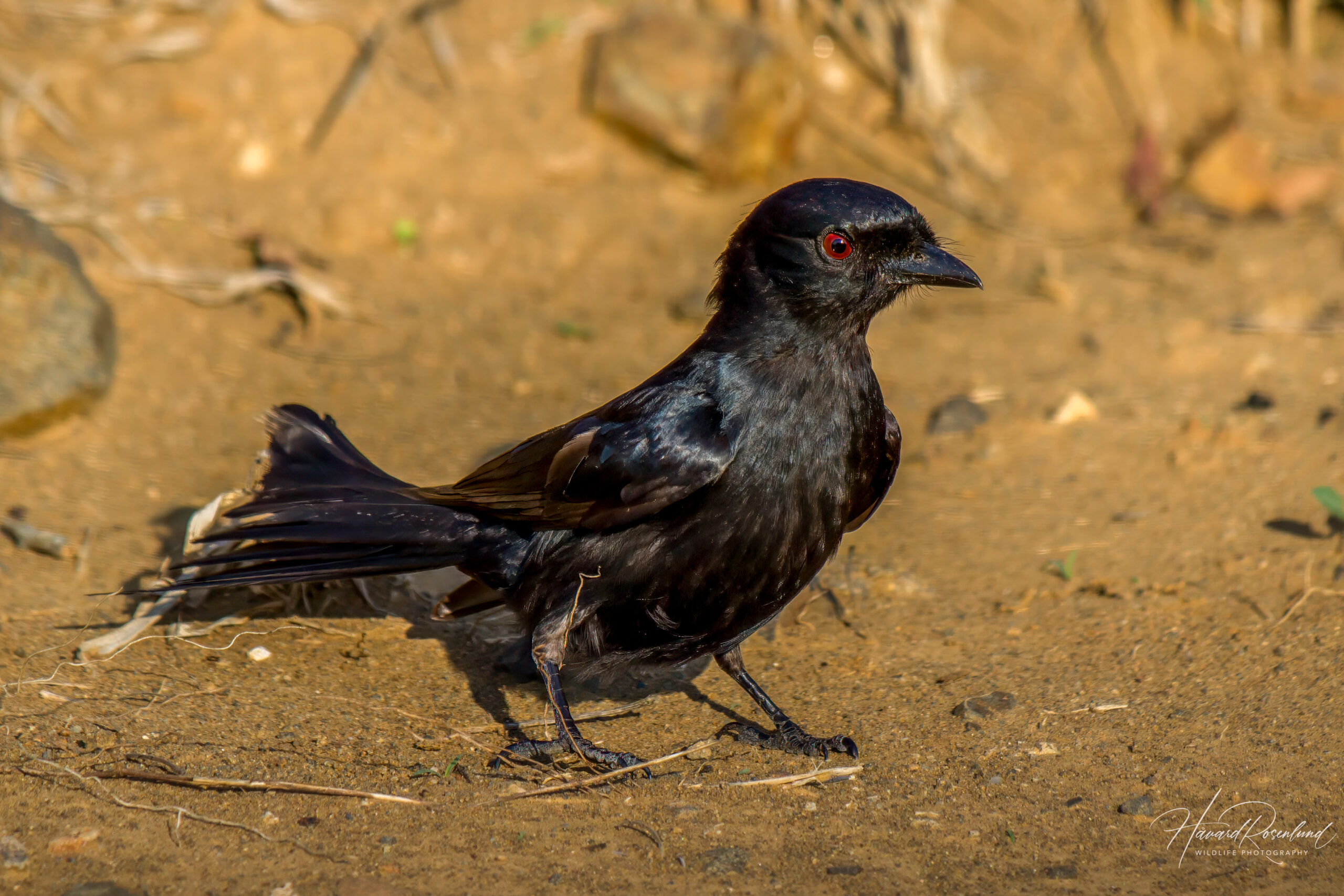
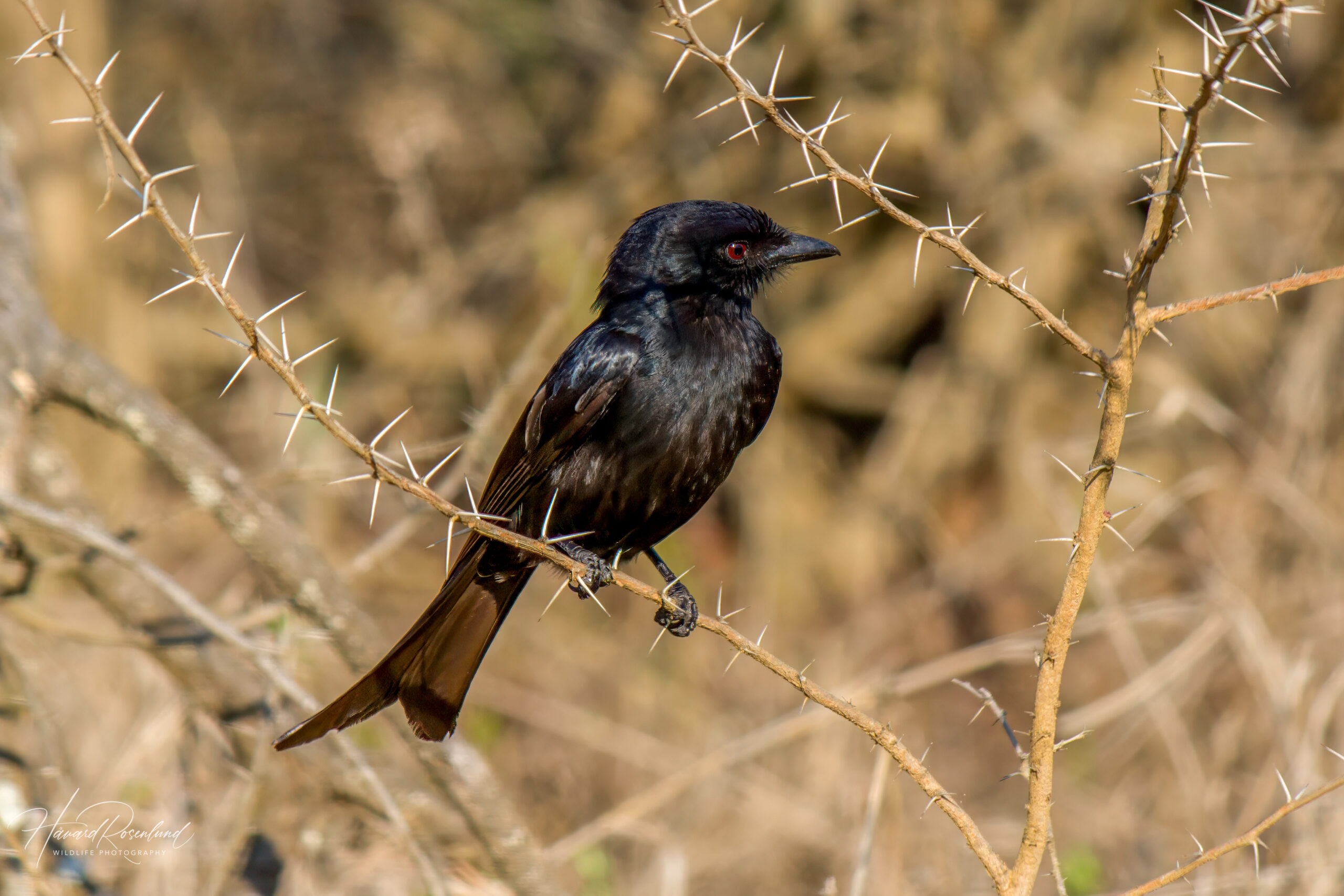
The fork-tailed drongo (Dicrurus adsimilis) is a familiar African songbird, about 23–26 cm long and weighing around 50 g. Adults are glossy black with deep red-brown eyes, a stout slightly hooked bill and a long, deeply forked tail. Males tend to be somewhat glossier than females, while juveniles are duller and browner.
The deeply forked tail, red-brown eye and upright stance make the species distinctive in open African woodland, where it often sits conspicuously on an exposed perch. The main confusion species in southern Africa is the smaller square-tailed drongo (Dicrurus ludwigii), which has a much shorter, only slightly notched tail and is more closely associated with forest and dense woodland.
Habitat
Fork-tailed drongos occupy a wide range of open and semi-open habitats, including savanna woodland, grassland with scattered trees, farmland, plantations, parks and gardens. They avoid the densest forests and the most extreme deserts but otherwise tolerate considerable habitat modification.
Diet
Insects dominate the diet, supplemented by spiders, scorpions and occasional small vertebrates such as lizards, frogs, fish and small birds. Food stolen from other animals can also make a substantial contribution in some populations.
Foraging
Fork-tailed drongos commonly hunt from exposed perches, launching into agile aerial sallies after flying insects or dropping to the ground after prey. They also follow grazing mammals and other active foragers and catch insects flushed by their movements.
Following other animals creates opportunities both to catch disturbed prey and to steal food, a behaviour known as kleptoparasitism. Drongos can therefore switch readily between catching their own prey, exploiting insects flushed by others and stealing food when a suitable opportunity appears.
Behaviour
The species is diurnal, alert and strongly territorial. Adults frequently use conspicuous perches as lookout posts and respond aggressively to raptors, crows and other potential threats, often mobbing birds much larger than themselves.
Fork-tailed drongos have a varied vocal repertoire and are accomplished mimics. Most calls serve ordinary communication or predator warning; their unusual use of false alarms to manipulate other species is described separately under Deception.
Deception
The fork-tailed drongo is one of the best-studied examples of deceptive communication in a wild animal. Drongos often follow ground-foraging species and give genuine alarm calls when predators appear. They can then exploit that established trust by giving a false alarm when another animal has found valuable food, causing the victim to flee and leave the item behind.
A study published in 2013 found that food theft provided about 22% of the food the drongos consumed in the Kalahari. False alarms were an important part of this strategy: meerkats (Suricata suricatta) and southern pied babblers (Turdoides bicolor) were among the species that could be deceived into abandoning food.
An experiment published in 2014 showed how flexible the deception can be. When victims became less responsive to repeated use of the same false alarm, drongos switched to another alarm type, including imitations of other species. Changing the warning signal helped keep the deception effective.
Breeding
Pairs are territorial. In southern Africa, egg-laying is recorded mainly from August to January, with a peak in September and October. The nest is a small, thin-walled cup of twigs, leaf stalks and tendrils bound firmly with spider web, usually suspended like a hammock in a tree fork about 4–6 m above the ground.
Two to five eggs may be laid. Both parents incubate for roughly 15–18 days and both feed the chicks after hatching. Young usually leave the nest after about 16–22 days.
Adults defend the nesting territory aggressively and readily mob much larger birds that approach the nest, extending the bold defensive behaviour seen during the rest of the year.
Status
The fork-tailed drongo is classified as least concern on the IUCN Red List. It has an enormous range across sub-Saharan Africa, remains common in many natural and human-modified landscapes and occurs widely both inside and outside protected areas.
No precise global population estimate is available. Local abundance can change with woodland structure and insect availability, but no major range-wide threat is currently identified.
Image gallery
Loading map and observations…
Have you seen this species?
Independent species archive
Did you find this species page useful?
Wildlife Vagabond is independently built and maintained. Voluntary support helps cover hosting, maps, data storage and continued improvements to the species archive.
Support Wildlife VagabondSpecies content will remain freely available.
References
Information about the species’ global distribution and status is based primarily on global Red List data. See the references below for details.
- BirdLife International. (n.d.). Fork-tailed Drongo Dicrurus adsimilis species factsheet. https://datazone.birdlife.org/species/factsheet/fork-tailed-drongo-dicrurus-adsimilis
- Flower, T. P., & Gribble, M. (2012). Kleptoparasitism by attacks versus false alarm calls in fork-tailed drongos. Animal Behaviour, 83(2), 403-410. https://doi.org/10.1016/j.anbehav.2011.11.009
- Flower, T. P., Child, M. F., & Ridley, A. R. (2013). The ecological economics of kleptoparasitism: pay‐offs from self‐foraging versus kleptoparasitism. Journal of Animal Ecology, 82(1), 245-255. https://doi.org/10.1111/j.1365-2656.2012.02026.x
- Flower, T. P., Gribble, M., & Ridley, A. R. (2014). Deception by Flexible Alarm Mimicry in an African Bird. Science, 344(6183), 513-516. https://doi.org/10.1126/science.1249723
- Flower, T. (2011). Fork-tailed drongos use deceptive mimicked alarm calls to steal food. Proceedings of the Royal Society B: Biological Sciences, 278(1711), 1548-1555. https://doi.org/10.1098/rspb.2010.1932
- International Union for Conservation of Nature. (n.d.). Dicrurus adsimilis (Fork-tailed Drongo). The IUCN Red List of Threatened Species. https://www.iucnredlist.org/species/103710902/95034217
- Kirwan, G. M., Rocamora, G., & Yeatman-Berthelot, D. (2023). Fork-tailed Drongo (Dicrurus adsimilis). Birds of the World. https://doi.org/10.2173/bow.fotdro5.02