
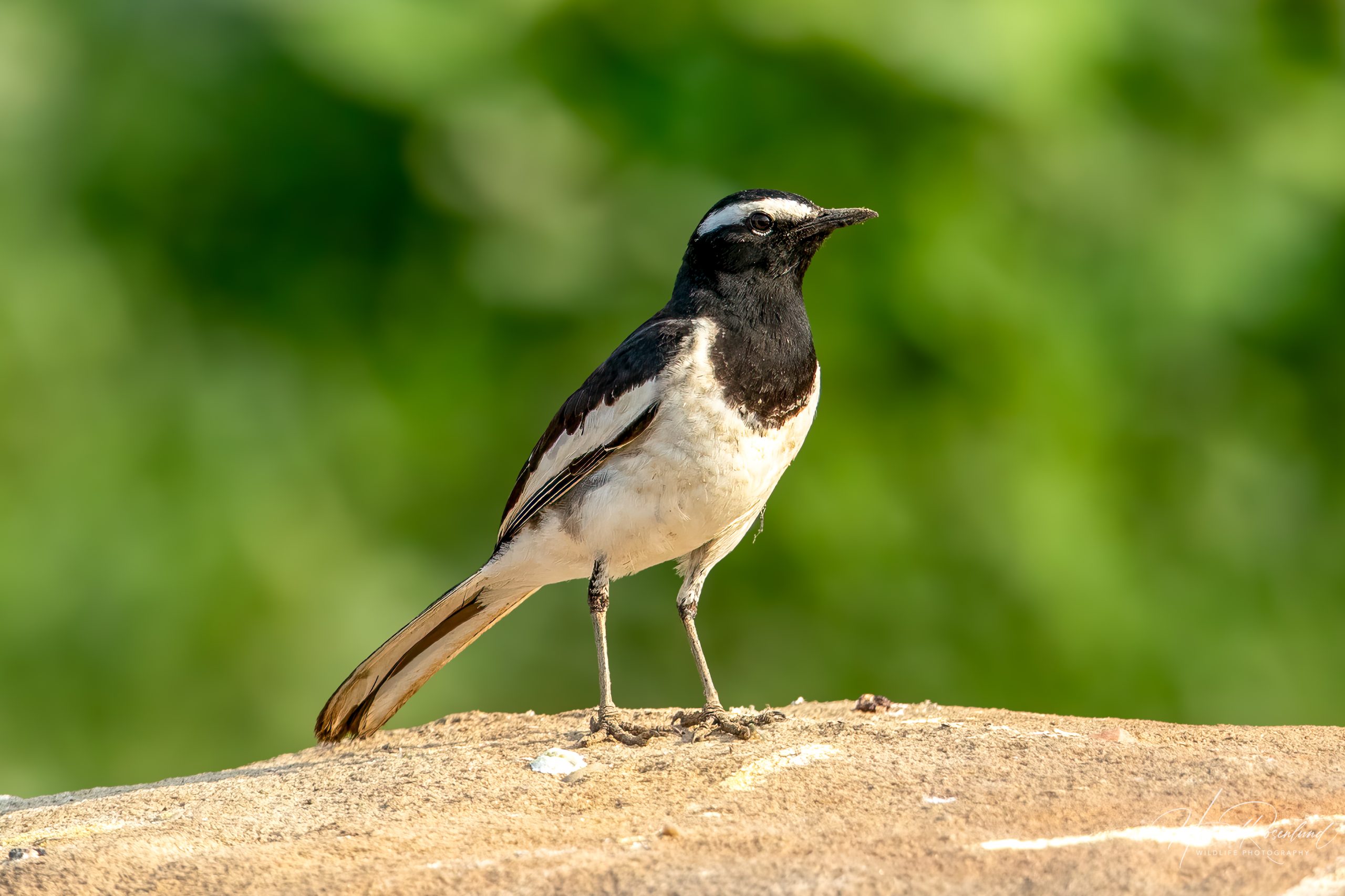
White-browed Wagtail
Motacilla maderaspatensis
At a glance
Habitat
- Rivers, lakes, ponds, reservoirs, canals and other open freshwater habitats, including urban watersides
Diet
- Mainly insects and other small invertebrates taken from the ground, water edges and in short aerial pursuits
Activity
- Diurnal
Size
- Length: 21–24 cm Weight: about 31–33 g
Range
- Resident across much of the Indian subcontinent
Description
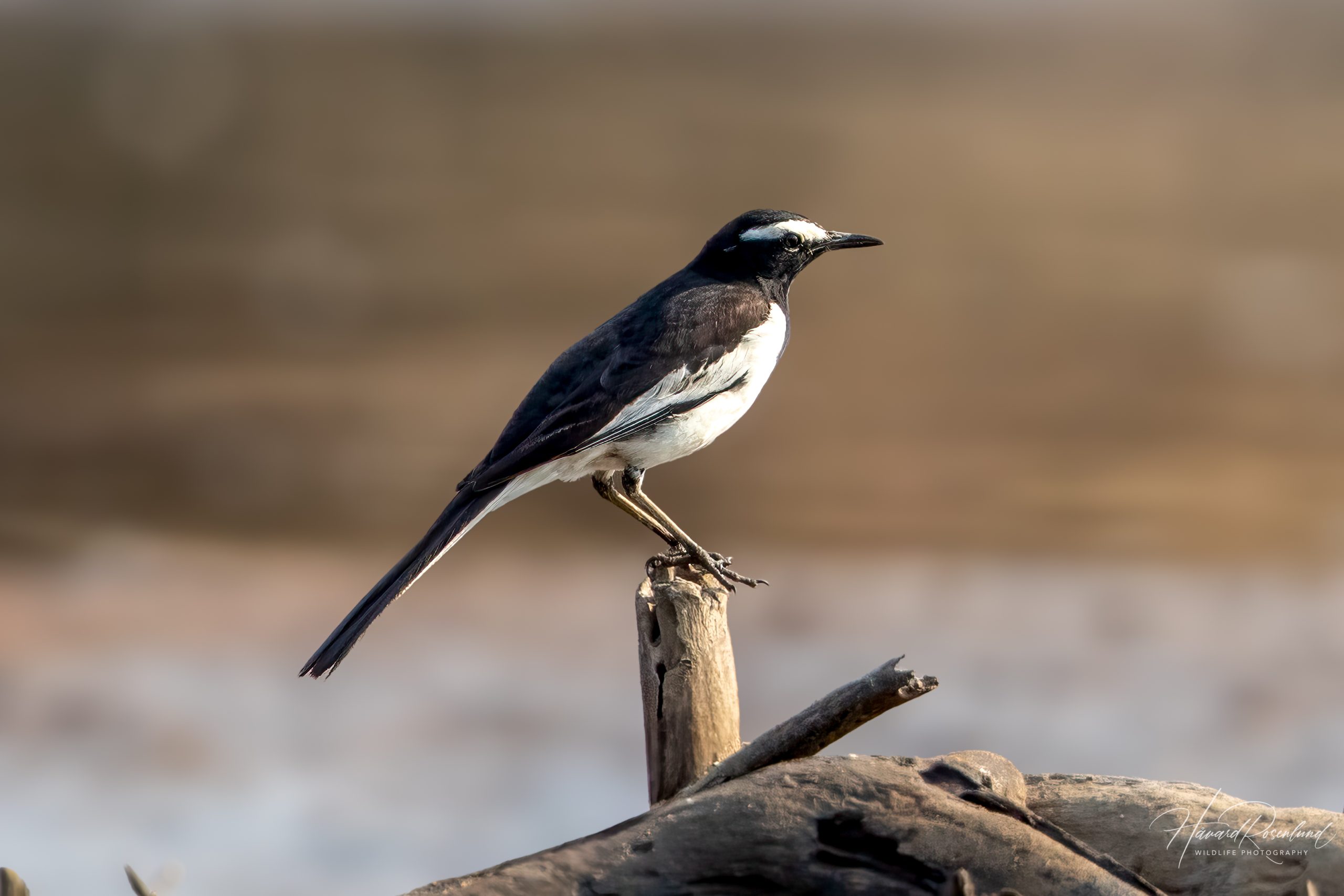
The white-browed wagtail (Motacilla maderaspatensis), also known as the large pied wagtail, is the largest of the wagtails and is native to the Indian subcontinent. Adults are about 21–24 cm long and weigh roughly 31–33 g. The plumage is boldly black and white, with a broad white eyebrow, white belly and wing markings contrasting with the black head, breast and upperparts.
The long tail is almost constantly in motion when the bird walks or pauses. White-browed wagtails can resemble white wagtails (Motacilla alba) in some plumages, but are larger and more strongly patterned, with an entirely dark back rather than the greyer upperparts shown by many white wagtails.
Habitat
The species is strongly associated with freshwater but is flexible about the surroundings. Rivers, streams, lake shores, ponds, reservoirs, irrigation canals and flooded fields are all used, and the birds are also common around urban lakes, dams and other human-made water bodies.
Open banks and short vegetation provide feeding areas, while rocks, walls, bridges and buildings offer perches and nesting sites. The white-browed wagtail is resident and endemic to the Indian subcontinent. Its ability to use both natural and heavily modified watersides is an important part of its ecology.
Diet
White-browed wagtails are mainly insectivorous. Beetles, flies, caterpillars, grasshoppers and other insects are taken together with spiders and other small invertebrates.
Behaviour
White-browed wagtails walk and run actively along banks and open ground, picking prey from the surface and making short bursts or aerial sallies after moving insects. Water edges are especially productive because insects emerge from the water or gather on wet mud, stones and vegetation. Birds often shift repeatedly between the shoreline and nearby raised perches, using each perch as a lookout before returning to the ground.
The repeated up-and-down movement of the long tail is one of the most characteristic features of the species. Outside breeding, birds are usually seen alone or in pairs and can remain within the same productive stretch of water for long periods.
Breeding
Pairs become strongly territorial during breeding and advertise from prominent rocks, rooftops, wires and other raised positions near water with clear, musical calls and song. A description published in 1954 records a conspicuous courtship display: the male rises steeply into the air, sings and glides down with dangling legs and fluffed plumage before continuing the display with raised tail and wings in front of the female. Breeding can occur over a long season, with much regional variation and many records from spring through the monsoon period.
The nest is a cup of grass, roots and other plant fibres, usually lined with softer material. It is placed in a protected crevice or ledge, often among rocks but also frequently in bridges, walls, buildings and other structures close to water. A clutch usually contains three to five eggs.
A field note published in 2007 followed several breeding attempts around Chiplun in Maharashtra. In one brood from 2006 incubation lasted 16 days and the chick left the nest after 14 days; in a later brood that year incubation lasted 13 days and fledging again took 14 days. Both adults took part in nest building and feeding the chicks, and at some nesting attempts both were also observed incubating. The small local sample shows that both incubation and the nestling period can be very short in this species.
The ability to nest on human-made structures helps explain why the species can remain common even in towns and intensively used landscapes when suitable water and feeding habitat remain nearby.
Status
The white-browed wagtail is classified as least concern on the IUCN Red List. It has a large range across the Indian subcontinent and is able to use many human-modified habitats as well as natural rivers and wetlands.
Indian monitoring published in 2025 indicates a long-term decline of about 25%, while the trend in recent years has been approximately stable. Local populations can nevertheless be affected when water bodies are heavily polluted, channelised or built over, or when open feeding areas along their margins disappear.
Image gallery
Loading map and observations…
Have you seen this species?
Independent species archive
Did you find this species page useful?
Wildlife Vagabond is independently built and maintained. Voluntary support helps cover hosting, maps, data storage and continued improvements to the species archive.
Support Wildlife VagabondSpecies content will remain freely available.
References
Information about the species’ global distribution and status is based primarily on global Red List data. See the references below for details.
- BirdLife International. (n.d.). White-browed Wagtail species factsheet. https://datazone.birdlife.org/species/factsheet/white-browed-wagtail-motacilla-maderaspatensis
- Birds of India. (n.d.). Motacilla maderaspatensis. https://www.birdsofindia.org/motacilla-maderaspatensis
- International Union for Conservation of Nature. (n.d.). Motacilla maderaspatensis. The IUCN Red List of Threatened Species. https://www.iucnredlist.org/species/22718363/94577111
- International Union for Conservation of Nature. (n.d.). White-browed Wagtail (2025 assessment). The IUCN Red List of Threatened Species. https://www.iucnredlist.org/species/22718363/280938796
- Kirkpatrick. (1954). The courtship display of the Large Pied Wagtail Motacilla maderaspatensis. Journal of the Bombay Natural History Society, 52, 602–603. https://www.biodiversitylibrary.org/page/48184492
- Palkar, S. B., Katdare, V. D., Mahabal, V. K., Joshi, V. V., Lovalekar, R. J., & Soman, A. (2007). Breeding notes of six species of birds from Chiplun, Ratnagiri district, Maharashtra (India). Indian Birds, 3(2), 54–59. https://indianbirds.in/pdfs/IB_Main_3.2_2007.pdf
- State of India's Birds. (2025). State of India’s Birds 2025 – White-browed Wagtail. https://stateofindiasbirds.in/species/ts-whbwag1/
- Store norske leksikon. (n.d.). Skjæreerle. https://snl.no/skjæreerle