
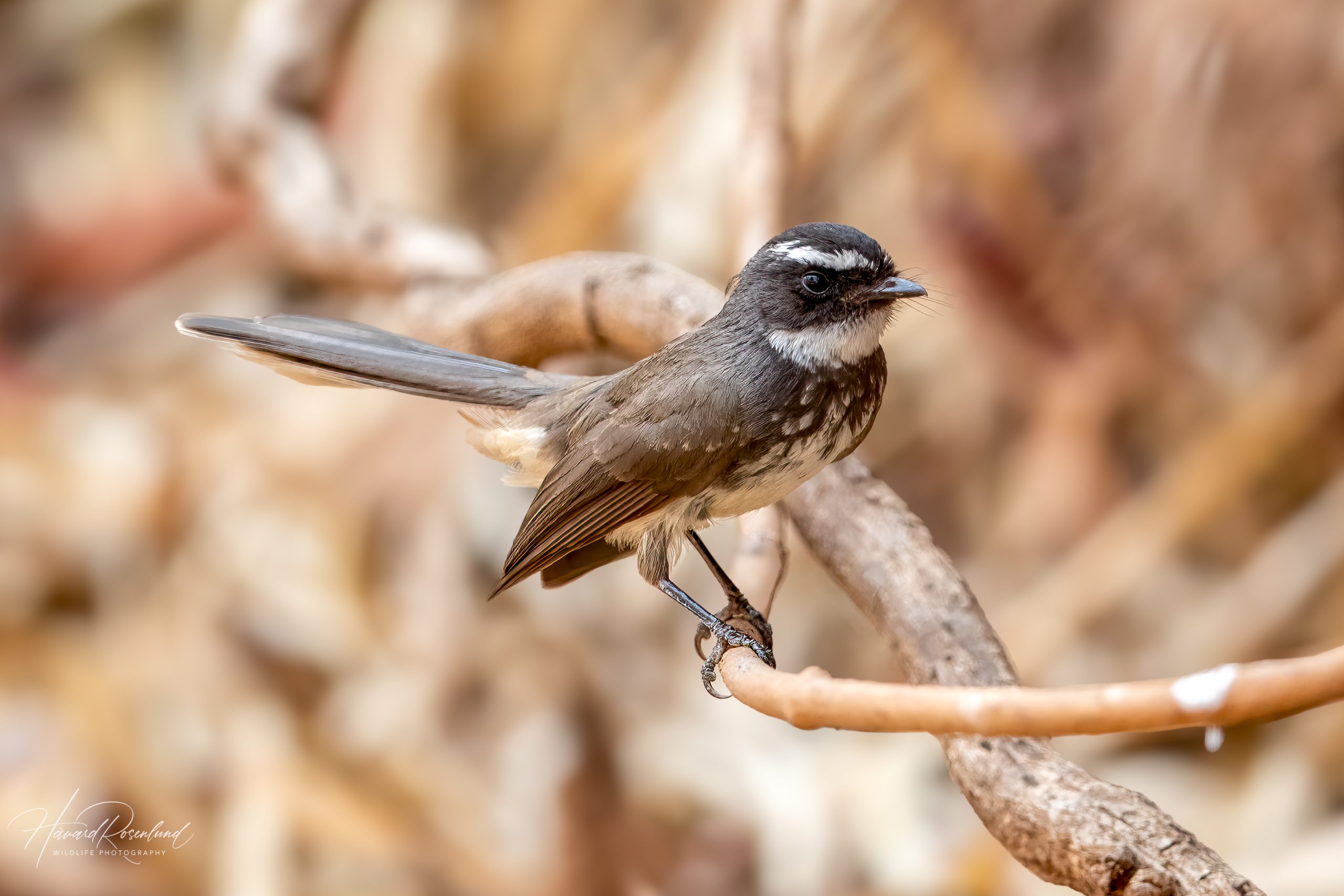
White-spotted Fantail
Rhipidura albogularis
At a glance
Habitat
- Deciduous and evergreen forest, forest edge, scrub, plantations and wooded gardens
Diet
- Small insects and other arthropods
Activity
- Diurnal
Size
- Length: 14.5–17 cm Weight: 10–13 g
Range
- Endemic to central and southern peninsular India
Description
The white-spotted fantail (Rhipidura albogularis), also known as the spot-breasted fantail, is a small fantail endemic to peninsular India. It measures about 14.5–17 cm and weighs roughly 10–13 g.
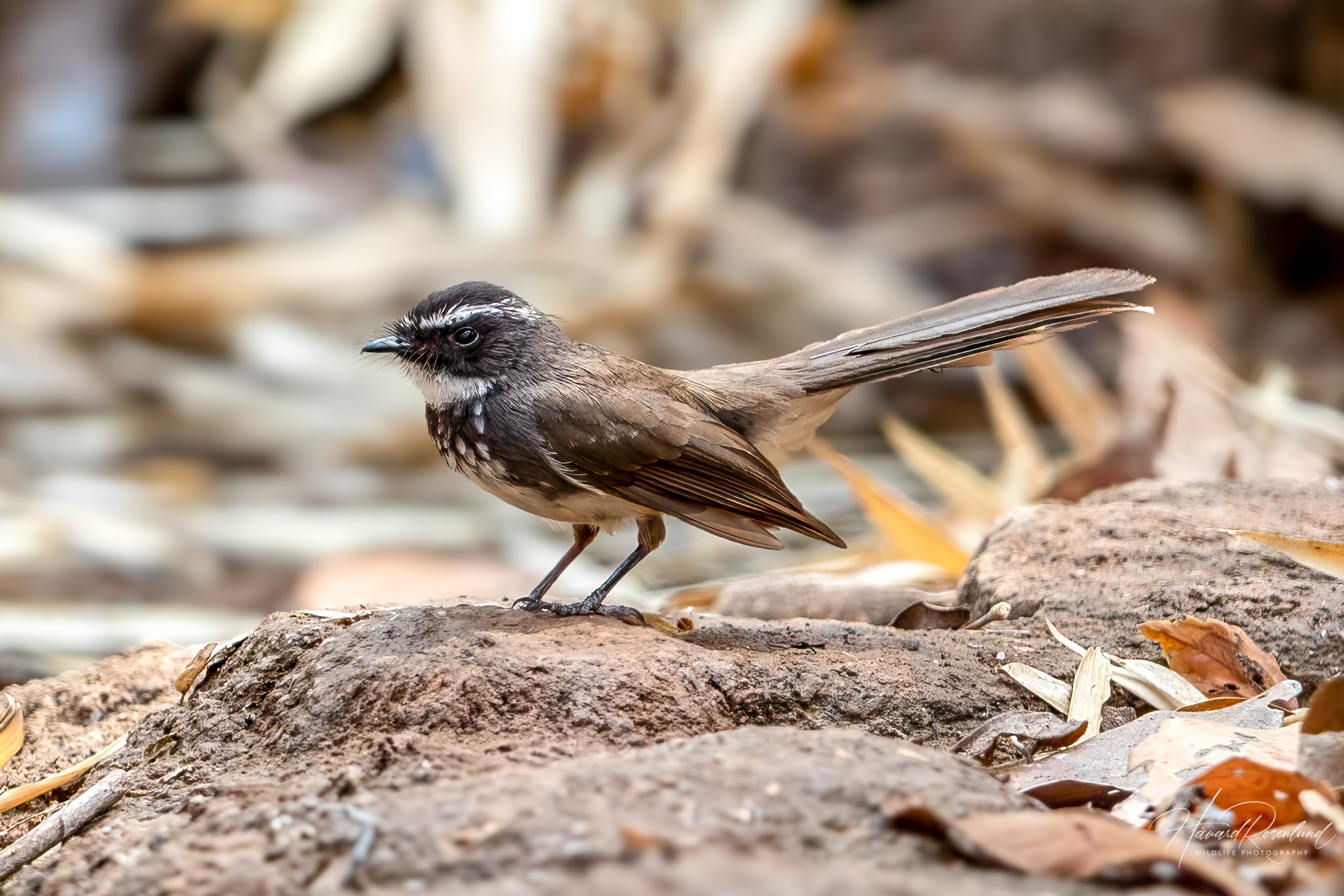
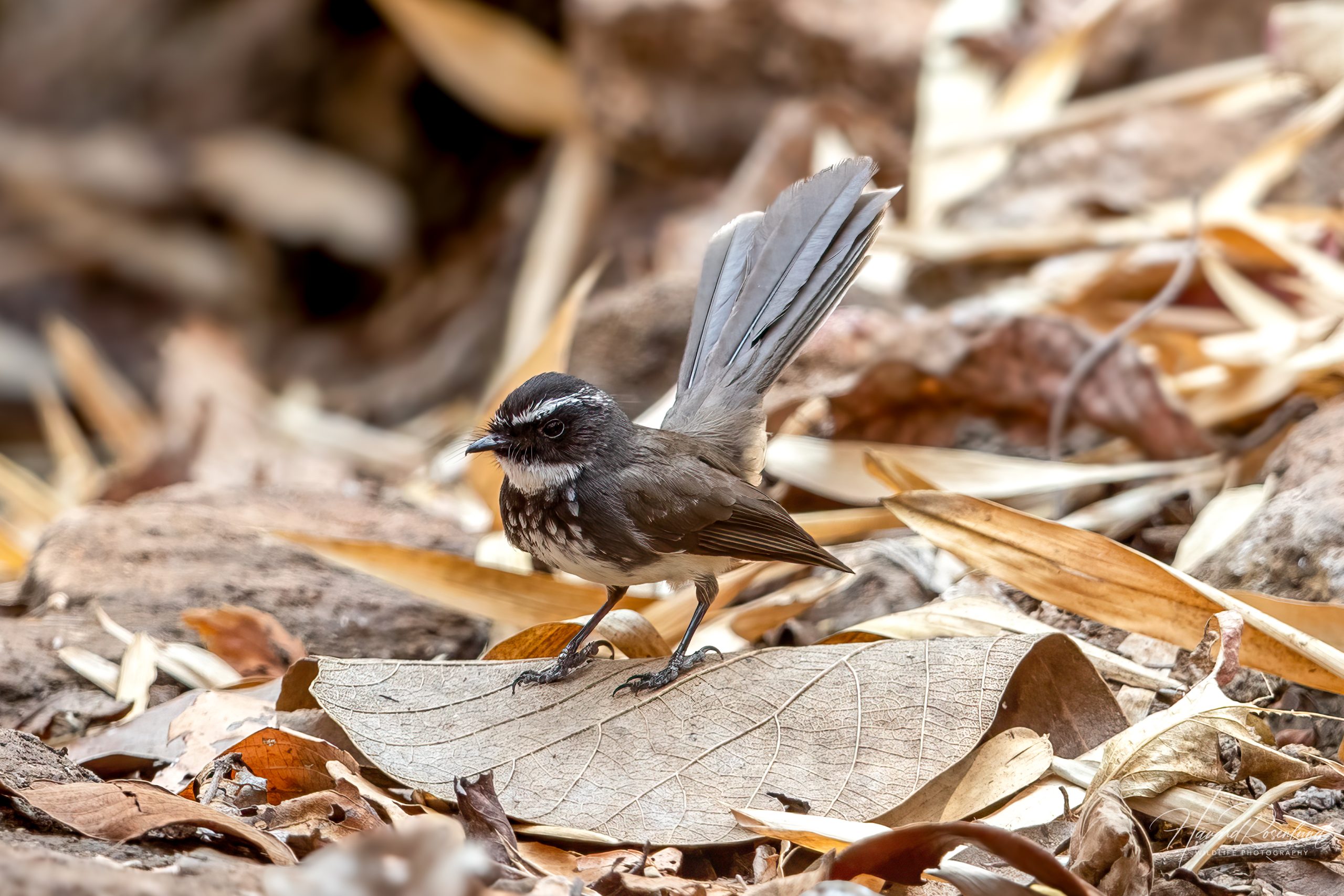
The upperparts are dark grey-brown, with a blackish face, a clear white eyebrow and a white throat. Across the breast is a dark band marked with small white spots, while the long dark tail has broad white tips. Compared with the white-browed fantail (Rhipidura aureola), it has a spotted breast band rather than a black throat with contrasting white moustachial stripes.
Taxonomy
The white-spotted fantail was formerly treated as part of the white-throated fantail (Rhipidura albicollis) complex. Differences in plumage, voice, distribution and broader phylogenetic work led major checklists to recognise the peninsular Indian form as the separate species R. albogularis.
AviList 2025 continues to recognise white-spotted fantail as a full species. Two subspecies are generally recognised within it, the nominate R. a. albogularis and R. a. vernayi. The historical connection with white-throated fantail is worth noting because older books and records may list Indian birds under R. albicollis.
Habitat
White-spotted fantails occur in deciduous and evergreen forest, forest edge, scrub, plantations, cultivated landscapes and wooded gardens across central and southern India. They usually forage in the lower and middle levels of vegetation, where branches and dense foliage provide both perches and cover.
The species tolerates some habitat modification and can occur close to people, but it still depends on enough trees and shrubs to support insect prey and provide nesting sites. Landscapes stripped of their lower vegetation are much less suitable.
Diet
The diet consists mainly of small insects and other arthropods. Birds pick prey from foliage and branches or pursue it in short, agile flights from a perch.
The constantly moving tail is part of the bird's active foraging style. It is repeatedly opened, closed and twisted as the bird hops through vegetation, which may help flush small prey into movement and make it easier to detect. Short aerial sallies allow the fantail to seize insects disturbed from leaves and branches before returning rapidly to cover.
Behaviour
White-spotted fantails are lively, conspicuous birds usually seen alone or in pairs. They frequently cock and spread the tail, change direction abruptly and make short flights through the lower and middle vegetation. They may also join mixed-species feeding flocks, moving with other small insect-eating birds while continuing their characteristic tail-fanning.
The species has a clear, musical song together with shorter contact and alarm notes, and calling birds are often much easier to locate than silent individuals in dense vegetation. Birds become especially vocal when maintaining contact with a mate or reacting to disturbance.
Breeding
Breeding is recorded mainly from March into August, although timing varies across peninsular India. Pairs become territorial around the nesting area, and tail-fanning and close aerial movements also form part of courtship. Both adults build a small, neat cup of fine plant fibres and cobweb, usually attached to a horizontal fork or slender branch.
Clutches usually contain two or three eggs. A 2024 preprint following 15 nests around Indore, Madhya Pradesh, found both adults taking part in nest building, incubation and feeding the young. In the successful nests, clutches contained two eggs; hatching occurred after roughly 13–16 days and the nestlings fledged at about 15 days. These timings come from one local study and may vary elsewhere.
Status
The white-spotted fantail is classified as least concern on the IUCN Red List. Although endemic to India, it has a broad range across much of the peninsula and occurs in both natural and partly modified wooded habitats.
State of India's Birds 2025 estimates a long-term national increase of about 173% and a current annual increase of about 14%. The species remains classified as Low Priority nationally. Local clearing of forest, scrub and lower vegetation can still remove habitat.
Image gallery
Loading map and observations…
Have you seen this species?
Independent species archive
Did you find this species page useful?
Wildlife Vagabond is independently built and maintained. Voluntary support helps cover hosting, maps, data storage and continued improvements to the species archive.
Support Wildlife VagabondSpecies content will remain freely available.
References
Information about the species’ global distribution and status is based primarily on global Red List data. See the references below for details.
- Avibase. (n.d.). AviList 2025 / Avibase – White-spotted Fantail (Rhipidura albogularis). https://avibase.bsc-eoc.org/species.jsp?avibaseid=E12FE2739090FB1A
- BirdLife International. (n.d.). White-spotted Fantail (Rhipidura albogularis) species factsheet. https://datazone.birdlife.org/species/factsheet/white-spotted-fantail-rhipidura-albogularis
- International Union for Conservation of Nature. (n.d.). Rhipidura albogularis. The IUCN Red List of Threatened Species. https://www.iucnredlist.org/species/103709613/118756437
- Nyári, Á. S., Benz, B. W., Jønsson, K. A., Fjeldså, J., & Moyle, R. G. (2009). Phylogenetic relationships of fantails (Aves: Rhipiduridae). Zoologica Scripta, 38(6), 553-561. https://doi.org/10.1111/j.1463-6409.2009.00397.x
- Sharma, V. K., Patidar, K., Vishwakarma, H., & Patidar, K. (2024). Breeding ecology and adaptive nest-building behavior in Indian white-spotted fantail flycatcher (<i>Rhipidura albogularis</i>). Research Square. https://doi.org/10.21203/rs.3.rs-3918719/v1
- State of India's Birds. (2025). 2025 – Spot-breasted Fantail (Rhipidura albogularis). https://stateofindiasbirds.in/species/spbfan1/
- xeno-canto. (n.d.). White-spotted Fantail recordings and distribution. https://xeno-canto.org/species/Rhipidura-albogularis