
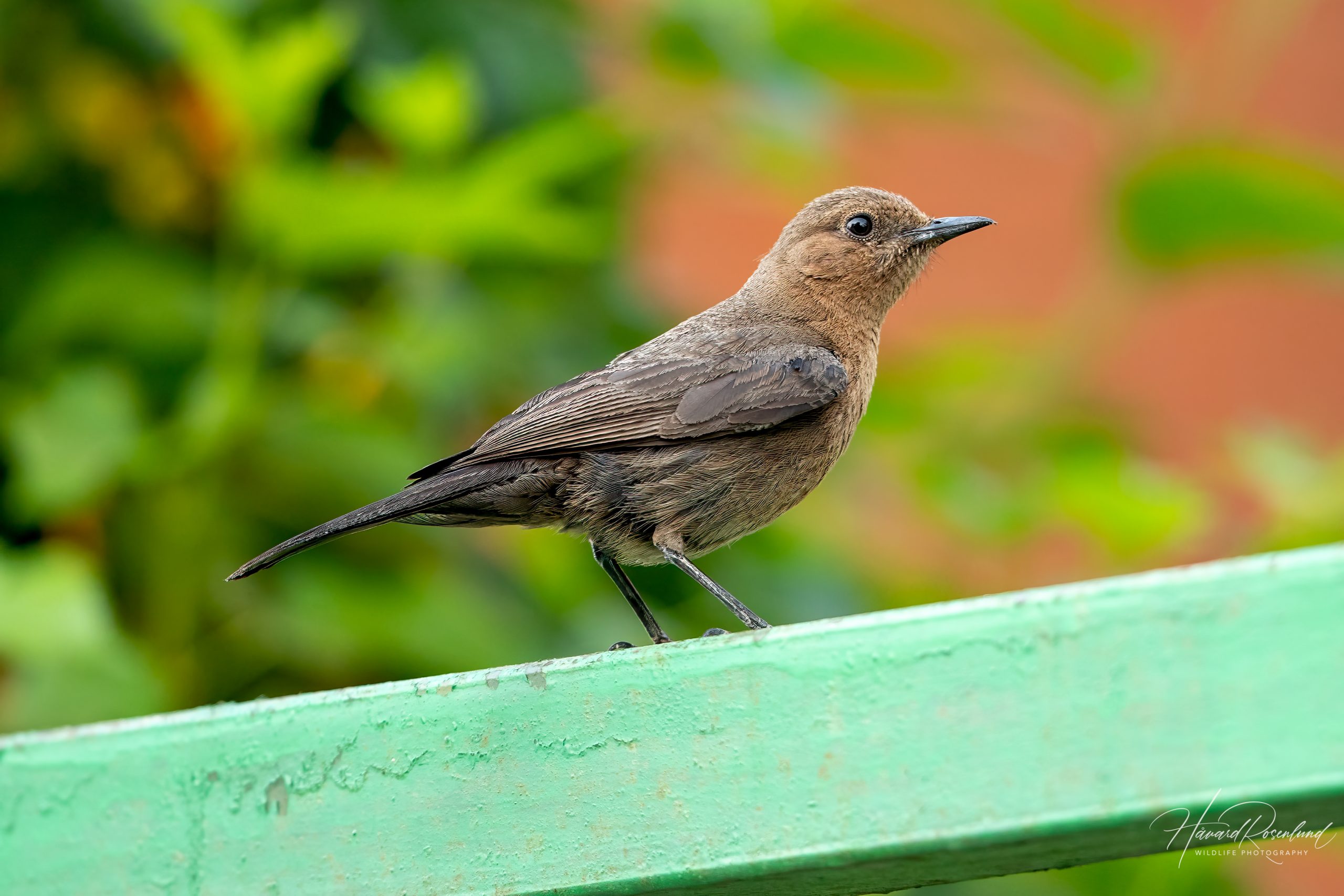
Brown Rock Chat
Oenanthe fusca
At a glance
Habitat
- Rocky outcrops, cliffs, quarries, ruins, walls, old buildings and settlements
Diet
- Mainly insects and other small invertebrates
Activity
- Diurnal; may also forage around artificial lights after dark
Size
- Length: About 17 cm Weight: About 12 g
Range
- Indian subcontinent, centred on northern and central India
Description
The brown rock chat (Oenanthe fusca), also known as the Indian chat, is a warm-brown songbird endemic to the Indian subcontinent. It is about 17 cm long and weighs around 12 g. The species is centred on northern and central India, with a more limited distribution into Pakistan and records from Nepal.
The plumage is almost uniformly rufous-brown, with somewhat darker wings and tail, and males and females look alike. It can resemble a female Indian robin (Copsychus fulicatus), but the brown rock chat is larger, has a stronger bill and shorter tail, and lacks the robin's chestnut vent. Older literature often uses the name Cercomela fusca; modern checklists place the species with the wheatears in the genus Oenanthe.
Habitat
Brown rock chats are closely associated with rocky and built environments. They occur around cliffs, rocky outcrops, quarries, road cuttings, ruins, walls, temples, old buildings and settlements, from dry lowlands into the Himalayan foothills.
Human structures can provide many of the same ledges, crevices and lookout points as natural rock faces. The species therefore readily uses towns and villages where open feeding areas and suitable nesting cavities remain nearby.
Diet
The diet consists mainly of insects and other small invertebrates. Birds watch from a low perch and drop to the ground to pick up prey, or make short flights to catch moving insects.
Brown rock chats can also exploit artificial lighting. A study published in 2009, based on field observations in Bikaner, Rajasthan, recorded birds feeding under sodium lamps during the monsoon, when insects gathered around the lights. Observed capture rates were about 13 prey per hour at night compared with 2.5 during the day. For an otherwise mainly diurnal bird, this is a striking example of flexible foraging.
Behaviour
Birds are usually seen alone or in pairs, often perched upright on a rock, roof, wall or other exposed point before dropping to the ground after prey. Slowly raising and fanning the tail, together with repeated head movements, is characteristic when a bird is alert or assessing its surroundings.
A study published in 2008 described eight distinct call types, used in contexts ranging from territorial defence and alarm to begging, feeding and roosting. The song is varied and can include imitations of other bird species, adding considerable complexity to an otherwise visually understated bird. Most populations are resident, although short local movements can occur.
Breeding
Breeding takes place mainly from spring through summer, and pairs can raise more than one brood. The cup-shaped nest is built from grass, roots, hair and other fibres and is often supported by small stones or pieces of clay. Natural rock crevices are used, but nests are also frequently placed on ledges and in holes in walls, windows and occupied buildings.
Clutches usually contain three or four pale blue eggs, often with rusty speckles toward the broader end. A three-year study in Haridwar, published in 2010, found only three- and four-egg clutches, with three eggs more common. A 2020 study in Udhampur recorded incubation of 12–14 days by the female and fledging at 16–17 days. Both parents usually feed and defend the young. A breeding observation published in 2023 from Nimbahera, Rajasthan, found that the complete period from nest building to fledging lasted about five to six weeks.
Status
The brown rock chat is classified as least concern on the IUCN Red List. It remains widespread across much of its Indian range and readily uses human-made structures as well as natural rocky habitat.
The State of India's Birds 2025 update estimates a current national increase of about 3.2% per year. Its longer-term estimate is also positive, at about 22%, but the uncertainty is too large to show a clear long-term increase, so the long-term trend is classified as stable. Renovation of old buildings and changes in construction can remove nesting crevices locally, but these changes do not currently appear to threaten the species across its range.
Image gallery
Loading map and observations…
Have you seen this species?
Independent species archive
Did you find this species page useful?
Wildlife Vagabond is independently built and maintained. Voluntary support helps cover hosting, maps, data storage and continued improvements to the species archive.
Support Wildlife VagabondSpecies content will remain freely available.
References
Information about the species’ global distribution and status is based primarily on global Red List data. See the references below for details.
- Avibase. (n.d.). Brown Rock Chat (Oenanthe fusca). https://avibase.bsc-eoc.org/species.jsp?avibaseid=F8995B0AFB17B03B
- BirdLife International. (n.d.). Brown Rockchat (Oenanthe fusca) species factsheet. https://datazone.birdlife.org/species/factsheet/brown-rockchat-oenanthe-fusca
- Cornell Lab of Ornithology. (n.d.). Birds of the World – Brown Rock Chat. https://birdsoftheworld.org/bow/species/indcha1/cur/introduction
- International Union for Conservation of Nature. (n.d.). Oenanthe fusca. The IUCN Red List of Threatened Species. https://www.iucnredlist.org/species/22710376/132087417
- Kumar, B. (2020). Nestling growth and development of an endemic avian species, the Brown Rock Chat (<i>Cercomela fusca</i>), in Udhampur District, Jammu and Kashmir, India. Journal on New Biological Reports, 9(2), 240–245. https://www.researchtrend.net/jnbr/pdf/Nestling%20Growth%20and%20Development%20of%20an%20Endemic%20a7.pdf
- Sethi, V. K., & Bhatt, D. (2008). Call repertoire of an endemic avian species, the Indian chat <i>Cercomela fusca</i>. Current Science, 94(9), 1173–1179. https://www.currentscience.ac.in/Volumes/94/09/1173.pdf
- Sethi, V. K., Kumar, A., & Bhatt, D. (2010). Egg characteristics and clutch size in an endemic avian species, the Brown Rock Chat, in Haridwar, India. Berkut, 19(1–2), 147–152. https://www.aetos.kiev.ua/berkut/berkut19/19-20.htm
- Sharma, A. K., & Tripathi, A. K. (2023). A Brown Rock Chat <i>Oenanthe fusca</i> feeding moss <i>Polytrichum</i> sp. to nestlings. Indian BIRDS, 19(4), 114–115. https://indianbirds.in/pdfs/IB_19_4_Sharma_Tripathi_BrownRockChat.pdf
- Singh, P. (2009). Unusual nocturnal feeding by Brown Rock-chat Cercomela fusca (Passeriformes: Muscicapidae) in Bikaner, Rajasthan, India. Journal of Threatened Taxa, 1(4), 251-251. https://doi.org/10.11609/JoTT.o1852.251
- State of India's Birds. (n.d.). Brown Rock Chat. https://stateofindiasbirds.in/species/indcha1/