
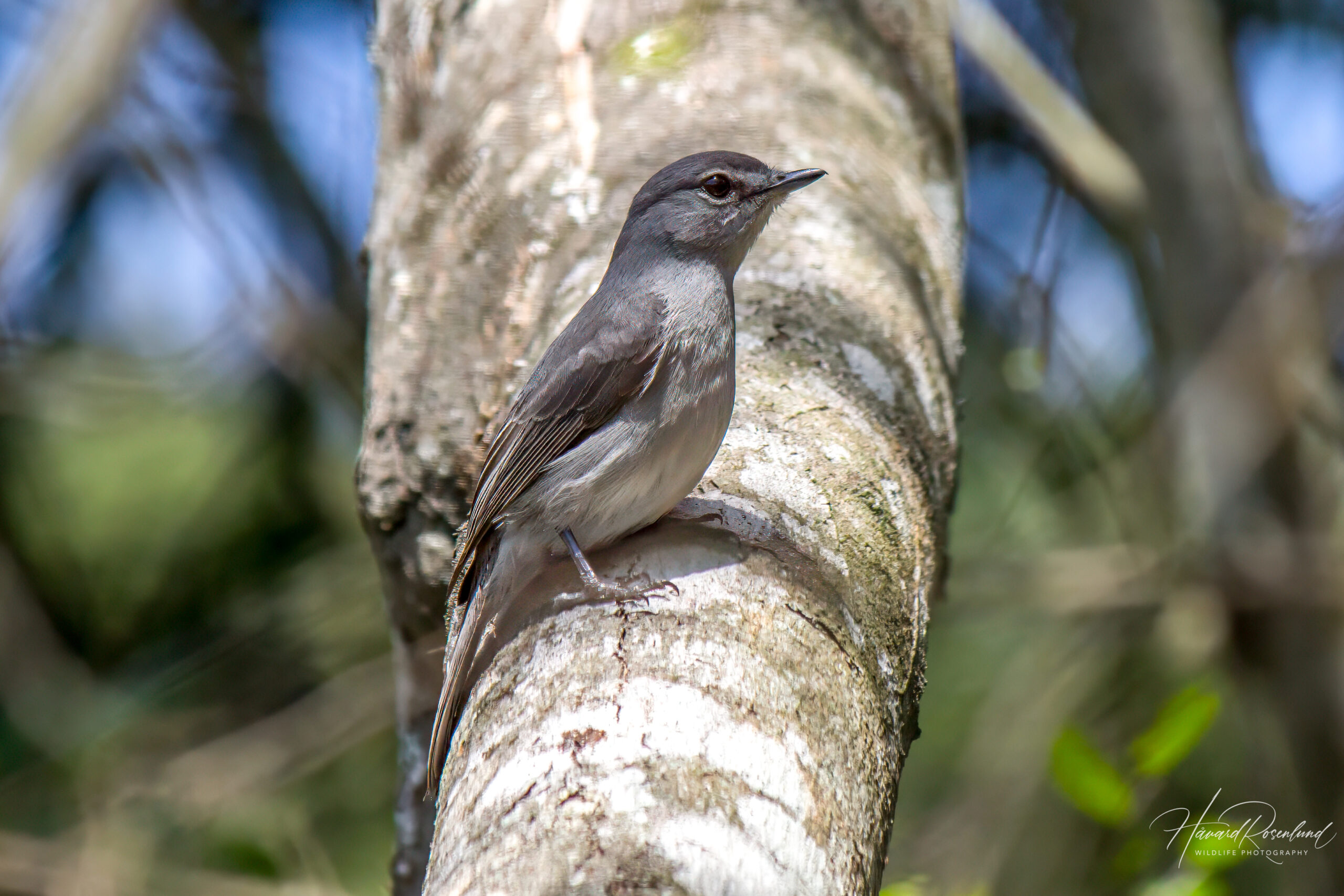
Ashy Flycatcher
Fraseria caerulescens
At a glance
Habitat
- Forest edge, dense woodland, riverine thicket, plantations and wooded gardens
Diet
- Mostly insects and other arthropods; occasional small fruit and very small vertebrates
Activity
- Diurnal
Size
- Length: 13–15 cm Weight: 14–21 g
Range
- Patchily distributed across western, central, eastern and southern sub-Saharan Africa
Description
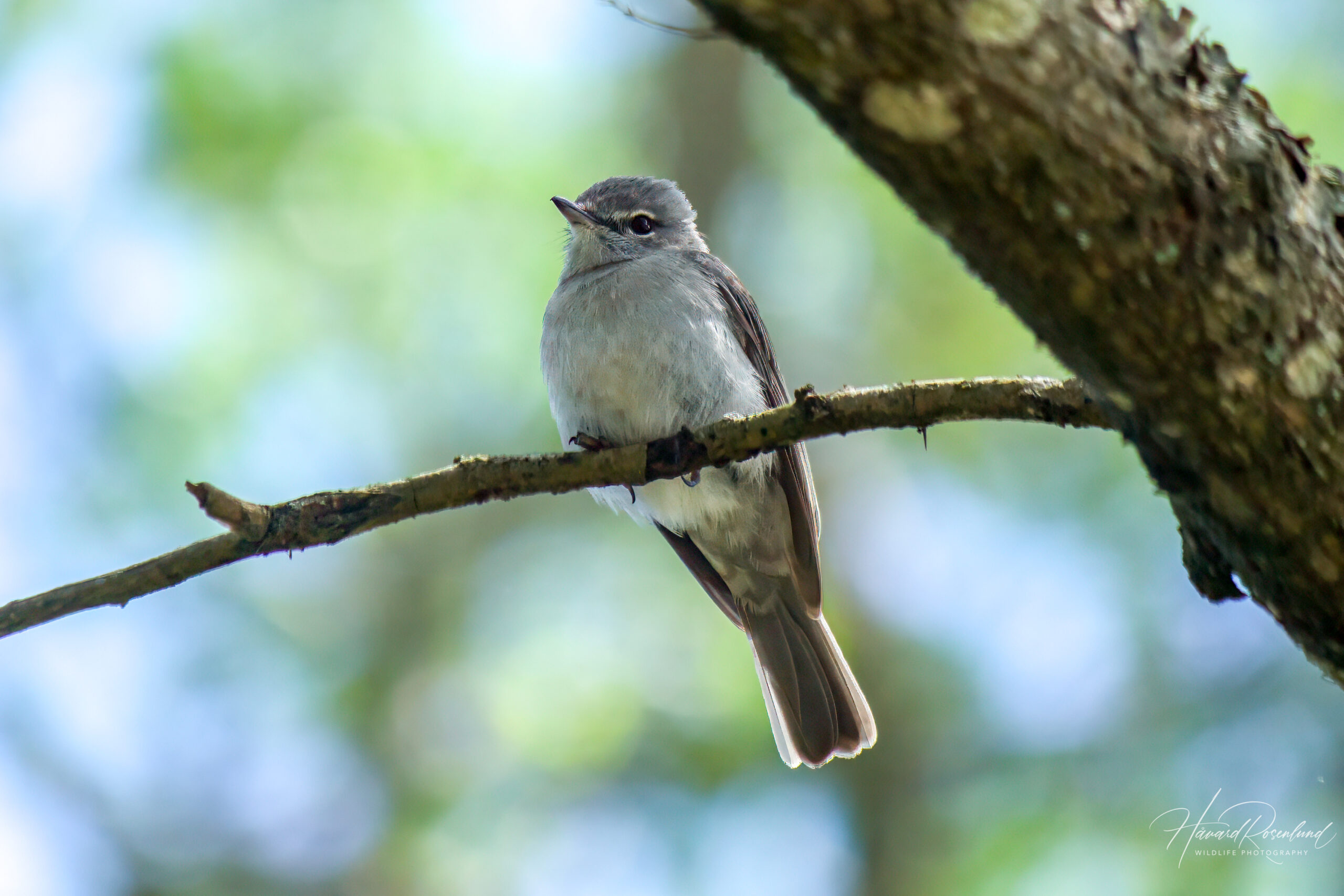
The ashy flycatcher (Fraseria caerulescens) is a small grey African flycatcher found patchily across western, central, eastern and southern sub-Saharan Africa. Adults are about 13–15 cm long and weigh roughly 14–21 g. The plumage is blue-grey to ashy grey, paler below, with a fine dark bill and a pale eye-ring or short pale line around the eye. The sexes are alike.
It can resemble the grey tit-flycatcher (Fraseria plumbea), but that species has conspicuous white outer tail edges and frequently fans the tail. The African dusky flycatcher (Muscicapa adusta) is browner and more compact.
Taxonomy
The ashy flycatcher was long placed in Muscicapa and consequently appears as Muscicapa caerulescens in much older literature. Molecular studies of African flycatchers showed that traditional Muscicapa contained several separate evolutionary lineages, and the ashy flycatcher is now placed in Fraseria.
The valid scientific name is Fraseria caerulescens, with six geographic subspecies recognised across the species' wide but fragmented African distribution.
Habitat
Ashy flycatchers favour varied wooded habitats, including forest edge, clearings, riverine thicket, dense woodland, moist savanna, plantations and mature gardens. In southern Africa they are particularly associated with the humid eastern escarpment and coastal belt rather than dry open country.
They usually remain within or close to dense vegetation, but small gaps and open edges provide room for short aerial sallies. This combination of cover and feeding space makes forest margins and wooded watercourses particularly suitable.
Diet
Ashy flycatchers feed mainly on insects and other arthropods. Small fruit is also eaten, and they occasionally take very small vertebrates such as geckos.
Prey is taken in short sallies from a perch, gleaned from foliage and branches and occasionally picked from the ground. The bird can therefore exploit food at several levels within the same woodland habitat.
Behaviour
The species is active but unobtrusive and is usually encountered singly, in pairs or in small family groups. It frequently joins mixed-species feeding flocks, moving through the mid-storey with other insectivorous birds.
Pairs defend territories, while most populations are resident and make only local movements in response to rainfall and food availability. Calls and song are relatively soft compared with many other African flycatchers, so watching mixed feeding flocks can sometimes be a more effective way of finding the species than listening for it.
Breeding
Breeding timing varies across the large African range. In southern Africa egg laying occurs mainly from September to January. Pairs are monogamous and defend a breeding territory.
Both sexes build the cup-shaped nest from grass, bark fibres, moss, rootlets and spider web. It is usually placed in a narrow fork, shallow cavity or crevice in a tree or stump and occasionally on a human structure. Clutches contain two to four eggs. Incubation lasts about two weeks, and both parents feed the nestlings, which remain in the nest for roughly another two weeks before fledging.
The ashy flycatcher has also been recorded as a host of Klaas's cuckoo (Chrysococcyx klaas).
Status
The ashy flycatcher is classified as least concern on the IUCN Red List. It has a very large range but is patchily distributed and can occur only locally even within apparently suitable habitat.
Loss and degradation of forest edge, riverine woodland and other dense wooded habitats can reduce populations locally, but no severe range-wide decline is currently known.
Image gallery
Loading map and observations…
Have you seen this species?
Independent species archive
Did you find this species page useful?
Wildlife Vagabond is independently built and maintained. Voluntary support helps cover hosting, maps, data storage and continued improvements to the species archive.
Support Wildlife VagabondSpecies content will remain freely available.
References
Information about the species’ global distribution and status is based primarily on global Red List data. See the references below for details.
- Avibase. (n.d.). Ashy Flycatcher (Fraseria caerulescens). https://avibase.bsc-eoc.org/species.jsp?avibaseid=3B3A6911F98DC3F3
- Biodiversity Explorer. (n.d.). Ashy Flycatcher. Iziko Museums of South Africa. https://www.biodiversityexplorer.info/birds/muscicapidae/muscicapa_caerulescens.htm
- BirdLife International. (n.d.). Ashy Flycatcher species factsheet. https://datazone.birdlife.org/species/factsheet/ashy-flycatcher-fraseria-caerulescens
- International Ornithologists’ Union. (n.d.). IOC World Bird List – Taxonomic updates. https://www.worldbirdnames.org/new/updates/taxonomy/
- International Union for Conservation of Nature. (n.d.). Ashy Flycatcher. The IUCN Red List of Threatened Species. https://www.iucnredlist.org/species/22709286/94201219
- Voelker, G., Huntley, J. W., Peñalba, J. V., & Bowie, R. C. K. (2016). Resolving taxonomic uncertainty and historical biogeographic patterns in Muscicapa flycatchers and their allies. Molecular phylogenetics and evolution, 94(Pt B), 618-625. https://doi.org/10.1016/j.ympev.2015.09.026