
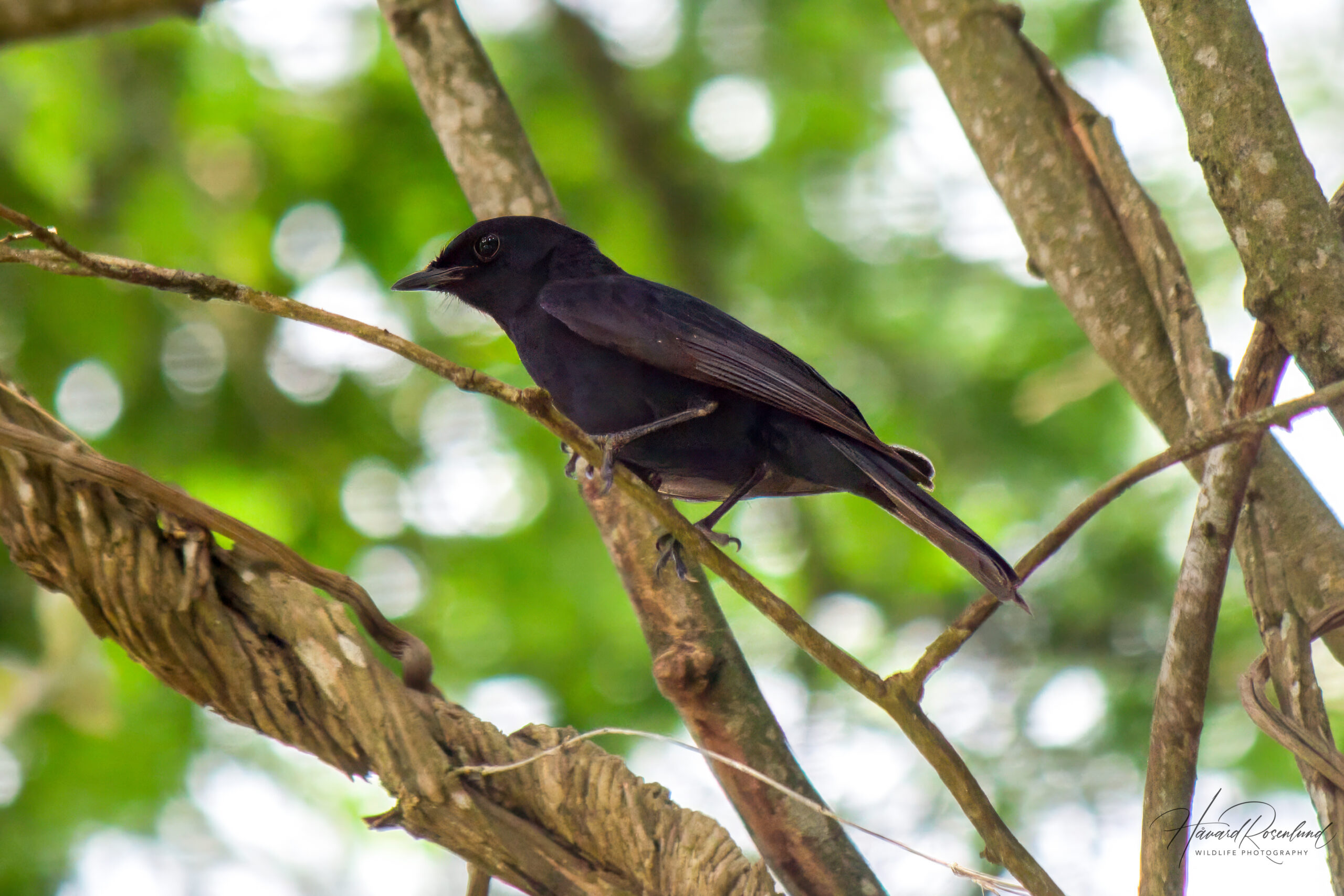
Southern Black Flycatcher
Melaenornis pammelaina
At a glance
Habitat
- Open woodland, savanna, woodland edge, plantations and wooded gardens
Diet
- Mostly insects and other invertebrates; occasional berries and aloe nectar
Activity
- Diurnal
Size
- Length: 19–22 cm Weight: 23–33 g
Range
- Eastern and southern sub-Saharan Africa, with patchy populations extending into central Africa
Description
The southern black flycatcher (Melaenornis pammelaina) is a medium-sized, entirely dark flycatcher of eastern and southern Africa. Adults are about 19–22 cm long and weigh roughly 23–33 g. The plumage is glossy black to charcoal-black, with dark eyes and a relatively slender bill. The sexes look alike.
At a distance it can be confused with the fork-tailed drongo (Dicrurus adsimilis), but the flycatcher has a shorter, much less deeply forked tail, dark rather than red eyes and a noticeably finer bill. Two subspecies are generally recognised: the widespread nominate M. p. pammelaina and M. p. diabolicus in parts of southwestern Africa.
Habitat
Southern black flycatchers favour habitats that combine trees or tall shrubs with open ground, including miombo, mopane and acacia woodland, savanna, riverine woodland, plantation edges, farmland and wooded gardens. In southern Africa they are common across many eastern and northern woodland regions.
Open perches are an important part of the habitat because much of the species' feeding begins from a lookout point. Moderately modified landscapes can therefore remain suitable when enough trees, shrubs and open feeding ground are retained.
Diet
Insects dominate the diet, including termites, beetles, grasshoppers and many other arthropods. Spiders, centipedes and worms are also taken. Plant food forms only a small part of the diet but includes berries and, in southern Africa, nectar from mountain aloe (Aloe marlothii).
Southern black flycatchers typically watch from a low exposed perch before dropping to the ground or making a short aerial sally after prey. They also glean food from leaves and branches. The combination of attacks from perches, brief aerial pursuit and gleaning allows the species to exploit food in several layers of the same woodland habitat.
Behaviour
The species is usually seen in pairs or small groups and occasionally joins mixed-species feeding parties. It shows a particularly interesting association with the fork-tailed drongo (Dicrurus adsimilis), a similarly black but more aggressive insectivore.
A field study in Eswatini found drongos in 68% of observations of southern black flycatchers, whereas flycatchers were present in only about one third of drongo observations. This asymmetry suggests that the flycatchers actively associate with drongos rather than the reverse. Possible benefits include improved predator warning or feeding opportunities, but the study did not establish the exact mechanism.
Most populations are resident, although local and seasonal movements occur, particularly in southern Africa. Pairs can remain within the same general area for long periods while adjusting their use of feeding sites as local conditions change.
Breeding
In southern Africa egg laying has been recorded from roughly May to January, with a peak in September and October. The female builds the shallow, thin-walled cup nest from dry grass and other plant material over a twig foundation and lines it with fine rootlets. Nests are often placed in a tree cavity, behind peeling bark or in another sheltered hollow.
Clutches contain one to four eggs, most often around three. The female is thought to perform the incubation, which lasts about 13–16 days. Both parents feed the chicks, which leave the nest after roughly 15–20 days and remain dependent for a short period afterwards.
Status
The southern black flycatcher is classified as least concern on the IUCN Red List. It has a broad African range, remains common in many suitable woodland and savanna habitats, and the global population trend is considered stable.
The species also uses moderately modified landscapes where sufficient trees, shrubs and open feeding ground remain. Local habitat loss can reduce populations where woodland structure is heavily simplified, but no major threat is known across the species' range.
Image gallery
Loading map and observations…
Have you seen this species?
Independent species archive
Did you find this species page useful?
Wildlife Vagabond is independently built and maintained. Voluntary support helps cover hosting, maps, data storage and continued improvements to the species archive.
Support Wildlife VagabondSpecies content will remain freely available.
References
Information about the species’ global distribution and status is based primarily on global Red List data. See the references below for details.
- Biodiversity Explorer. (n.d.). Southern Black Flycatcher (Melaenornis pammelaina). Iziko Museums of South Africa. https://www.biodiversityexplorer.info/birds/muscicapidae/melaenornis_pammelaina.htm
- BirdLife International. (n.d.). Southern Black Flycatcher species factsheet. https://datazone.birdlife.org/species/factsheet/southern-black-flycatcher-melaenornis-pammelaina
- International Union for Conservation of Nature. (n.d.). Southern Black Flycatcher. The IUCN Red List of Threatened Species. https://www.iucnredlist.org/species/22709085/132079602
- Morgan, T., McCleery, R., Moulton, M., & Monadjem, A. (2012). Are Southern Black Flycatchers Melaenornis pammelaina associated with Fork-tailed Drongos Dicrurus adsimilis? Ostrich, 83(2), 109-111. https://doi.org/10.2989/00306525.2012.690351
- Oiseaux.net. (n.d.). Southern Black Flycatcher. https://www.oiseaux.net/en/southern.black.flycatcher.html