
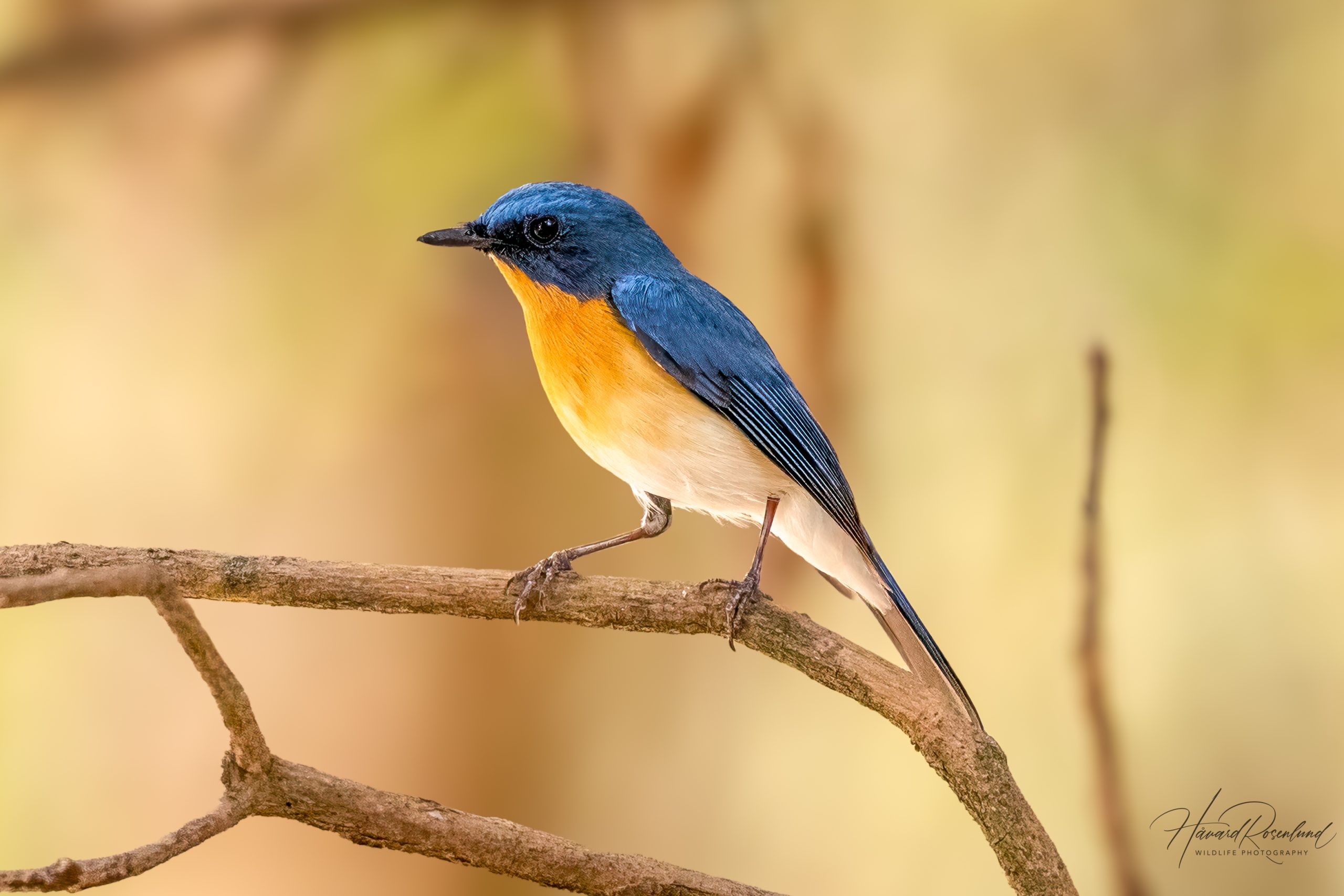
Tickell’s Blue Flycatcher
Cyornis tickelliae
At a glance
Habitat
- Dry and moist woodland, forest edge, scrub, bamboo, plantations and wooded gardens
Diet
- Mainly insects and other small invertebrates, caught in flight or picked from vegetation and ground
Activity
- Diurnal
Size
- Length: about 14–15 cm Weight: about 16 g
Range
- Resident across much of the Indian subcontinent and Sri Lanka, extending locally into Myanmar
Description
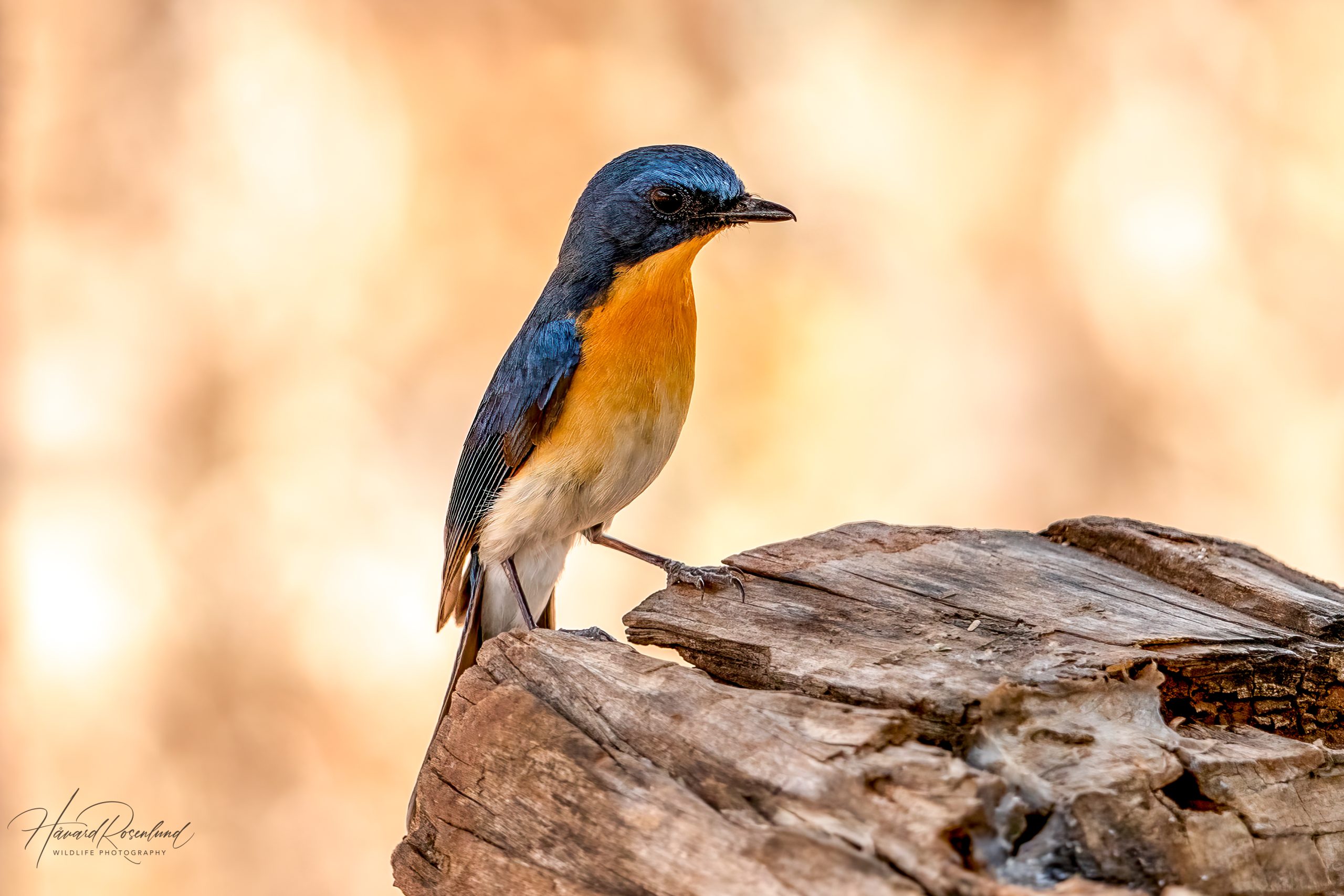
Tickell's blue flycatcher (Cyornis tickelliae) is a small, upright flycatcher of the Indian subcontinent. Adults are about 14–15 cm long and weigh roughly 12–18 g. Males are striking, with bright blue upperparts, an orange-rufous throat and breast and a clean white lower belly. Females are much duller, with brownish to muted blue upperparts and softer orange tones below.
Several Asian Cyornis flycatchers are very similar. Blue-throated blue flycatcher (Cyornis rubeculoides) has blue extending onto the throat in adult males, while Tickell's usually shows orange from throat through breast. Voice, range and a combination of plumage characters are often important in identification.
Taxonomy
Older treatments used Tickell's blue flycatcher for a broader group of populations extending farther into Southeast Asia. The Indochinese populations are now recognised as a separate species, Indochinese blue flycatcher (Cyornis sumatrensis).
Current checklists recognise two subspecies of Tickell's blue flycatcher: the nominate C. t. tickelliae on the Asian mainland and C. t. jerdoni in Sri Lanka. This split explains why older field guides may give the species a wider Southeast Asian range than modern checklists.
Habitat
The species uses dry and moist deciduous woodland, forest edge, scrub, bamboo, secondary growth, plantations and well-wooded gardens. It is often associated with shady lower and middle vegetation and frequently occurs near streams, ravines and other places where dense cover meets small openings.
In India, the species is resident and occurs in both forest and plantations. It can tolerate some modified landscapes, but mainly where substantial woody vegetation and a shaded understorey remain.
Diet
Tickell's blue flycatchers feed mainly on insects and other small invertebrates. Beetles, caterpillars, flies, termites, earwigs and spiders are among the prey taken.
Foraging
Birds hunt from low or mid-level perches, making short aerial sallies to catch flying insects and also gleaning prey from leaves, branches and the ground. They often forage low in vegetation, repeatedly shifting between concealed perches and brief sallies into the open.
During periods of intense insect activity, a bird may return to the same perch again and again after short flycatching flights, allowing it to exploit both aerial prey and invertebrates picked from vegetation or the ground.
Behaviour
Tickell's blue flycatchers are usually encountered alone or in pairs and often remain within a fairly small shaded area of woodland or scrub.
Males sing from shaded perches within woodland or scrub and use the song to mark and defend territories. The voice can therefore reveal a bird that remains difficult to see in dense vegetation.
Breeding
Breeding timing varies across the range but falls mainly between March and August in India. The nest is placed in a cavity or sheltered recess, including holes in trees, banks and rock faces, and sometimes among bamboo or roots. Moss, rootlets, dry leaves, fibres and other plant material are used to build a compact cup. Clutches usually contain three to five eggs.
Field observations published in 2012 from the Lower Palni Hills in southern India documented nests with young in rocky roadside clefts in late April and late June, showing how readily the species uses natural recesses close to the ground or along banks. Both adults feed the nestlings.
Status
Tickell's blue flycatcher is classified as least concern on the IUCN Red List. It remains widespread on the Indian subcontinent.
State of India’s Birds 2025 estimates a long-term national increase of about 77.01% and a recent annual increase of about 4.43%. The national data therefore show no broad current decline in India. Retention of forest, scrub and tree-rich plantation habitat remains important for this resident insectivore.
Image gallery
Loading map and observations…
Have you seen this species?
Independent species archive
Did you find this species page useful?
Wildlife Vagabond is independently built and maintained. Voluntary support helps cover hosting, maps, data storage and continued improvements to the species archive.
Support Wildlife VagabondSpecies content will remain freely available.
References
Information about the species’ global distribution and status is based primarily on global Red List data. See the references below for details.
- Avibase. (n.d.). AviList/Avibase – Cyornis tickelliae taxonomic concept. https://avibase.bsc-eoc.org/species.jsp?avibaseid=0EA33C18FD9B29E5
- Balasubramanian et al. (n.d.). Breeding observations from the Lower Palni Hills. https://threatenedtaxa.org/JoTT/article/download/1317/2394?inline=1
- BirdLife International. (n.d.). Tickell's Blue Flycatcher species factsheet. https://datazone.birdlife.org/species/factsheet/tickells-blue-flycatcher-cyornis-tickelliae
- Clement, P., & Christie, D. (2020). Tickell's Blue Flycatcher (Cyornis tickelliae). In Birds of the World. Cornell Lab of Ornithology. https://doi.org/10.2173/bow.tibfly3.01
- International Union for Conservation of Nature. (n.d.). Tickell's Blue Flycatcher. The IUCN Red List of Threatened Species. https://www.iucnredlist.org/species/103761678/111162678
- State of India's Birds. (2025). State of India’s Birds 2025 – Tickell’s Blue Flycatcher. https://stateofindiasbirds.in/species/or-tibfly3/
- Tobias, J. A., Sheard, C., Pigot, A. L., Devenish, A. J. M., Yang, J., Sayol, F., Neate‐Clegg, M. H. C., Alioravainen, N., Weeks, T. L., Barber, R. A., Walkden, P. A., MacGregor, H. E. A., Jones, S. E. I., Vincent, C., Phillips, A. G., Marples, N. M., Montaño‐Centellas, F. A., Leandro‐Silva, V., Claramunt, S., … Schleuning, M. (2022). AVONET: morphological, ecological and geographical data for all birds. Ecology Letters, 25(3), 581-597. https://doi.org/10.1111/ele.13898