
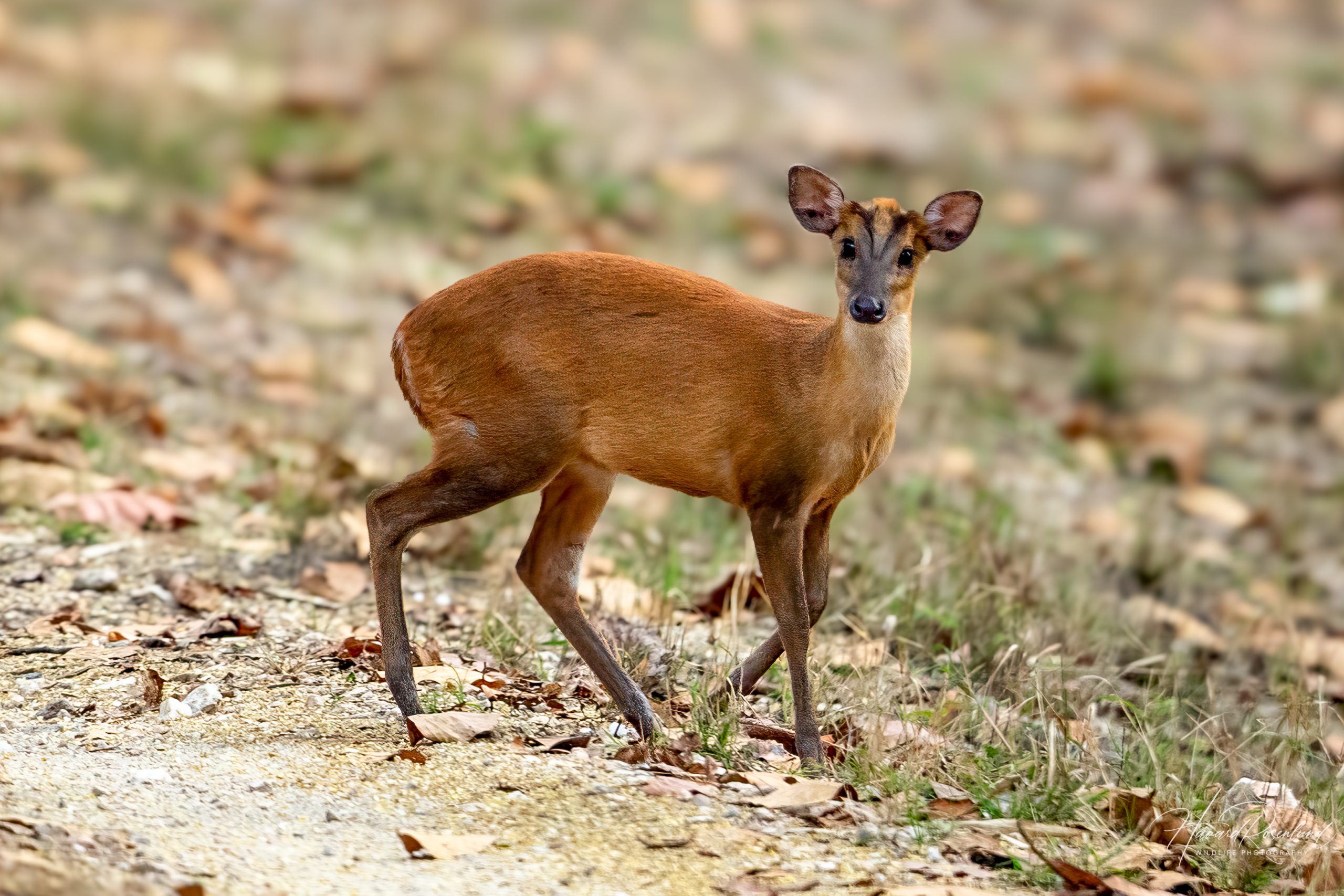
Northern Red Muntjac
Muntiacus vaginalis
At a glance
Habitat
- Dense forest and scrub, especially habitats with a well-developed understorey; from lowland forest to Himalayan foothills
Diet
- Mainly leaves, shoots, herbs and fruit; the mix changes with season and plant availability
Activity
- Flexible; often most active around dawn and dusk but also active by day or night depending on locality and disturbance
Size
- Length: 89–135 cm head-body Weight: 14–35 kg
Range
- South Asia to mainland Southeast Asia; exact southern limits remain taxonomically unsettled
Description
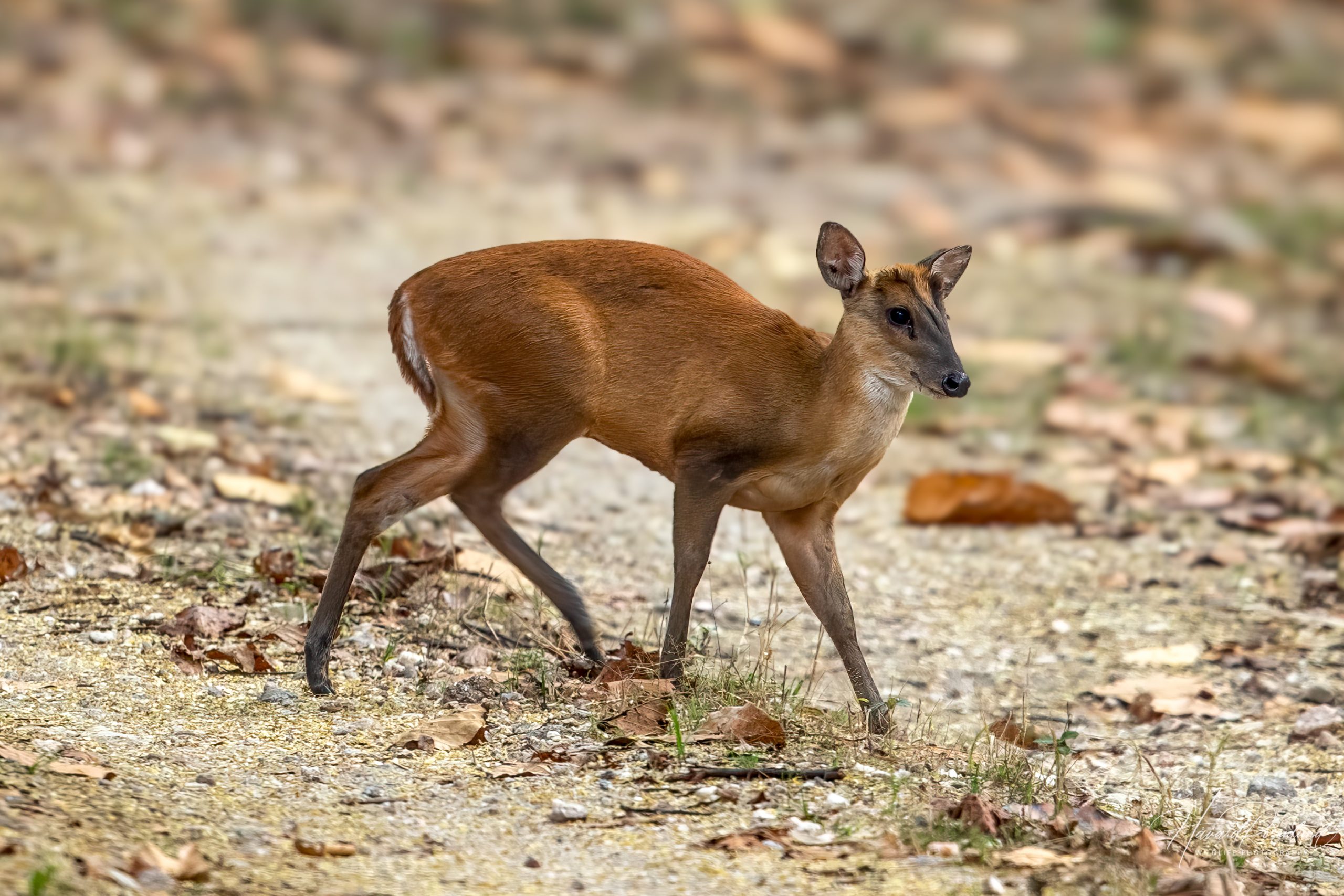
The northern red muntjac (Muntiacus vaginalis) is a small forest deer found across South Asia and parts of mainland Southeast Asia. Adults are roughly 89–135 cm in head-and-body length and weigh around 14–35 kg. The coat is typically rich reddish-brown, becoming darker or duller in some seasons and populations.
Males have short antlers carried on long bony pedicles and elongated upper canine teeth that project below the lip. The canines are important weapons in close combat and can be more consequential than the small antlers. Both sexes have prominent facial scent glands. Dark facial markings are another distinctive feature: the elongated frontal glands form a blackish V from the forehead toward the muzzle, while females have corresponding dark frontal hair where males carry the antler pedicles. The southern red muntjac (Muntiacus muntjak) is extremely similar in general appearance, and the exact boundary between red-muntjac lineages remains taxonomically unsettled in parts of the range.
Taxonomy
The red muntjac complex has undergone major taxonomic revision. Northern red muntjac is now widely recognised as Muntiacus vaginalis, separate from the southern red muntjac Muntiacus muntjak. The species boundaries remain unsettled: populations historically called aureus and malabaricus may represent additional distinct species, and uncertainties surrounding older names still complicate the taxonomy.
The northern red muntjac lineage is also famous for having remarkably few chromosomes. Females have only six and males seven, the lowest number known among mammals. DNA studies show that this arose because ancestral chromosomes repeatedly joined together over evolutionary time. Older genetic studies often used the name Muntiacus muntjak vaginalis; under the modern split, those animals belong to the northern red muntjac lineage.
Habitat
Northern red muntjacs are strongly associated with forest and dense cover. They occur in tropical and subtropical broadleaf forest, sal forest, riverine forest, moist and dry deciduous woodland, Himalayan foothill forest and secondary vegetation with a thick understorey. They can use disturbed forest, but they generally depend on cover for feeding, resting and escaping predators.
In lowland Nepal, barking deer preferred riverine and sal forest over the more open hill habitats used by four-horned antelope (Tetracerus quadricornis), a similarly sized antelope. Studies in the Himalayan foothills likewise link the species to areas with suitable tree and shrub cover, while recent landscape-scale surveys in Sikkim and Darjeeling show that abundance varies considerably with forest structure and elevation.
Diet
Northern red muntjacs feed mainly on leaves, shoots, herbs, shrubs and fruit, with the mix changing through the year. Research in Nepal found that their diet came largely from woody plants and herbs rather than tropical grasses.
Detailed analysis of droppings from the Himalayan foothills of Pakistan found that material from trees dominated the diet in both summer and winter, while shrubs became relatively more important in winter. Twenty-seven plant species were recorded in summer samples and nineteen in winter. The species is therefore a flexible forest feeder, but it is much more dependent on leaves and other browse than on grass.
Behaviour
Northern red muntjacs are usually solitary. Females are most often seen alone or with a dependent fawn, while males use scent marking and close-range aggression when interacting with rivals. The long upper canines are effective weapons during fights, complementing the short antlers. A radio-telemetry study of 28 Indian muntjacs in Bardia National Park, Nepal, published in 2007 found high site fidelity but substantial overlap among adult home ranges. Strict territoriality was not observed; the pattern instead suggested a looser form of dominance associated with particular areas.
The loud bark that gives muntjacs the name “barking deer” is one of their most characteristic behaviours. Barking occurs when animals are disturbed or detect potential danger and may continue for prolonged periods. Early work on Indian muntjacs suggests that the call can signal that a potential threat has been detected and can also be used in social interactions between muntjacs.
Activity is flexible and varies with locality. A year-long camera-trap study published in 2025 from Baiyun Mountain, southern China, found clear peaks between about 06:00–08:00 and 17:00–19:00. The same population shifted its use of elevation seasonally, occurring more often toward the foothills in the dry season and on hillsides during the rainy season, showing that both daily activity and local use of the habitat can change with conditions.
Predation
Northern red muntjacs are important prey for large carnivores in several Asian forest systems. Tigers (Panthera tigris), leopards (Panthera pardus) and dholes (Cuon alpinus) all take muntjac, and diet studies from Bhutan and Thailand have found muntjac among the major prey species of these predators.
Dense understorey provides important cover. An animal often freezes or slips into vegetation rather than trying to outrun a predator over long distances. It may give its characteristic bark after detecting danger, while newborn fawns remain hidden in vegetation during their most vulnerable first weeks.
Reproduction
Northern red muntjacs can breed throughout the year rather than being restricted to a short seasonal rut. Females usually give birth to a single fawn after a gestation of roughly six to seven months. The newborn remains hidden in dense vegetation during its first weeks, and the mother returns to nurse it.
Much of the detailed reproductive literature predates the modern split of the red muntjac complex and was published under the broader name Muntiacus muntjak. Those studies consistently describe year-round breeding and small litters, although precise timing can vary among populations.
Status
The northern red muntjac is classified as least concern on the IUCN Red List. It remains widespread across South and mainland Southeast Asia and is still common in many protected forests.
Local populations can nevertheless be reduced substantially by hunting and forest degradation. A camera-trap study published in 2025 from protected areas in Mizoram, northeast India, found lower ungulate densities than reported from several other protected areas in India and identified illegal hunting as one possible reason. Northern red muntjac was the most abundant ungulate recorded in the study.
Image gallery
Loading map and observations…
Have you seen this species?
Independent species archive
Did you find this species page useful?
Wildlife Vagabond is independently built and maintained. Voluntary support helps cover hosting, maps, data storage and continued improvements to the species archive.
Support Wildlife VagabondSpecies content will remain freely available.
References
Information about the species’ global distribution and status is based primarily on global Red List data. See the references below for details.
- Animal Diversity Web. (n.d.). Muntiacus muntjak (historical red muntjac life-history account). https://animaldiversity.org/accounts/Muntiacus_muntjak/
- Gogoi, A. P., Chakma, J., Kawlni, L., Kolipakam, V., & Qureshi, Q. (2025). Caught on Camera: Insights Into Mizoram's Mammalian Diversity Through a Camera‐Trap‐Based Distance Sampling Approach. Ecology and Evolution, 15(12), e72501. https://doi.org/10.1002/ece3.72501
- Habiba, U., Anwar, M., Khatoon, R., Hussain, M., Khan, K. A., Khalil, S., Bano, S. A., & Hussain, A. (2021). Feeding habits and habitat use of barking deer (Muntiacus vaginalis) in Himalayan foothills, Pakistan. PLOS ONE, 16(1), e0245279. https://doi.org/10.1371/journal.pone.0245279
- International Union for Conservation of Nature. (n.d.). Northern Red Muntjac. The IUCN Red List of Threatened Species. https://www.iucnredlist.org/species/136551/22165292
- Mammal Diversity Database. (n.d.). Muntiacus vaginalis. American Society of Mammalogists. https://www.mammaldiversity.org/taxon/1006338/
- Odden, M., & Wegge, P. (2007). Predicting spacing behavior and mating systems of solitary cervids: A study of hog deer and Indian muntjac. Zoology, 110(4), 261-270. https://doi.org/10.1016/j.zool.2007.03.003
- Pokharel, K. P., Yohannes, E., Salvarina, I., & Storch, I. (2015). Isotopic evidence for dietary niche overlap between barking deer and four-horned antelope in Nepal. Journal of Biological Research-Thessaloniki, 22(1), 6. https://doi.org/10.1186/s40709-015-0029-0
- Sharma, C. M., Bhattacharjee, S., Sharief, A., Joshi, B. D., Thakur, M., & Sharma, L. K. (2024). A tapestry of habitats: exploring abundance and habitat preferences of the Northern Red Muntjac (Muntiacus vaginalis) across the Central Himalayan landscape. Mammalia, 88(4), 280-291. https://doi.org/10.1515/mammalia-2023-0150
- Singh, B., Kumar, A., Uniyal, V. P., & Gupta, S. K. (2019). Complete mitochondrial genome of northern Indian red muntjac (Muntiacus vaginalis) and its phylogenetic analysis. Molecular Biology Reports, 46(1), 1327-1333. https://doi.org/10.1007/s11033-018-4486-z
- Tong, F., Li, R., Liu, F., Zheng, Q., Yi, J., Lin, Y., & Peng, Y. (2025). Activity Rhythms of Muntiacus vaginalis in Baiyun Mountain Scenic Area of Guangzhou Based on Camera Trapping. Tropical Geography, 45(8), 1440–1448. https://doi.org/10.13284/j.cnki.rddl.20240625
- Wang, Y., Li, D., Wang, G., Zhu, P. B. D., Liu, W., Li, C., & Jin, K. (2022). Morphological, Phaneroptic, Habitat and Population Description of Three Muntjac Species in a Tibetan Nature Reserve. Animals, 12(21), 2909. https://doi.org/10.3390/ani12212909
- Wiles, G. J., & Weeks, H. P. (1981). Barking Behavior in Indian Muntjacs (Muntiacus muntjak). Journal of Mammalogy, 62(1), 208-211. https://doi.org/10.2307/1380500
- Yin, Y., Fan, H., Zhou, B., Hu, Y., Fan, G., Wang, J., Zhou, F., Nie, W., Zhang, C., Liu, L., Zhong, Z., Zhu, W., Liu, G., Lin, Z., Liu, C., Zhou, J., Huang, G., Li, Z., Yu, J., … Wei, F. (2021). Molecular mechanisms and topological consequences of drastic chromosomal rearrangements of muntjac deer. Nature Communications, 12(1), 6858. https://doi.org/10.1038/s41467-021-27091-0