
Red-billed Oxpecker
Buphagus erythroryncha
At a glance
Habitat
- Savanna, grassland and open woodland where large wild or domestic mammals are abundant
Diet
- Ticks and other ectoparasites, plus blood, wound tissue and other material taken from mammal hosts
Activity
- Diurnal; spends much of the day riding and foraging on large mammals
Size
- Length: About 20 cm Weight: 42–59 g
Range
- Eastern and southern Africa, closely linked to the distribution of suitable large mammal hosts
Description
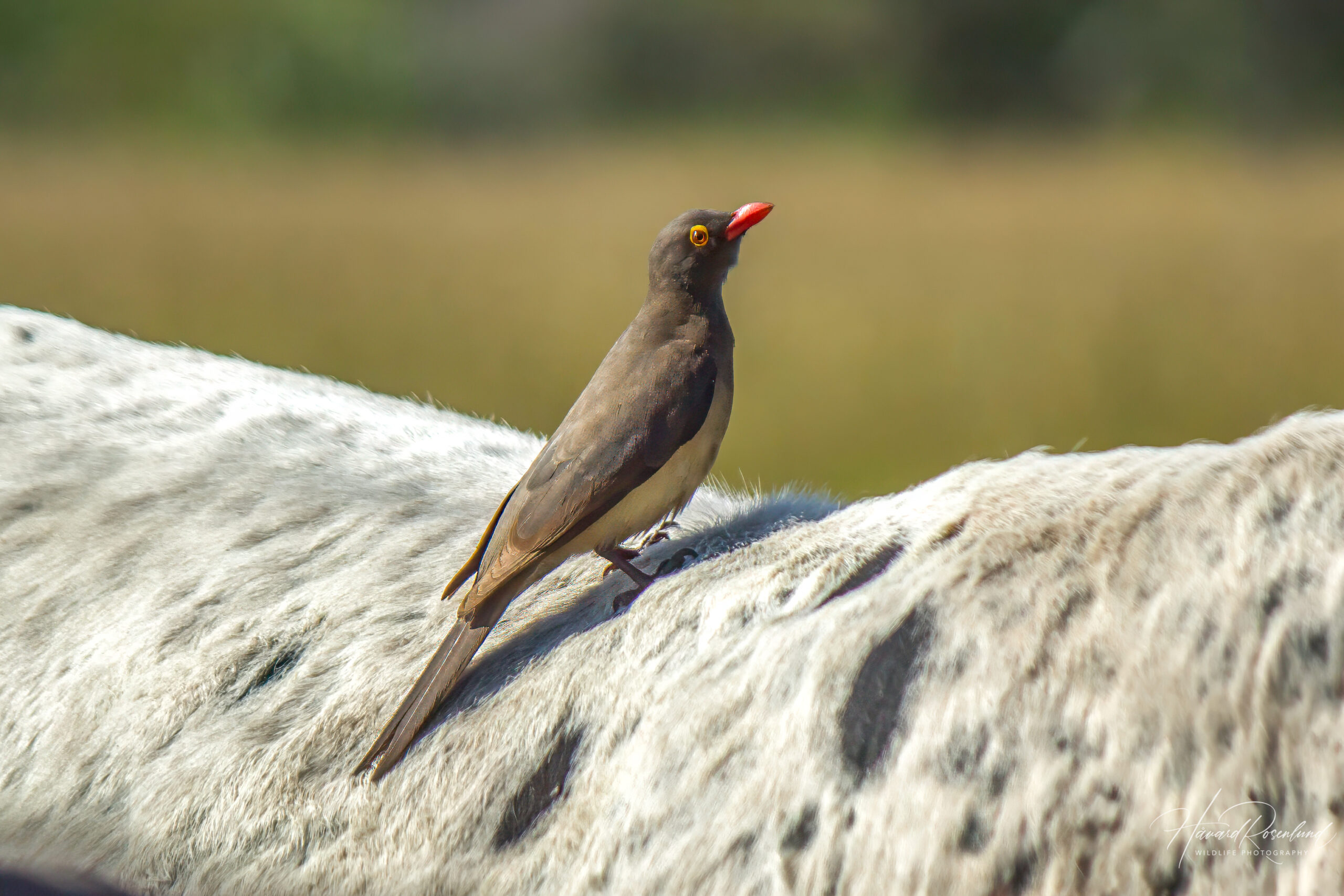
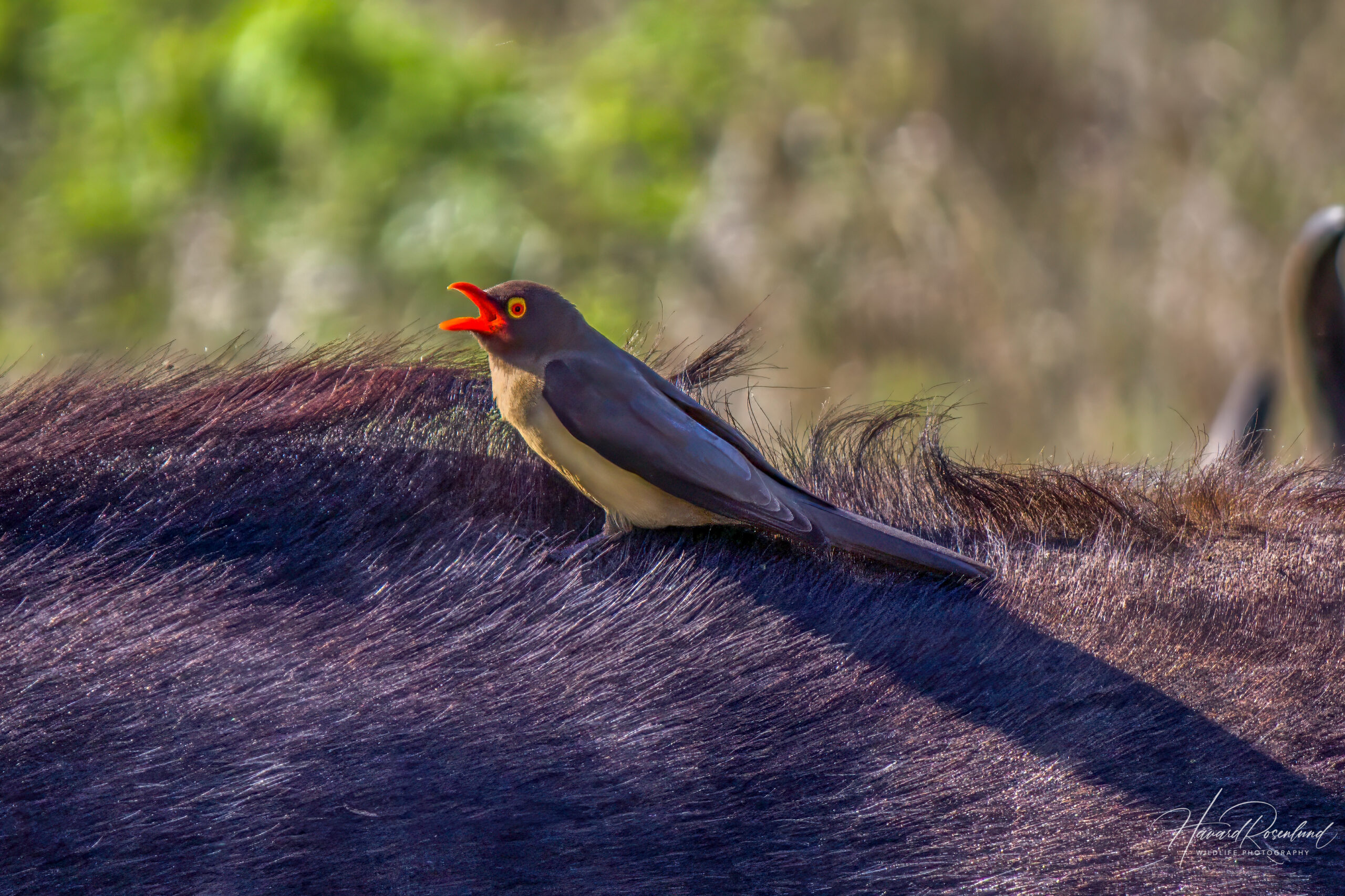
The red-billed oxpecker (Buphagus erythroryncha) is a highly specialised songbird of eastern and southern Africa that spends much of its life on large mammals. It is about 20 cm long and weighs roughly 42–59 g. Adults are mainly brown with paler underparts, a bright red bill and a conspicuous yellow eye-ring. Juveniles are duller and initially have a dark bill.
Only two oxpecker species survive today. Where their ranges overlap, the red-billed oxpecker differs from the yellow-billed oxpecker (Buphagus africanus) in having an entirely red adult bill and a yellow eye-ring; the latter has a yellow-based bill and lacks the yellow ring around the eye.
Taxonomy
Current global checklists use the scientific name Buphagus erythroryncha. The species was long widely written as B. erythrorynchus, and the still older spelling B. erythrorhynchus also appears in the literature.
The spelling erythroryncha restores Stanley's original epithet from 1814. Because the epithet is treated as a noun, its ending does not change to agree with the genus name. The different spellings all refer to the same red-billed oxpecker and do not represent a taxonomic split.
Habitat
Red-billed oxpeckers occur mainly in savanna, grassland and open woodland where suitable large mammals are abundant. Their habitat therefore depends as much on which large mammal hosts are present as on the vegetation itself.
They use both wild herbivores and domestic livestock and can persist in ranching landscapes when enough hosts, food and safe nesting cavities remain. Areas with few large mammals or intensive parasite-control treatments are much less suitable.
Diet
Ticks and other ectoparasites are important food, but the diet is broader than the familiar image of a bird simply cleaning its host. Oxpeckers also consume blood, wound tissue, mucus and other material taken directly from mammals.
The relationship with the host can therefore be beneficial or harmful. Removing ticks can benefit a mammal, while repeatedly feeding at wounds may delay healing. The balance varies with host species, parasite load and alternative food availability.
Foraging
Red-billed oxpeckers cling to buffaloes, giraffes, rhinoceroses, antelopes, cattle and other large mammals, using strong claws and a flattened body posture to move across the host as it walks or feeds. The bill is used to comb through hair, pick visible parasites and feed around wounds and other places on the host where food is available.
Host choice is not random. Large-bodied mammals that support many ectoparasites tend to be particularly valuable, while the foods taken also vary with local conditions and the mammal community. Birds may remain on one mammal for extended periods before flying to another nearby host.
A feeding study published in 1980 estimated that the daily food intake of a captive red-billed oxpecker was equivalent to about 7,200 engorged tick larvae, illustrating how large the intake of small ticks can be.
Behaviour
Oxpeckers do more than feed from their hosts. Their sharp alarm calls can give large mammals information about approaching danger. The Swahili expression askari wa kifaru—often translated as “the rhino's guard”—reflects this association with rhinoceroses.
Field experiments with black rhinoceroses (Diceros bicornis) showed that animals carrying red-billed oxpeckers detected approaching people more reliably and at greater distances than rhinos without the birds. The birds can therefore provide an early warning of danger in addition to their feeding interactions with the host.
Social behaviour
Red-billed oxpeckers are social birds, and their cooperative breeding gives many groups a family structure. A breeding pair is commonly accompanied by two or three helpers of either sex, often thought to be offspring from earlier broods. Outside breeding, birds can also gather in larger, noisy flocks as they move among feeding and resting sites.
Breeding
Red-billed oxpeckers form monogamous breeding pairs and nest in natural tree cavities, lining them with grass, rootlets, mammal hair and sometimes dung. Breeding timing varies geographically and is often associated with the rainy season, when both insect activity and host condition can improve.
Clutches usually contain two to five eggs, and incubation lasts about 12–13 days. The breeding pair performs the incubation, while helpers can join the parents in nest construction, defence and feeding the chicks. The young remain in the cavity for roughly a month before fledging.
Pairs can breed repeatedly when conditions remain favourable. A study in Kruger National Park documented three broods during a breeding season that lasted 176 days.
Relationship with humans
Changes in large wild mammal populations and the treatment of livestock have strongly influenced the species. Red-billed oxpeckers declined severely in parts of South Africa when wild ungulates disappeared and livestock were treated with acaricides that both reduced tick food and could expose feeding birds to toxic residues.
Reintroduction programmes have since restored the species to parts of its former South African range. In livestock landscapes, oxpeckers fare better when tick treatments reduce harmful parasites without exposing the birds to toxic residues.
Status
The red-billed oxpecker is classified as least concern on the IUCN Red List and remains widespread in suitable parts of eastern and southern Africa.
Local numbers can nevertheless fall sharply when large mammal hosts or ticks become scarce or when toxic veterinary tick-control chemicals are widely used.
Image gallery
Loading map and observations…
Have you seen this species?
Independent species archive
Did you find this species page useful?
Wildlife Vagabond is independently built and maintained. Voluntary support helps cover hosting, maps, data storage and continued improvements to the species archive.
Support Wildlife VagabondSpecies content will remain freely available.
References
Information about the species’ global distribution and status is based primarily on global Red List data. See the references below for details.
- AviList. (n.d.). b – Red-billed Oxpecker (Buphagus erythroryncha). https://www.avilist.org/checklist/v2025b/
- Bezuidenhout, J. D., & Stutterheim, C. J. (1980). A critical evaluation of the role played by the red-billed oxpecker Buphagus erythrorhynchus in the biological control of ticks. The Onderstepoort journal of veterinary research, 47(2), 51-75. https://pubmed.ncbi.nlm.nih.gov/7413164/
- BirdLife International. (n.d.). Red-billed Oxpecker species factsheet. https://datazone.birdlife.org/species/factsheet/red-billed-oxpecker-buphagus-erythrorynchus
- Cornell Lab of Ornithology. (2024). nomenclature correction to Buphagus erythroryncha. https://www.birds.cornell.edu/clementschecklist/updates-and-corrections-october-2024/
- International Union for Conservation of Nature. (n.d.). Red-billed Oxpecker. The IUCN Red List of Threatened Species. https://www.iucnredlist.org/species/22711009/131961538
- Kalle, R., Combrink, L., Ramesh, T., & Downs, C. T. (2017). Re‐establishing the pecking order: Niche models reliably predict suitable habitats for the reintroduction of red‐billed oxpeckers. Ecology and Evolution, 7(6), 1974-1983. https://doi.org/10.1002/ece3.2787
- Lukubwe, M. S., Velarde-Garcéz, D., Sequeira, F., Lopes, S., Craig, A. J., & Mata, V. A. (2024). Feeding ecology and interactions with mammal hosts in a symbiotic genus of birds (Buphagus spp.) in Namibia. Avian Research, 15, 100200. https://doi.org/10.1016/j.avrs.2024.100200
- Plantan, T. B., Howitt, M. J., Kotzé, A., & Gaines, M. S. (2014). Breeding biology of Red‐billed oxpeckers Buphagus erythrorhynchus at the National Zoological Gardens of South Africa. International Zoo Yearbook, 48(1), 92-100. https://doi.org/10.1111/izy.12029
- Plotz, R. D., & Linklater, W. L. (2020). Oxpeckers Help Rhinos Evade Humans. Current Biology, 30(10), 1965-1969.e2. https://doi.org/10.1016/j.cub.2020.03.015
- Stutterheim, C. J. (1982). Breeding biology of the red-billed oxpecker in the Kruger National Park. Ostrich, 53(2), 79-90. https://doi.org/10.1080/00306525.1982.9634731
- Weeks, P. (2000). Red-billed oxpeckers: vampires or tickbirds? Behavioral Ecology, 11(2), 154-160. https://doi.org/10.1093/beheco/11.2.154