
Brahminy Starling
Sturnia pagodarum
At a glance
Habitat
- Open dry woodland, scrub, farmland, gardens and settlements
Diet
- Fruit, nectar and insects, taken both in trees and on the ground
Activity
- Diurnal
Size
- Length: 19–22 cm Weight: 40–54 g
Range
- Indian subcontinent and adjacent South Asia; winter vagrants reach Southeast Asia and introduced populations occur in parts of the Gulf
Description
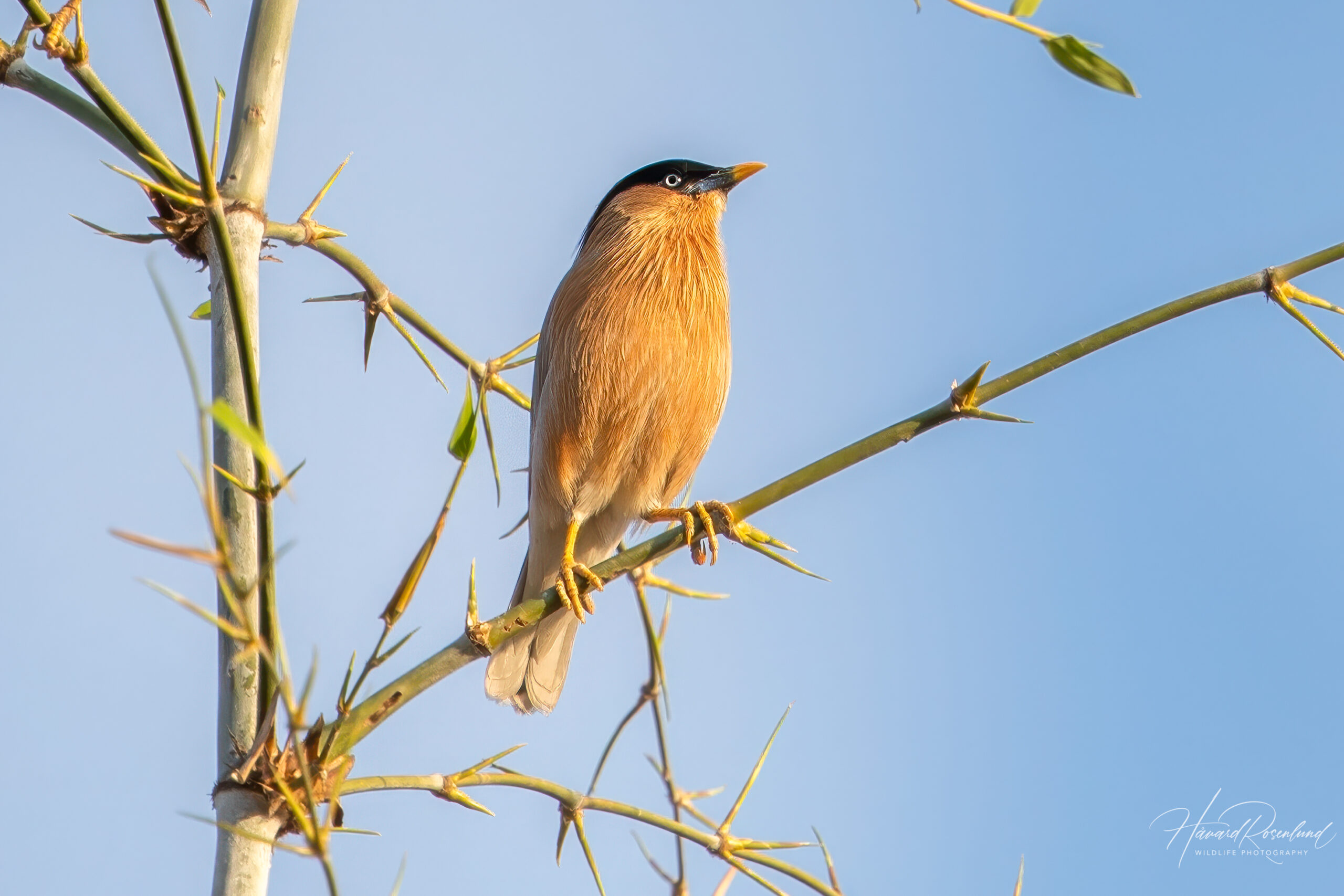
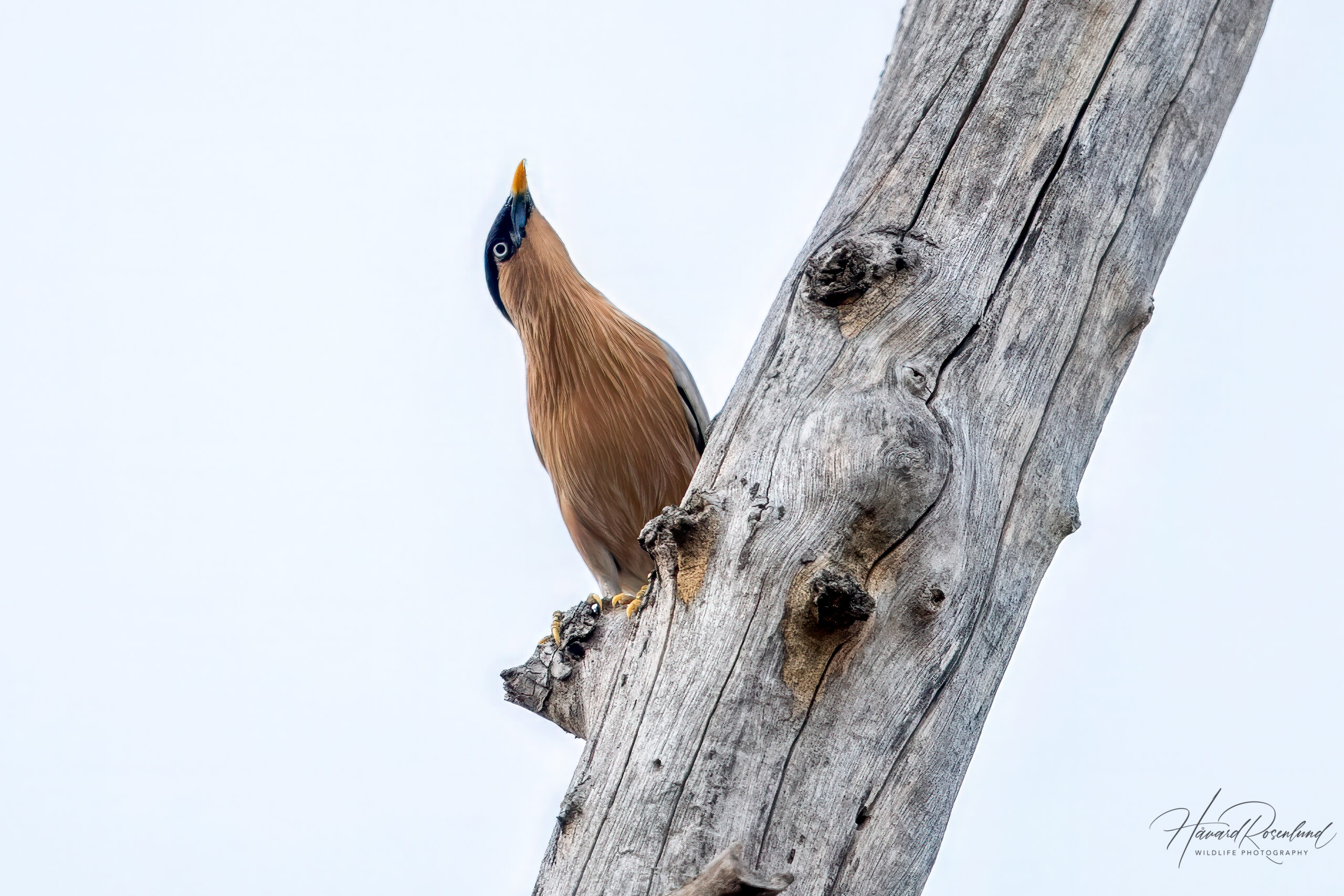
The Brahminy starling (Sturnia pagodarum) is a small, distinctive starling native to the Indian subcontinent and neighbouring parts of South Asia. Adults are roughly 19–22 cm long and weigh about 40–54 g. The black cap ends in a loose, wispy crest, contrasting with cinnamon-buff underparts, grey-brown upperparts and a dark tail tipped with white. The bill is bright yellow with a bluish base and the legs are yellow. Females resemble males but generally have a shorter crest, while juveniles are duller and lack the fully developed head plumes.
The combination of black crest, warm cinnamon body and two-coloured bill makes adults unusually distinctive among South Asian starlings. Small numbers occur as winter vagrants beyond the main range into Southeast Asia, and an introduced population occurs in the United Arab Emirates.
Habitat
Brahminy starlings favour open dry woodland, scrub, farmland, gardens and settlements and readily use landscapes altered by people. Scattered mature trees, orchards and flowering or fruiting vegetation are especially important because they provide both feeding sites and cavities for nesting.
The species is not restricted to undisturbed forest and is common in agricultural and peri-urban mosaics where suitable food and nest sites remain available.
Diet
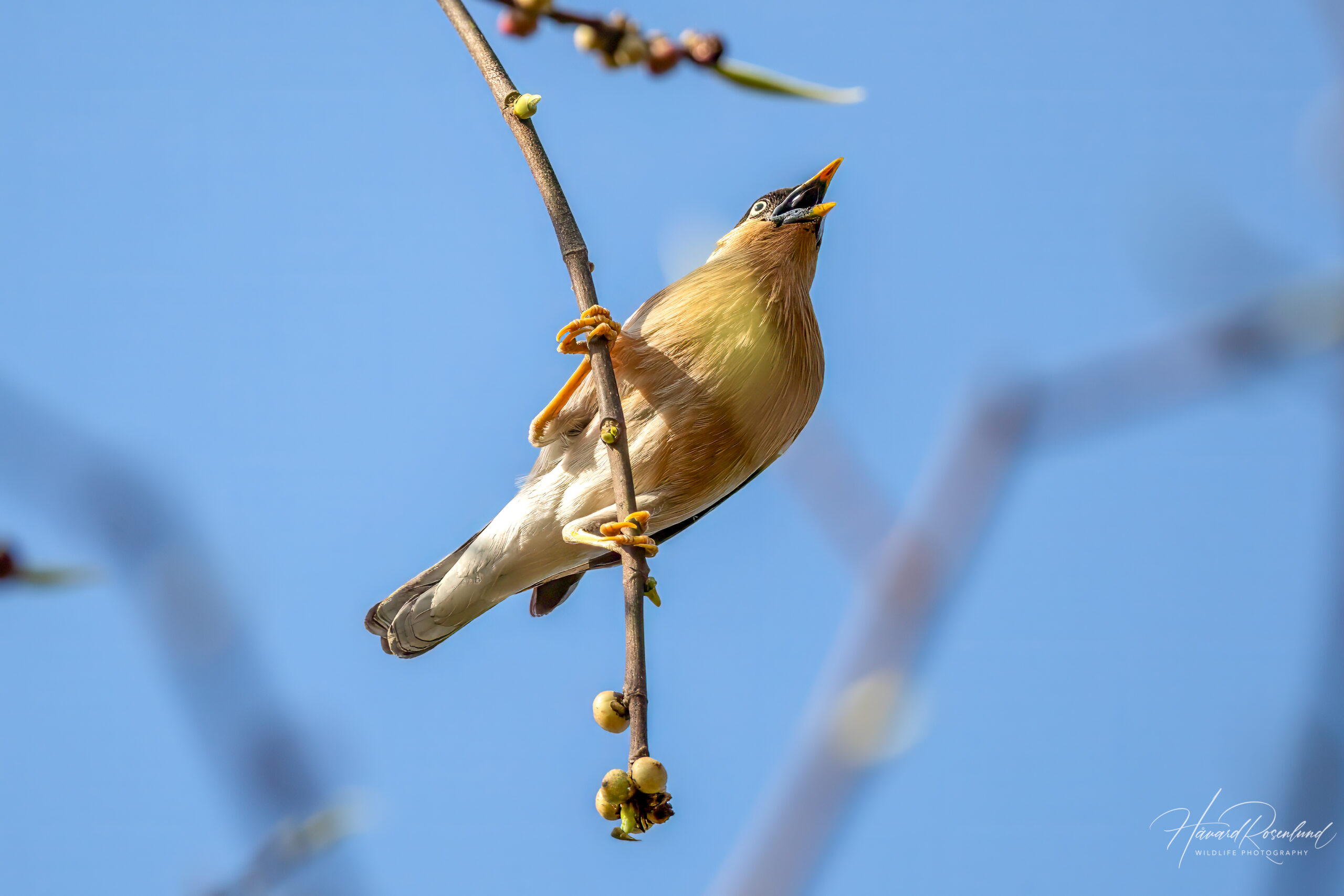
The diet is broad and includes fruit, nectar, insects and other small invertebrates. Food is taken both in trees and on the ground, and birds frequently visit flowering and fruiting plants around villages, gardens and cultivated land.
Diet changes with local availability. Fruit and nectar can be important where trees are flowering or fruiting heavily, while insects form a substantial animal component and become especially important when adults are feeding young.
Behaviour
Brahminy starlings are social without usually forming the enormous flocks associated with some other starlings. They are commonly seen in pairs or small family groups and may join larger gatherings where food is concentrated or outside the breeding season. Mixed groups with other starlings and mynas are also common in suitable habitat.
The vocal repertoire is varied and includes nasal or harsh calls, more musical phrases and imitation of other bird species. Flocks remain in frequent vocal contact while moving between feeding and roosting sites.
Breeding
Brahminy starlings are cavity nesters. Natural tree holes are used, but the species readily adopts cavities in buildings and other artificial structures. A study conducted from 2022 to 2023 in peri-urban Ajmer, Rajasthan, India, found extensive use of man-made nesting sites by Brahminy starlings and three other starling species.
Both sexes contribute to nest construction and later feed the young. The nest is a loose structure of grasses, rootlets, feathers and other available material, and a typical clutch contains around three to four pale blue eggs. Their use of both natural and artificial cavities allows them to breed across a wide range of wooded and settled habitats.
Status
The Brahminy starling is classified as least concern on the IUCN Red List and remains widespread across a very large South Asian range.
Indian monitoring data published in 2025 give a long-term national estimate of about −23% and a recent annual estimate of about −1.3%, but both trends are classified as inconclusive. The species remains common, widespread and in the low conservation-priority category in India.
Image gallery
Loading map and observations…
Have you seen this species?
Independent species archive
Did you find this species page useful?
Wildlife Vagabond is independently built and maintained. Voluntary support helps cover hosting, maps, data storage and continued improvements to the species archive.
Support Wildlife VagabondSpecies content will remain freely available.
References
Information about the species’ global distribution and status is based primarily on global Red List data. See the references below for details.
- BirdLife International. (n.d.). Brahminy Starling species factsheet. https://datazone.birdlife.org/species/factsheet/brahminy-starling-sturnia-pagodarum
- eBird. (n.d.). Brahminy Starling. Cornell Lab of Ornithology. https://ebird.org/species/brasta1
- International Union for Conservation of Nature. (n.d.). Brahminy Starling. The IUCN Red List of Threatened Species. https://www.iucnredlist.org/species/22710864/132090827
- Naing, S., Paw, N. L. P., Lanzinger, B., Soisook, P., Pearch, M. J., & Bates, P. J. (2016). The status of the Brahminy Starling Sturnia pagodarum (Gmelin, 1789) (Aves: Passeriformes: Sturnidae) in Southeast Asia. Journal of Threatened Taxa, 8(13), 9574. https://doi.org/10.11609/jott.2803.8.13.9574-9578
- Oiseaux-Birds. (n.d.). Brahminy Starling. https://www.oiseaux-birds.com/card-brahminy-starling.html
- Shakshi, Choudhary, R., Sharma, V., Dutta, S., & Chandra, S. (2023). Nesting Resource Partitioning of Four Species (Acridotheres tristis, Acridotheres ginginianus, Sturnia pagodarum and Gracupica contra) of Sturnidae Family in Peri-Urban Region of Ajmer City, Rajasthan, India. Asian Journal of Research in Zoology, 6(4), 100-106. https://doi.org/10.9734/ajriz/2023/v6i4127
- State of India's Birds. (2025). 2025 – Brahminy Starling. https://stateofindiasbirds.in/species/brasta1/